


More news on this day
United Airlines is emerging as the country’s most disruption-prone major carrier this summer, with fresh data showing it leading U.S. airlines in cancellations while severe delays at its flagship hubs in Chicago and Newark regularly hold up more than half of scheduled flights.
Get the latest news straight to your inbox!
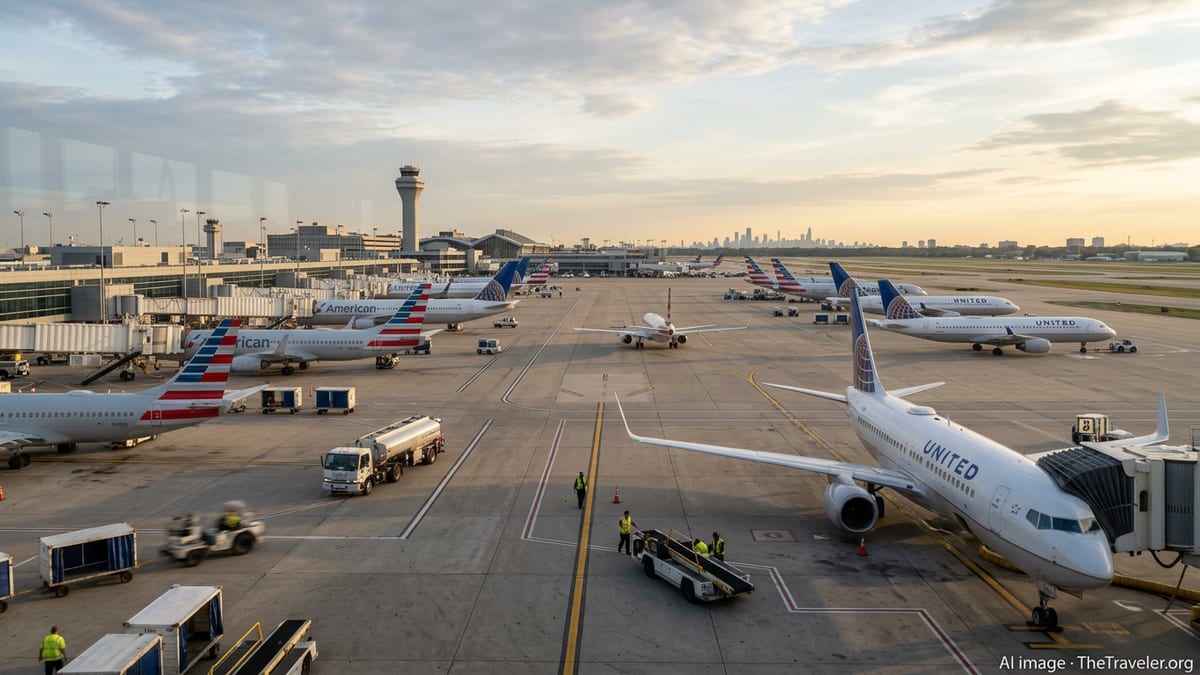
Fresh Summer Data Puts United at the Front of the Pack for Cancellations
Real-time statistics from FlightAware and related analytics tools indicate that United has recently spent multiple peak travel days at or near the top of U.S. airlines for cancellations, even when overall national disruption levels remained moderate. On some days, United’s cancellation rate has run several times higher than rivals of similar size, despite comparable weather challenges and traffic levels, according to publicly viewable carrier scorecards and cancellation tables.
The pattern has been particularly visible on high-volume summer weekends, when storm systems and tight air-traffic capacity converge with vacation crowds. On one recent Sunday tracked by FlightAware data and summarized by technology outlets, Chicago O’Hare International Airport recorded 148 canceled departures and 124 canceled arrivals, with more than 1,300 delays. United, O’Hare’s dominant airline, accounted for the largest share of those cancellations and ended the day with a cancellation rate more than five times higher than that of American Airlines, the airport’s other mainline giant.
While ultra-low-cost and regional carriers still record the highest cancellation percentages in multi-year U.S. Department of Transportation datasets, newer analyses focusing on daily operational “misery” show United frequently leading the major full-service airlines on the worst individual days. Independent reliability reviews note that longer-term federal statistics still rank United competitively for overall cancellation rate, but those figures can mask spikes in disruption clustered around its biggest hubs.
The disconnect between long-term government averages and short-term tracking snapshots helps explain why many summer travelers perceive United as particularly unreliable right now, even though DOT data over a two-year horizon still places some of its network metrics ahead of legacy competitors. Day-of-travel experience this July and August has been driven less by multi-year trends and more by where storms hit and how heavily each airline is concentrated at the most constrained airports.
Chicago O’Hare: Global Delay Hotspot and United’s Pressure Point
Chicago O’Hare has emerged as a central flashpoint in United’s current operational challenges. Flight-tracking analyses cited by travel outlets identify days this summer when O’Hare not only led the United States, but topped all airports worldwide for total delays, with more than half of all flights in and out of the airport arriving late or never departing at all. United, which holds the largest share of seats at O’Hare, has been disproportionately exposed to the resulting disruption.
Reports describe days when O’Hare alone logged well over a thousand delays and hundreds of cancellations, with data aggregators showing that a majority of flights were affected. On several of those days, United absorbed nearly half of the airport’s total seat capacity, a concentration that magnified the impact for its own passengers and made it statistically more likely to be the national leader in cancellations.
Regulators have been signaling concern about O’Hare’s throughput for months. In a recent notice, the Federal Aviation Administration detailed how overscheduling at the airport, combined with construction and existing airspace constraints, has forced the use of ground delay programs to keep operations manageable. The agency warned that without schedule reductions, O’Hare’s bottlenecks would continue to ripple across the national airspace system, triggering congestion and missed connections at downline hubs.
To contain the problem ahead of the 2026 summer season, the FAA established specific reduction targets at O’Hare and other highly congested fields. Industry filings and public comments show that both United and American have been asked to moderate growth plans, particularly during peak hours, to preserve basic reliability. Even with those caps, however, weather systems moving through the Midwest this summer have repeatedly pushed O’Hare past its practical capacity, ensuring that any airline with large exposure there would feel an outsized impact.
Newark’s Chronic Delays Keep United in the Disruption Spotlight
On the East Coast, United’s primary international gateway at Newark Liberty International Airport has faced its own cascade of delays that frequently drag more than half of flights off schedule. Publicly available FAA traffic management alerts and news coverage document multiple ground stops and flow restrictions at Newark this summer, driven by a mix of thunderstorms, limited arrival corridors and ongoing air-traffic controller shortages.
In late July, for example, the FAA slowed traffic into all three New York City airports and Philadelphia after staffing shortages combined with severe weather. Reports from the same period highlight Newark and its peers in the region as especially hard-hit, with average ground delays stretching well past an hour in some cases and knock-on effects lasting into subsequent days. Separate coverage described earlier storms that produced average inbound delays to Newark of around four hours during peak evening banks.
United’s own growth strategy has sharpened its exposure. The airline has promoted Newark as a central gateway in recent network announcements, tying a major international expansion to the airport’s role as a core hub. At the same time, FAA and port authority filings show that regulators have imposed hourly caps on Newark’s operations through at least October 2026, keeping flight volumes below what airlines might otherwise schedule in order to avoid gridlock.
Internal and industry newsletters note that even with those caps in place, Newark has only recently begun to show improved punctuality after several summers marked by crippling delays and cancellations. Online traveler forums continue to describe the hub as among the most disruption-prone in the country, with common accounts of late-day cancellations, long taxi delays and aircraft turning back to gates after crews time out. With United handling the majority of Newark’s traffic, those localized constraints show up directly in its national cancellation totals.
Regulatory Caps, Weather and Network Choices Combine to Hit United Hardest
The convergence of regulatory limits, weather volatility and United’s own network design helps explain why the carrier currently appears to “lead the way” in cancellations when disruption spikes. FAA orders have capped operations at both Newark and Chicago O’Hare to stabilize the system, but those caps do not eliminate vulnerability to storms, which can instantly erase whatever spare capacity exists on a given afternoon or evening.
United’s strategy of concentrating a large portion of its domestic and international flying through a small group of megahubs means that a localized ground delay program in Chicago or New York can rapidly cascade into missed connections and crew misalignments across the network. Flight-tracking summaries from this summer show that, on some of the worst days, United’s cancellations cluster heavily around those two airports, while its operations at other hubs such as Denver and Houston remain relatively stable.
Publicly available technical histories underscore that United has also been vulnerable to internal system shocks. A major failure in an earlier generation of its flight-data and dispatch software in 2025, documented in independent reporting, triggered a nationwide ground stop that delayed more than a third of its flights and forced cancellations across all of its hubs. While that specific incident predates this year’s disruptions, analysts often cite it as an example of how core technology outages can intensify the impact of already fragile hub operations.
Industry observers note that airlines make different choices in how they manage irregular operations, with some carriers leaning more heavily on lengthy delays to preserve high completion factors while others move more quickly to cancel and rebook. That strategic mix can shape day-to-day statistics on cancellations versus delays, but does not change the underlying pressure faced by airports whose scheduled demand is consistently at the edge of what their runways and controllers can handle.
What Travelers Can Expect as Peak Season Continues
Looking ahead to the remainder of the 2026 summer season and into the busy fall travel period, both regulators and airlines are signaling that constraints at United’s core hubs will persist. FAA documents outlining schedule caps at Newark and O’Hare extend through at least late October, and agency commentary suggests that ground delay programs will remain a standard tool whenever storms or staffing shortages shrink available capacity in the Northeast or Midwest.
For passengers, that means United’s national performance rankings are likely to continue rising and falling in tandem with the operational health of just a handful of airports. On relatively clear days without major traffic management initiatives, real-time dashboards show United performing on par with or better than legacy rivals. When weather and airspace restrictions hit Chicago or New York, however, publicly available FlightAware tables and delay maps quickly push the airline to the top of the cancellation lists.
Travel analysts recommend that passengers who must connect through Newark or O’Hare build in extra buffer time, particularly for late-afternoon and evening flights that are most exposed to accumulating delays. Some consumer advocates also point travelers toward federal dashboards that summarize each airline’s customer-service commitments in the event of controllable cancellations, along with third-party flight tracking tools that can provide early warning when a hub begins to seize up.
For now, the numbers suggest that United’s heavy reliance on two of America’s most constrained airports is keeping it in the spotlight whenever the nation’s aviation system begins to fray. Unless new capacity, automation or staffing improvements significantly ease the load at Chicago and Newark, the carrier is likely to remain a leading indicator of disruption for U.S. air travelers.
FlightAware live cancellation statistics
FAA delays at New York and Philadelphia airports