

More news on this day
United Airlines is preparing to introduce a new economy seating concept called United Relax Row, turning selected rows on its Boeing 777 and 787 fleets into couch-like spaces that can be shared or converted into a lie-flat surface on long-haul flights.
Get the latest news straight to your inbox!
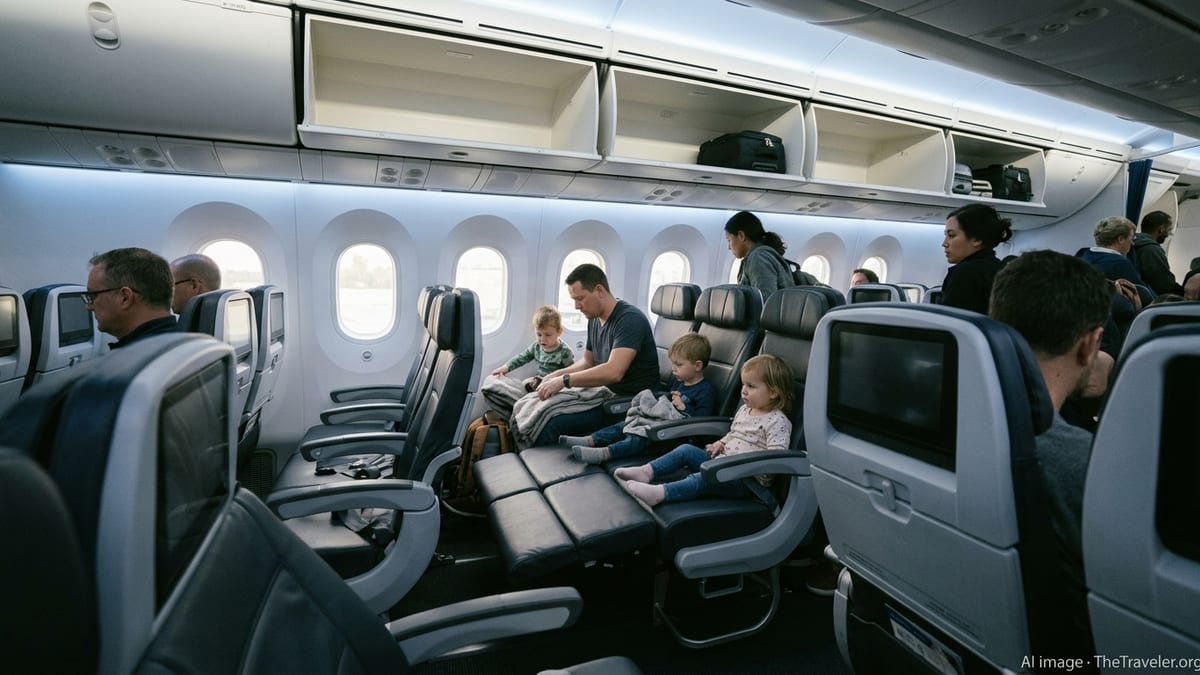
A New Couch-Style Option in Standard Economy
United Relax Row is designed as a configurable set of three economy seats that can be transformed into a flat or nearly flat surface, allowing passengers to stretch out in a way that has previously been limited to premium cabins or improvised empty rows. According to published coverage of the launch, the product will debut within the United Economy cabin on long-haul routes operated by Boeing 777 and 787 aircraft.
Publicly available details indicate that Relax Row is built on a familiar three-seat economy block, but with engineered leg rests and extensions that rise to meet the seat cushions. When activated, these panels create a continuous padded platform, turning the row into a shared couch for occupants of that block. The concept is similar in principle to “sky couch” products already offered by some international airlines, but this marks the first such offering announced by a large United States carrier for its widebody fleet.
United has positioned Relax Row as an enhancement to standard economy rather than a separate premium cabin. The seats will remain in the main economy section, with the same overall layout and width, but with added hardware that enables the conversion. Reports indicate that the pitch will be around 32 inches, placing it between regular economy and extended-legroom economy on United’s long-haul aircraft, which may help preserve cabin density while still allowing enough space for the couch function.
Rollout on 777 and 787 Widebodies
United intends to install Relax Row on a substantial portion of its long-haul network. Information released alongside the announcement indicates that the product is planned to launch in 2027, with a goal of being available on more than 200 Boeing 787 Dreamliners and Boeing 777 widebodies by 2030. These two aircraft families form the backbone of United’s intercontinental operations, serving routes across the Atlantic and Pacific as well as to South America and beyond.
The airline has been investing heavily in the interiors of its 787 and 777 fleets, including new Polaris business-class suites, refreshed Premium Plus cabins and updated economy seats with larger screens and Bluetooth audio. Relax Row appears as the latest layer in that broader “nose-to-tail” refresh strategy, using the existing 3-3-3 and 3-4-3 layouts in economy while introducing a distinct monetizable product within the main cabin.
Reports suggest that each equipped aircraft will feature roughly nine to twelve Relax Row sections, typically grouped in areas where families and couples might be more likely to book together. Those rows will still function as standard seats when purchased individually, but will be flagged during booking so that travelers can pay a supplement to unlock the couch configuration for their row.
Targeting Families and Long-Haul Leisure Travelers
While frequent flyers in business class have long enjoyed lie-flat seats, United appears to be targeting a different audience with Relax Row. Public discussion around the launch highlights families with young children as a core market, positioning the couch-style row as a more comfortable space for kids to sleep or play during overnight sectors. The ability to create a single flat surface across three seats could appeal to parents managing infants and toddlers on flights of eight hours or more.
The product is also likely to attract couples and budget-conscious leisure travelers who want more rest than a standard upright economy seat can offer but are not ready to pay for premium economy or business class. With pricing not yet publicly detailed, travel industry observers expect a tiered model, where the base economy fare secures the seat and an additional supplement unlocks the couch functionality for the entire row when booked as a unit.
United has emphasized that Relax Row does not remove any existing rows from the cabin compared with current layouts. That suggests the airline is seeking incremental revenue through differentiation rather than by trading seat count for extra space. For passengers, the key question will be whether the added comfort and flexibility justify the surcharge compared with moving up to Economy Plus, Premium Plus or seeking sale fares in business class.
How the Transforming Seat Mechanism Works
Technical information referenced in patent filings and seating documentation describes a mechanism in which leg rests and infill panels fold up from the base of each seat. When deployed, these panels align with the seat cushions to form a near-continuous surface. The design aims to keep the structure compact when stowed so that the row behaves like a conventional economy block during taxi, takeoff and landing.
In couch mode, passengers are expected to use seat belts in approved positions, and the configuration will be subject to the same safety requirements that govern reclining seats and bulkhead rows. Early illustrations and descriptions suggest that the leg rests can also lock at an intermediate angle, allowing individual passengers to use them as extended footrests when the row is not fully converted. That provides a secondary benefit for solo travelers who might occupy one of the seats without using the entire couch.
United’s version of the concept appears to build on broader industry work by seat manufacturers exploring convertible economy products, including patent applications describing rows that can be turned into beds or bunks. By integrating the mechanism into standard-width seats rather than widening the row, the airline can retain familiar cabin geometry while adding a visibly distinct feature that marketers can promote as a comfort upgrade.
Competitive and Passenger Experience Implications
The introduction of Relax Row positions United within a small but growing group of global airlines experimenting with configurable economy seating. Some carriers in Asia-Pacific and the South Pacific have previously marketed couch-style rows on long-haul routes, framing them as a bridge between standard economy and premium cabins. United’s move suggests that similar ideas are gaining traction among large North American operators seeking new ancillary revenue options.
From a passenger experience perspective, Relax Row may help address persistent complaints about comfort in tightly configured widebody cabins. While it does not change the overall seat density, the ability for certain travelers to lie flat or spread out could soften perceptions of long-haul economy on key routes. Families, in particular, may see the product as a meaningful improvement over trying to manage sleep across three separate upright seats.
At the same time, the product raises familiar questions about inequality of comfort within the same cabin. Travelers seated immediately adjacent to Relax Row sections may find themselves wishing for similar options, and social media reaction is likely to scrutinize pricing, availability and policies about who can book and share the couch rows. As more details emerge ahead of the planned 2027 launch, the marketplace will be watching to see whether United’s bet on transformable economy seating reshapes expectations for long-haul travel on 777 and 787 aircraft.