


More news on this day
Travel across the United States faced fresh disruption today as flight-tracking data showed significant delays and cancellations affecting Delta Air Lines, American Airlines, Southwest Airlines and Frontier Airlines at key hubs in Chicago, Atlanta, Dallas and New York, with Cincinnati/Northern Kentucky International Airport reporting 32 delays and 3 cancellations alone.
Get the latest news straight to your inbox!
Delays Ripple From Regional Airports to Major U.S. Hubs
Publicly available flight-tracking boards for June 23 indicated that Cincinnati/Northern Kentucky International Airport, a key secondary hub and connection point for several carriers, recorded at least 32 delayed departures and arrivals, along with three outright cancellations. While the majority of flights at the airport continued to operate, the disruption was large enough to strain gate capacity and lengthen turnaround times.
Operational interruptions at a regional airport like Cincinnati quickly feed into the broader national network. Many of the affected flights connect into large hubs such as Chicago, Atlanta, Dallas and the New York area, where Delta Air Lines, American Airlines, Southwest Airlines and Frontier Airlines operate dense schedules. When aircraft and crews arrive late into those hubs, the knock-on effect can cascade into subsequent departures, even on routes that are not directly impacted by the initial delay.
Industry data and historical analyses show that once multiple flights in an aircraft’s daily rotation are pushed back, recovery becomes increasingly difficult. Each additional delay complicates crew duty-time limits, aircraft positioning and runway congestion, which can push airlines toward last-minute cancellations to rebalance schedules. Passengers, in turn, face rebookings, missed connections and extended overnight stays.
Multiple Carriers Confront Operational Strain
The disruptions involve several of the country’s busiest airlines. Delta Air Lines and American Airlines run extensive domestic and international networks through hubs in Atlanta, Dallas and the New York region, while Southwest Airlines and Frontier Airlines focus heavily on high-frequency domestic routes. When all four carriers experience operational strain simultaneously across overlapping airports, passengers encounter reduced options for same-day rebooking.
Recent performance statistics compiled by aviation data providers highlight structural vulnerabilities. In recent years, Delta has typically reported one of the highest on-time arrival rates among major U.S. carriers, while Southwest has periodically faced elevated cancellation rates during periods of system stress. Frontier’s own regulatory filings have acknowledged that congestion and severe weather at hubs such as Denver, Orlando and Atlanta can cause “severe disruptions” and additional costs to its operation. These patterns illustrate how even relatively small clusters of delays at feeder airports can join with preexisting congestion to tip networks into broader disruption.
According to industry reporting, large U.S. carriers have been operating close to their capacity limits during busy travel periods, with tight scheduling designed to maximize aircraft utilization. While efficient in normal conditions, such tight margins can leave little room to absorb sudden shocks, whether from weather, air traffic control constraints or technical and staffing issues. The situation observed today, with dozens of delayed flights converging on multiple hubs, reflects that balancing act.
Chicago, Atlanta, Dallas and New York Feel the Impact
The interconnected nature of U.S. air travel means that major hubs often bear the brunt of any regional instability. Chicago’s airports, Atlanta’s Hartsfield-Jackson, Dallas-Fort Worth and Dallas Love Field, and the New York area’s airports serve as transfer points for millions of travelers each month. When inbound flights arrive late from cities such as Cincinnati, even modest disruptions can multiply into gate bottlenecks, longer taxi times and extended waits on the tarmac.
In recent seasons, Chicago and New York have seen significant disruption during weather systems that ultimately dropped less precipitation than forecast, demonstrating that the anticipation of adverse conditions can be as disruptive as the weather itself. In Atlanta and Dallas, severe thunderstorms and summer heat routinely challenge on-time performance. Combined with constrained airspace and high passenger volumes, these factors help explain how a localized issue in one part of the network can contribute to delays on routes that never experience bad weather directly.
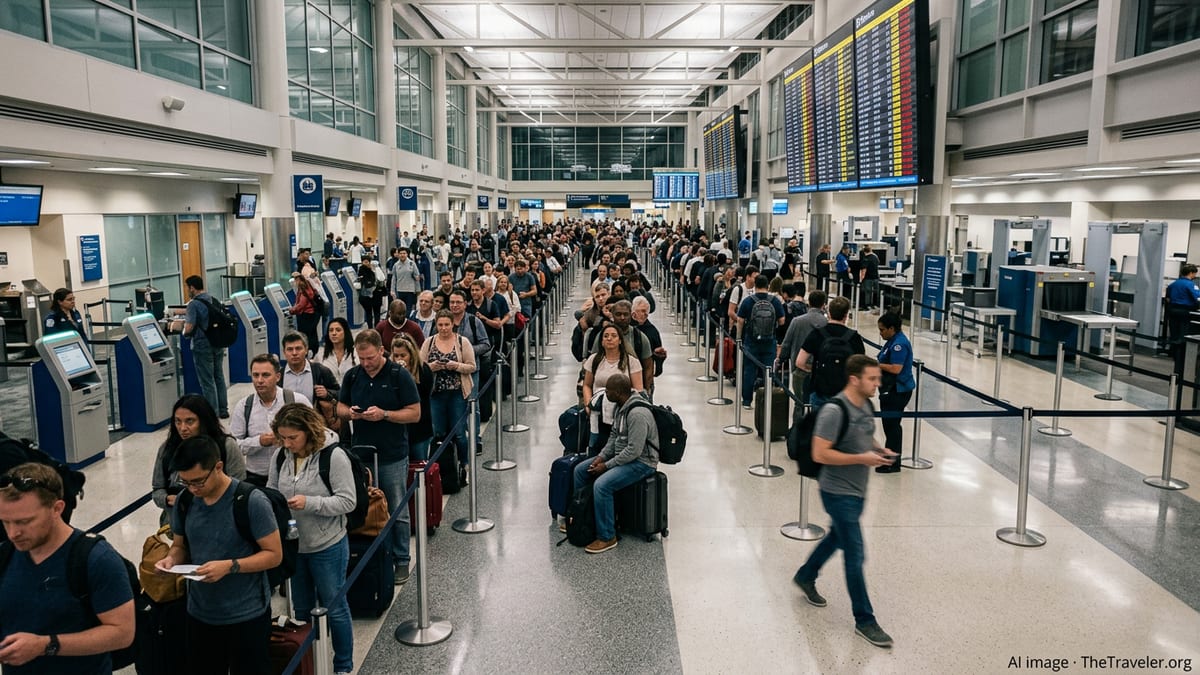
Reports indicate that on days like today passengers at these hubs face long lines at customer service counters, crowded gate areas and mounting anxiety about missed connections. With several major carriers affected at the same time, alternative routing options can quickly be exhausted, and available hotel rooms near airports can become scarce.
Passengers Navigate Limited Options and Confusing Information
For travelers caught in the disruption, immediate concerns range from missed business meetings to lost vacation time and added out-of-pocket expenses. Anecdotal accounts shared on social platforms in recent months describe passengers enduring rolling delays that extend by 60 to 120 minutes at a time, only to be followed by last-minute cancellations once alternative flights for the day have largely departed.
Consumer advocates note that the patchwork of carrier policies and limited federal requirements for compensation in the United States can leave many passengers frustrated. In practice, assistance often depends on the cause of the delay and the airline’s internal guidelines. While some carriers provide meal vouchers, hotel stays or rebooking on partner airlines during controllable disruptions, others may offer more limited accommodation, particularly when delays are attributed to weather or air traffic control constraints.
Public guidance from travel risk and corporate travel management firms encourages passengers to monitor airline mobile apps and departure boards closely, rather than relying solely on initial departure times. In many cases, same-day rebooking using digital tools can secure better options than waiting in line at airport counters, especially when multiple carriers are experiencing strain at once.
Persistent Systemic Challenges Behind Repeated Disruptions
Today’s pattern of delays and cancellations sits against a broader backdrop of systemic challenges in the U.S. aviation system. Industry studies examining flight delay networks have shown how tightly coupled schedules can amplify seemingly minor operational issues into nationwide disruption. Researchers have modeled how a single late outbound flight can affect subsequent flights by the same aircraft throughout the day, particularly at busy hubs.
At the same time, publicly available statistics on flight performance emphasize the central role of weather in causing delays nationwide, while highlighting that airline-specific operational decisions contribute significantly to how severely passengers are affected. Carriers must balance crew scheduling rules, maintenance requirements and profitability targets with the need for resilience during peak periods.
As travelers across Chicago, Atlanta, Dallas, New York and connecting airports such as Cincinnati adapt to today’s disruption, aviation analysts point out that similar patterns are likely to recur through the busy summer and holiday seasons. Without expanded capacity in infrastructure, staffing and system flexibility, clusters of delays and cancellations at a single regional airport will continue to send shockwaves through the broader national network.