

More news on this day
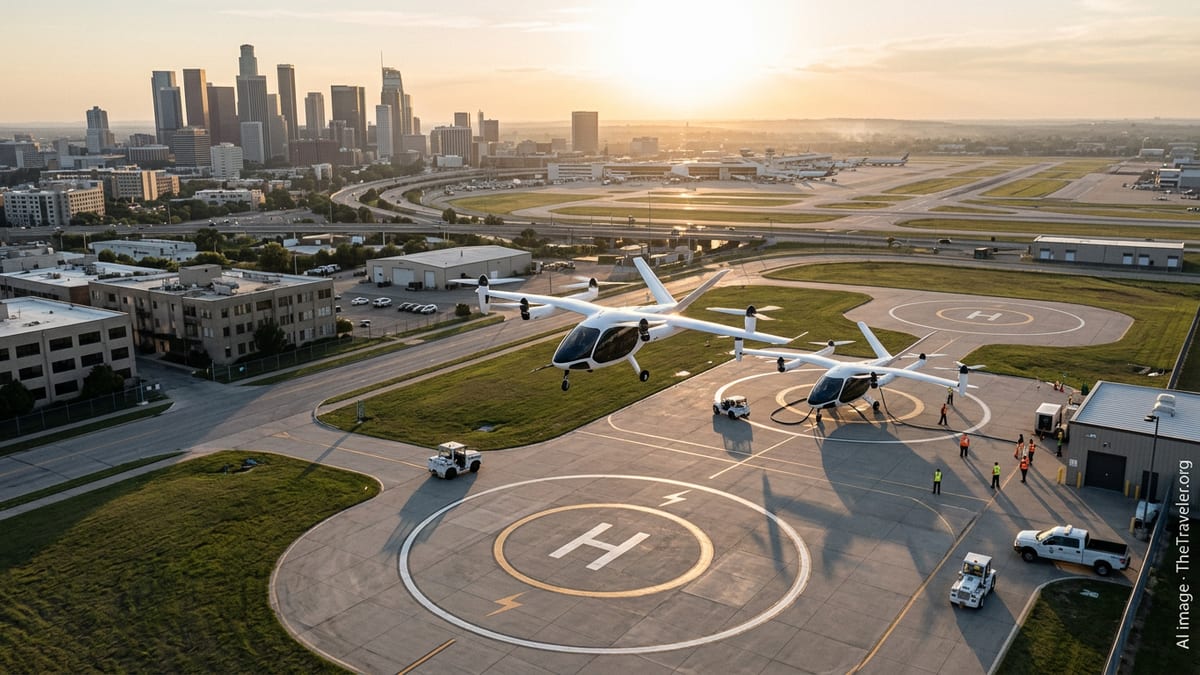
The United States has taken a decisive step toward mainstreaming electric vertical takeoff and landing aircraft, with Archer Aviation and Joby Aviation emerging as frontrunners to turn experimental air taxis into a new layer of everyday travel.
What the FAA Green Light Really Means
For years, electric vertical takeoff and landing aircraft, known as eVTOLs, have been showcased at air shows and tech conferences as the future of urban mobility. Now U.S. regulators are beginning to convert that vision into an operational framework, giving companies like Archer and Joby a clearer path to carrying paying passengers in American airspace.
The Federal Aviation Administration has created a dedicated certification and operations roadmap for powered lift aircraft, including new airworthiness criteria, pilot training rules and procedures for integrating eVTOLs into existing air traffic systems. This includes a special federal aviation regulation that sets standards for how pilots are trained and how early commercial operations can begin, signaling that the agency no longer sees these aircraft as experimental curiosities but as transportation tools that must fit safely into crowded skies.
Instead of a single sweeping approval, the FAA is advancing eVTOLs through a series of certificates and rulemakings that together amount to an operational green light. Manufacturers must secure type certificates proving their aircraft meet safety and performance requirements, production certificates for mass manufacturing and air carrier certificates to run commercial services. The process is complex and slower than many early industry forecasts, but it is now concrete enough for airlines, airports and city governments to plan around real launch dates rather than distant projections.
Industry analysts caution that the path from certification to full-scale operations will likely be staggered, with limited pilot routes, conservative weather limits and tight oversight in the early years. Yet the change in tone from Washington, from skepticism to structured engagement, marks a pivotal shift for travelers hoping to someday book an electric air taxi alongside a traditional flight.
Archer and Joby: Front-Runners in the eVTOL Race
Among dozens of eVTOL developers worldwide, Archer Aviation and Joby Aviation have emerged as the most closely watched in the U.S. Both companies have built and flown full-scale prototypes, secured major airline partnerships and advanced deep into the FAA’s multi-stage certification process, putting them in position to launch some of the first commercial services.
Archer’s flagship Midnight aircraft is designed to carry one pilot and four passengers on trips up to roughly 100 miles at speeds around 150 miles per hour, targeting densely populated corridors that are poorly served by existing ground transport. The company has been progressing through FAA certification milestones and has also obtained foundational approvals that will eventually allow it to operate Midnight as a commercial air taxi, while building out an assembly plant in the United States to support scaled production.
Joby has likewise focused on a piloted, multi-passenger eVTOL optimized for short city and regional hops. The company was among the first in the sector to obtain an FAA Part 135 air carrier certificate, which permits it to conduct on demand commercial flights using conventional aircraft while it refines operations, training and customer experience for future eVTOL services. Joby has also completed key stages of the FAA’s type certification process, positioning its aircraft for more advanced test campaigns as regulators finalize powered lift rules.
Investors and competitors are watching closely because these two programs will likely set benchmarks for safety, noise, reliability and pricing that shape the entire market. How Archer and Joby handle issues such as battery longevity, maintenance turnaround and passenger throughput at vertiports could determine whether eVTOLs become a niche premium product or a broadly accessible travel option.
From Airports to Downtowns: How Travelers Could Use eVTOLs
For travelers, the most immediate impact of eVTOL operations is expected on congested airport access routes, where flights could shave significant time off ground journeys that often stretch far longer than the flight itself. Archer’s partnership with United Airlines, for example, envisions electric air taxis linking major hubs such as Chicago O’Hare and Newark Liberty with downtown vertiports, turning trips that can take an hour or more by car at peak times into flights measured in minutes.
These initial routes are short by design, often 10 to 20 miles, but they solve a persistent pain point: the last stretch between airport and city center. Airlines see them as a way to attract premium passengers, streamline missed connection recovery and showcase their sustainability credentials, while cities view them as a chance to test how aerial mobility can relieve pressure on gridlocked expressways without expanding road infrastructure.
Over time, operators and regulators expect eVTOL networks to grow beyond airport shuttles into cross-metropolitan links connecting suburbs, business districts and key tourism locations. For example, a visitor might step off a long haul flight and transfer directly to an electric air taxi to reach a coastal resort, mountain town or regional conference venue without driving through multiple traffic bottlenecks.
Yet the rollout will be shaped by ground realities as much as airspace rules. Vertiports need to be sited, permitted and built, complete with high capacity charging, emergency response plans and integration with rail, metro and rideshare services. Noise assessments, community consultations and local zoning decisions will heavily influence which neighborhoods see early service and which remain on the drawing board.
Safety, Regulation and Public Acceptance
The FAA’s cautious approach reflects the fact that eVTOLs blend characteristics of helicopters, small airplanes and high voltage electric vehicles. Regulators are insisting that these aircraft meet reliability standards comparable to commercial jets while demonstrating that batteries, propulsion systems and software can safely withstand real world wear, weather and human error.
Specialized pilot training standards are being put in place for powered lift operations, covering transition between vertical and wing borne flight, energy management and emergency procedures unique to multi rotor electric designs. In parallel, air traffic managers are testing how to integrate dozens or even hundreds of low altitude flights per hour into already busy terminal areas without overloading controllers or compromising separation from conventional aircraft.
Public acceptance will hinge on more than safety statistics. Noise footprints, visual impact and perceived benefits for local communities will all weigh on whether residents welcome or resist frequent eVTOL traffic overhead. Early test flights and demonstration services are being closely watched for how loud the aircraft are during takeoff and landing compared with helicopters, and whether routes can be designed to avoid the most sensitive neighborhoods.
Transparency around incidents, clear fare structures and equitable access will also shape perceptions. Advocates argue that if eVTOL services eventually match or undercut premium rideshare prices while cutting travel times, they could win over skeptical travelers and city councils. Critics warn that if services remain expensive and limited to a few affluent corridors, they may be dismissed as a novelty rather than a serious transportation tool.
When Will Travelers Actually Fly in eVTOL Air Taxis?
For now, eVTOL travel in the United States remains on the cusp rather than fully real. Archer and Joby conduct regular test flights, simulation campaigns and infrastructure planning with partners, but the precise dates for opening ticket sales depend on how quickly final certification steps are completed and how smoothly early operational trials proceed.
Most current industry timelines point to the second half of this decade for meaningful commercial services in a handful of U.S. cities, with initial operations likely limited in scale, weather conditions and routes. Regulatory updates, such as the dedicated powered lift rules and pilot training standards, have reduced uncertainty, but they have also introduced new testing requirements that manufacturers must satisfy before flying passengers.
For travelers planning future itineraries, that means eVTOLs are unlikely to replace airport shuttles or regional rail in the immediate term, but they could begin to appear as premium add ons offered by major airlines and booking platforms within a few years. Early adopters may find themselves boarding sleek electric aircraft from rooftop pads or repurposed heliports for fast hops between city centers and airports, while the broader public watches to see whether the experience is as quiet, smooth and reliable as promised.
As the FAA refines its framework and Archer and Joby rack up flight hours, the once speculative idea of urban air taxis is settling into a more familiar aviation story: incremental progress, regulatory scrutiny and gradual expansion. For the travel industry, the question is no longer whether electric air taxis will fly in U.S. cities, but how quickly they can scale from headline making test flights to everyday options in the trip planning menu.