

More news on this day
Thousands of air travelers across Saudi Arabia were stranded on Saturday as cascading delays and cancellations linked to US-Israel strikes on Iran rippled through key hubs in Riyadh, Jeddah, Dammam and Madinah, snarling operations for Saudia, Gulf Air, FlyDubai, Etihad Airways and several other regional and international carriers.
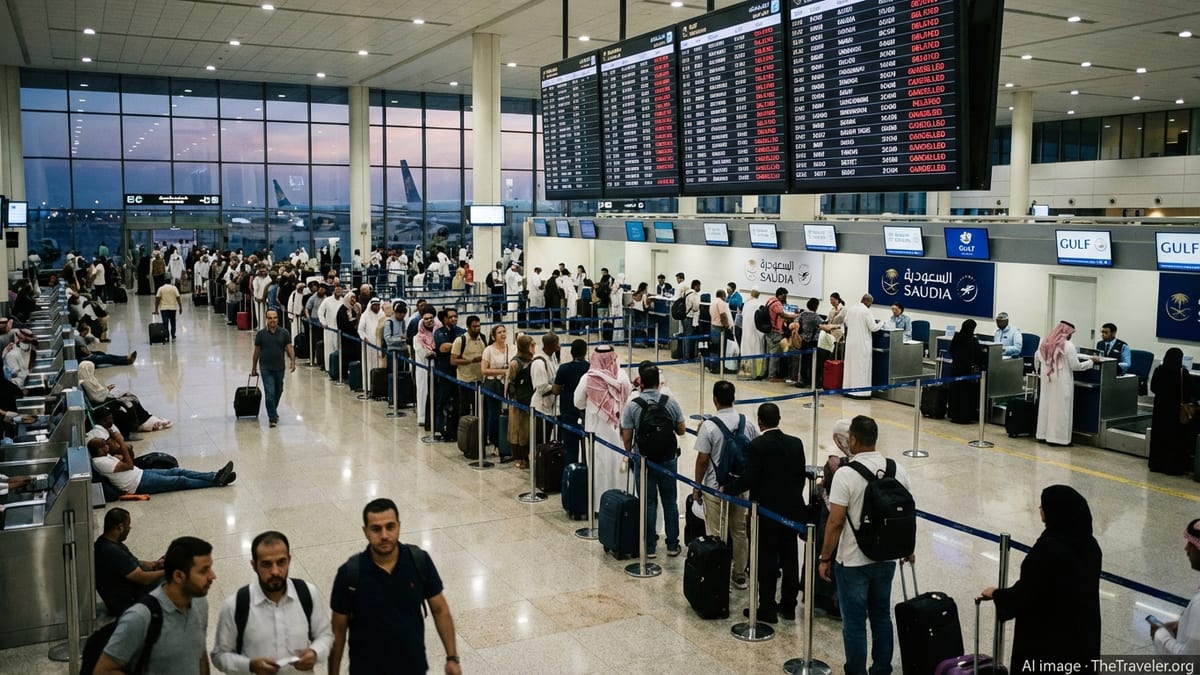
Saudi Hubs Grapple With Wave of Delays and Cancellations
Saudi Arabia’s main international gateways spent February 28 struggling to absorb the shock from sudden airspace closures and reroutings across the wider Gulf, with operational data indicating at least 324 flight delays and 279 outright cancellations affecting services in and out of Riyadh, Jeddah, Dammam and Madinah. While Saudi airspace has not been fully shut, knock-on disruption from neighboring closures has left terminals crowded and schedules badly dislocated.
Jeddah’s King Abdulaziz International Airport has recorded some of the heaviest disruption in the Kingdom, with well over 250 movements affected in a matter of hours as aircraft arriving from Europe and Asia were forced into lengthy diversions or ground holds. In Riyadh, King Khalid International is facing a similar pattern of rolling delays, particularly on long haul departures attempting to skirt restricted skies over Iran, Iraq, Kuwait and Qatar.
Operational staff in Dammam and Madinah report that the problem is less about local weather or capacity and more about a global network shock that is rippling along the Europe–Gulf–Asia corridor. With flights unable to overfly large swathes of West Asian airspace, arrivals are bunching into tight windows, gate availability is becoming constrained and crews are timing out, prompting further last minute cancellations.
Airspace Closures After Strikes on Iran Upend Regional Routing
The turmoil follows coordinated strikes by the United States and Israel on targets inside Iran, which prompted Iran, Iraq, Qatar, Kuwait, Bahrain and Israel to close or severely restrict their airspace to civilian traffic. Aviation trackers show large portions of the Middle East that are normally dense with overflights now almost empty of commercial jets, forcing carriers to route around the region via longer and less efficient paths.
Airports in the United Arab Emirates have been particularly hard hit after authorities imposed temporary closures, with Dubai International suspending flights and Abu Dhabi reporting more than 180 cancellations and over 150 delays. Those shutdowns have pushed additional traffic and diversions toward Saudi airports, which remain technically open but are contending with the overflow as aircraft seek alternative fuel stops or diversion fields.
Aviation analysts note that the Middle East was already a critical artery for Europe–Asia connectivity, especially with large parts of Russian airspace restricted since 2022. The latest conflict has effectively pinched that corridor from both sides, leaving airlines to stitch together longer routes over the eastern Mediterranean, the Caucasus or the Arabian Sea, all of which add hours of flying time and increase the likelihood of missed connections further down the line.
Saudia and Gulf Carriers Activate Emergency Contingency Plans
Flag carrier Saudia confirmed it has cancelled a significant number of regional flights and is closely monitoring the situation through its Emergency Coordination Center, prioritizing routes judged essential for repatriation and key international links. The airline is steering passengers toward digital channels and call centers for rebooking, while warning that schedules are subject to rapid change as airspace notices are updated.
Other Gulf and regional airlines are in similar crisis mode. FlyDubai has suspended or rerouted services to Iran, Iraq, Kuwait, Tel Aviv and several Levant destinations, while Etihad Airways is operating an abridged schedule from Abu Dhabi as it navigates the evolving restrictions. Gulf Air and a range of South Asian carriers have also pared back services into Saudi cities, reducing both point to point and connecting options for travelers transiting through the Kingdom.
European and North American airlines have joined the pullback, with major groups such as Lufthansa, Air France–KLM and British Airways cancelling or suspending flights to multiple Middle Eastern destinations, including Riyadh and other Saudi gateways. US and Canadian carriers are avoiding affected airspace entirely, contributing to a sharp reduction in westbound and eastbound frequencies and undermining the reliability of long haul itineraries that normally hinge on Gulf stopovers.
Passengers Face Long Queues, Patchy Information and Limited Options
For passengers on the ground, the crisis is playing out in long queues at check in counters, crowded transfer halls and overburdened customer service desks. At Riyadh and Jeddah, many travelers arriving for evening departures have been met with rolling delay notices or last minute cancellations, with some international flights returning to their origin airports after hours in the air when new closure notices were issued.
Families heading for school holidays, religious visitors bound for Madinah and Mecca and business travelers connecting onward to Asia have all been caught in the disruption. Many report difficulty securing hotel rooms near the airports as carriers work through backlogs of stranded customers, while others have been advised that the first available rebooking options may be several days away due to heavy load factors on remaining flights.
Airlines are generally offering fee waivers, date changes and in some cases refunds, but policies vary by carrier and route. Travel agents in Saudi Arabia say they have been inundated with requests to reroute itineraries via alternative hubs in Europe, North Africa or South Asia, though the pool of viable alternatives is shrinking as more countries issue safety advisories and carriers trim schedules.
Uncertain Outlook as Authorities Prioritize Safety
Regulators and aviation safety bodies have underscored that safeguarding civilian aircraft remains the overriding priority as military operations continue. Authorities across the Gulf and wider region are issuing rolling updates to airspace notices, meaning airlines are planning in much shorter increments than usual and building additional buffer time into operations where possible.
Industry experts caution that even if some airspace restrictions are partially lifted in the coming days, the backlog created by nearly three thousand disrupted flights across the region will take time to clear. Aircraft and crews are out of position, maintenance windows have been squeezed and cargo flows have been interrupted, all of which will weigh on timetable reliability well beyond the initial shock.
For now, travelers with upcoming journeys through Riyadh, Jeddah, Dammam or Madinah are being urged to monitor flight status closely, remain flexible about routing and prepare for extended waits in terminals. With tensions between the US, Israel and Iran still volatile, both airlines and passengers in Saudi Arabia are bracing for the possibility that this severe travel crunch could stretch from days into weeks before anything resembling normality returns.