

Managing money in Thailand is straightforward once you understand how ATMs, card payments and cash exchange actually work on the ground. With fixed fees on foreign cards, airport exchange traps and a fast-growing cashless culture, a bit of preparation can save you real money and stress. This guide walks you through the latest information on using ATMs and exchanging money in Thailand in 2026, so you can focus on enjoying your trip instead of worrying about baht.
Understanding Thai Baht and How People Pay Today
Thailand’s currency is the Thai baht, written as THB or simply with the symbol ฿. Notes commonly used by travelers are 20, 50, 100, 500 and 1,000 baht, while coins come in smaller denominations suitable for local transport and street food. Prices for everyday items such as meals, taxis and small purchases are still largely quoted and paid in cash, so you will need physical baht even if you rely heavily on cards.
At the same time, Thailand has embraced digital payments quickly. In cities like Bangkok, Chiang Mai and Phuket, QR code payments through Thai banking apps are now routine, and many mid range and upscale businesses accept Visa and Mastercard credit and debit cards. Tourists will notice that large malls, chain restaurants, hotels and some tour operators comfortably handle card transactions, while smaller shops, markets and rural businesses remain cash focused.
This mixed landscape means you should plan for a combination of cash withdrawals from ATMs, currency exchange at reputable booths and strategic use of cards. Getting the balance right helps you minimize fees without carrying more cash than you feel safe with. The sections below explain what to expect from ATMs, where to exchange money and how to avoid common pitfalls that catch first time visitors.
Before you travel, it is also wise to check with your home bank or card issuer about any foreign transaction or cash withdrawal fees they add on top of Thai bank charges. These can significantly change whether ATMs or cash exchange desks make more sense for you personally.
Using ATMs in Thailand: Fees, Limits and How They Work
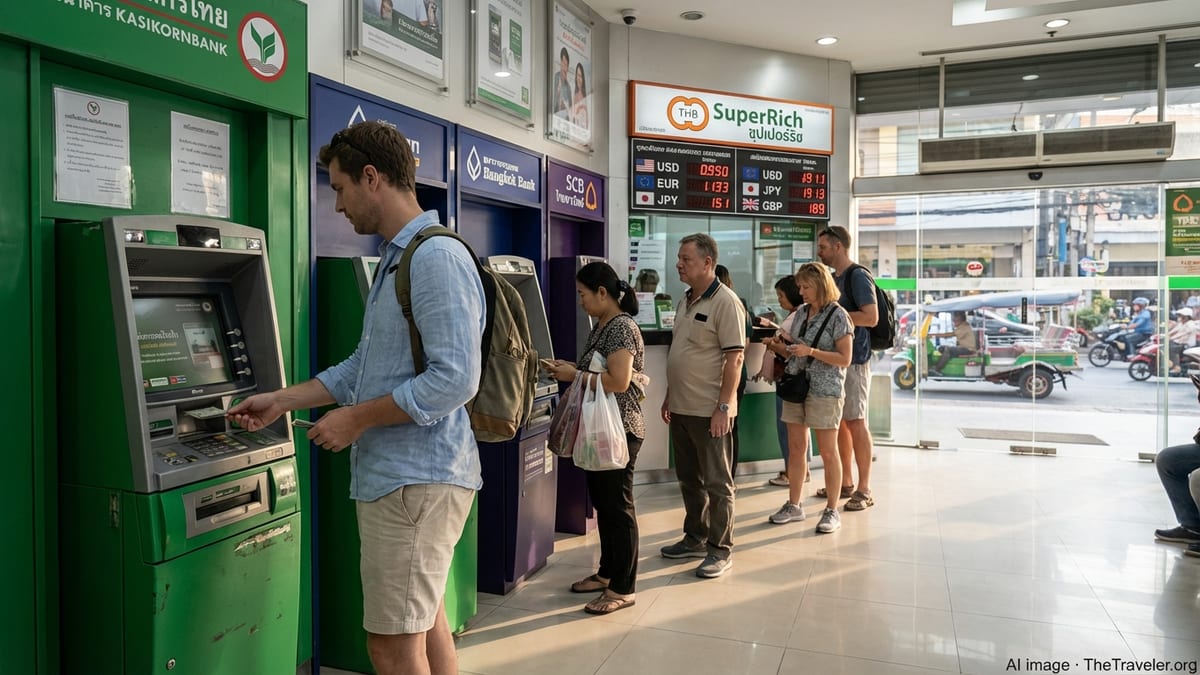
ATMs are widespread throughout Thailand and are easy to use with foreign cards. In major cities and tourist areas you will see machines from large banks such as Bangkok Bank, Kasikornbank, Siam Commercial Bank and Krungsri on almost every busy street, as well as in 7 Eleven stores, malls, hospitals and transport hubs. Menus almost always offer English language options and follow a familiar flow: insert card, choose English, enter PIN, select withdrawal amount, confirm the local fee and choose the currency for the transaction.
For visitors, the most important detail is the fixed surcharge Thai banks apply to foreign cards. As of early 2026, most Thai bank ATMs charge around 220 to 250 baht per withdrawal when you use a card issued overseas. This fee is added by the local bank and appears clearly on the screen before you confirm the transaction. You can still cancel at this point if you prefer not to proceed. Your own bank at home may then add its own withdrawal or foreign transaction fee on top, which is why it is essential to know your bank’s charging structure in advance.
Per transaction withdrawal limits for foreign cards usually fall in the range of about 20,000 to 30,000 baht, depending on the bank and sometimes the specific machine. Some operators, including major banks such as Bangkok Bank, offer higher limits on many machines, which helps dilute the impact of the fixed local fee. However, your home bank’s daily withdrawal limit can still be the binding constraint, so ensure that your daily cap is set high enough before you leave.
Thai ATMs generally expect a 4 digit PIN. Cards with longer PIN codes may not work properly, so travelers should ask their bank to switch to a 4 digit PIN before departing if possible. Most machines accept Visa, Mastercard and their related networks, and many also accept UnionPay and JCB. While reliability is generally high in cities, it is sensible to withdraw cash before heading to very remote islands or rural areas where machines may be few, far between or temporarily offline.
Strategies to Reduce ATM and Currency Conversion Costs
Because Thai ATMs charge a fixed fee per foreign withdrawal, your costs fall as you make fewer, larger withdrawals instead of many small ones. For example, paying roughly 220 to 250 baht once to withdraw 20,000 or 30,000 baht is usually cheaper than paying that same fee multiple times for several small withdrawals. Of course, this must be balanced against personal safety considerations and how comfortable you feel carrying cash. Many travelers compromise by taking out a few days’ worth of expenses at a time rather than withdrawing daily.
Another important cost factor is dynamic currency conversion, often abbreviated as DCC. When you withdraw cash or pay by card, the machine or payment terminal may offer to charge you in your home currency rather than in baht. This can look convenient but nearly always comes with a poor exchange rate set by the local operator, effectively adding a hidden percentage fee. To avoid this, always choose to be charged in baht and let your own bank or card provider handle the currency conversion instead.
You can also reduce overall costs by combining ATM use with good value cash exchange. If your home country offers reasonable rates on Thai baht or you have access to specialist travel cards, you might arrive with some cash already. Once in Thailand, many visitors withdraw one larger lump sum at an ATM to cover fixed costs such as accommodation, then use competitive money changers in cities for topping up. This mixed strategy takes advantage of better rates at specialist exchangers while limiting how often you pay ATM surcharges.
Finally, consider using cards or accounts that refund ATM fees or waive foreign transaction charges. Several online banks and multi currency providers offer products specifically aimed at travelers. While you will still see the local Thai ATM fee on screen, your provider may reimburse it later, or at least avoid adding its own conversion markup. This can make ATM withdrawals significantly more attractive relative to airport or hotel exchange desks that use much wider exchange rate margins.
Exchanging Cash: Airports, City Booths and When It Makes Sense
Currency exchange remains a popular and often cost effective way to obtain Thai baht, especially for travelers who prefer to avoid repeated ATM charges. However, where you exchange your money matters greatly. Airport counters in the arrivals hall typically offer the most convenient but least favorable rates, taking advantage of newly arrived passengers who may be tired, unfamiliar with the airport layout and in a hurry to leave. Their margins over the market rate can be several percentage points, which adds up quickly on larger amounts.
At Bangkok’s Suvarnabhumi and Don Mueang airports, more competitive booths can usually be found by heading down to the basement level near the Airport Rail Link train into the city. Well known brands such as SuperRich and certain bank branches located in this area often offer rates significantly closer to the mid market rate than the counters immediately after immigration or in the main arrivals halls. Travelers commonly exchange only a small amount upstairs for an emergency taxi or snack, then change a larger sum downstairs or later in the city once they have had time to compare rates calmly.
Within Bangkok and other major destinations, specialist money changers and some bank branches in central locations tend to provide better rates than hotels or shopping mall kiosks. These operators work on high volumes and low margins, which allows them to quote rates that are often only slightly below the real interbank rate. They typically do not charge additional commission, earning their profit entirely from the spread between buy and sell prices. Shops in busy shopping districts or near major transit hubs are easy to reach and are accustomed to dealing with tourists.
When exchanging cash, carry bills that are as clean and undamaged as possible. Thai exchangers can be more cautious about torn, heavily creased or marked notes, particularly in currencies like US dollars and euros. Larger denominations in major currencies generally attract the best rates, while smaller notes or more obscure currencies may receive slightly poorer terms. You will need your passport for over the counter foreign exchange transactions as Thai regulations require identification for these operations.
How Much Cash to Carry and Key Safety Considerations
Deciding how much cash to carry in Thailand involves balancing convenience, fees and personal safety. Carrying too little means frequent ATM withdrawals or urgent trips to exchange counters, increasing both costs and stress. Carrying too much exposes you to the risk of loss or theft, however small that risk may be. Many visitors find it practical to hold enough cash for several days of average spending, backed up by at least one debit card and one credit card stored separately as a safety net.
Using a money belt or secure interior pocket when moving between hotels, airports and bus stations is sensible if you are carrying larger sums. Once you arrive at your accommodation, use in room safes where available or ask reception about secure storage options. Divide your resources by keeping some cash on your person for daily use, some in a secure spot in your room and the bulk of your cards or emergency funds in a different place so that a single incident does not leave you completely stranded.
Travelers should also be aware of customs rules on bringing money into and out of Thailand. There is no specific upper limit for foreign currency, but amounts equivalent to more than 20,000 US dollars must be declared on arrival or departure using forms available from customs. For Thai baht, travelers taking more than 50,000 baht out of the country in cash are required to declare it, with higher thresholds applying only for certain neighboring destinations. These rules are reviewed periodically, so always check the latest official guidance before traveling with unusually large sums.
As a practical rule, unless you have a special reason to carry substantial cash, it is usually safer and simpler to move money electronically through bank transfers, reputable remittance services or multi currency accounts. This approach helps you stay within customs limits, reduces the chance of loss or theft and creates a clearer transaction record if any questions arise at borders or by local authorities.
Card Payments, QR Codes and Going Partly Cashless
Although cash is still important, Thailand has become increasingly friendly to card and mobile payments, particularly in urban and tourist centers. Major hotels, shopping malls, chain restaurants and larger tour operators typically accept international credit and debit cards. Visa and Mastercard have the widest acceptance, with some support for other networks depending on the merchant. Using a card with no foreign transaction fees can be an efficient way to pay for larger expenses such as accommodation, domestic flights, high end dining and organized tours while preserving your cash for places that do not accept cards.
Travelers will quickly notice the prevalence of QR payment stickers at shops, cafes, street stalls and even in taxis. These are part of Thailand’s domestic PromptPay and bank QR ecosystem, which allows locals to pay instantly from their bank apps. Tourists staying longer or seeking a more cashless experience may investigate options such as opening a local bank account, using multi currency wallets that support Thai QR payments, or tourist focused solutions promoted by local banks and the tourism authority. Availability and conditions evolve quickly, so it is wise to check current options shortly before your trip.
When using cards in Thailand, the same caution about dynamic currency conversion applies as with ATMs. Payment terminals may offer to bill your card in your home currency, displaying the approximate converted amount. This usually hides a poor exchange rate that benefits the local processor. Politely insist on being charged in baht so your own bank or card company can perform the conversion, typically at a much more favorable rate. Check your receipts to confirm that the currency listed is THB before signing.
Despite the rapid growth of digital payments, some aspects of daily life still rely heavily on cash. Local buses, many taxis and tuk tuk drivers, small guesthouses, rural shops and most street food vendors prefer or only accept cash. Even in big cities, it is common to find that a favorite noodle stall or night market requires physical baht. Having a mix of payment options ensures that you can always complete transactions without scrambling to find an ATM at short notice.
Practical Tips for First Time Visitors Managing Money
First time visitors to Thailand can avoid many common frustrations by setting up a clear money plan before they land. Inform your bank and card issuers about your travel dates and destinations to reduce the risk of security blocks on your cards. Enable app or text alerts for card transactions so you can quickly spot any unusual activity. If you have multiple cards, spread them between your luggage and day bag rather than carrying every card in a single wallet.
Upon arrival, consider withdrawing or exchanging only a modest amount of cash in the terminal where rates are poor, enough to pay for transport and immediate expenses. Once you are less rushed and have oriented yourself, seek out better value exchange booths in the airport basement near the city rail link or in central city locations such as busy commercial districts. If you plan to rely primarily on ATMs, aim for fewer, larger withdrawals at machines belonging to major Thai banks, both for reliability and to reduce the impact of fixed local fees.
Keep receipts from ATMs and exchange counters until you have verified transactions against your online banking records. These slips can be useful if a machine dispenses the wrong amount, a withdrawal appears twice or you need to explain the origin of cash later, for example when making larger purchases or if questioned at a border. While such issues are uncommon, having documentation makes resolution simpler.
Finally, stay flexible. Exchange rates move daily and local offers change over time. A strategy that works well one year may be less optimal the next if fees or regulations shift. Check updated information in the weeks before your trip and, once in Thailand, take a few minutes to compare actual rates on the ground rather than assuming that any single method is always best. Combining ATMs, competitive money changers and smart card use usually yields the most balanced outcome for both cost and convenience.
The Takeaway
Using ATMs and exchanging money in Thailand in 2026 is largely a matter of understanding fixed ATM fees, avoiding poor exchange rates and carrying a reasonable mix of cash and cards. Thai ATMs are widespread, user friendly and reliable, but each withdrawal with a foreign card attracts a noticeable local fee, so planning larger and less frequent withdrawals is key. Currency exchange desks can provide excellent value when you use reputable operators in the right locations, particularly in airport basements and city centers rather than at the first booth you encounter after landing.
Cash remains essential for many everyday transactions, especially in markets, small shops and rural areas, yet Thailand’s rapid adoption of card and QR payments allows visitors to handle larger expenses electronically. By combining good habits such as declining dynamic currency conversion, checking your bank’s fee structure, carrying clean major currency notes for exchange and keeping careful track of your withdrawals, you can keep costs under control without worrying constantly about money.
Above all, treat money management as part of your trip planning rather than an afterthought. A little preparation before you leave, followed by a calm comparison of options once you arrive, will help ensure that fees, rates and regulations remain in the background while you focus on exploring Thailand’s food, culture and landscapes.
FAQ
Q1: Do all Thai ATMs charge a fee for foreign cards?
Most Thai ATMs add a fixed fee per withdrawal when you use a card from overseas, typically around 220 to 250 baht, regardless of the amount withdrawn.
Q2: Is it cheaper to use ATMs or exchange cash in Thailand?
The answer depends on your bank’s fees and how much you withdraw, but competitive city exchange booths often beat ATMs once you factor in fixed local withdrawal charges.
Q3: Should I accept the ATM offer to charge me in my home currency?
No. This is dynamic currency conversion and usually comes with a poor exchange rate. Always choose to be charged and withdraw in Thai baht instead.
Q4: How much cash should I carry day to day in Thailand?
Many travelers carry enough cash for a couple of days of normal spending, backed up by at least one debit card and one credit card stored separately for security.
Q5: Are money exchange counters at Bangkok airports a good deal?
Counters immediately after immigration tend to have weaker rates, while booths in the basement near the Airport Rail Link and specialist city exchangers generally offer better value.
Q6: Do I need my passport to exchange currency in Thailand?
Yes. Foreign visitors are usually required to show a passport when exchanging cash at official money changers or bank branches due to local regulations.
Q7: Can I rely on paying by card everywhere in Thailand?
No. Cards work well in hotels, malls and larger restaurants, but many markets, small shops, rural businesses and street food vendors still operate on a cash only basis.
Q8: Are there limits on bringing cash into or out of Thailand?
There is no strict cap on foreign currency, but amounts over the equivalent of about 20,000 US dollars must be declared, and taking more than 50,000 baht out of the country also requires declaration.
Q9: What is the safest way to carry larger sums of cash?
Use a money belt or secure pocket in transit, store most funds in a hotel safe, split money between locations and keep cards separate so a single loss does not leave you without access.
Q10: Is it worth opening a Thai bank account as a tourist?
For short trips it is rarely necessary, but long term visitors may benefit from a local account to avoid repeated ATM fees and to access domestic QR payment systems more easily.