


Utuado, in the central mountains of Puerto Rico, brings together Taíno history, cool rivers, coffee farms, and limestone canyons in a compact region that works surprisingly well for families. The key is matching specific activities to your children’s ages, fitness levels, and comfort around water. This guide looks at what current operators and official tourism sources say, then translates that into practical suggestions so you can build an itinerary that feels adventurous but still realistic and safe for your family.
Get the latest updates straight to your inbox!
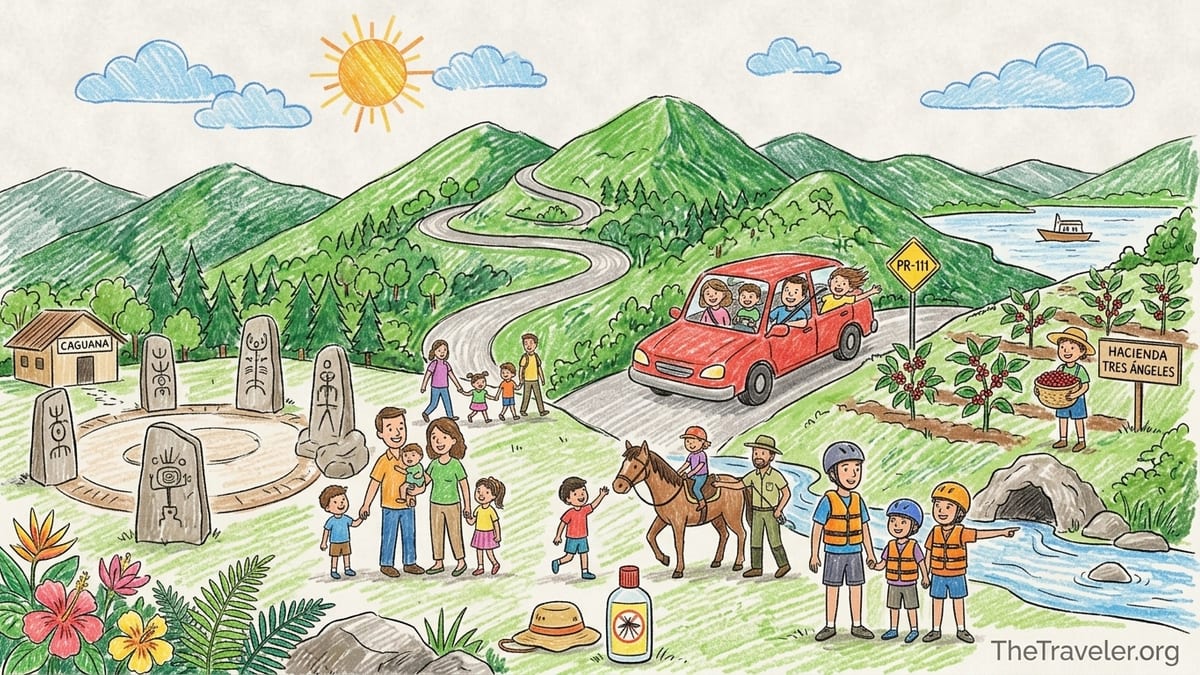
Understanding Utuado With Kids: Terrain, Weather and Driving
Utuado sits in Puerto Rico’s central mountains, roughly a 1.5 to 2.5 hour drive from San Juan depending on traffic and route. The scenery is beautiful but the roads between Arecibo, Adjuntas and Utuado twist back and forth through steep hills. Children and adults prone to motion sickness often feel queasy on these stretches, especially on PR-111 and secondary roads leading to attractions such as Caguana or Tanamá staging areas. Families who know this is a problem should plan light meals before the drive, keep motion sickness remedies handy and allow time for short stops at viewpoints or small roadside groceries for fresh air and water.
The mountain climate is cooler than the coast, especially in the mornings and evenings, but the sun is still strong and rain showers are common year-round. Many outdoor experiences in Utuado, from Taíno sites to coffee farms and Río Abajo trails, are partially or fully exposed. Lightweight long sleeves, brimmed hats, and generous insect repellent are important, particularly in shaded forest and riverside areas where mosquitoes and other insects are active. Families should bring their own repellent and sun protection instead of assuming they can buy them at each site.
Because public transportation is very limited in the interior, a rental car is the most practical way to explore with children. Choose a vehicle with good brakes and enough power for mountain climbs, and double-check that your child seats meet safety standards and are correctly installed before leaving San Juan or Aguadilla. Rain can make narrow shoulders and informal parking areas muddy, so closed-toe shoes and a spare outfit for kids are helpful even on days when you are not planning water activities.
Utuado is primarily rural, and services cluster in town rather than at every attraction. Families should expect to drive back toward the main town or nearby barrios for full meals, pharmacies, supermarkets and fuel. Pack snacks, extra water and basic first-aid items whenever you head out to a river, canyon, or forest trail, and ask local hosts or guides in advance where the nearest reliable bathrooms and restaurants are located.
Caguana Indigenous Ceremonial Park: Easiest Entry to Taíno History
The Parque Ceremonial Indígena de Caguana, about 20 minutes from central Utuado, is one of the Caribbean’s most important Taíno archaeological sites and one of the simplest cultural outings for families. Managed by the Puerto Rico Institute of Culture, it combines a small indoor museum with outdoor ceremonial plazas and stone monoliths carved with petroglyphs. The site has onsite parking, staffed entry, basic visitor information and restrooms, making it less logistically complex than many other stops in the region.
Recent government and environmental publications describe Caguana as having a nominal entry fee, historically just a few dollars per adult and less for children, making it relatively affordable even for larger families. Opening hours and exact prices can shift with budget changes and maintenance work, so parents should check the latest information with the Puerto Rico Institute of Culture or a current tourism office before driving out. The site is compact enough that young children can explore at their own pace, with enough open space for strollers or short rest breaks, but families should still prepare for sun exposure and some uneven ground.
Caguana works especially well for school-age children who are studying Indigenous cultures or Spanish in school. Parents can point out petroglyphs, talk about how plazas might have been used for ceremonies and ball games, and compare what they see to museum exhibits in San Juan. Because the park is relatively quiet compared with coastal attractions, nervous or sensory-sensitive children often find it easier to engage without crowds or loud music in the background.
For teens, Caguana can be a starting point for broader conversations about colonization, language, and the survival of Taíno identity in modern Puerto Rico. Combining a morning at the ceremonial park with an afternoon coffee farm visit or an easy viewpoint such as a roadside mirador gives older kids cultural context alongside scenery, while keeping the day manageable if younger siblings are along.
Gentle Nature and Viewpoints: Young Children and Cautious Families
For families with toddlers and young elementary-age children, or anyone uncertain about water and heights, Utuado still offers low-pressure nature time. Short walks around town plazas, lakes in the surrounding area, and viewpoints on the road toward Arecibo provide photo opportunities without committing to long hikes. Parents who want a relaxed base can look at rural houses or small lodges in barrios such as Caguana or along the road toward Lago Dos Bocas, where mornings are quiet and kids can watch birds, roosters and cows in nearby fields.
Río Abajo State Forest, which stretches across Utuado and Arecibo, offers a network of trails through karst forest and limestone formations. Some paths, including sections near the visitors area, are gentle enough for families used to walking with young children, provided everyone wears closed-toe shoes and insect protection. Bathroom facilities at small forest parking areas may be very basic or temporarily closed, so parents should plan bathroom breaks before entering the forest and carry wipes, tissues, and hand sanitizer.
Horseback riding operators in the Utuado area, including Batey Zipline Adventures in partnership with Hacienda Horizonte, now offer specific kids’ trail rides designed for roughly ages three to ten and beginners. These short, guided rides keep horses on calm, predictable routes and allow a parent to join on horseback or walk nearby. Helmets are typically provided and strongly encouraged, but families should confirm in advance that child-sized helmets are available and in good condition, and ask how guides manage nervous riders or sudden rain showers.
Young children who dislike being wet or cold can still experience rivers visually without jumping in. Some rural accommodations near the Tanamá corridor or small bridges outside town let kids watch the water from the bank or a safe vantage point. Parents can schedule a riverside picnic, keeping everyone in regular walking shoes and bringing a change of clothes primarily in case of mud or spilled drinks rather than full immersion. This gentle exposure often helps hesitant kids feel more comfortable before older siblings attempt cave tubing or canyon adventures on another day.
Coffee Farms, Meals and Bathroom Planning
Utuado is widely known as a coffee-growing area, and several farms open their operations to visitors. Hacienda Tres Ángeles, for example, offers scheduled coffee experiences that walk guests through the planting, processing and tasting stages, finishing with a cup of their own coffee paired with a house dessert. Another long-running local option is Café Gran Batey, which travelers frequently mention for its family-run tours and tastings. These farms operate on set tour times and limited capacity, so families should reserve in advance and confirm language options if grandparents or kids are more comfortable in Spanish or English.
Coffee experiences work especially well for school-age children and teens who have studied agriculture, ecosystems or business. Kids can see coffee cherries on the plant, learn how altitude and shade affect quality, and compare the flavor of freshly roasted coffee to what parents drink at home. Younger children often enjoy the open fields, machinery and chance to taste locally made sweets, but parents should be prepared to supervise closely around drying patios, equipment and hot liquids.
Bathroom access on coffee farms is usually better than at remote river put-ins but may still be limited to a few toilets near the main house or café. When booking, ask whether restrooms are available before and after the tour and whether they remain open if the group lingers to buy beans or snacks. After coffee visits, many families choose to eat in Utuado town or at small roadside restaurants that serve rice and beans, roast pork, stews and fried snacks. These sit-down meals also give children a break from the car and a chance to reset before another winding drive.
Because Utuado’s mountain roads and activities demand energy, it helps to build in unhurried meal stops. Families might schedule Caguana in the morning, then a lunch at a simple local restaurant, followed by an easy rural drive or short forest stop rather than stacking Caguana, a full coffee tour and a river excursion in one day. Extra time allows for slow service, rain delays and tired children without turning the trip into a forced march from one booking to the next.
Tanamá River and Cañón Blanco: Matching Adventure to Kids and Conditions
The Tanamá River winds through limestone canyons and caves between Utuado, Arecibo and Adjuntas. Local and national tourism materials highlight the area as an adventure destination for activities such as river hiking, cave tubing, rappelling, canyoning and, in some spots, cliff jumps. Discover Puerto Rico often describes guided Tanamá experiences as “family-friendly” and emphasizes the professionalism of local guides. At the same time, individual operators stress that guests need good physical condition and that tours vary in difficulty. For example, Tanamá River Adventures states on its own site that children are welcome from about eight years old, but also lists significant hiking through forest and river and expects participants to arrive rested and ready for demanding outdoor activity.
This tension between “family-friendly” and “physically demanding” is critical for parents. A guided outing may use harnesses, helmets, life jackets and well-briefed guides, but that does not make every tour appropriate for every child. Some cave tubing experiences, such as those marketed by Batey Adventures, present themselves as suitable for families who enjoy nature and adventure, while still requiring comfort with cold water, darkness, wearing life jackets and following instructions for several hours. Other Tanamá-area operators lead more technical canyoning or rappelling that are clearly geared toward active teens and adults rather than younger kids.
Cañón Blanco, a photogenic white-rock canyon in the Utuado area, appears often in recent travel coverage and social media. Visiting this canyon typically involves walking along or in the riverbed and sometimes wading through pools, depending on season and rainfall. Local guides and recent travelers emphasize that water levels and flow change quickly with mountain storms. Families should only consider Cañón Blanco with current advice from local operators and with a clear understanding that heavy rain anywhere in the watershed can turn a calm stream into a fast, unsafe flow. If operators or hosts indicate that water or weather conditions are not right, families should be prepared to skip the canyon altogether.
Across all Tanamá and canyon experiences, proper gear matters. Reputable operators generally provide helmets and life jackets for water and canyon tours and may require closed-toe water shoes with good grip rather than loose sandals. Parents should confirm that child and teen sizes are available and in good condition, ask how equipment is cleaned between groups, and bring backup river shoes and a full change of clothes for each child. Lightweight synthetic layers, small dry bags for phones and snacks, and towels in the car make it easier to handle sudden rain or a child who ends up more submerged than planned.
Age-Based Suggestions: Young Children, School-Age Kids and Teens
For young children, roughly ages three to seven, Utuado works best as a base for gentle exploration rather than peak adrenaline. A realistic day might combine breakfast at your lodging, a slow drive to Caguana Indigenous Ceremonial Park for an hour or two of walking and storytelling, then lunch in town and a relaxed afternoon at a rural house with a view or a very short forest walk near Río Abajo. Families could add a dedicated kids’ horseback trail ride with a provider such as Batey Zipline Adventures, which explicitly designs short outings for ages three to ten, focusing on calm horses and simple routes. Any water play at this age is ideally limited to supervised splashing on shallow riverbanks near accommodations or viewpoints identified as safe and calm by local hosts.
School-age children, roughly eight to twelve, often have the stamina and curiosity for more structured adventures, but still vary widely in swimming ability and confidence. Some Tanamá operators, including Tanamá River Adventures, welcome children from about eight years old on select tours, provided they are in good health and can manage hiking through forest and river terrain. Parents should have an honest conversation with guides about each child’s fitness, swimming skill and anxiety around darkness or heights before reserving. For many families, a moderate cave tubing route or river hike with lots of stops may be a good first Tanamá experience, while siblings who are less enthusiastic could spend the day at a coffee farm or exploring Utuado town with the other parent.
Teenagers, especially those who play sports or hike regularly, are often ready for more demanding Tanamá itineraries, long river hikes, or rappel-inclusive canyoning with specialized operators. Still, “teen” is not automatically equal to “ready.” Parents should check minimum age policies, read equipment lists carefully, and clarify with guides whether there are sections that require jumps, crawling through tight spaces, or extended swims. Teens prone to anxiety in enclosed spaces or who dislike cold water may prefer dry-land options such as longer horseback rides, advanced coffee and agriculture tours, or more substantial hikes in Río Abajo State Forest.
Across all ages, comfort around water is just as important as age or height. A cautious ten-year-old who dislikes deep water may be far better suited to Caguana, short forest walks, and an easy coffee tour than to four hours of river tubing, even if the operator accepts that age. A confident seven-year-old strong swimmer still might not meet an operator’s minimum age for cave tubing or canyoning. Parents should treat age and “family-friendly” labels on websites as starting points, then make final decisions based on the specific child, recent weather, and clear discussions with guides.
Safety, Gear and Choosing Truly Family-Friendly Operators
In Utuado, the difference between a “family-friendly operator” and an activity that is “appropriate for every child” is significant. Operators such as Tanamá River Adventures, Batey Zipline Adventures and others in the Tanamá corridor market experiences for families and often host multi-generational groups. They typically provide helmets, life jackets, harnesses where relevant, and trained guides who monitor river levels and weather. However, even these companies emphasize on their own channels that guests need good physical condition, should rest well the night before, and should be ready for potentially strenuous outings involving hiking over rocks, climbing into caves, and spending hours in and around water.
Parents choosing an operator should ask detailed, practical questions before paying deposits. These include maximum group size, guide-to-guest ratios, whether there is a separate guide at the back of the group, and what happens if a child wants to stop or cannot continue. It is reasonable to ask about training and certifications, whether helmets and life jackets are mandatory for children, how they handle afternoon thunderstorms, and what the backup plan is if river conditions deteriorate mid-tour. Families should also ask directly whether there are sections that involve required jumps or swimming across deep pools and whether there is an easy way to bypass them.
For any water or canyon activity, families should bring their own water shoes if possible, even if the operator provides basic pairs. Shoes with covered toes and solid tread protect feet from sharp limestone and prevent slipping on algae-coated rocks. Each child should have a full change of clothes, including dry underwear and a warm layer, waiting in the car, along with a towel and plastic bags for wet items. Parents may also want lightweight gloves for longer rock scrambles, especially for teens with sensitive hands.
Beyond gear, families should keep a conservative approach to conditions. If recent heavy rain has hit the central mountains, operators may cancel or modify tours at the last minute. Responsible guides will err on the side of caution, but parents retain the final say in whether to proceed. If a guide expresses hesitation about a particular canyon or river stretch for your group’s youngest or least-fit member, treat that input as decisive and opt for a tamer alternative such as a coffee farm, Caguana, or a horseback ride instead.
The Takeaway
Utuado rewards families who slow down, ask questions and match activities realistically to their group. Caguana Indigenous Ceremonial Park provides a straightforward, meaningful introduction to Taíno history, with parking, restrooms and modest admission fees that make planning simple. Coffee farms such as Hacienda Tres Ángeles and Café Gran Batey add hands-on learning about agriculture and business, along with bathrooms and cafés that are reassuring for parents traveling with children.
On the adventure side, Tanamá River and Cañón Blanco can deliver the kind of unforgettable river caves and white-rock canyons that teens talk about for years, but only when water levels, weather and the specific child’s abilities line up. Discover Puerto Rico and several operators highlight these outings as family experiences, while the same operators point out that guests must be in good shape and that tours differ markedly in difficulty. The safest approach is to treat every Tanamá excursion as something that requires careful, operator-specific screening rather than a standard checklist item for anyone under eighteen.
For young children, focus on Caguana, kids’ trail rides, gentle walks and scenic drives. For school-age kids, selectively add a moderate river or cave tubing tour only if they are eager, fit and comfortable in water. For teens, consider more demanding canyoning or long hikes, but continue to ask detailed questions and carry proper gear, including helmets, life jackets, water shoes and spare clothing. By layering culture, coffee and cautious adventure, families can leave Utuado with a richer sense of Puerto Rico’s interior and memories that feel exciting rather than overwhelming.
FAQ
Q1. Is Utuado a good base in Puerto Rico for families with young children?
Utuado can work very well for families with young children who enjoy quiet rural settings, short drives to cultural sites like Caguana and time at kid-focused horseback rides or gentle forest walks, but it is better suited to those comfortable with mountain roads and fewer big-resort amenities.
Q2. At what age can children realistically join Tanamá River adventures?
Some operators, such as Tanamá River Adventures, accept children from around eight years old on selected tours, but participation should depend on each child’s fitness, swimming ability and comfort in cold, moving water and dark caves, not just the posted minimum age.
Q3. Are all Tanamá River tours truly “family-friendly” for any child?
No. Even when Discover Puerto Rico or an operator calls a tour family-friendly, many Tanamá outings involve long hikes, scrambling over rocks, cold water and potential jumps, so they are not automatically suitable for every child, especially younger or less confident ones.
Q4. How easy is it to visit Caguana Indigenous Ceremonial Park with kids?
Caguana is one of the simplest cultural stops in the area, with onsite parking, restrooms, a small museum and a compact outdoor site, plus relatively low admission fees, so it is manageable for families with strollers or short attention spans.
Q5. What should we pack for a day of activities around Utuado?
Families should bring sun protection, insect repellent, closed-toe shoes, plenty of drinking water, snacks, a basic first-aid kit, motion sickness remedies for mountain roads and, for water activities, water shoes, towels and a full change of clothes for each child.
Q6. Are there family-friendly coffee farm tours in Utuado?
Yes. Coffee farms such as Hacienda Tres Ángeles and Café Gran Batey welcome visitors on guided tours that explain coffee cultivation and roasting; they are suitable for school-age children and teens with close parental supervision around equipment and hot drinks.
Q7. How can we manage car sickness on Utuado’s mountain roads?
To reduce car sickness, schedule drives when children are rested, offer light snacks instead of heavy meals, seat prone kids where they can see forward, keep windows cracked when safe, take breaks at viewpoints and use doctor-recommended motion sickness medications if needed.
Q8. What safety gear should reputable operators provide for river and canyon tours?
Responsible Tanamá and canyon operators typically provide helmets, life jackets and, when needed, harnesses and ropes; parents should confirm that child and teen sizes are available, that equipment is in good condition, and that guides insist children keep gear on throughout the activity.
Q9. Can we visit Cañón Blanco on our own with children?
It is strongly recommended to visit Cañón Blanco only with local guidance and after checking water levels and weather; fast-changing river conditions and slippery rock make self-guided family visits risky, particularly with children who are not experienced hikers or swimmers.
Q10. How many days should a family spend in Utuado?
Many families find that two to three nights in Utuado is enough to visit Caguana, tour a coffee farm, add one river or canyon outing for older children and still leave room for relaxed meals and rest between drives without over-scheduling kids.