


Guavate’s famous strip of lechoneras in the hills of Cayey is one of Puerto Rico’s best day trips, but the experience starts long before the first plate of pork. Reaching this stretch of PR-184 means leaving the coastal highways behind, driving into the mountains, and dealing with tight curves, weekend traffic and improvised roadside parking. With a bit of planning, though, the drive from San Juan, Ponce or the east coast can be straightforward, safe and surprisingly scenic.
Get the latest updates straight to your inbox!
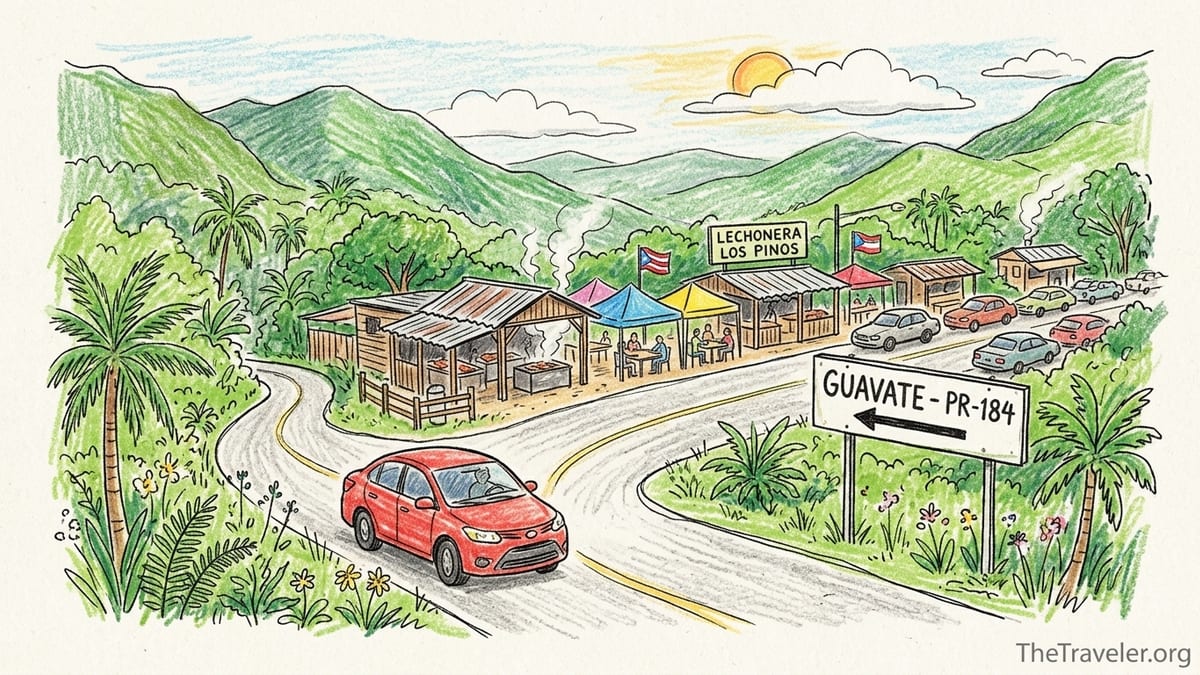
Where Guavate Is and How You Actually Reach It
Guavate is a mountain barrio of the municipality of Cayey, in Puerto Rico’s central range, known for a short but dense section of Puerto Rico Highway 184 lined with open-air roast-pork restaurants. Official tourism material describes it as roughly 40 minutes south of San Juan under normal conditions, which matches common driving estimates in light traffic. The key point for drivers is that Guavate is not a town square with a single parking lot but a few miles of rural mountain road where businesses, music and parked cars cluster on both sides.
The most important landmark for reaching Guavate by car is PR-52, the main toll expressway that runs between San Juan and Ponce across the island. From either direction you access Guavate via Exit 32, which is clearly signposted for Guavate, Cayey Este and Cidra. At the bottom of the exit ramp, turning south takes you onto PR-184 and into the mountains toward Guavate and, further on, the Carite State Forest. This is the same route currently described in Discover Puerto Rico’s official guide, which directs visitors along PR-52 to Exit 32 and then up PR-184 into the lechonera zone.
Once you are on PR-184, the character of the drive changes quickly. After a few minutes of semi-rural surroundings, the road begins to climb and tighten into sharper curves. Guavate itself is not marked by a single large sign; instead, you will know you have arrived when you begin to see the first lechoneras, parking pull-outs and weekend crowds along both sides of the highway. For planning purposes, think of Guavate as a corridor you gradually enter rather than a single destination you suddenly reach.
Because there is no convenient public transport that serves this stretch of PR-184 in a practical way for visitors, and because the lechoneras are spread along the road rather than clustered around one bus stop, nearly all travelers reach Guavate by private car, rental vehicle or on a guided excursion that includes transportation.
Driving from San Juan: Fastest Route and Realistic Timing
From the San Juan metro area, Guavate is a straightforward southbound drive almost entirely on PR-52. In October 2026, common mapping services route drivers from central San Juan to Guavate via PR-18 and PR-52, covering roughly 47 to 55 kilometers depending on your exact starting neighborhood. In light traffic, typical estimates are around 40 to 50 minutes to the first lechoneras, which matches Rome2Rio and tourism-site figures that suggest a drive of approximately 40 minutes with no congestion. Allow closer to one hour door to door from most city hotels to account for on-ramps, tolls and the slower final segment on PR-184.
As an example, a mid-morning weekday check from the Condado area to PR-184 via Exit 32 usually returns an estimated time around 45 to 55 minutes with normal traffic. Leaving from Old San Juan, with its slower street grid, often adds five to ten minutes to reach PR-18 and PR-52 before you are fully on the expressway. Once you are south of Caguas, PR-52 becomes a fast toll road through the mountains, with wide curves and good pavement that contrasts sharply with the narrower PR-184 that follows.
On weekends and holidays, the numbers change. When Discover Puerto Rico and local guides advise visitors to arrive in Guavate before noon, they are responding to predictable Saturday and Sunday congestion. Around late morning, traffic can back up on PR-184 as residents and visitors converge on the same handful of lechoneras. That congestion may add 15 to 30 minutes from the exit ramp to your final parking spot, even if the expressway portion of the drive is relatively clear.
The most reliable strategy from San Juan is to treat Guavate as a brunch or early-lunch excursion. Aim to depart the metro area between 8:30 and 10:00 a.m. if you are visiting on a Saturday or Sunday. In practice, that often means arriving at PR-184 while many lechoneras are already serving food, but before the densest crowds and tightest parking of early afternoon.
Driving from Ponce, Guayama and the South Coast
From Ponce and the southern coast, Guavate is reached either via PR-52 northbound or via older mountain roads that connect to Cayey. For most visitors, PR-52 is the most efficient and comfortable choice. Driving from central Ponce to Exit 32 near Cayey typically covers around 70 to 80 kilometers and, in normal traffic, mapping services in late 2026 suggest driving times around one hour to one hour and fifteen minutes to the Guavate strip, depending on your exact starting point in the city.
For instance, a route from Ponce’s historic center to PR-52 and then to PR-184 via Exit 32 often shows approximately 1 hour and 5 minutes under moderate conditions. This includes the highland climb between Ponce and Cayey, which can experience heavy rain and occasional fog, especially in the afternoon. Drivers coming from beach resorts around Santa Isabel or Salinas will typically join PR-52 north of Ponce, trimming perhaps ten to twenty minutes off the drive compared with starting in central Ponce.
From Guayama, there are two broad options. One is to drive inland on PR-15 toward Cayey, a route that forms part of the historic Carretera Central and the broader Ruta Panorámica through the mountains. This road is more scenic but slower, with tighter curves and passing zones that require patience. Expect around 45 minutes to one hour from central Guayama to Cayey via PR-15, and then another 15 to 25 minutes to reach the busiest section of PR-184 near the lechoneras. The other option is to loop west to PR-52 near Salinas and come up the expressway before exiting toward Guavate, which usually produces similar or slightly shorter times in exchange for tolls and a less scenic approach.
Whichever route you choose from the south coast, it is wise to check live mapping data on the day of your trip. Heavy rain events, minor landslides or roadwork occasionally impact mountain roads in central Puerto Rico. If you see unexpected slowdowns on PR-15 or PR-52, it may be better to delay departure or adjust your route rather than risk a long standstill in the hills.
Reaching Guavate from the East Coast and Other Regions
Visitors staying on Puerto Rico’s east coast, around Fajardo, Luquillo or Humacao, often combine a Guavate visit with time in El Yunque rainforest or the beaches of Luquillo. From these areas, the most practical approach usually involves joining PR-30 or PR-53 and then connecting to the PR-52 corridor toward Cayey. For example, from Humacao, drivers often head inland on PR-30 toward Caguas, then merge onto PR-52 southbound and exit at the familiar Exit 32 to reach PR-184. In light traffic, the Humacao to Guavate drive can take around one hour to one hour and fifteen minutes according to current mapping estimates.
From Luquillo or Fajardo, the first leg involves coastal routes westward, then a jog inland. Common GPS routes in 2026 send drivers along PR-3 and then inland via PR-66 or PR-30 before reaching PR-52. That longer distance translates into typical drive times of approximately one hour and a half to the Guavate area, sometimes a bit more during busy weekend periods or if you are traveling directly after a morning in El Yunque when other visitors are also leaving the rainforest.
Travelers coming from the central northern suburbs, such as Bayamón or Guaynabo, will usually cut across local connectors like PR-22, PR-199 or PR-1 to meet PR-52 near Caguas, then continue south to Exit 32. Here, too, real-time navigation is your friend. Urban congestion around Caguas can occasionally make PR-1 a better approach than PR-52 for the first segment of the trip, especially at rush hour, even though PR-52 is the formal expressway route used in most tourism descriptions.
Because the lechonera strip runs along PR-184 for several kilometers, drivers from any region should look carefully at map pins for specific restaurants they plan to visit. Some, like El Rancho Original or Los Pinos, sit further up the mountain, while others appear closer to the base of PR-184 near the highway exit. If you are traveling with someone prone to motion sickness, you might consciously pick a lechonera that requires fewer switchbacks at the upper end of the road.
Why a Rental Car Is Usually the Most Practical Option
For most visitors staying in San Juan or on the coasts, renting a car is the simplest way to reach Guavate and enjoy the day on your own schedule. In late 2026, major rental brands such as Enterprise, Hertz and Avis operate at Luis Muñoz Marín International Airport and in tourist neighborhoods like Isla Verde and Condado, often offering day rates that compare reasonably with the combined cost of organized tours for two or more people. A compact car can be sufficient, as PR-52 is a modern expressway and PR-184, though narrow, does not require high clearance.
The main reason a rental car is more practical than public transport is that there is no direct bus or train service that deposits visitors in the middle of Guavate’s lechoneras. While there are intercity buses and private shuttle services across Puerto Rico, they tend to focus on major city pairs, airports and cruise ports rather than rural food corridors. Even if you could arrange a custom shuttle, it would need to navigate the same tight curves and roadside parking, and you would still be locked into fixed pick-up times rather than deciding on the fly whether to linger over another plate of pork or one more set from the live band.
Compared with rideshare, a rental car avoids uncertainty around your return trip. Rideshare services such as Uber operate actively around San Juan and some larger towns, but coverage thins quickly in mountain areas. It may be possible to grab a ride-share into Guavate from a city with strong coverage, but drivers are less likely to accept pickups along PR-184 once the afternoon crowds thin. Having your own car ensures that you decide when to leave, where to pull over for views, and whether to continue deeper into Carite or along the Ruta Panorámica instead of heading straight back to your hotel.
Finally, a car gives you flexibility if weather or crowds change your plans. If a heavy downpour rolls in, you can easily leave early and pivot to a coffee shop in Cayey, a shopping stop in Caguas or a beach on the south coast. If you find the parking at your first-choice lechonera impossibly tight, you can drive a few minutes up or down PR-184 to an alternative with more space. That kind of adaptability is difficult to achieve if you are tied to a fixed tour or counting on a single rideshare driver to find you in the chaos.
Weekend Congestion, Narrow Roads and Parking Reality
Weekend congestion is part of the Guavate experience. On Saturdays and especially Sundays, live music, families and groups of friends turn the lechonera strip into a street party. Official tourism organizations describe Guavate as a weekend pilgrimage, and local commentary reinforces that the busiest hours typically fall between late morning and mid-afternoon. During these windows, PR-184 functions as both a road and an overflow plaza, with cars creeping along, pedestrians crossing unexpectedly and vendors operating close to the shoulder.
PR-184 itself is a two-lane mountain road with no central divider. In the Guavate section, there are frequent curves, occasional speed bumps and short, steep driveways leading into restaurant parking areas. On weekends, when free or informal parking along the roadside fills up, drivers often tuck their vehicles onto narrow shoulders or improvised pull-outs, which further narrows the functional width of the roadway. This combination means that your progress may slow to walking speed well before you spot an open space.
Some of the larger lechoneras have their own small lots or terraced parking areas, but these can fill completely by early afternoon. Local guides and residents frequently recommend arriving before noon if you want an easy parking experience, and some suggest budgeting up to 45 to 60 minutes just for parking and walking to your chosen restaurant on the busiest days. On weekdays, by contrast, visitors report near-empty lots and minimal congestion, at the cost of a quieter, less festive atmosphere and fewer lechoneras open at once.
When parking along PR-184, think about the drive out as well as the walk in. Choose a spot that leaves enough room for you to pull back into the lane without a dangerous blind merge on a curve. Avoid blocking entrances, driveways or narrow bridges, even if you see other cars doing so. Because local police and tow trucks occasionally respond to badly parked vehicles, particularly when access for emergency services is threatened, it pays to park slightly further away and walk rather than squeezing into an unsafe space close to your preferred lechonera.
Rideshare, Taxis and the Question of Getting Back
Rideshare services in Puerto Rico are concentrated in the San Juan metro area, with moderate presence in some other cities and limited reach into rural mountain regions. Travelers occasionally manage to take an Uber or similar service out of San Juan toward Cayey and then into Guavate, especially on busy weekends when drivers are already circulating on the expressway. However, relying on finding a return rideshare from Guavate in the afternoon is risky. Once you are several kilometers up PR-184, cellular coverage can be patchy, and there may be few or no drivers nearby on the app even if coverage is adequate.
Traditional taxis face similar constraints. While you can negotiate a round-trip fare with a San Juan or Ponce taxi company in advance, this behaves more like a private driver or small tour than a casual cab ride. The driver must be willing to spend several hours waiting or shuttling nearby while you eat and explore, and rates reflect that time commitment. For most travelers, the cost of such an arrangement for a couple or small family is likely to exceed the price of a one- or two-day rental car while offering less flexibility.
Guided tours that include Guavate as a food stop do exist, sometimes combining the lechoneras with other activities like coffee farm visits or scenic viewpoints around Cayey. These can be a good option for visitors who strongly prefer not to drive mountain roads. However, tour itineraries are fixed, and you may find yourself leaving just as the band starts or wishing for an extra hour to digest and wander. If you do book a tour, confirm that it specifically visits Guavate on PR-184 rather than only stopping at a single roast-pork restaurant elsewhere in the region.
If you are still tempted to depend on a rideshare for the return journey, have a backup plan. Save the phone numbers of at least one local taxi company in Cayey and one in San Juan, and carry enough cash or card capacity to pay for a last-minute private transfer if necessary. In practice, though, the simplest answer for most visitors remains to drive themselves or appoint a sober driver within their own group.
Driving Safely, Alcohol and Designated Drivers
Part of Guavate’s appeal is its party atmosphere. Many lechoneras serve cold beer, rum-based cocktails and shots alongside generous plates of pork, rice, pasteles and blood sausage. Live bands encourage visitors to dance, and it can be easy to lose track of time and consumption, especially when friends keep refilling drinks. At the same time, every visitor who leaves must eventually navigate the same narrow, winding PR-184 and the high-speed lanes of PR-52 to return to their lodging.
The safest solution is to plan for a designated driver before you arrive. If you are traveling as a couple, decide explicitly which person will avoid alcohol for the day. In a larger group, rotate that responsibility across the trip so no one feels that they always draw the short straw. A designated driver can still enjoy the food, music and scenery; they simply skip the Medalla, piña colada or rum punch that others might order. Building in a generous digestion and sobering-up window between your last drink and your departure is wise, even for those who drink lightly.
Because the return drive involves both slow corners and faster segments, even low levels of impairment can make a difference. Guavate’s pedestrian activity also demands sharper attention than a typical highway exit. Children dart across PR-184, cars pull out from tight parking gaps and music from competing sound systems can be distracting. A sober driver is better equipped to deal with an unexpected animal in the road, a sudden rain squall or a stalled vehicle blocking a lane on a blind curve.
If everyone in your party wants to drink, consider alternatives such as hiring a private driver for the day or booking a small-group tour that handles transportation. Confirm in advance how long the vehicle will remain with your group and whether you can adjust your departure time within reasonable limits. While this may cost more than driving yourselves, it can be a worthwhile investment for those who prioritize tasting craft rums or sampling multiple cocktails without worrying about the ride back to San Juan, Ponce or the coast.
Combining Guavate with Cayey, Carite and the Ruta Panorámica
Because Guavate lies in the hills above Cayey, many travelers choose to make a full day of their visit by combining roast pork with other attractions in the region. The town of Cayey itself sits at the junction of several important routes, including PR-52 and the historic Carretera Central, and offers supermarkets, pharmacies, fuel stations and basic services that are scarce along PR-184. Stopping in Cayey on the way up or down is a practical way to pick up cash at an ATM, buy motion-sickness tablets or refuel your car before or after the climb.
Continuing uphill past the core lechonera strip on PR-184 brings you toward Bosque Estatal de Carite, a state forest known for cool temperatures, pine groves and hiking trails. One of the most popular spots, Charco Azul, is a natural pool and picnic area that local and tourism sources describe as roughly 10 to 20 minutes further along PR-184 beyond the main Guavate restaurants. Many visitors enjoy dividing their day so that they walk to Charco Azul in the morning, cool off in the forest, then return down the road in time for a late lunch at a lechonera when the grills are in full swing.
For those interested in longer drives through the central mountains, the broader network of routes known as the Ruta Panorámica runs east to west across Puerto Rico’s interior. Segments of this route intersect near Cayey and Carite, connecting roads such as PR-15 and PR-14. A realistic, concrete itinerary for a long day from San Juan might involve driving to Guavate for an early lunch, continuing a short distance into Carite for an afternoon walk, then looping back toward the coast via PR-15 to Guayama and following coastal highways back toward the city. From Ponce, a traveler might reverse this pattern, starting with a scenic climb through Aibonito and Cayey, stopping to eat in Guavate, then descending toward San Juan in the evening.
Whichever combination you choose, build in extra time for slow segments and spontaneous stops. Viewpoints over the Sierra de Cayey, roadside fruit stands and unexpected festivals in small towns can all tempt you to pull over for photos or snacks. Realistically, a “half-day” excursion that includes Guavate and Carite often becomes a full day once driving, parking, queuing for food, eating, resting and walking are all taken into account. Planning with that in mind prevents you from feeling rushed and reduces the pressure to speed on unfamiliar mountain roads.
The Takeaway
Reaching Guavate is not complicated, but it does require more thought than a simple city-to-city freeway hop. From San Juan, you will spend most of your time on PR-52 before exiting at kilometer 32 and climbing into the hills on PR-184. From Ponce, Guayama and the east coast, a mix of expressways and mountain routes offers several paths into the Cayey area, all converging on the same exit and the same winding final approach.
A rental car remains the most practical option for most visitors, offering control over timing, the ability to explore Cayey and Carite on your own terms and a reliable way back once the music fades and the pork is gone. Weekend congestion, narrow lanes and informal parking are part of the story, but they are manageable when you arrive early, drive patiently and accept that the last few kilometers may be slow. With a designated driver at the wheel and a flexible plan that allows for scenic detours, the trip to Guavate becomes as memorable as the feast that awaits at the end of the road.
FAQ
Q1. How long does it really take to drive from San Juan to Guavate?
In light traffic, current mapping tools in 2026 usually show around 40 to 50 minutes from central San Juan to the Guavate lechonera strip, but you should allow about one hour to include the slower final segment on PR-184 and minor delays.
Q2. Is it safe to drive to Guavate if I am not used to mountain roads?
PR-52 is a modern expressway, and while PR-184 is narrow and winding, many cautious drivers without mountain experience manage it safely by taking their time, using low gears on descents and avoiding distracted driving or heavy drinking.
Q3. Do I need a four-wheel-drive vehicle to reach Guavate?
No, a regular compact or midsize rental car is sufficient in normal conditions, since PR-52 and PR-184 are paved; four-wheel drive is only useful if you plan to explore rougher side roads beyond the main lechonera strip.
Q4. Are there tolls on the way to Guavate?
Yes, if you travel on PR-52 between San Juan and Cayey or between Ponce and Cayey you will pass through toll plazas, so make sure your rental includes an electronic toll device or have a payment method approved by the agency.
Q5. Can I visit Guavate using public transportation?
There is no simple, direct public transportation route that drops visitors along the lechonera strip on PR-184, so arranging a rental car, private driver or guided tour with transportation is generally much more practical.
Q6. Is parking free at the lechoneras in Guavate?
Many lechoneras offer free or low-cost parking in small lots or roadside pull-outs, but space is limited and fills quickly on weekends, so be prepared to park a short walk away and always avoid blocking traffic or driveways.
Q7. What is the best time of day to arrive to avoid traffic?
On Saturdays and Sundays, arriving before noon usually means lighter traffic on PR-184 and a better chance of finding parking; after early afternoon, congestion often increases as more locals and visitors arrive to eat and listen to live music.
Q8. Will my mobile navigation work in Guavate?
Most drivers can use GPS navigation along PR-52 and much of PR-184, but coverage may become spotty in some mountain sections, so it is wise to save offline maps or directions to your chosen lechonera before you leave the city.
Q9. Is it realistic to combine Guavate with a visit to Carite or the Ruta Panorámica in one day?
Yes, many travelers visit Charco Azul in Carite State Forest or drive a short segment of the Ruta Panorámica on the same day as Guavate, but you should plan for a full day to account for slow roads, parking, walking and mealtimes.
Q10. How should we handle alcohol if everyone in our group wants to drink?
If no one is willing to stay sober to drive the narrow, winding roads back from Guavate, consider booking a private driver or small-group tour that includes transportation so you can enjoy drinks responsibly without needing to get behind the wheel.