

More news on this day
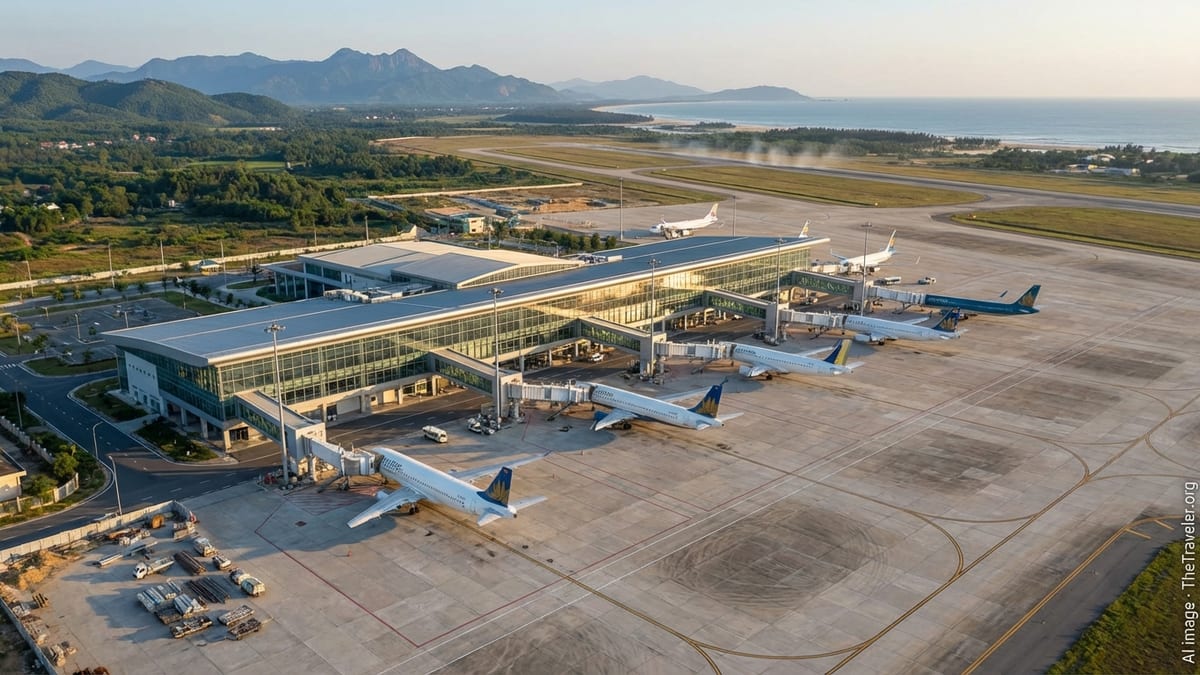
Vietnam is moving ahead with an ambitious long-term aviation strategy centered on Dong Hoi Airport, outlining plans to transform the compact coastal facility in Quang Binh province into a key international gateway with capacity for up to five million passengers a year by 2050.
From Overstretched Domestic Airfield to Growth Anchor
Dong Hoi Airport, which serves the central province of Quang Binh, is currently operating well beyond its original design. Built to handle around 500,000 passengers a year, the airport has already exceeded that level by more than half and is projected to approach one million passengers annually in the near term, according to local authorities and airport operators.
The rapid growth has laid bare the constraints of an airfield that, until recently, was viewed primarily as a secondary domestic facility. With Vietnam’s tourism and domestic air travel booming, pressure on infrastructure in destinations such as Quang Binh has intensified, prompting Hanoi to fold smaller regional airports into a broader, long-range aviation master plan.
That plan now casts Dong Hoi in a much more strategic light. Officials say the airport will be upgraded in stages, first to relieve immediate bottlenecks and later to position it as an international entry point for the wider North Central region. By 2030, capacity is targeted at around three million passengers a year, rising toward five million by mid-century.
The expansion drive forms part of Vietnam’s push to distribute air traffic more evenly across the country, alleviating strain on major hubs such as Hanoi and Ho Chi Minh City while opening new gateways closer to emerging tourism and logistics clusters.
Near-Term Upgrades Lay Groundwork for International Operations
The first phase of Dong Hoi’s transformation is already underway, with a 2024 to 2026 upgrade program focused on core capacity. Work includes the construction of a new T2 passenger terminal, expansion of the aircraft parking apron from four to eight positions, and associated technical and support facilities.
Provincial leaders and the Airports Corporation of Vietnam have agreed on an accelerated timeline to ensure land clearance and construction proceed in parallel. Nearly 30,000 square meters of land were handed over in 2025 to enable terminal works and apron expansion, a milestone that local officials describe as pivotal in unlocking the project’s next stage.
Once complete, the new T2 terminal is expected to handle up to three million passengers annually and will primarily serve domestic flights. The existing terminal is intended to be reconfigured to process international services, effectively preparing the airport for its future cross-border role while maintaining capacity for steadily increasing domestic demand.
In addition to passenger facilities, plans call for improved airfield infrastructure and navigation systems to meet international operational standards. Authorities emphasize that detailed technical specifications and phasing remain subject to central government planning approvals and potential adjustments as demand forecasts evolve.
North Central Region Poised for Tourism and Logistics Lift
Quang Binh, marketed as Vietnam’s “cave kingdom” thanks to world-renowned sites such as Son Doong and Phong Nha–Ke Bang National Park, has emerged as a tourism hotspot but still relies heavily on limited domestic air links. The long-term vision for Dong Hoi Airport is aimed at changing that equation by making it easier for international visitors to arrive closer to their final destinations.
Officials argue that upgraded air access will help lengthen visitor stays, attract higher-spending markets and support investment in hospitality and services along the central coast. Improved connectivity is also expected to aid regional trade, particularly as the airport’s cargo handling capabilities are enhanced over time.
The strategy is not confined to a single airfield. Regional planning documents pair Dong Hoi’s development with the construction of Quang Tri Airport to the north, envisaged as a higher-category facility with substantial passenger and freight capacity. Together, the two airports are designed to form a complementary aviation system that can support import-export flows, logistics services and tourism across the broader North Central belt.
Local leaders say that as expressways, seaports and airports come online in tandem, the region will be better positioned to attract manufacturing, logistics and service-sector investment that has traditionally clustered around Vietnam’s two main metropolitan areas.
Aligning With Vietnam’s National Aviation Vision
The decision to chart a path for Dong Hoi Airport toward international status by 2050 fits within Vietnam’s national transport planning, which calls for a network of regional gateways rather than just a handful of dominant hubs. New mega-projects such as Long Thanh International Airport near Ho Chi Minh City are intended to handle very high traffic volumes, but policymakers are also keen to avoid excessive concentration.
By steadily upgrading airports like Dong Hoi, Vietnam aims to build redundancy into its aviation system, improve resilience to disruptions and shorten travel times for passengers living outside the main urban centers. The approach mirrors trends seen elsewhere in Asia, where secondary cities have leveraged improved air access to accelerate tourism and diversify their economies.
Authorities stress that Dong Hoi’s development timeline will unfold over decades, with each stage contingent on demand, funding and regulatory approvals. However, recent directives from the central government, including calls to expedite work on key regional aviation projects, signal that infrastructure remains a policy priority as Vietnam seeks to sustain higher growth.
For now, the focus is on delivering near-term capacity increases on schedule and to international standards. Over the longer horizon to 2050, the goal is for Dong Hoi to function not just as a feeder airport, but as a recognized international gateway contributing meaningfully to Vietnam’s broader aviation and economic landscape.