

More news on this day
Escalating conflict across the Middle East has prompted Vietnam’s aviation regulator to issue an urgent safety advisory, ordering airlines to avoid closed and high-risk airspace and triggering a wave of long-haul reroutes, cancellations and passenger disruption.
Vietnam’s Aviation Watchdog Moves to Shield Passengers
The Civil Aviation Authority of Vietnam has instructed all airlines operating to, from or through Vietnamese airports to immediately steer clear of conflict-affected skies in the Middle East. The move follows rapid military escalation involving the United States, Israel and Iran and the subsequent shutdown or severe restriction of airspace across large swathes of the region.
Under the directive, carriers must review flight plans, select safer alternative routings and ensure that no aircraft operate over or near active conflict zones. Air traffic controllers have been told to prioritize safety-led reroutes, even when these add significant time and fuel burn to long-haul journeys linking Asia and Europe.
Vietnam’s air traffic management authorities have also been tasked with closely coordinating with international aviation bodies to track real-time changes to airspace status, particularly as countries issue rolling notices to air missions about closures and restrictions.
Officials describe the measures as a preemptive safety lockdown designed to keep Vietnam-connected traffic well clear of missile and air defense activity while maintaining core connectivity for travelers.
Middle East Airspace Closures Ripple Across Vietnam Routes
The Vietnamese advisory comes as Iran, Iraq, Israel, Syria, Qatar, Kuwait, Bahrain and other states either close their airspace outright or impose tight restrictions in response to the latest round of strikes and counterstrikes. Key Gulf hubs, including Dubai, Abu Dhabi and Doha, have suspended or sharply curtailed operations as commercial traffic is pushed away from sensitive corridors.
For Vietnam-linked travel, the immediate pressure is being felt on routes that depend on Middle Eastern hubs for onward connections. Airlines have begun canceling or delaying departures while they await clearer guidance on when key flight paths might reopen or when safe alternatives can be reliably scheduled.
Industry analysts note that the Middle East has long functioned as a crucial bridge between Southeast Asia and Europe, as well as to Africa and the Americas. With airspace over several countries effectively sealed, many of those traditional trunk routes have been severed, forcing carriers either to detour via Central Asia and the Caucasus or to suspend services outright.
Vietnam’s regulators caution that the situation is fluid and that further adjustments are likely in the coming days as governments and militaries reassess risk levels and revise airspace restrictions.
Emirates and Qatar Airways Services Hit, Aircraft Stranded
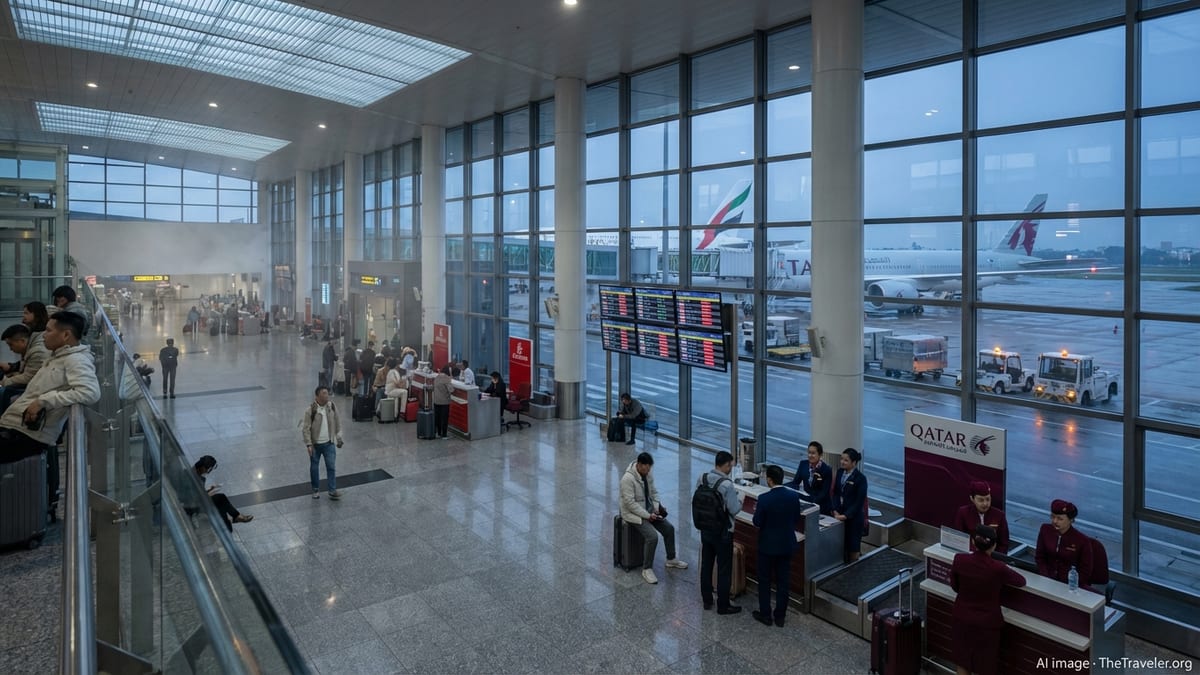
Among the hardest hit in Vietnam are Middle Eastern carriers that operate non-stop flights to Gulf hubs. Qatar Airways has canceled multiple services between Hanoi, Ho Chi Minh City and Doha since February 28, leaving several widebody aircraft parked at Vietnamese airports as crews wait for clearance or new flight plans.
Emirates has also suspended flights between Vietnam and Dubai as United Arab Emirates authorities partially close segments of national airspace and as Dubai International Airport limits movements amid heightened security protocols. Several Emirates and Qatar Airways passenger and cargo rotations have been scrubbed entirely, with thousands of ticket holders now seeking refunds or alternative routes.
Vietnamese airport operators report that some foreign aircraft remain on the ground at Hanoi’s Noi Bai International Airport, unable to depart along their usual corridors. While ground operations at Hanoi and Ho Chi Minh City continue normally, terminal staff and airline agents are managing a surge of rebooking requests and overnight accommodation needs.
Both Emirates and Qatar Airways have rolled out flexible rebooking policies and fee waivers for affected itineraries, but travelers transiting the Gulf face extended delays and, in many cases, complete itinerary overhauls to bypass the region.
Vietnamese Carriers Reroute Europe Flights Around Conflict Zones
Vietnam Airlines, the national flag carrier, says its flights between Vietnam and European gateways such as Paris, Frankfurt and London are still operating, but crews are flying longer, more northerly or southerly tracks to avoid closed Middle Eastern airspace. These alternative routings can add 15 to 30 minutes or more to flight times and raise fuel costs.
Despite the operational strain, Vietnamese airlines emphasize that safety remains the overriding priority. Vietnam Airlines has stated that its Europe services remain well outside the areas where hostilities are taking place and that the carrier is monitoring developments with foreign aviation authorities hour by hour.
Other Vietnamese carriers, including low cost operators and leisure-focused airlines, currently do not operate Europe or Middle East routes and therefore have no scheduled services directly traversing the affected skies. Even so, they have been instructed to remain alert to potential knock-on effects, such as congestion on alternative airways or changes in overflight permissions along Asian corridors.
Vietnam’s air traffic management centers are working with international partners to continuously update route availability, ensuring that rerouted flights comply with the latest safety and security guidance issued by countries along the revised tracks.
What Travelers Need to Know Right Now
For travelers in or transiting through Vietnam, the most immediate impact is on journeys involving Middle Eastern hubs or tickets issued on Gulf carriers. Passengers booked with Emirates, Qatar Airways, Etihad Airways or other regional airlines should expect possible cancellations, last minute schedule changes and significant delays.
Vietnamese authorities and airlines are urging passengers to maintain close contact with their carrier and to monitor official communication channels for updated departure times, rebooking options and revised routings. Even for itineraries that do not involve a Middle Eastern stop, longer flight times and altered paths between Asia and Europe are now likely as aircraft are funneled into fewer, safer corridors.
Travelers already in Vietnam who need to reach Europe or North America may be rebooked via Northeast Asian, Central Asian or direct European gateways instead of Gulf hubs. While these alternatives help preserve connectivity, they may involve additional stops or tighter connection windows as airline networks are hastily reconfigured.
Officials warn that the disruption could extend beyond the formal reopening of some airspace, as airlines will need time to reposition aircraft, rebuild schedules and regain operational stability once the immediate security crisis begins to ease.
Ongoing Monitoring as Crisis Evolves
Vietnam’s Civil Aviation Authority has framed its directive as an evolving safety response rather than a one-off decision, stressing that carriers must continue to assess operational risks as the Middle East conflict unfolds. Further instructions are expected if airspace closures expand, shift geographically or are lifted in stages.
Aviation experts say the current disruption ranks among the most severe regional shocks to global air travel in recent years, given the Middle East’s central role in connecting continents. With numerous key flight information regions either shut or constrained, Vietnam’s decision to effectively shut its skies to those risk areas reflects a broader global trend toward extreme caution.
For now, the message to travelers is to prepare for uncertainty. While Vietnam’s domestic network and most direct long haul services remain intact, the knock-on effects of the Middle East shutdown will be felt at check-in desks, departure boards and connection hubs worldwide for days, and possibly weeks, to come.
Authorities say they will continue to update airlines and passengers as new information emerges, aiming to balance the imperative of flight safety with the need to keep Vietnam connected to the wider world.