

More news on this day
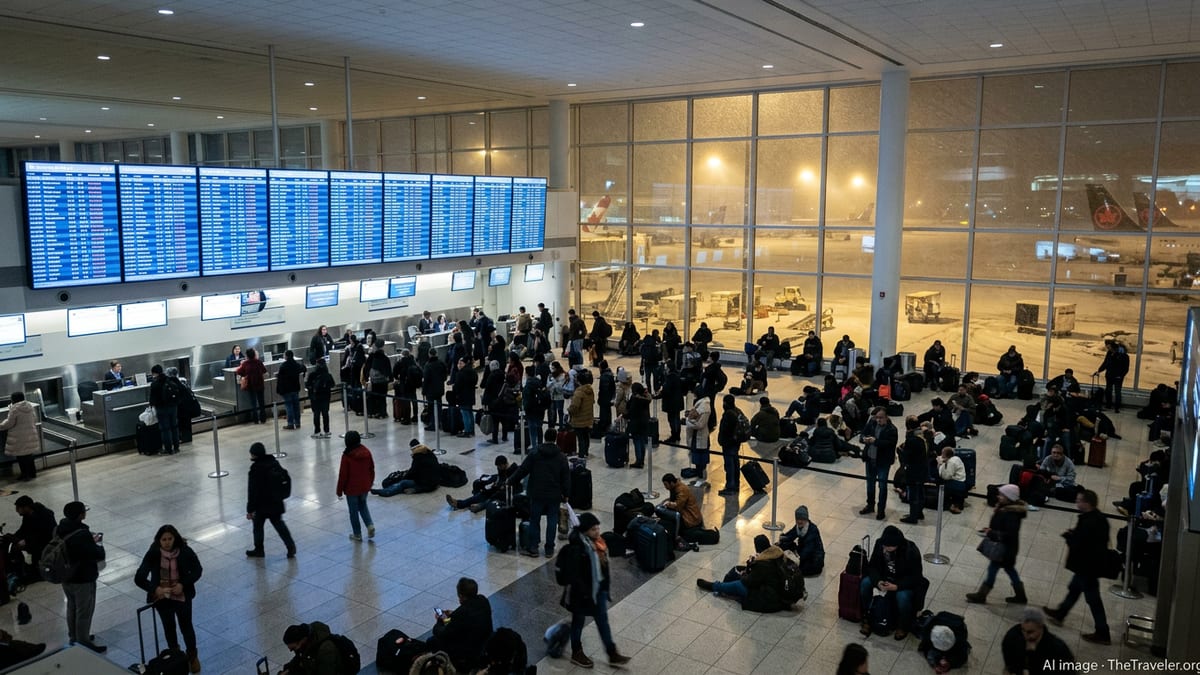
A powerful late-winter storm system sweeping across North America has triggered severe travel disruptions at Toronto Pearson International Airport, with mass flight cancellations, mounting delays and thousands of passengers stranded as aviation networks struggle to recover.
Get the latest news straight to your inbox!
Storm System Slams a Key North American Hub
Toronto Pearson, Canada’s busiest airport and a vital transcontinental hub, has emerged as one of the hardest-hit facilities as the sprawling weather system brings heavy snow, high winds and rapidly changing visibility to large parts of the continent. Publicly available flight-tracking data shows hundreds of departures and arrivals at Pearson either cancelled or heavily delayed over a short span, with the impacts radiating outward to cities across Canada and the United States.
The disruption coincides with a broader pattern of volatile late-season weather affecting North American aviation. Recent winter storms have repeatedly strained airport operations from the Great Lakes to the eastern seaboard, and the latest system has proved particularly challenging for Toronto thanks to intense snowfall bands and gusty crosswinds that complicate runway use and deicing.
According to published coverage, airlines have been operating on reduced schedules at several major hubs as the storm progresses, creating a rolling wave of cancellations that is now converging on Pearson. With many aircraft and crews already out of position from earlier weather events this winter, the fresh round of storms has amplified existing vulnerabilities in tightly timed airline networks.
Operational updates indicate that the situation remains fluid, with intermittent improvements in conditions quickly offset by new snow squalls or wind shifts. This has forced carriers and air traffic managers to continually recalculate capacity, contributing to sudden timetable changes and widespread uncertainty for travelers.
Thousands Stranded as Cancellations Cascade
Inside the terminals at Toronto Pearson, the numerical scale of the disruption is reflected in departure boards dominated by red cancellation and delay notices. Based on current schedules and cancellation tallies, several hundred flights have been affected over the course of the storm, translating into thousands of stranded passengers both in Toronto and at downline destinations waiting for aircraft that never arrive.
Reports from national and local media describe lengthy queues at airline service counters, with travelers rebooking for later dates or being routed through secondary hubs in an effort to bypass the most congested corridors. With many flights already sold out due to earlier disruptions this winter, same-day or even next-day alternatives are proving difficult to secure for some passengers.
Accommodation has become another pressure point. According to hotel industry data and travel trade reporting, properties near Pearson and along key highway corridors west of Toronto have seen a spike in last-minute bookings from displaced travelers seeking a bed for the night. In some cases, limited room availability and higher-than-usual walk-in demand have left travelers searching farther afield in Mississauga, Brampton and downtown Toronto.
Publicly available social media posts and traveler forums suggest that families with young children, older passengers and those with tight international connections are among the hardest hit. Many have reported extended overnight stays on airport seating or in crowded gate areas as they wait for rebooked flights or for their aircraft to arrive from storm-affected regions.
Ripple Effects Across North American Flight Networks
The turmoil at Toronto Pearson is not occurring in isolation. Aviation data and network maps show that the same weather system is disrupting a wide swath of the North American air grid, with knock-on effects stretching from regional feeders to long-haul international routes.
Airlines have proactively grounded or consolidated flights at other major hubs in the United States and Canada as the storm has moved eastward. According to aviation analytics firms and published transportation coverage, large numbers of cancellations have been recorded at airports in the Midwest and Northeast, where blizzard conditions and low visibility periodically make takeoffs and landings unsafe.
Because Toronto functions as both a domestic connector and a transatlantic gateway, problems there reverberate on multiple continents. Flights between Europe and Western Canada that normally rely on smooth connections through Pearson have been especially vulnerable, with some passengers facing missed onward segments and extended layovers while they await open seats on later departures.
Industry analysts note that the interconnected nature of modern aviation means a single major weather event can rapidly evolve into a continent-wide operational challenge. Aircraft stuck on the ground in storm-hit cities cannot be repositioned for flights elsewhere, and crew duty-time limits further constrain how quickly schedules can be restored once conditions improve.
Airlines Cut Schedules and Issue Flexible Policies
In response to the unfolding disruption, the major carriers serving Toronto Pearson have implemented a range of mitigation steps drawn from publicly available travel advisories. Many have significantly reduced their scheduled operations for the storm period, cancelling clusters of flights in advance to ease pressure on ground handling and deicing operations and to limit last-minute chaos at the gates.
Travel alerts on airline websites indicate that flexible rebooking policies are in effect across large portions of their North American networks. These policies typically allow affected customers to change travel dates without additional change fees, and in some cases without paying fare differences if they move to flights within a specified window once conditions stabilize.
Carriers have also been working to consolidate lightly booked flights and to prioritize routes where passengers have limited alternative options. Publicly available route and schedule data suggests particular attention to key domestic trunk routes from Toronto to cities such as Vancouver, Calgary and Halifax, along with critical cross-border links to major US hubs.
Despite these measures, reports from travelers and consumer advocates highlight ongoing frustration over long call-center wait times, congested online chat systems and mobile apps occasionally timing out under heavy traffic. For many stranded passengers, simply obtaining updated information about their options has become a significant part of the ordeal.
Travelers Face Lengthy Recovery Timeline
Even as meteorological forecasts point to gradual improvement in conditions, aviation experts caution that the operational recovery from such a wide-reaching weather event can lag the storm itself by several days. Aircraft and crews must be repositioned, maintenance checks completed and backlogs of stranded passengers cleared before schedules can fully normalize.
According to transportation analysts cited in recent media coverage, large hub airports such as Toronto Pearson often experience a pronounced “aftershock” period following major storms, during which delays and isolated cancellations persist even under blue skies. This reflects the complexity of matching available capacity to residual demand and reconnecting disrupted segments across domestic and international routes.
For travelers yet to begin their journeys, publicly available guidance from airlines and airport authorities strongly emphasizes advance planning. Passengers are being urged to monitor flight status frequently, build extra time into connections, and consider carrying essential items, including medications and basic toiletries, in hand luggage in case bags become separated during irregular operations.
With climate scientists and transportation planners drawing attention to the increasing frequency of disruptive weather patterns, the current episode at Toronto Pearson is likely to fuel further debate about how North American aviation can adapt. For now, though, the immediate reality for thousands of travelers is a prolonged wait in crowded terminals, as airlines and airports work to untangle another web of weather-related chaos.