


More news on this day
When storms shut down runways and snow squalls snarl air traffic, airlines routinely blame “weather” and assure travelers there is little more they can do. The reality is more complicated, and passenger rights vary sharply by where you are flying.
Get the latest news straight to your inbox!
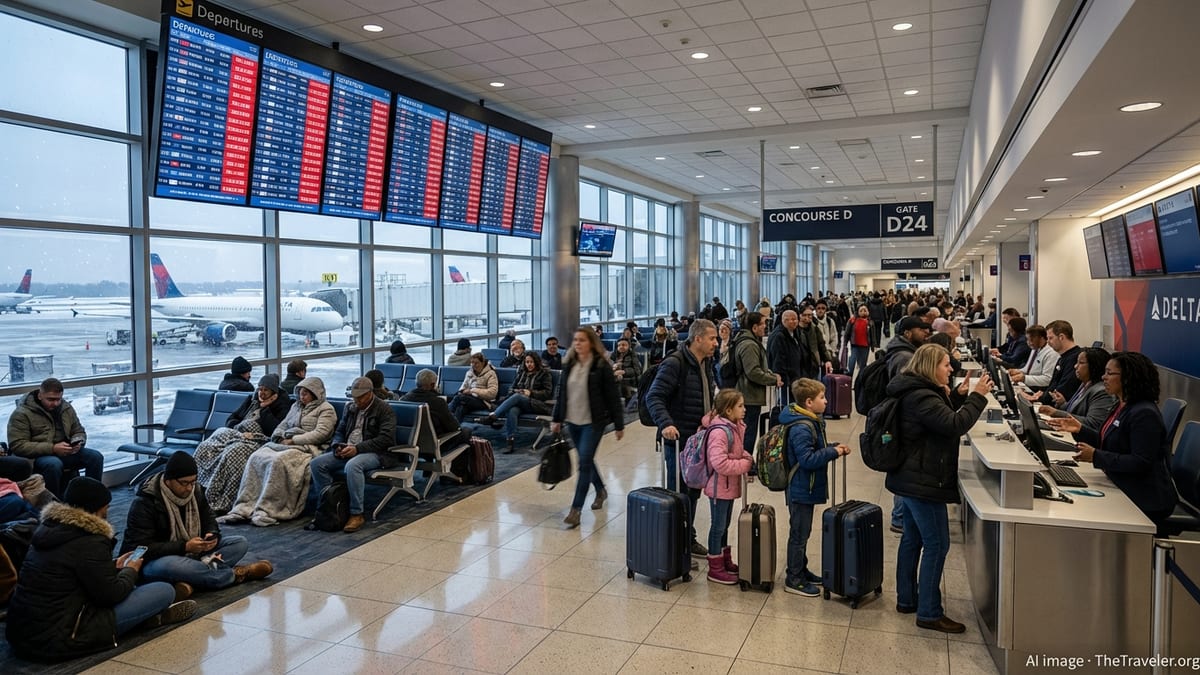
Weather delays versus airline-caused disruptions
Airlines across major markets draw a clear line between disruptions they can control and those attributed to extraordinary conditions such as severe weather, volcanic ash or airspace closures. When bad weather is cited, many forms of cash compensation that apply to mechanical or crew-related delays no longer apply, but minimum standards of care often still do.
In the United States, publicly available guidance from the Department of Transportation (DOT) explains that federal law does not require airlines to provide meals or hotels when a flight is delayed or canceled due to weather. Instead, these so-called “acts of God” are generally treated as outside the carrier’s control, and any vouchers are a matter of airline policy rather than legal obligation. By contrast, when a cancellation is within the airline’s control, carriers increasingly commit to cover overnight accommodations and rebooking at no extra cost.
In Europe and the United Kingdom, Regulation EC 261/2004 establishes common rules on compensation and assistance when flights are delayed or canceled. The regulation identifies adverse weather as an “extraordinary circumstance,” meaning airlines do not owe lump-sum compensation when storms or fog make flying unsafe. However, the same rules still require carriers to provide care in the form of meals, refreshments and, if needed, hotel accommodation when passengers are stranded, even when the initial cause is weather.
Canada’s Air Passenger Protection Regulations adopt a similar tiered approach. Airlines are excused from paying financial compensation when a delay or cancellation is outside their control, explicitly including many weather events and air-traffic restrictions linked to weather. Standards of treatment, such as food, communication and rebooking, can still apply depending on the length of the disruption and whether the carrier is classified as large or small.
What airlines must provide during long tarmac delays
Even when weather makes it impossible to take off or land, airlines are subject to strict rules once passengers are on the aircraft and away from the gate. In the United States, DOT’s tarmac delay rule requires airlines operating from U.S. airports to provide food and drinking water no later than two hours after a tarmac delay begins, so long as safety and security conditions allow. The same framework requires operable lavatories and, if needed, medical attention during the delay.
The U.S. rule also limits how long passengers can be kept aboard without the chance to disembark. For domestic flights, carriers generally may not keep passengers on the tarmac for more than three hours, and for international flights the limit is typically four hours, subject to narrow safety and air-traffic control exceptions. Carriers must also keep travelers informed of the status of the delay at regular intervals, including updates on opportunities to deplane.
Canada’s regime mirrors several of these protections. Highlights published by the Canadian Transportation Agency state that during tarmac delays, whether in Canada or abroad, airlines must allow passengers to disembark after three hours, with a possible extension of up to 45 minutes if takeoff is imminent and the carrier can still operate safely. Standards of treatment in Canada also include adequate ventilation, food and drink, access to toilets and the ability to communicate with people outside the aircraft when possible.
Within the European Union, EC 261/2004 does not set a specific maximum time for tarmac delays, but the duty of care provisions still apply. Once delays reach certain thresholds measured against the planned flight distance, passengers become entitled to meals and refreshments in reasonable relation to the waiting time, as well as hotel accommodation and transport between the airport and lodging if an overnight stay is necessary.
Rebooking, refunds and hotels in bad weather
When weather forces cancellations outright, the rules governing rebooking and refunds diverge by jurisdiction but share some common foundations. In the United States, DOT guidance and airline contracts of carriage show that passengers are entitled to a prompt refund if the airline cancels a flight or makes a significant schedule change and the traveler chooses not to travel, regardless of the cause. That means even a weather-related cancellation unlocks the right to get money back rather than accept a credit or rebooking.
Separate from refunds, the question of hotel rooms and meal vouchers is largely governed by airline policy in the U.S. A DOT-operated airline customer service dashboard summarizes which major carriers commit to providing complimentary meals or hotel accommodations during overnight delays that are under their control. Many of these same carriers specify that when weather is responsible, they will rebook passengers on the next available flight at no extra fare, but they do not guarantee hotel coverage.
In Europe and the United Kingdom, the legal framework is more prescriptive. Under EC 261/2004, once delays or cancellations cause passengers to wait for extended periods, airlines must offer meals and refreshments, two free communications such as phone calls or emails, and hotel accommodation if an overnight stay becomes necessary, even when weather is the underlying issue. Travelers are not entitled to the regulation’s fixed cash compensation when adverse weather qualifies as an extraordinary circumstance, but the duty of care continues until they reach their final destination.
Canada’s rules distinguish between disruptions within an airline’s control and those outside its control, which include many weather events. For delays and cancellations beyond the carrier’s control, large airlines must still ensure passengers are rebooked on the next available flight, including, in some circumstances, on other airlines if they cannot complete travel within a certain timeframe. However, the obligation to provide hotels during weather disruptions is more limited than in Europe and tends to focus on situations where the airline has greater control over the cause.
How to use public tools to understand your rights
Travelers can use several government resources to decode how “weather” affects their options before they accept a voucher or pay out of pocket. In the United States, the DOT’s Airline Cancellation and Delay Dashboard consolidates each major airline’s written commitments on issues such as rebooking, hotel vouchers and meal credits when disruptions are within the carrier’s control. While the dashboard is focused on controllable events, reviewing an airline’s stated policies can clarify what will and will not be offered if the disruption is attributed to weather instead.
For trips touching Canada, the Canadian Transportation Agency’s site provides plain-language summaries of the Air Passenger Protection Regulations, including examples of what regulators consider outside the airline’s control. Travelers can consult these materials to understand when they may be entitled to rebooking on another carrier, a refund, or only basic standards of treatment during a storm-related disruption.
Within Europe, the full text of Regulation EC 261/2004 is available through official legal portals, and numerous consumer-focused summaries explain how extraordinary circumstances are interpreted. These resources highlight a critical distinction: even when weather removes the right to financial compensation, it does not erase the carrier’s obligation to provide meals, communication and, when necessary, accommodation until passengers can be transported.
Because airline contracts and national regulations can change, travelers are widely encouraged to consult the most current government pages and the specific contract of carriage for their airline before departure. Doing so can clarify what assistance is guaranteed versus discretionary when weather disrupts a carefully planned trip.
Practical steps when weather threatens your itinerary
When forecasts show severe storms or snow in your departure or connection city, acting early can expand your options. Many North American and European carriers publish flexible travel alerts that waive change fees or fare differences for a limited time ahead of major weather systems. Monitoring these notices through airline websites or mobile apps can allow passengers to move flights to earlier or later days, sometimes at no additional cost, and avoid the peak of the disruption.
If a cancellation or long delay becomes unavoidable, travelers can refer to regional passenger rights frameworks to decide whether to request a refund, push for rebooking or seek reimbursement for out-of-pocket expenses. In the U.S., asking for a refund instead of a credit when a flight is canceled remains a key protection that applies even when weather is to blame. In Europe, keeping receipts for meals and hotels can matter if an airline fails to provide required care and passengers later seek reimbursement under EC 261/2004.
For complex itineraries involving multiple countries, protections may overlap or differ by segment. A flight departing the European Union on a non-European carrier will generally still be covered by EC 261/2004, whereas a U.S. domestic leg that later misconnects in Europe may trigger different rights. Understanding these distinctions before travel can help passengers navigate what airlines must provide when weather upends plans, and where traveler initiative is still necessary to secure alternate arrangements.
Ultimately, weather will always remain one of the least predictable elements of air travel. Knowing which obligations are hard law, which are airline policy and which are purely goodwill gestures can help travelers respond quickly and confidently when the forecast turns against them.
U.S. Department of Transportation: Fly Rights
U.S. DOT Airline Cancellation and Delay Dashboard
Regulation (EC) No 261/2004 (EUR-Lex)
Canadian Transportation Agency: Air Passenger Protection Regulations Highlights