


More news on this day
More than twelve years after the Costa Concordia cruise ship capsized off Italy’s Giglio Island, public interest persists in the fate of its former captain, Francesco Schettino, whose actions on the night of 13 January 2012 became a global symbol of maritime failure and personal disgrace.
Get the latest news straight to your inbox!
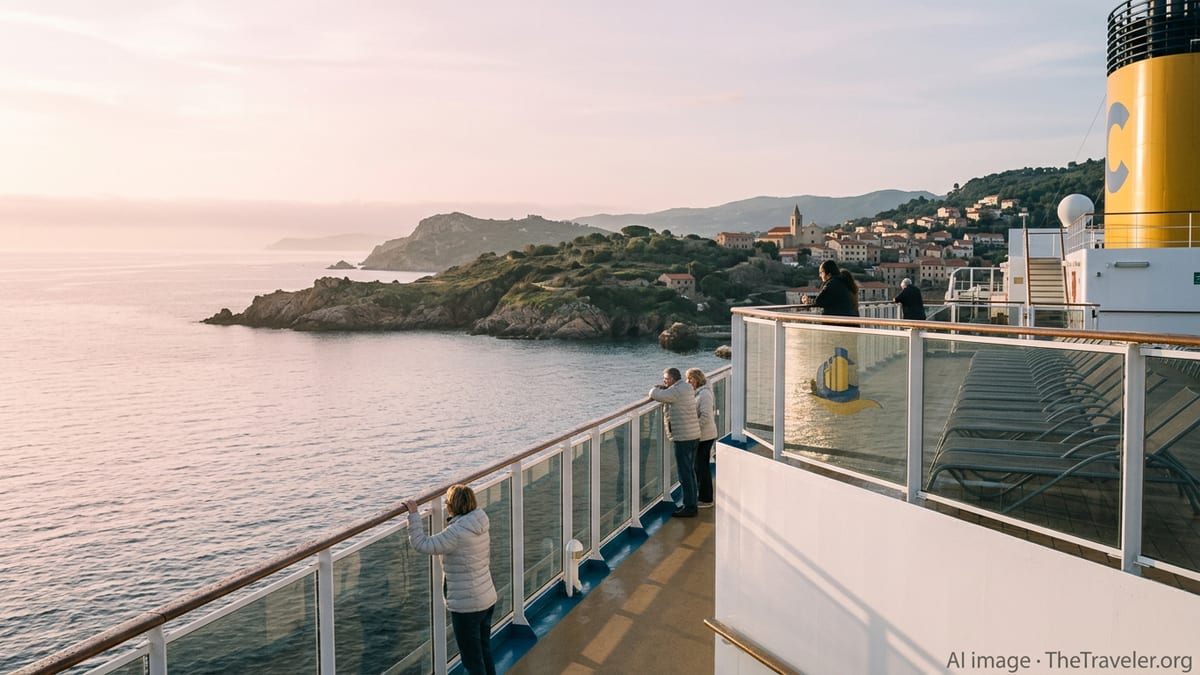
From Nighttime Showboating to Deadly Disaster
The Costa Concordia left Civitavecchia, the port for Rome, on 13 January 2012 for a weeklong Mediterranean cruise. Near the Tuscan island of Giglio, the vessel deviated from its programmed route to perform a close-passing manoeuvre near shore, an apparent salute intended to impress people on land and on board. Investigations later concluded that this decision, made under the command of Captain Francesco Schettino, set in motion the events that would lead to one of the worst peacetime cruise ship disasters in history.
Shortly after 9:40 p.m., the ship struck submerged rocks, tearing a long gash in its hull. Power failures and flooding followed, and the 290-meter vessel began to list dramatically to one side. While crew members and passengers struggled to understand what had happened, conflicting information circulated on board. Publicly available reconstructions show that only after a significant delay was a full evacuation order given, reducing the time window available for a safe and orderly escape.
The Costa Concordia ultimately capsized in shallow waters near Giglio, coming to rest on its side. Thirty-two people died as a result of the collision and chaotic evacuation, and thousands more were forced to flee via lifeboats, rescue craft and makeshift routes along the tilted hull and interior spaces.
The Controversial Abandonment of Ship
Amid the unfolding emergency, Schettino’s conduct became a central focus of public outrage. Recordings released in the aftermath captured a heated exchange between the captain and an Italian coast guard officer, who demanded that Schettino return on board to coordinate the evacuation. Instead, he was already on shore or in a lifeboat while passengers and crew remained trapped on the listing ship.
Schettino maintained that he had fallen into a lifeboat when the ship lurched and did not intend to abandon those still on board. However, investigative reports and subsequent court findings rejected that version as inconsistent with the evidence. The widely publicized audio of maritime officials ordering him to “go back” to the vessel entrenched an image of a captain who deserted his ship while people were still in danger.
Publicly available accounts indicate that, in the days after the disaster, Schettino was dismissed by Costa Crociere, the ship’s operator, and placed under house arrest as Italian prosecutors examined his role. The combination of the close-passing manoeuvre, the delayed alarm, the confused evacuation and his early departure from the vessel formed the backbone of the criminal case that followed.
Trial, Conviction and a 16-Year Sentence
Formal criminal proceedings against Schettino began in 2013 in the Tuscan city of Grosseto. He faced charges including multiple counts of manslaughter, causing a maritime disaster, abandoning ship and abandoning passengers unable to care for themselves. Other Costa Concordia officers and a company official reached plea bargains and received shorter sentences, leaving Schettino as the only individual standing full trial.
In February 2015, the Grosseto court found him guilty on all main counts. He received a prison sentence of 16 years and one month, along with a ban from holding maritime command for a period fixed by the court. Judges later published a lengthy rationale for the verdict, stating that the deaths and injuries would likely have been avoided had the emergency been managed promptly and in strict accordance with established procedures.
Schettino’s legal team immediately announced plans to appeal, arguing that responsibility for the disaster should have been shared more broadly with other officers and with Costa Crociere’s shore-based managers. They contended that the captain had been turned into a scapegoat for wider systemic failures in training, safety culture and corporate oversight.
Appeals Exhausted and Imprisonment Confirmed
Appeal proceedings extended over several years, keeping Schettino free while higher courts reviewed the case. In 2016, an appeals court in Florence upheld the 16-year sentence, rejecting arguments to substantially reduce or overturn the conviction. Legal analysts noted that the court reinforced the view that the captain bears ultimate responsibility for the safety of ship, passengers and crew, particularly once a crisis is underway.
The final step came in May 2017, when Italy’s highest court, the Court of Cassation, confirmed the lower-court rulings. With all avenues of appeal exhausted, Schettino was required to begin serving his sentence. Shortly after the decision, he reported to prison in Italy, entering a high-security facility to start what is effectively a long-term term of incarceration.
Open-source legal commentary and later reporting indicate that there have been occasional discussions in maritime circles about revisiting certain aspects of the disaster, including technical issues surrounding navigation orders and corporate decision-making. Nonetheless, these debates have not altered the core judicial outcome for Schettino, whose conviction and sentence remain in force.
Where the Former Captain Is Now
As of 2026, publicly available information indicates that Francesco Schettino remains in an Italian prison, serving the 16-year sentence imposed for his role in the Costa Concordia disaster. Under Italian law, inmates may be eligible for various forms of early release, conditional measures or sentence adjustments, but no authoritative reports suggest that he has been freed or that his conviction has been overturned.
Given that Schettino entered prison in 2017, the nominal end of his sentence would fall in the early 2030s, depending on how credit for time served and any potential reductions might be calculated under Italian penal rules. Observers note that such calculations can be complex and are typically handled on a case-by-case basis by the prison and judicial authorities.
Beyond his incarceration, the former captain has largely disappeared from public life. Earlier in the legal process he attempted to defend his reputation in interviews and legal filings, describing himself as part of a broader organisational failure rather than its sole cause. In recent years, however, attention has shifted away from his personal story and toward the wider legacy of the Costa Concordia disaster.
That legacy includes extensive reforms to cruise-industry safety practices, evacuation drills and navigation procedures, as operators and regulators sought to ensure that a similar chain of misjudgments cannot so easily lead to catastrophe again. For many in the public, however, the question of what happened to the captain who abandoned the Costa Concordia has a straightforward answer: he is still behind bars, serving out the consequences of a night when routine showmanship turned into tragedy.