

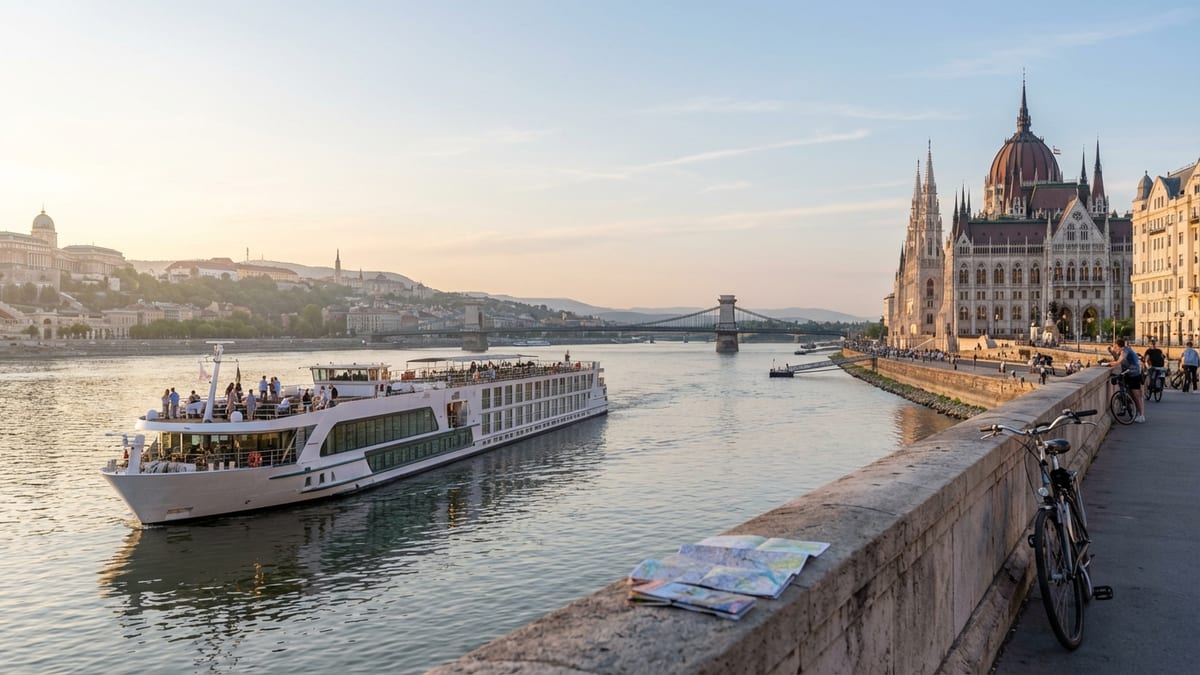
The Danube is one of Europe’s great storytellers. Rising in Germany’s Black Forest and flowing 1,770 miles to the Black Sea, it threads together ten countries, four capitals and centuries of shifting borders and cultures. Modern river cruises on the Danube follow this ribbon of water across Central and Eastern Europe, offering travelers a rare chance to visit multiple countries in one seamless voyage without repacking a suitcase.
Yet not every sailing covers the whole river, and not every itinerary stops in each country the Danube touches. Understanding which countries a Danube cruise passes through, and what each stretch offers, helps you choose the itinerary that matches your time, interests and appetite for discovery.
The Danube at a Glance: From Black Forest to Black Sea
The Danube rises in southwestern Germany, where the Brigach and Breg streams meet near the town of Donaueschingen. From there, the river flows generally southeast through Central and Southeastern Europe before reaching the Danube Delta on the Black Sea, primarily in Romania with a small share in Ukraine.
Along its course it passes through or borders ten countries: Germany, Austria, Slovakia, Hungary, Croatia, Serbia, Bulgaria, Romania, Moldova and Ukraine. This makes it one of the most international rivers in the world and a natural corridor for cruise travel. Seeing how countries connect along the river explains why certain Danube cruise itineraries are more popular.
For travelers, it is helpful to think of the Danube in three broad cruising regions. The Upper Danube runs from Germany through Austria and into Slovakia and Hungary, a landscape of baroque abbeys, vineyard-lined valleys and imperial capitals.
The Middle Danube covers the central plains and borderlands of Hungary, Croatia and Serbia, transitioning into the dramatic gorge of the Iron Gates between Serbia and Romania. The Lower Danube refers loosely to the river’s eastern reaches through Bulgaria and Romania, continuing into the wetlands of the Danube Delta on the frontier with Ukraine.
Most popular river cruises concentrate on one or two of these regions rather than attempting the full length in a single trip. Weeklong itineraries often operate between Germany or Austria and Hungary, while longer two-week sailings push farther east into the Balkans or all the way to the Black Sea. Coverage alone does not guarantee enjoyment, which is why travelers ask if Danube cruises are worth it overall. Expedition-style river cruises, which are less common, may venture into the delta itself. Each segment of the river reveals different histories and landscapes, and the mix of countries you visit will depend on where your chosen itinerary begins and ends.
Germany: Where the Danube Story Begins
Germany is where the Danube gains its name and identity, yet comparatively few international itineraries focus exclusively on this westernmost section. The river forms in Baden-Württemberg and flows east across Bavaria, passing historic towns such as Ulm, Regensburg and Passau. The landscape here is gentle and green, with castles on wooded hillsides and medieval cores that survived or were carefully restored after wartime damage. This is also where the Danube connects to the Rhine–Main–Danube Canal, creating a navigable waterway from the North Sea to the Black Sea.
In cruise terms, Germany typically serves as the starting or ending point for Upper Danube itineraries. Passau, perched on the confluence of three rivers near the Austrian border, is a major embarkation port; some cruises also begin near Regensburg or even further west, linking the Danube with Rhine itineraries through the canal. Shorter “taster” cruises may run only between German cities, focusing on beer culture, Bavarian villages and cycling along riverside paths. Longer journeys east toward Vienna and Budapest use Germany as a tranquil prologue to more crowded stretches downstream.
Cruising through Germany highlights the engineering dimension of the modern Danube. Locks and regulated channels here help manage water levels and maintain year-round navigation for freight and passenger ships alike. For travelers this means smooth sailing but occasionally tight scheduling through lock systems. Late summer and autumn can sometimes bring low-water challenges across several Danube countries, including Germany, which cruise lines monitor closely and manage with adjustments such as modified embarkation ports or touring by coach when river levels become too shallow.
Austria, Slovakia and Hungary: The Classic Danube Trio
The trio of Austria, Slovakia and Hungary forms the core of what many travelers imagine when they picture a Danube cruise. This stretch is home to three capital cities on the river: Vienna, Bratislava and Budapest, often visited in a single week. Most mainstream cruise itineraries for first-time river cruisers focus on exactly this region, sometimes with an extra day or two in Germany upstream or an extension into the Hungarian countryside downstream.
In Austria, the Danube winds through the UNESCO-listed Wachau Valley, known for its terraced vineyards, apricot orchards and hilltop ruins. River ships dock at or near towns such as Melk, with its grand Benedictine abbey, and Dürnstein, where cobbled lanes and local wine cellars draw day visitors. Farther east, Vienna’s riverfront is set a little away from the historic center, but efficient public transport and guided tours make it easy to explore the city’s opera houses, coffeehouses and Habsburg palaces in a single day.
From Vienna it is a relatively short cruise downstream to Bratislava, the compact Slovak capital that has evolved from a somewhat overlooked stop into a rewarding highlight. Many itineraries schedule a half day here, allowing time for a walking tour of the Old Town, a visit to Bratislava Castle and a taste of Central European cuisine in local restaurants. Because the distance between Vienna and Bratislava is modest, some cruises even include scenic daytime sailing between the two, giving passengers uninterrupted views of forested riverbanks and castle-topped hills.
Budapest, straddling both banks of the Danube, is often a marquee port for Danube cruises and a frequent turnaround city. Ships usually arrive or depart in the heart of the city, with views of the Parliament building, Buda Castle and the Chain Bridge illuminated at night. Many cruise lines encourage guests to book pre- or post-cruise land stays in Budapest to enjoy its thermal baths, culinary scene and Jewish heritage sites. Although the river continues onward through Hungary, a significant share of Danube cruises begin or end their journey here, making this trio of countries the most commonly visited on Danube itineraries.
Croatia and Serbia: The Middle Danube and the Balkans
East of Budapest the Danube enters a region less frequently explored by first-time river cruisers but increasingly popular with travelers seeking something beyond the well-trodden capitals. Here the river forms part of the border between Croatia and Serbia, then continues through the Serbian heartland toward Belgrade. Many “Middle Danube” or “Balkans” cruises include at least one Croatian port on the river and several Serbian ports, sometimes combined with land excursions deeper into the interior.
Croatia’s best-known coastal destinations lie on the Adriatic, but the country’s short stretch of Danube frontage in the northeast offers a different perspective. Ports such as Vukovar present a poignant mix of baroque architecture, riverfront promenades and museums documenting the sieges and conflicts of the 1990s. Cruises that stop here often include excursions to nearby wine regions or to Osijek, known for its Austro-Hungarian heritage. Because the Danube only clips a corner of Croatia, not every longer itinerary calls here, but those that do give travelers a rare opportunity to see the country’s inland face.
In Serbia the Danube is central to both geography and identity. Belgrade, one of the four capital cities on the river, sits where the Sava meets the Danube and serves as a key port for many mid- and lower-Danube sailings. From the riverfront, passengers are within easy reach of Belgrade Fortress, the lively Skadarlija quarter and museums reflecting the country’s complex past. Further upstream or downstream, ports such as Novi Sad bring access to monasteries, national parks and villages that feel far removed from the grand boulevards of Vienna or Budapest.
Continuing east from Belgrade, the river narrows and cuts through the Carpathian and Balkan mountain ranges, forming the Iron Gates Gorge along the border between Serbia and Romania. For many travelers, sailing this dramatic section is a highlight of Middle Danube journeys. Sheer cliffs, hydroelectric dams and colossal rock reliefs carved into the stone create a sense of drama unmatched elsewhere along the river. It is a reminder that the Danube has not always been a gentle highway but also a formidable natural barrier throughout history.
Bulgaria and Romania: The Lower Danube to the Black Sea
Downstream from the Iron Gates the Danube fans out across the plains of the Lower Danube, forming a long natural boundary between Bulgaria on the southern bank and Romania to the north. Many cruise itineraries that market themselves as “Danube to the Black Sea” or “Lower Danube” focus on this region, often either beginning or ending in cities such as Budapest, Bucharest (with a coach transfer to the river) or Romanian ports closer to the delta. Compared with the Upper Danube, the river here feels broader and more rural, with wide views across agricultural land and wetlands.
Bulgaria’s Danube ports, including cities such as Ruse and Vidin, showcase a blend of Ottoman and European influence in their architecture and street plans. Shore excursions typically include visits to medieval fortresses, rock-hewn churches and wine regions, along with walks through town centers that still reflect 19th century prosperity. Many itineraries also use Bulgarian stops as gateways to inland attractions, from Veliko Tarnovo’s hillside citadel to monasteries in the foothills of the Balkan Mountains.
On the opposite bank, Romanian river ports such as Giurgiu and Cernavodă serve as access points for excursions to Bucharest and other destinations. Some cruises dock farther east at ports closer to the Danube Delta, while others rely on coach transfers to carry passengers between the river and the capital. For travelers, this means that Romania on a Danube cruise is often experienced as a combination of riverine towns and urban excursions, with a chance to compare life along the water’s edge with the bustle of a major capital.
Farther east, the Danube splinters into several channels forming the Danube Delta, one of Europe’s largest wetlands and a UNESCO-listed biosphere reserve. Not all cruise ships venture into the narrower, shallower waters of the delta, but specialized itineraries and smaller vessels do operate here, offering birdwatching, fishing-village visits and close-up encounters with the reeds and lagoons that mark the river’s final approach to the Black Sea. It is in this region that the Danube also brushes the territory of Ukraine, whose southernmost corner shares in the delta’s labyrinth of waterways.
Moldova and Ukraine: The Danube’s Briefest Encounters
While the Danube is commonly said to flow through or border ten countries, Moldova and Ukraine account for only its shortest reaches. This brevity means that most mainstream river cruises do not call at ports in these countries, and many itineraries do not enter their waters at all. Nonetheless they are part of the river’s geopolitical tapestry and occasionally feature on more specialized sailings that emphasize the full length of the Danube.
Moldova’s contact with the Danube is particularly limited: just a short strip of riverfront near the village of Giurgiulești, where the country has access to a small port facility. This sliver of shoreline is crucial for Moldova’s maritime trade but plays almost no role in the current river-cruise market. Large international cruise ships are unlikely to call here, and for most passengers Moldova remains an unseen but present member of the river’s family of states.
Ukraine’s share of the Danube is concentrated in the delta at the river’s mouth. Here the labyrinth of channels, marshes and lakes that form the Danube Delta extend across both Romanian and Ukrainian territory. Some specialized or expedition-style river cruises and smaller regional boats do sail into Ukrainian sections of the delta, focusing on birdlife, fishing communities and the meeting of river and sea. However, security conditions, navigation regulations and water levels can influence whether international cruise lines include these waters in any given season.
For travelers planning a standard Danube cruise, it is realistic to expect that the focus will be on Germany, Austria, Slovakia, Hungary, Croatia, Serbia, Bulgaria and Romania, with only occasional or specialized itineraries reaching ports associated with Moldova or Ukraine. Those determined to include every Danube country in a single journey often need to combine scheduled cruises with overland travel and smaller local boats rather than rely solely on one through-cruise.
How Typical Itineraries Combine Danube Countries
Knowing which countries the Danube touches is only half the picture. The other half is understanding how cruise lines assemble itineraries across these borders. A common one-week “Classic Danube” itinerary might begin in Passau, Germany, and end in Budapest, Hungary, or reverse the direction. Such a voyage usually includes stops in Germany, Austria, Slovakia and Hungary. Because distances between these capitals are moderate, you often enjoy a mix of scenic daytime cruising and overnight sailing that allows for full days ashore.
Longer itineraries of 10 to 14 nights usually tack on countries farther downstream. An extended “Grand Danube” journey may run from Germany or Austria all the way to Romania, adding ports in Croatia, Serbia and Bulgaria along the way. In this case you can expect to visit at least six or seven countries from the full list of ten, often with land extensions in major cities such as Prague, Bucharest or sometimes even Istanbul, using coach or air connections from the river.
At the more adventurous end, some river cruises operate full-length or “from source to sea” style voyages, either in one continuous sailing or as back-to-back segments. These itineraries aim to cover every navigable stretch from Germany to the Black Sea and may include approaches to the Danube Delta. Depending on routing, they may also traverse or skirt the narrow Moldovan and Ukrainian sections of the river near the delta. These longer trips typically extend beyond two weeks and attract travelers interested in a deep exploration of the river’s entire cultural and historical arc.
When comparing options, it is worth noting that water levels, local regulations and regional security conditions can influence exactly which ports and countries a cruise visits in any given year. Cruise lines often retain some flexibility to alter routes while maintaining the overall structure of the itinerary. If visiting a particular country is a priority, it is wise to confirm with the operator how frequently that stop has run in recent seasons, and what alternatives they provide if river or local conditions require changes.
The Takeaway
A Danube cruise is more than a river journey; it is a moving cross-section of Central and Eastern Europe. From its source in Germany to its delta on the borderlands of Romania and Ukraine, the river threads through or along ten countries: Germany, Austria, Slovakia, Hungary, Croatia, Serbia, Bulgaria, Romania, Moldova and Ukraine. In practice, most cruise passengers experience a curated slice of this geography, with itineraries frequently centered on the celebrated capitals of Vienna, Bratislava and Budapest or extended eastward through the Balkans to the Black Sea.
Choosing the right Danube cruise comes down to deciding how many of these countries you hope to see and in what depth. A week on the Upper Danube delivers architectural splendor and vineyard landscapes in four countries, while two weeks or more open up lesser-known ports in Croatia, Serbia, Bulgaria and Romania, along with the dramatic Iron Gates and, for some, the wild beauty of the Danube Delta. Moldova and Ukraine, although part of the river’s story, remain niche inclusions accessible mainly through specialized or expedition-style programs.
Whichever route you choose, the Danube’s great advantage as a travel corridor lies in the ease with which you can cross borders without the disruptions of airports or constant packing. From the deck of a river ship you watch languages, cuisines and skylines change in a matter of hours, yet the river itself remains a constant guide. Understanding how its waters connect ten different countries allows you to read your cruise itinerary not just as a list of ports, but as a chapter in a much longer European narrative.
FAQ
Q1. How many countries does the Danube River flow through or border?
The Danube flows through or forms part of the borders of ten countries: Germany, Austria, Slovakia, Hungary, Croatia, Serbia, Bulgaria, Romania, Moldova and Ukraine.
Q2. Do all Danube cruises visit every one of these ten countries?
No. Most cruises focus on a particular section of the river, such as the Upper Danube between Germany and Hungary or the Lower Danube between Hungary and Romania. Only longer or specialized itineraries attempt to cover most of the ten countries in a single journey.
Q3. Which countries are included on a typical one-week Danube cruise?
A common one-week itinerary between Passau and Budapest, or similar routes, usually includes Germany, Austria, Slovakia and Hungary, sometimes with an overnight or extended stay in Vienna or Budapest.
Q4. Are Croatia and Serbia regularly featured on Danube cruises?
Croatia and Serbia appear mainly on longer “Grand Danube” or Balkans-focused itineraries. Not every cruise stops in Croatia, but many extended routes visit at least one Croatian port and several Serbian ports, including Belgrade.
Q5. How often do Danube cruises visit Moldova or Ukraine?
Only a small number of specialized or expedition-style cruises include Moldovan or Ukrainian waters, usually in the Danube Delta region. Moldova’s river frontage is very short, and most mainstream itineraries do not call there.
Q6. Where do most Danube cruises start and finish?
Popular turnaround cities include Passau and Regensburg in Germany, Vienna in Austria and Budapest in Hungary. Some Lower Danube itineraries use ports in Romania or coach connections to and from Bucharest as starting or ending points.
Q7. Can I sail the entire length of the Danube from Germany to the Black Sea?
Yes, but these full-length voyages are relatively long, often two weeks or more, and may be sold as single extended itineraries or as back-to-back segments. They usually pass through at least eight countries and sometimes approach the Danube Delta near the Black Sea.
Q8. Which stretch of the Danube is considered most scenic for cruising?
Opinions vary, but many travelers highlight Austria’s Wachau Valley for its vineyards and abbeys, the section through Budapest for its illuminated skyline and the Iron Gates Gorge between Serbia and Romania for its dramatic cliffs and dams.
Q9. Are there visa or border formalities when a cruise crosses from one Danube country to another?
For most passengers, especially those from the European Union, the United Kingdom or North America, formalities are minimal and handled by the cruise line in coordination with local authorities. However, visa rules depend on your nationality and the countries visited, so it is important to check entry requirements before booking.
Q10. How can I choose a Danube cruise based on the countries I want to see?
Start by deciding whether you prefer the classic Upper Danube capitals, the Balkans and Iron Gates region, or the Lower Danube and delta. Then match itineraries to your priorities by checking which ports and countries are specifically listed for each departure and how much time is allocated to them.