


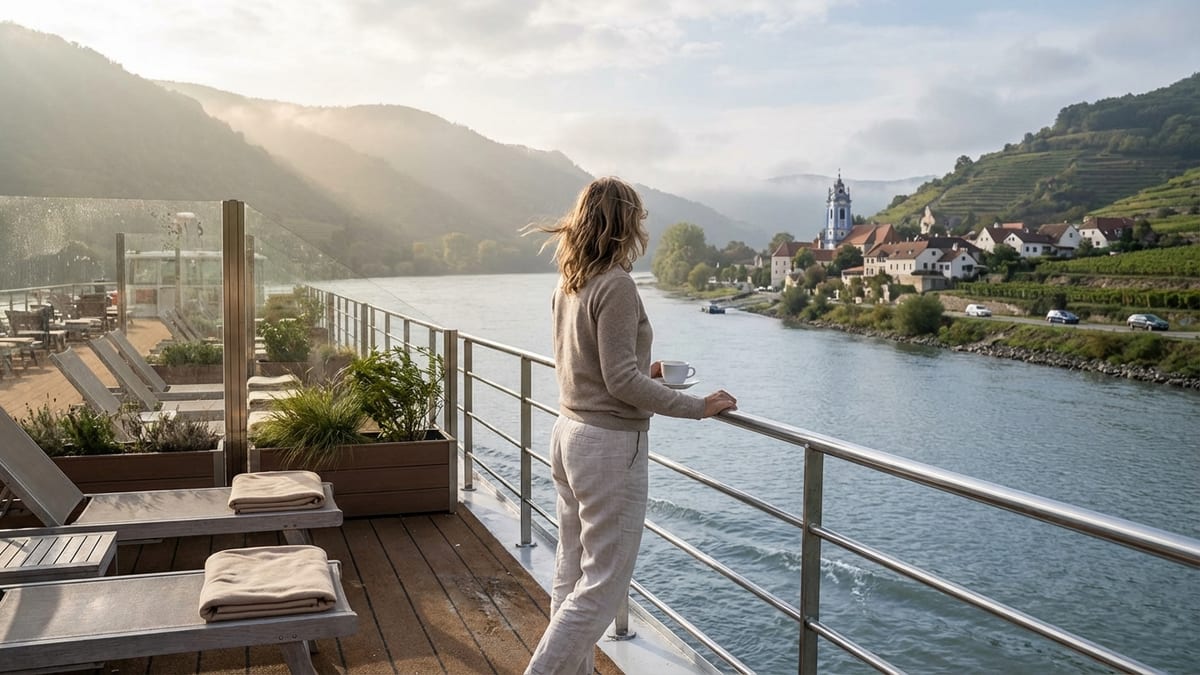
I went into my first Danube river cruise with high hopes and a suitcase full of linen. In my head, I pictured gliding past medieval castles at golden hour, stepping off the ship directly into old town squares, and sipping Grüner Veltliner on the sun deck as church bells rang in the distance. Some of that happened.
A surprising amount did not. What I actually experienced was a strange mix of postcard moments, bus transfers, time pressure, quiet comforts and a persistent question in the back of my mind: was this really worth the money and the hype?
What I Actually Booked: Itinerary, Cost and Fine Print
For context, I booked a one-week “classic” Danube itinerary from Budapest to Regensburg, sailing in late September. This is shoulder season on the Danube, when river cruise lines typically still run a full schedule but prices soften compared to peak summer. The cruise ran for seven nights, with stops in Budapest, Bratislava, Vienna, Wachau Valley (Melk and Dürnstein), Linz and Regensburg.
Understanding pricing helps avoid surprises, especially when reviewing current Danube cruise deals. One of the biggest factors is whether luxury vs budget Danube cruises better match your expectations.
I chose a well-known mid-range river cruise company, not budget and not ultra-luxury. My base fare for a standard French balcony cabin was a little under 4,000 US dollars per person, not including flights. That is broadly in line with current averages of roughly 3,000 to 5,000 dollars per person for a mid-range seven-night Danube sailing. Drinks outside of mealtimes and some optional excursions were extra. By the time I added economy flights from the United States to Budapest and home from Munich, one optional concert in Vienna, travel insurance, and pre- and post-cruise hotels, the week on the Danube had quietly become a trip in the 7,000 to 8,000 dollar range for two people.
On paper, the cost covered my floating hotel room, almost all meals, basic walking tours in each port, and transportation between cities I had always wanted to see. In reality, some of that transportation turned into buses due to the Danube’s unpredictable water levels, which have been a growing issue in recent years. I had read warnings that both low water during summer and early fall, and occasional flooding in spring and early summer, can force cruise lines to adjust routes, bus guests between stretches of river, or in extreme cases cancel sailings entirely. I knew this in theory when I booked. It feels different when you are the one being told that the “sailing” part of your river cruise is being shortened by a day.
The experience also depends heavily on the route, so comparing the main Danube cruise itineraries is essential. Once you decide a river cruise makes sense, these are the best Danube cruises to book based on travel style and budget. Some travelers also compare this route with others, especially when weighing Danube cruises vs Rhine cruises.
The Good Parts: Scenery, Convenience and Cabin Life
Let me start with what genuinely delivered. When I was actually on the river, and not on a coach, the Danube felt as romantic as the brochure suggested. Early mornings were my favorite. I would take my coffee up to the top deck and watch the riverbanks drift past. Vineyards climbed the hillsides, small villages clustered around tall church spires, and mist clung to the water in the Wachau Valley. Sailing into Vienna at sunrise and into Budapest at night, with the Parliament and Buda Castle lit up, were among the best travel moments I have had in Europe.
The convenience of unpacking once and still seeing multiple cities cannot be dismissed. I did not have to drag my suitcase through train stations, worry about hotel check in times, or constantly figure out public transport between towns. Each evening I fell asleep in one place, and by breakfast we would often be somewhere new. That simplicity mattered more than I expected, especially because I was a bit jet-lagged for the first few days. For anyone who finds independent European travel intimidating or physically tiring, this logistical ease is a real selling point.
My cabin itself was comfortable rather than glamorous. The French balcony was basically a large sliding glass door that opened to a railing, not a walk-out terrace. Still, being able to slide open the door and hear the water at night felt special. Storage was smarter than it looked, with room to tuck suitcases under the bed and shelves for clothes. The bathroom was compact but well designed, with strong water pressure and reliable hot water. I found the sound insulation decent. I could hear hallway noise when people passed by but not much from neighboring cabins.
Because modern river ships are capped in length and height due to locks and bridges, amenities are limited compared to big ocean liners. There was no sprawling spa complex, no multi-story atrium, and no theater with Broadway-style shows. Instead, the onboard atmosphere felt more like a small boutique hotel with a lounge, bar, small sundeck and dining room. Personally, I liked the understated feel. It was quiet, easy to navigate, and I never had to queue for anything onboard. If you crave casino nights and water slides, though, you will not find them on the Danube.
Where Expectations Cracked: Water Levels, Buses and “Silent” Changes
The biggest shock to me as a first-time river cruiser was how vulnerable the entire experience is to the mood of the river. I hit the Danube in late September, which is usually considered a solid compromise between busy summer and cold winter. Yet that particular month followed an unusually dry summer in parts of Central Europe. Sections of the Danube had been running abnormally low, enough that cargo ships were forced to operate at reduced capacity and river traffic was being closely monitored. Cruise lines have been tweaking itineraries more frequently in recent years to cope with these variations.
About two weeks before departure, I got an email saying our “sailing order and technical routing may be subject to change.” That was it. No specifics. Once onboard, the cruise director explained that in order to avoid a section of the river that was borderline too shallow, we would sail a shorter distance than planned and be bused for roughly two hours between two ports, then rejoin a sister ship on the other side. The company framed this as a smooth contingency plan. Operationally, it was. Emotionally, it felt like I had paid for seven days of river sailing and was getting six.
The bus transfer day was not awful, but it broke the spell. Instead of gliding through vineyards, I sat in a coach on the highway, watching the river occasionally flash past. We had to pack an overnight bag because the ship would be repositioned, and even though the crew handled the main luggage, it introduced a layer of hassle I had explicitly tried to avoid by booking a cruise. To their credit, the line kept our included excursions mostly intact by adjusting timing, and they offered a free glass of sparkling wine at dinner as a kind of apology. Still, it underscored a hard truth: a significant part of what you pay for on a Danube cruise is not guaranteed. Water levels can be too low or too high, and you have virtually no recourse beyond whatever goodwill the cruise company offers.
This is not just a once in a decade fluke. Recent years have seen both drought-related low water and serious flooding on parts of the Danube, with river traffic occasionally halted and some cruises canceled or heavily modified at short notice. Ocean cruises also change ports due to weather, but river routes are far more sensitive to even small shifts in depth. I went into the trip intellectually aware of that, but I did not grasp how quickly a “cruise” can morph into a bus tour with a boat as your hotel until I experienced it.
Days in Port: How Much I Really Saw of Each City
Another area where reality diverged from my expectations was time in port. The brochures and websites showed evocative images of Budapest’s Chain Bridge, Vienna’s grand boulevards, and Regensburg’s medieval lanes. In my head, I imagined long, lazy days exploring each place. In practice, most stops gave me a structured walking tour of about two hours, plus a block of unscheduled time that ranged from two to six hours, depending on the port and whether we were sailing away that evening.
Budapest was the outlier, largely because I arrived a day early and booked a hotel on my own. That pre-cruise day was essential. The actual cruise schedule had us boarding in the afternoon, joining a short orientation walk and a night sailing. If I had relied solely on the cruise for Budapest, I would have left feeling that I barely scratched the surface. With the extra day, I could visit thermal baths, walk the Great Market Hall, and wander on my own pace. I would strongly recommend anyone doing a Danube cruise starting or ending in Budapest or Vienna to add at least one independent night on either side.
Vienna felt particularly compressed. We arrived in the morning, did the included coach-and-walk tour around Ringstrasse and the historic center, and then had a chunk of free time before an optional evening concert for those who paid extra. On paper, that looks like a solid day. On the ground, it felt like a race. I had to choose between actually going inside the Hofburg, lingering in a coffee house, or exploring side streets. I did not have time for all three, and the constant need to watch the clock so I would not miss the bus back to the ship chipped away at the relaxed fantasy I had imagined.
Smaller places like Dürnstein and Melk worked better with the cruise model. These towns are compact, and a morning tour plus an hour or two of free wandering felt about right. The ship docking close to the center meant I could head back easily for lunch or a rest. Still, even in these gems, I was aware of being on the same schedule as 100-plus other passengers, with everyone funneling into the same handful of cobbled streets and viewpoints.
In the end, the cruise gave me pleasant samplers of several cities rather than deep experiences. If your goal is to say you have “seen” Budapest, Bratislava and Vienna, this model works. If you prefer to linger in one place, follow your curiosity down side alleys, and absorb the rhythm of daily life, the structured, time-boxed cruise days may frustrate you.
Life Onboard: Food, Fellow Passengers and the Social Dynamic
Onboard life was mostly comfortable, occasionally charming, and sometimes repetitive. Meals were on the whole solid but not extraordinary. Breakfast and lunch operated partially buffet style, with additional items to order. Dinner was a multi-course sit-down affair with a menu that changed daily but followed a familiar pattern: a soup, salad, two or three main choices, dessert. Regional dishes appeared here and there, like goulash or Wiener schnitzel, but the line clearly aimed to please an international palate. I never went hungry, but I also rarely felt that I was eating something I would remember later.
The drinks policy was where the nickel-and-diming crept in. Wine and beer were included with lunch and dinner but not at the bar or on the sundeck outside of those hours. Coffee and tea stations were free, but cocktails and anything in between meals added up quickly. I knew this going in, but there was still a faint sense of being nudged toward add-ons at every turn, especially when the staff would highlight “premium” wine tastings or specialty coffees during announcements.
The passenger mix skews older on most Danube cruises, and my sailing was no exception. I would estimate the majority of guests were over 60, many retired, with a sprinkling of middle-aged couples and just a handful of people under 40. As someone in my 40s, I did not feel out of place, but the onboard programming clearly targeted a conservative, largely North American audience. Evening entertainment ranged from local folk performers to a pianist in the lounge. It was pleasant but quiet. If you picture late-night dancing and a buzzing nightlife, you will likely be disappointed.
Socially, the small ship size cuts both ways. I liked seeing familiar faces throughout the week and enjoyed conversations at shared dinner tables. I met people I genuinely liked and with whom I still occasionally exchange emails. At the same time, there is almost no way to be anonymous on a river ship. If you have a clash of personality with a fellow passenger or simply want solitude, you will need to be deliberate about carving it out, perhaps by taking your coffee to the top deck at off hours or choosing two-person tables when possible.
Safety, Seasonality and Practical Realities I Wish I Knew Earlier
From a safety and security standpoint, I felt comfortable on the Danube. River cruising has its risks, including collisions and accidents, and past incidents have shown how quickly things on the water can go wrong. The line I sailed with conducted safety briefings, enforced lifejacket drills, and limited access to the ship to passengers and staff. In busy cities like Budapest and Vienna, the dock areas were reasonably well lit and there was always staff present when we returned from shore.
Seasonality is one of the most critical factors to think through if you are considering a Danube cruise. The main cruise season typically runs from late March or early April through about November. Spring can be beautiful but is known for higher water levels due to snowmelt and rain, which can occasionally make parts of the river impassable for a time. Summer brings long days and a festive atmosphere but also more crowds, higher prices and, increasingly, a greater risk of low water disruptions during heatwaves and drought periods. Shoulder months like May, September and October are generally considered sweet spots for milder weather and slightly fewer tourists, but they are not immune to either flooding early in the season or low water later on.
There is also a special Christmas market season along the Danube from late November into December, when many itineraries focus on holiday markets in cities such as Budapest, Vienna, Bratislava, Passau and Regensburg. I did not do a Christmas cruise, but several crew members mentioned that these sailings can be magical, with light displays, mulled wine and festive markets, albeit with colder temperatures and shorter days. They also warned that departures close to Christmas sell out early and that river conditions in late November and December can still require flexibility.
There were a few practical details I wish I had understood earlier. First, docking spots in large cities are often shared among multiple ships. In Budapest and Vienna especially, our ship sometimes ended up tied up alongside another vessel, which meant that from our cabin window we looked directly into someone else’s room. Privacy goes out the window in those situations, unless you keep your curtains firmly closed whenever you are in port. Second, some docks are located a good distance from the historic center. The cruise line provided buses into town for the included tours, but if you wanted to explore on your own at odd hours, you might face a long walk or the need to arrange a taxi.
Money, Value and Whether I Felt It Was Worth the Price
The blunt question I kept coming back to was whether I felt I got fair value for what I spent. River cruises on the Danube are not cheap. When you factor in the base fare, flights from North America, add-on excursions, gratuities, and pre- and post-cruise stays, it is easy to approach or exceed the cost of a well-planned independent two-week trip to Central Europe.
On the positive side, I did see a lot in a short time without feeling frantic. I visited multiple countries, unpacked exactly once, and never once had to worry about train schedules or finding my hotel in a new city. For someone who values their energy and prefers to outsource logistics, that is significant. The staff onboard were consistently friendly and seemed genuinely invested in guests enjoying the trip, especially when dealing with the water-level itinerary change. The ship itself was comfortable and spotless.
On the negative side, the cruise had built-in inefficiencies from a traveler’s perspective. I lost meaningful hours to group organization, bus shuttles, safety talks and waits at locks. Some ports were short enough that I walked away feeling I had tasted the city but not truly savored it. The forced bus transfer due to low water was a reminder that the core product I believed I was buying, time actually sailing the river, could be undercut by factors outside anyone’s control. And while food and basic excursions were included, I still felt a subtle pressure to spend more on drinks packages, specialty experiences and premium excursions.
If I calculate “value” purely in terms of cost per hour of relaxed, meaningful experience, not per day of travel, the equation looks less flattering. There were magical hours on the sundeck and on quiet walks through small towns. There were also a surprising number of hours that felt like logistical overhead. I would not say I regret taking the cruise, but I am not convinced it was the most efficient way to invest that amount of travel money in Central Europe.
If I Did It Again: What I Would Change and Who It Suits Best
If I ever booked another Danube cruise, I would change several things. First, I would absolutely build in more independent time on land. At a minimum, I would give myself two extra nights in Budapest or Vienna at the start and one or two nights in whichever city I disembark from at the end. That breathing room makes a huge difference in how rushed the trip feels and lets you dive deeper into at least one or two places.
Second, I would be more strategic about season and itinerary. I would likely aim for late April or early May, or late September into early October, while also accepting that climate patterns are less predictable than they used to be. I would study recent reports about water levels and disruptions, knowing that there are no guarantees but that some months carry higher risk. I would prioritize itineraries that have a good balance of big cities and smaller towns, and be wary of overpacked schedules with a different port every day and little time built in for sailing.
Third, I would set my expectations differently. I would go in treating the cruise as a comfortable sampler with logistics included, not as a deep cultural immersion. I would plan to skip at least one included excursion in a smaller port and explore on my own instead, using the ship as a flexible base rather than adhering rigidly to the group. I would budget honestly for onboard extras, rather than mentally clinging to the term “all inclusive” that river cruise marketing often implies but not all lines fully deliver on.
Finally, I would be more honest with myself about my travel style. I like walking down side streets until I get lost, lingering in museums, and making last-minute decisions about where to spend my time. A river cruise inherently limits those impulses. For friends of mine who dislike planning, who feel nervous about foreign languages, or who want a gentle, structured way to see Central Europe without the stress of independent travel, a Danube cruise is an elegant solution. For people who crave spontaneity and deep dives into individual cities, it is a compromise at best.
The Takeaway
So, are Danube cruises worth it? For me, the answer is “yes, but only for a certain kind of traveler and with eyes wide open.” The Danube itself is beautiful. There were moments on deck when the evening light hit the water, church bells rang in the distance, and small villages glided by that felt almost unreal. The ability to unpack once, be gently carried between countries, and wake up to a new skyline was quietly luxurious. I met interesting people, slept well, and never had to think about where my next meal was coming from.
At the same time, my week on the river exposed the trade-offs behind the glossy brochures. The experience can be surprisingly vulnerable to weather and river conditions, leading to bus transfers and rearranged plans that chip away at the romance. Time in major cities is limited and heavily structured. The cost is significant, especially once flights and extras are included, and not all of that cost translates into meaningful travel experiences. If you love lingering in one place, building your own itinerary, or squeezing maximum value from every travel dollar, you might walk away feeling that a Danube cruise only partially delivered.
I would recommend a Danube cruise most strongly to travelers who value comfort and convenience over autonomy, who appreciate having logistics handled by someone else, and who enjoy a calm, social atmosphere with like-minded passengers. It is particularly well suited to older travelers, people with limited mobility, and those who are new to Europe and want a low-stress, curated introduction to several countries at once. It can also be a lovely option for holiday-themed travel, such as Christmas market cruises, where the focus is on atmosphere rather than deep exploration.
If you see yourself in that description, and you go in understanding the limitations as well as the charms, then a Danube cruise can absolutely be worth it. If you are more of an independent wanderer, you may still enjoy it, as I did in many moments, but you might ultimately decide that next time you would rather take the train along the river, watching the ships glide by while you choose your own stops along the way.
FAQ
Q1: How long should a first-time Danube cruise be?
For a first trip, I found seven nights to be a good baseline. It felt long enough to justify the flights and cost, yet short enough that the structured nature of cruising did not start to feel confining. If you pair a week on the river with a few extra nights in Budapest or Vienna on your own, you get a more balanced experience.
Q2: What is the best time of year to take a Danube cruise?
In hindsight, I would aim for late April to early May or late September to early October. These shoulder periods usually offer milder temperatures and slightly fewer crowds than peak summer. However, water levels can still be unpredictable in spring due to snowmelt and rain, and late summer and fall can suffer from low water after heatwaves, so there is no completely risk-free month.
Q3: How formal is the dress code on Danube river cruises?
On my mid-range line, the atmosphere was resort casual. During the day, people wore comfortable clothes suitable for walking tours. In the evenings, most passengers changed into smart-casual outfits, such as collared shirts or simple dresses. There were no true formal nights with tuxedos or gowns, although some guests chose to dress up a bit more for the captain’s dinner.
Q4: Do I need to book excursions, or can I explore on my own?
Basic walking tours were included in my fare at each port, and I joined most of them to get oriented. However, I sometimes skipped parts of the organized program to explore independently. In big cities like Vienna and Budapest, it is entirely possible to go your own way once you understand where the ship is docked and how to get back. Just keep an eye on “all aboard” times, because the ship will not wait indefinitely.
Q5: How does a Danube river cruise compare to an ocean cruise?
To me, a Danube cruise felt more intimate and quieter than a typical ocean cruise. The ships are much smaller, there are fewer passengers, and the entertainment is low key. You are always close to land, and ports are usually central or at least near city centers. On the flip side, there are fewer onboard amenities, almost no sea days, and a stronger focus on shore excursions and scenery than on shipboard activities.
Q6: Are Danube cruises suitable for children or teenagers?
Based on my sailing, I would say most standard Danube cruises are not ideal for younger children. The demographic skewed older, and there were no kid-specific facilities or programs. Teenagers who are mature and interested in history and culture might enjoy it, but families with very active kids would likely find the pace and onboard environment frustrating.
Q7: What surprised me most about the Danube cruise?
The biggest surprise was how often the experience bumped up against practical limitations: water levels, docking locations, shared piers, and strict schedules. I went in focused on the romance of the river and had not fully grasped how operational the whole enterprise is. It did not ruin the trip, but it did strip away some of the idealized glow I had built up beforehand.
Q8: How much walking is involved during a typical day in port?
Most of the included walking tours covered between two and four miles over a couple of hours, often on cobblestones and sometimes with hills or stairs. I was fine in comfortable shoes, but I saw a few passengers struggle, especially in places like Dürnstein with steep paths. If mobility is an issue, it is worth asking the cruise line in advance about gentler tour options or shorter routes.
Q9: Is it better to book directly with the cruise line or through a travel advisor?
I booked directly, but after dealing with last-minute itinerary changes, I can see the value of a good advisor. A knowledgeable agent can explain differences between lines, help choose the best season for your priorities, and advocate for you if disruptions occur. If you are new to river cruising or investing a lot in a special trip, I would at least consider using one.
Q10: Would I personally do a Danube cruise again?
If I do one again, it will be with adjusted expectations and a slightly different structure. I would still consider a Danube cruise, especially a themed itinerary like a Christmas market trip, but I would pair it with more independent time on land and be mentally prepared for potential changes due to river conditions. I would not repeat the experience expecting it to be a fully carefree, perfectly choreographed journey. Taken for what it is, rather than what the brochures promise, it can still be a rewarding way to see this part of Europe.