

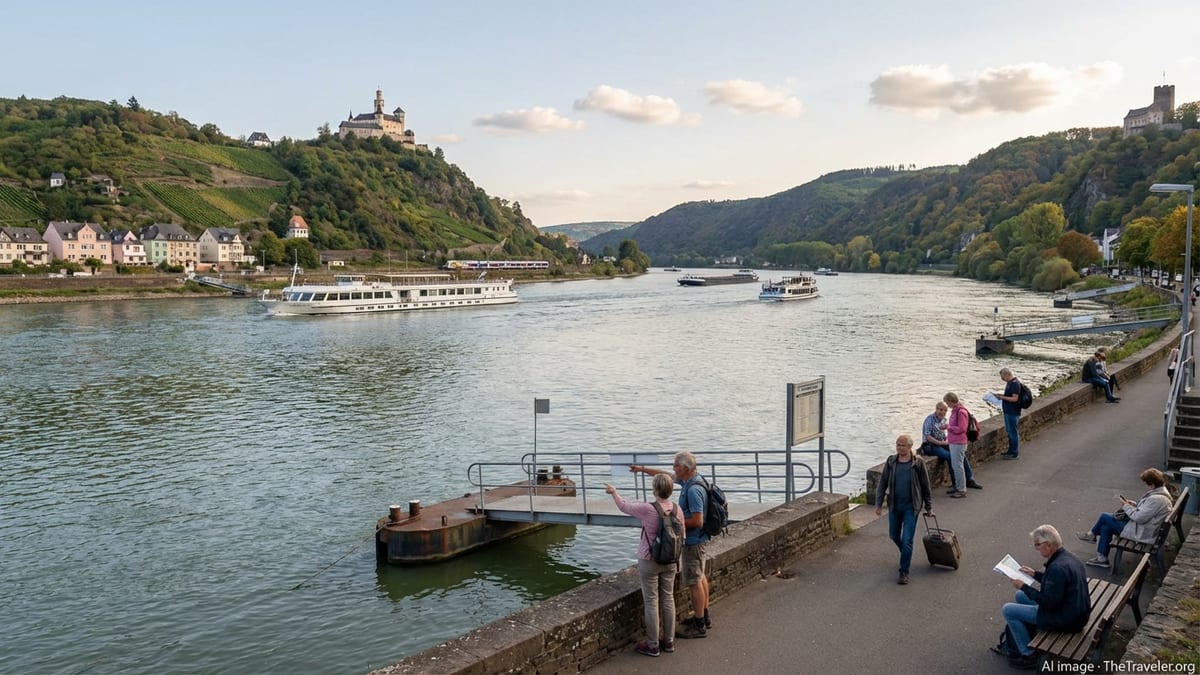
The small Rhine town of Lahnstein sits in a privileged position at the confluence of the Lahn and the Rhine, only a short hop from Koblenz and the fabled Deutsches Eck where the Rhine and Moselle meet. Yet when travelers start comparing Rhine and Moselle cruises, they quickly discover that very few brochures actually list Lahnstein as a departure port.
Instead, most ships call here as a scenic stop on longer itineraries, while the bulk of day cruises and round-trips begin in nearby Koblenz, Boppard or Cochem. Understanding what really operates on the water today, how Lahnstein fits into the regional timetable, and which Rhine and Moselle cruises are worth booking from (or via) Lahnstein can save you a lot of confusion and missed opportunities.
How Lahnstein Fits Into the Rhine and Moselle Cruise Network
Lahnstein lies on the Middle Rhine between Koblenz and Rüdesheim, tucked just south of where the Moselle joins the Rhine at Koblenz. This is important, because most commercial sightseeing and day-cruise networks are organised around major hubs: Koblenz, Boppard and Rüdesheim on the Rhine, and Cochem and Trier on the Moselle. Lahnstein benefits from that web of routes, but it is not one of its primary nodes.
That means you will almost always be using Lahnstein as a convenient boarding or disembarkation point on a through-cruise, or as an easy rail and bus connection point to larger nearby ports, rather than as the main start and finish of a circular boat trip.
Several river cruise operators include Lahnstein as a scheduled stop on multi-day itineraries that combine the Rhine and Moselle. These are typically week-long cruises linking cities such as Strasbourg, Mainz or Cologne with Koblenz, Cochem and sometimes Trier.
On these routes, Lahnstein acts as a quieter alternative to overnighting in busier Koblenz, with easy access to Marksburg Castle across the river at Braubach and to the castle hotel complex at Burg Lahneck above town. The practical takeaway is that if you specifically want Lahnstein as your place to sleep and stroll, you are usually looking at an itinerary where it is one port of call among many, rather than the main base for day trips.
Day cruises are a different story. Many travelers hesitate at this stage, especially when wondering if Lahnstein is worth visiting or just a transit stop. The bulk of Rhine day boats in this stretch depart from Koblenz, Boppard, St Goar and Rüdesheim.
On the Moselle, regular excursion boats concentrate on Cochem, Bernkastel-Kues and Trier, with longer seasonal links running between Koblenz and Cochem. As a traveler staying in Lahnstein, you can reach these hubs quickly by train, bus or taxi, then board the more frequent departures from there. When considered this way, Lahnstein is less a cruise port in its own right and more a perfectly placed land base at the junction of several top-rated Rhine and Moselle cruise experiences.
Rhine Sightseeing Cruises Accessible from Lahnstein
If your priority is classic Rhine Gorge scenery with castles and legendary rocks, the key question is which cruises along the Middle Rhine are easiest to join from Lahnstein. The answer is that the strongest choices depart from Koblenz and Boppard, both reachable from Lahnstein in well under half an hour by regional train or road. From Koblenz, you can board long six-hour sailings that trace the UNESCO-listed Rhine Gorge, as well as shorter one and two-hour sightseeing circuits focused on the section between Koblenz and Braubach or between Koblenz and Boppard.
The most consistently well-reviewed Rhine day cruises accessible from Lahnstein tend to be those that cover the stretch between Koblenz or Boppard and the Loreley Rock near St Goar. Cruises make more sense after reviewing the core things to do in Lahnstein. This route threads you through some of the densest clusters of castles on the river, including Stolzenfels Castle just south of Koblenz, Marksburg above Braubach, the twin castles of Katz and Maus near St Goarshausen, and the ruined Rheinfels fortress above St Goar.
Operators highlight this run for its mix of steep vineyard slopes, narrow bends and picture-book towns that many travelers recognise from Rhine postcards.
For travelers staying in Lahnstein without a car, it is practical to think in terms of a train-plus-cruise loop rather than an out-and-back cruise that starts and finishes at the same point. One common strategy is to take a morning train south from Lahnstein to Boppard or even as far as Bacharach, then ride a northbound cruise ship back through the gorge to Koblenz. From there, a short hop by train returns you to Lahnstein. This pattern saves time, allows you to see more river in one day, and fits more comfortably with the actual direction and timing of most scheduled ships.
Moselle Cruises Within Easy Reach of Lahnstein
Although the Moselle itself does not pass Lahnstein, its confluence with the Rhine at Koblenz is just upriver. From there, the Moselle twists westward through a series of meanders lined with vineyards and small wine towns. Scenic Moselle day cruises are less frequent than Rhine boats, but they do operate in season between Koblenz and Cochem, and there are dense networks of short panoramic sailings up in Cochem and Bernkastel-Kues. From a Lahnstein base, that opens up three distinctive Moselle cruise options worth considering.
The first is a full-day excursion by ship from Koblenz up the Moselle, typically as far as Cochem or one of the intermediate wine villages such as Alken or Winningen. These cruises often take five or more hours one way due to the river’s locks and lazy bends, so they appeal most to travelers who relish long, slow days on the water with a strong focus on landscape. Burgundy-colored vineyards, tiny train lines hugging the shore, and castles like Burg Thurant above Alken are the real draw here. The pace is contemplative and the scenery feels more intimate than on the broader Rhine.
The second option is to treat Cochem itself as a cruise hub. From Lahnstein, frequent trains via Koblenz reach Cochem in under an hour, even when you factor in a change of platform. Once there, one-hour panoramic sailings run multiple times a day in the main season, giving a close-up view of Reichsburg Cochem and the tightly folded Moselle valley around town. These short cruises are relatively inexpensive, easy to fit into a half-day visit and ideal if you are combining boating with a castle visit or wine tasting.
A third possibility for those with more time is to link Cochem with Bernkastel-Kues or Trier using a combination of train and boat. The upper Moselle hosts a number of one-hour and longer scenic cruises from Bernkastel-Kues, a half-timbered wine town that feels like a fairy-tale set, while Trier offers more urban river views alongside major Roman monuments ashore. Taken together, these options demonstrate that while Lahnstein is not on the Moselle, it sits at the mouth of a river system where varied Moselle cruising is quite feasible as a day or overnight outing.
Multi-Day Rhine and Moselle Itineraries Calling at Lahnstein
For many travelers, the most satisfying way to experience both Rhine and Moselle scenery is on a multi-day river cruise, and Lahnstein appears regularly as a peaceful overnight or afternoon stop on such itineraries. A number of European river cruise lines operate week-long or slightly shorter journeys that alternate between the Moselle’s smaller-scale vineyards and villages and the Rhine’s more dramatic gorge and larger towns. Typical routes run between Strasbourg and Cochem, or between Cologne and the middle Moselle, pausing in Koblenz, Boppard, Rüdesheim and occasionally Lahnstein.
These itineraries are worth booking from a Lahnstein perspective if you value being docked in a small town environment rather than in a major city every night. Lahnstein’s riverfront is quieter than Koblenz, with easy walking access to the historic Oberlahnstein district, the medieval Martinsburg and the wooded slopes leading up to Burg Lahneck. Some operators schedule evening folklore shows or castle visits that are easier to manage logistically from Lahnstein than from busier ports, using short coach rides up into the surrounding hills.
Another advantage of choosing a route that calls at Lahnstein is the flexibility it offers before or after the cruise. Lahnstein’s rail connections make it straightforward to tack on independent travel to Frankfurt, Cologne or Luxembourg without navigating a large city riverfront with luggage. For travelers who prefer quieter hotels on land, Lahnstein can also be the place where you disembark and transfer a short distance to a guesthouse, then spend a few extra days exploring the region’s rail-accessible castles and walking trails.
From a value perspective, the multi-day Rhine and Moselle cruises that include Lahnstein as a stop rather than a turn-around point tend to be strong choices because they maximise river time in the most scenic stretches. You are not paying for days spent largely on transit between distant cities, but rather for a concentrated sequence of Middle Rhine and central Moselle landscapes punctuated by classic river towns like Cochem, Boppard and Rüdesheim.
Seasonal Factors, River Conditions and What They Mean for Your Booking
One of the least understood aspects of Rhine and Moselle cruising is how strongly the calendar and river conditions shape what actually operates, especially if you are using Lahnstein as your base. On the Rhine, day cruises between Koblenz, Boppard and the Loreley generally run from April through late October, with the fullest timetables in high summer. Outside these months, sailings become sporadic or focus on weekend and holiday themes. It is possible to cruise in winter on special Advent and New Year departures based from Cologne or Mainz, but these are self-contained event cruises with limited local sightseeing stops.
The Moselle is more sensitive still. Its cruise season is shorter, and the presence of locks adds complexity. Periodic engineering works or incidents at locks can affect traffic with little notice. In recent seasons, there have been temporary disruptions on sections of the Moselle near Cochem, which forced some river cruise lines to adjust itineraries or use buses for affected stretches until repairs were completed. While such issues are not constant, they underscore the importance of reading your chosen operator’s current season information rather than relying on old brochures or generic descriptions of the route.
Water levels can also influence timetables. In very dry summers, shallow stretches on the upper Rhine or Moselle may require reduced loads or even temporary suspensions for larger vessels, which in turn may affect departure points or the exact section covered by certain day cruises. On the other hand, unusually high water can limit clearance under bridges, especially in early spring. From the traveler’s point of view, the practical step is simple: when you are planning a Lahnstein-based trip that hinges on a particular long day cruise, check the operator’s live schedule for the specific date window you have in mind, and remain flexible about whether you embark in Koblenz, Boppard or Cochem.
Seasonality also shapes the feel on board. High summer on the Middle Rhine and central Moselle often means crowded decks, full commentary in multiple languages and a buoyant, sometimes noisy atmosphere. Shoulder seasons in April, May, September and early October can be more comfortable for those who prefer quieter ships and slightly cooler temperatures. Autumn brings the added charm of harvest activity in the vineyards and wine festivals in towns like Cochem, Bernkastel-Kues and Boppard, which can pair very well with a river cruise from a Lahnstein base.
How to Choose the Right Cruise if You Are Staying in Lahnstein
When evaluating which Rhine or Moselle cruises are genuinely worth booking from Lahnstein, it helps to start by clarifying your priorities. If you want maximum time afloat and you are happy to travel a little to reach the departure point, then the longer Rhine gorge cruises from Koblenz or Boppard and the full-day Moselle sailings toward Cochem are good candidates. Plan your day so that you reach the port city early, leaving margin for delays, and aim for an itinerary that avoids unnecessary backtracking on the water.
If your focus is on iconic highlights in a compact time frame, look instead at one or two-hour sightseeing cruises that you can pair with a castle visit or town walk. For example, a day trip from Lahnstein to Cochem might combine a short train ride, a visit to Reichsburg Cochem, a one-hour panoramic Moselle cruise around town and a tasting in a wine cellar. A similar pattern is possible on the Rhine with a Lahnstein to Boppard train, a Rhine cruise through the deepest section of the gorge to St Goar, and a late-afternoon regional train back.
Another factor is whether you prefer a structured, inclusive experience or a more independent patchwork of boats and trains. Multi-day river cruises provide a high level of comfort and simplicity, with your cabin, most meals and guided excursions bundled in. In that scenario, Lahnstein is something you receive as part of the package, a distinctive small-town stop among better-known ports. Independent day-tripping from Lahnstein, by contrast, leans on public transport and local excursion boats, can be better value for money and allows you to linger if a particular town appeals to you.
Finally, be realistic about travel times. While maps can make Lahnstein and Cochem look far apart, trains via Koblenz are frequent and fast enough that day trips are entirely manageable. The same applies to Boppard and St Goar on the Rhine. If you budget in the connection times and avoid the last boat or last train of the day, using Lahnstein as a calm base while enjoying some of the best Rhine and Moselle cruising on offer today is not only possible but often preferable to staying directly in busier Koblenz.
The Takeaway
The question of which Rhine and Moselle cruises from Lahnstein are worth booking has a nuanced answer. Very few mainstream boat lines treat Lahnstein itself as a major departure port, but many of the most scenic cruises on both rivers are within easy reach by rail and road. On the Rhine, six-hour gorge cruises and short sightseeing loops from Koblenz and Boppard consistently deliver the castle-studded landscapes that travelers come to the region to see. On the Moselle, slow, full-day journeys from Koblenz and short panoramic sailings from Cochem and Bernkastel-Kues provide a different kind of river experience among tightly folded vineyards and smaller wine towns.
Multi-day river cruises that include Lahnstein as a stop are particularly appealing if you value docking in a quieter town and waking up to wooded hillsides instead of city skylines. These itineraries typically weave together the best of the Rhine and Moselle without long stretches of less interesting water, making them strong value for those who want a single, comprehensive cruise. Whatever you choose, the key is to think of Lahnstein less as an isolated port and more as a well-placed hub at the junction of two storied rivers, with flexible access to a wide menu of cruising options.
By aligning your expectations with how the regional network actually works, checking current-season schedules, and building in a little flexibility for river conditions, you can use Lahnstein as a comfortable base while enjoying some of the most rewarding Rhine and Moselle cruises on offer. The town’s quiet riverfront, historic core and easy train links tie together a constellation of day cruises and longer itineraries, turning a small dot on the map into a practical gateway to two of Europe’s most celebrated river valleys.
FAQ
Q1. Can I board a regular sightseeing cruise directly in Lahnstein?
Lahnstein is mainly used as a stop by multi-day river cruise ships and less often as a departure point for short circular sightseeing cruises. For frequent day boats, you will usually travel a short distance to Koblenz, Boppard or Cochem and embark there.
Q2. How far is Lahnstein from Koblenz and Cochem?
Lahnstein is only a few minutes by regional train from Koblenz, and under an hour by train from Cochem with a simple connection in Koblenz. That makes it easy to reach the main Rhine and Moselle cruise hubs in a single day’s outing.
Q3. Is it realistic to see both the Rhine Gorge and the Moselle from a Lahnstein base?
Yes. You can spend one day focusing on the Middle Rhine, for example using a train to Boppard and a cruise back through the gorge to Koblenz, and another day heading by train to Cochem for a short Moselle cruise and castle visit.
Q4. Are Moselle cruises as frequent as Rhine cruises?
No. Rhine day cruises run more often and on more routes than Moselle cruises, especially between Koblenz and the Loreley. Moselle routes are more seasonal and focused on hubs such as Cochem, Bernkastel-Kues and Trier, so advance timetable checks are important.
Q5. When is the best time of year to book Rhine and Moselle cruises from Lahnstein?
The main cruising season runs from April to late October, with the most frequent departures in summer. Many travelers find late spring and early autumn particularly pleasant, thanks to milder temperatures and vineyard activity along the Moselle.
Q6. Do I need to book day cruises in advance or can I buy tickets on the day?
For short one or two-hour cruises, it is often possible to buy tickets on the day, especially outside peak weekends. For longer full-day sailings through the Rhine Gorge or up the Moselle to Cochem, advance booking is strongly recommended, particularly in high summer or during holiday periods.
Q7. Are Rhine and Moselle cruise boats accessible for travelers with limited mobility?
Many larger boats on the Rhine and Moselle provide level boarding or ramps and accessible restrooms, though not all vessels or piers are identical. If accessibility is crucial, contact the operator in advance and choose the specific departure point and ship that best match your needs.
Q8. What should I wear on a day cruise from Lahnstein’s nearby ports?
Dress is casual, but bring layers. Temperatures on deck can be cooler than on land, especially when the boat is moving. A light jacket, comfortable flat shoes and sun protection are advisable, along with a small bag for camera and water.
Q9. Can I combine a castle visit with a river cruise in one day?
Yes. Classic combinations include a Rhine cruise with a visit to Marksburg Castle above Braubach, or a Moselle cruise from Cochem paired with a tour of Reichsburg Cochem. With Lahnstein as your base, trains and local buses make these pairings feasible within a single day.
Q10. Is a multi-day Rhine and Moselle river cruise worth it if I am already staying in Lahnstein?
If you want a seamless experience with your accommodation, most meals and guided excursions included, a multi-day cruise that calls at Lahnstein can be very rewarding. If you prefer flexibility and lower overall cost, using Lahnstein as a land base for a series of day cruises and town visits may suit you better.