


On September 9, 2026, just two days before the 25th anniversary of the September 11 attacks, United Airlines abruptly canceled a highly choreographed 9/11 memorial flyover planned in Denver. The decision followed mounting public concern over the idea of a low-altitude commercial jet, flanked by fighter aircraft, tracing a timed flight path above the city. The episode has become a case study in how aviation tragedies are remembered in public, and where tributes can cross the line from solemn to unsettling.
Get the latest updates straight to your inbox!
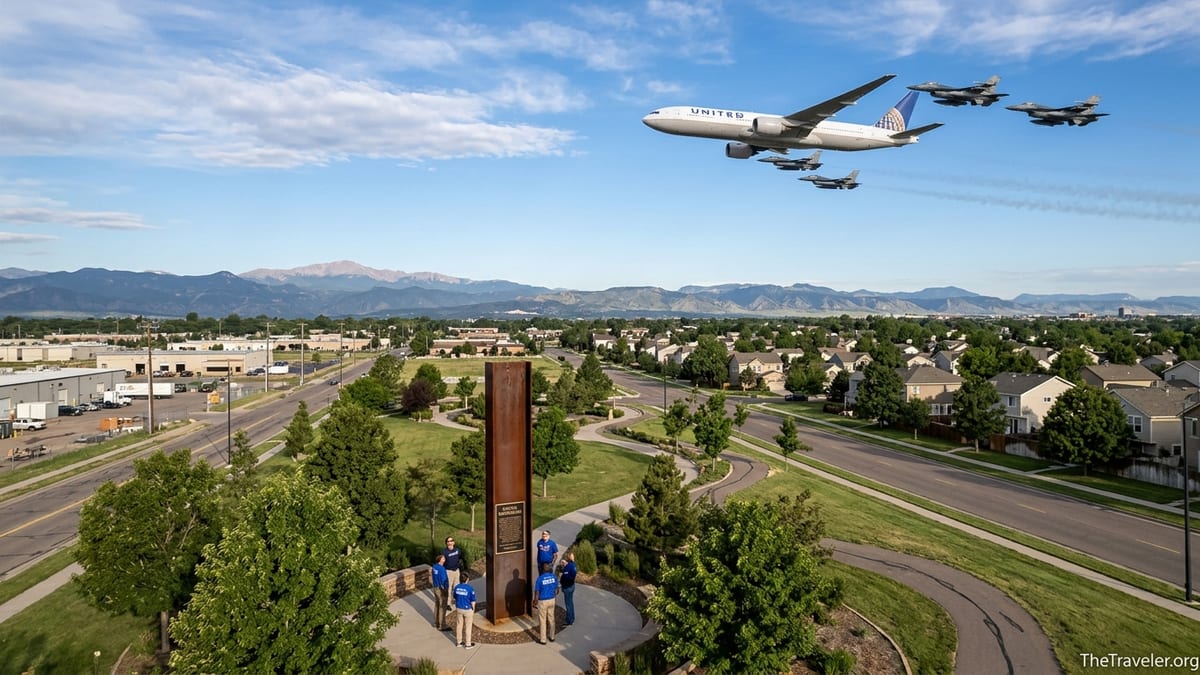
What United’s 9/11 Denver Flyover Was Supposed To Be
United’s memorial concept centered on a Boeing 777 flyover in formation with four Colorado Air National Guard F-16 fighter jets above northeast Denver on the morning of September 11, 2026. Reporting from airline industry outlets and local media indicates the formation was to pass near United’s massive Flight Training Center complex, close to the intersection of Quebec Street and Martin Luther King Jr. Boulevard, where the airline has created a memorial garden for employees killed in the attacks.
According to detailed reconstructions in aviation publications and local news reports, the 777 was scheduled to depart Denver International Airport at approximately 8:14 a.m., mirroring the departure time of United Flight 175 from Boston on September 11, 2001. The flyover was then to be timed so that the aircraft would pass near the training center around 9:03 a.m., the exact moment Flight 175 struck the South Tower of the World Trade Center. Sources familiar with the plans describe a low but legal altitude intended to make the aircraft clearly visible and audible to those gathered below.
The event formed part of a broader internal commemoration for United employees in Denver. Company statements and local coverage describe a private remembrance ceremony at the Flight Training Center that would include the unveiling of a permanent monument built from steel recovered from the World Trade Center. The memorial structure, reported to be 9 feet 11 inches tall, was designed to anchor an existing reflection garden where crew members and staff already gather each year for moments of silence and reading of names.
Crucially, United and city officials repeatedly emphasized that the flyover was never intended as a public air show. Attendance at the ground ceremony was limited to employees and invited guests, not ticketed passengers or the general public. The flyover itself, however, by its very nature would have been experienced by anyone under the flight path across parts of northeast Denver, including residential neighborhoods and busy arterial roads.
The Timeline: From Announcement To Backlash To Cancellation
The plan first reached broad public attention on September 8, 2026, when Denver’s Office of Emergency Management used social media and local news outlets to warn residents that a low-flying United jet escorted by fighter jets would be visible over the city on the morning of September 11. The alert was framed as a reassurance, urging people not to call 911 about a large passenger plane and multiple F-16s flying in formation over Denver.
That same day and into September 9, local and national coverage amplified the story. Newspapers such as the Denver Gazette and national outlets like the New York Times, along with aviation-focused sites, described the timing of the flyover, the Boeing 777 involved, and the role of the Colorado Air National Guard. Cable news segments, YouTube newscasts and social media posts rapidly circulated headlines emphasizing that a passenger jet with fighter escort would fly low over Denver on the anniversary of the attacks.
Public reaction was swift. Local television stations highlighted viewers describing the concept as “disturbing” and “tone deaf,” and social media threads in Denver and aviation communities filled with criticism. Online discussions pointed out that the city had felt real aviation anxiety in the past, including debris from United Flight 328 falling over suburban neighborhoods in 2021, making the prospect of another dramatic aviation spectacle less appealing. Some residents compared the idea to staging a car convoy through Dealey Plaza on the anniversary of President Kennedy’s assassination.
On September 9, after nearly a full day of intensifying criticism, Denver’s Office of Emergency Management confirmed that the flyover had been called off. United publicly stated that it had decided to cancel the event due to “concerns in the community.” By the evening of September 10, multiple outlets from local TV stations to aviation industry news sites were reporting the cancellation as final, and the 777’s special flight plan was withdrawn.
Why The Flyover Was Controversial
The core controversy stemmed from the visuals the flyover would have created. For many people, the mental image of a large commercial jet flying low over a metropolitan area, tailed by military fighters, is inseparable from the events of September 11, 2001. Critics argued that experiencing this image in real time, even as a tribute, risked triggering fear or trauma for residents who lived through that day or who associate low-flying airliners with danger.
Commentary from aviation writers and security experts stressed that Denver’s advance warnings were a double-edged sword. On one hand, it was responsible to notify the public so that residents would not flood emergency lines. On the other, the warning language, which effectively told people not to be alarmed by the sight of a passenger plane and fighter jets on 9/11, underlined precisely why the idea felt alarming. Local police and emergency planners were effectively preparing for a wave of mistaken 911 calls, which some critics took as proof that the tribute was ill-conceived.
There were also concerns over taste and symbolism. While military flyovers using fighter jets are common in American commemorations, from Memorial Day ceremonies to NFL games, using a branded commercial airliner as the centerpiece of a 9/11 spectacle struck many observers as unsettling commercialization of a tragedy. Commenters in Denver and across national media questioned whether a company whose aircraft were used in the attacks should stage a visually dramatic re-creation involving one of its own jets.
Finally, some residents felt blindsided by the apparent lack of local consultation. Denver officials later indicated that the city had not been asked to weigh in on whether the flyover was a good idea before flight plans moved ahead. That left municipal agencies in the position of reassuring the public about a spectacle they had not requested, while fielding understandable questions from residents who worried that the sight or sound of the formation might cause panic in offices, schools, and homes along the route.
What Organizers Intended To Symbolize
United’s internal messaging and later public statements painted a very different picture of the flyover’s purpose. The airline framed the event as a solemn memorial for its own employees, particularly the crews of United Flight 175 and United Flight 93, who were killed in the hijackings. Company representatives described the Denver Flight Training Center as the operational heart of the airline, where pilots and flight attendants from around the world cycle through regular simulator training, and said that marking the 25th anniversary there underscored the continuing impact of 9/11 on aviation professionals.
The planned Boeing 777 was to represent the modern long haul fleet that grew from the generation of aircraft involved in the attacks, while the Colorado Air National Guard’s F-16s symbolized the air defense role that US military pilots were thrust into on and after 9/11. For employees attending the ceremony on the ground, organizers intended the formation as a salute passing overhead as names were read and the new monument was unveiled, rather than as an aerial show for mass spectators.
In interviews with local reporters, airline representatives stressed that the flyover was designed as a one-time gesture tied to the 25th anniversary, not an annual tradition. United highlighted its longer track record of more understated remembrances, including memorial tables with photographs and roses that appear every September 11 at major hubs like Denver, Chicago and San Francisco, as well as scholarships and support programs for families of crew and passengers lost in 2001.
When the backlash grew, United’s official statements attempted to balance explaining that intention with acknowledging community discomfort. The cancellation message cited “concerns in the community” without accusing critics of misunderstanding the plan, and the airline pivoted quickly to promoting quieter remembrance activities at the Denver headquarters and across its network. Still, the gap between organizer intent and public reaction highlighted how sensitive aviation-related symbolism remains a quarter century after the attacks.
Community Reaction And Public Debate
Once Denver’s emergency management alert circulated, public feedback poured in over the next 24 to 36 hours. Local talk radio hosts fielded calls from listeners who said they understood United’s desire to honor its employees but struggled with the imagery. Some described seeing planes grounded at Denver International Airport on September 11, 2001 and feeling that silence itself had been a powerful memorial. The idea of bringing a large jet low over the city on the anniversary felt to them like the opposite of that experience.
On social platforms, Denver residents and aviation enthusiasts shared diagrams and tracking predictions showing the expected flight path from Denver International Airport toward the training center and then back toward the airport. People living under the projected route, including in neighborhoods such as Central Park and portions of Aurora, wondered how low the aircraft would be and whether school administrators had been briefed on what students might see and hear during morning classes.
Nationally, commentators weighed in as screenshots of local TV headlines spread. Some opinion writers and bloggers argued that the plan illustrated how anniversaries can drift into spectacle, especially when powerful visuals are available. Others defended United’s intentions, noting that military funeral flyovers using missing-man formations are long-standing traditions, and suggesting that the controversy reflected a broader discomfort with discussing 9/11 directly rather than through familiar rituals like moments of silence.
However, there was relatively broad agreement, even among some United employees who posted anonymously, that careful consultation with local officials and mental health experts might have headed off the misstep. The story became not only about a single event in Denver but about how airlines, airports and cities should collaborate when designing public or semi-public memorials that are inseparable from traumatic imagery.
Ceremonial Flyover Versus Regular Airline Operations
One key point that emerged as coverage unfolded is the difference between a ceremonial flyover and a scheduled passenger flight. The canceled United event would have used an aircraft operating a special, one-off mission with no paying passengers on board, flying a predetermined path at a specific altitude in coordination with the Federal Aviation Administration and the Colorado Air National Guard. In that sense, it more closely resembled a choreographed air show maneuver than a typical United 777 flight between cities like Denver and London or San Francisco.
Denver-area travelers with tickets on September 11, 2026 were not directly affected by the cancellation. Regular United operations at Denver International Airport, including morning bank departures and arrivals, continued as scheduled, aside from the removal of the special flyover flight plan. There were no widespread 9/11-related schedule disruptions similar to the ground stops seen on the day of the attacks in 2001, when US airspace was closed and all commercial flights were halted.
The episode nevertheless underscored for many passengers how sensitive unusual flight activity can be. Travelers at Denver International that week were already encountering heightened security measures associated with the anniversary, ranging from additional law enforcement visibility in terminals to occasional secondary screening at checkpoints. Advance warnings that a low-flying 777 might appear over the city with fighter escorts added a layer of anxiety for some passengers who remembered past incidents, such as the 2021 engine failure on United Flight 328 that scattered debris over Broomfield before the aircraft returned safely to Denver.
For readers considering future travel around significant anniversaries, the distinction is important. Ceremonial flights are handled through special approvals, insurance coverage and airspace coordination, and can be canceled without affecting routine schedules. In Denver’s case, once community concerns became clear, United was able to pull the plug on the flyover without causing ripple effects for thousands of travelers moving through one of its primary hubs that day.
How United Marked 9/11 In Denver After The Cancellation
With the flyover off the schedule, United redirected attention to quieter observances. On September 11, 2026, the airline hosted a memorial event at its Denver headquarters and Flight Training Center, unveiling the World Trade Center steel monument and expanding its existing garden dedicated to the 18 United employees killed in the attacks. Local coverage showed crews, executives and training staff gathering for a moment of silence and the reading of names, with the new memorial serving as a focal point rather than a passing aircraft overhead.
Elsewhere at Denver International Airport, airlines and airport managers observed the anniversary with ceremonies familiar from other major US airports. Terminal gatherings included honor guards, brief remarks by local officials and clergy, and coordinated moments of silence around the times of the impacts and the collapse of the towers. For travelers, the most visible reminders were memorial tables set up near high-traffic gate areas, where United placed framed photographs of lost crew members and simple floral arrangements. Passengers walking through concourses reported pausing at these displays between flights, an understated contrast to the high-energy visuals a flyover would have created.
Across Colorado, the anniversary also featured community-based events linked to United’s history. In Colorado Springs, for example, schools and universities held ceremonies honoring local victims, including a Mitchell High School graduate who served as a United flight attendant on Flight 175. In media interviews, United pilots based in Denver described visiting the new headquarters monument during layovers or between simulator sessions, framing the site less as a spectacle and more as a place for personal reflection.
The absence of the flyover did not diminish the volume of coverage devoted to the anniversary, but it did shift the narrative. Rather than images of a low-flying 777 over Denver, stories focused on the new permanent memorial, on how 9/11 reshaped security and operations at Denver International Airport, and on the fact that many younger crew members now working for United have no direct memory of the day yet feel its impact through the security procedures, training protocols and commemorative culture that followed.
United’s 9/11 History And The Challenge Of Aviation Memorials
United’s decision to attempt, and then cancel, a dramatic aviation tribute cannot be separated from its unique place in 9/11 history. Two of the four hijacked aircraft on September 11, 2001 were United flights: Flight 175, which crashed into the South Tower, and Flight 93, which crashed in a Pennsylvania field after passengers and crew fought back against the hijackers. The airline lost crew members, customer service agents and other employees, in addition to hundreds of passengers whose families have long-standing relationships with the company.
Over the past 25 years, United has developed a variety of remembrance practices. These have included internal remembrance services at hubs like Chicago O’Hare and San Francisco, support for the Flight 93 National Memorial in Pennsylvania, and behind-the-scenes assistance for families. For front-line staff and management alike, the attacks remain a defining moment in the airline’s modern story, shaping everything from cockpit door design to crew training in de-escalation and security.
Aviation experts note that memorializing an aviation tragedy is always complex. Military funeral flyovers, missing-man formations and aircraft salutes at state funerals are common and widely accepted. Yet commercial aviation disasters are different because the aircraft involved are tools of everyday life for millions of travelers. A tribute centered on a passenger jet can easily slide from solemn to uncanny, particularly when it visually echoes the circumstances of the original tragedy or takes place in busy urban airspace where people are caught by surprise.
The Denver episode may therefore influence how airlines and airports design future 9/11 observances. Early indications suggest a renewed emphasis on permanent memorials, educational displays, and low-key rituals rather than spectacular aerial demonstrations. For travelers, that likely means more opportunities to encounter quiet spaces of remembrance in terminals and training centers, and fewer unexpected sights in the sky that could resemble the scenes that made 9/11 such a shattering day in aviation history.
What The Denver Cancellation Reveals About Remembering 9/11 Today
United’s canceled flyover highlights how the meaning of 9/11 continues to evolve a quarter century on. More than 100 million Americans were born after the attacks, and many of today’s pilots, flight attendants and airport workers were children or not yet born when they happened. For this generation, memorials are as much about education and context as about personal recollection. The Denver controversy suggests that younger and older audiences alike still respond strongly to imagery that visually replays the events, even when framed as tribute.
At the same time, the episode underscores how intensely local the experience of a national tragedy can be. New York, Washington and Shanksville remain the primary sites of official 9/11 observances, but cities like Denver, which is home to a major airline hub and thousands of aviation workers, also bear a lasting imprint. Decisions about how to commemorate 9/11 in such places are shaped not only by national memory but by local history, from previous aviation incidents to the particular geography of flight paths over neighborhoods and schools.
For travelers passing through Denver and other hubs on future anniversaries, the lesson is subtle but important. Commemorations that feel appropriate in an airport terminal, such as a brief gate-side moment of silence or a memorial wall near security, may land differently than spectacles in the sky that evoke the attacks too literally. The Denver cancellation suggests that communities are more comfortable with tributes that invite quiet reflection than with those that risk recreating the shock of the original events.
In that sense, United’s decision to call off the flyover, while embarrassing in the short term, may help shape a more sensitive template for future aviation memorials. As airlines, airports and cities continue to navigate how to honor 9/11 in the decades ahead, the Denver experience is likely to be cited in internal planning meetings as a reminder that, when it comes to aviation tragedies, the line between remembrance and re-enactment remains thin and must be approached with exceptional care.