

More news on this day
Air travel across Europe has been hit by a new wave of disruption as winter storms and strike action combined to delay 989 flights and cancel 86 more, impacting services in and out of Italy, Denmark, Belgium and other countries through major hubs such as Paris Charles de Gaulle, Edinburgh, Madrid and Zurich.
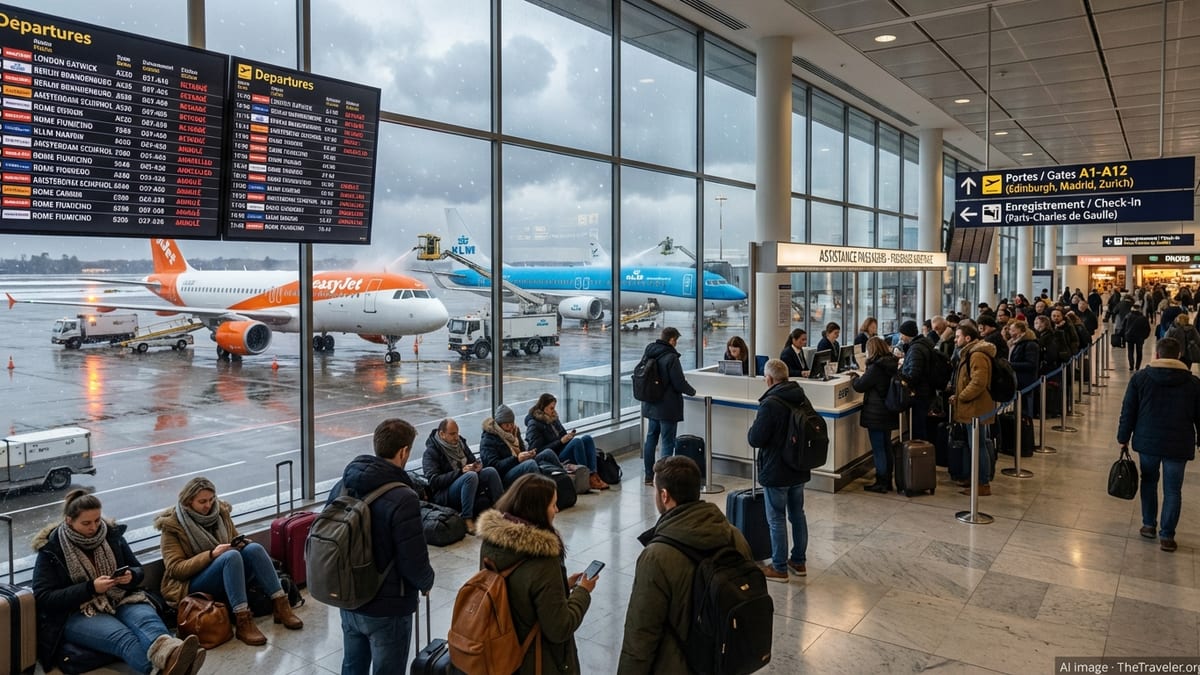
Storms and Staff Walkouts Create a Perfect Disruption Storm
The latest chaos comes at the tail end of a turbulent February for European aviation, in which severe weather and labour disputes have repeatedly strained airline and airport operations. A powerful winter system sweeping across northern and central Europe has brought heavy snow, ice and strong winds to parts of France, Spain, Italy, Belgium and the Nordic region, forcing crews to slow operations and close runways at intervals for de-icing and safety checks.
At the same time, industrial action in Italy and pockets of labour unrest elsewhere have further reduced available capacity. Italian aviation unions have confirmed a 24 hour nationwide strike affecting ground handlers, cabin crew and pilots at ITA Airways and easyJet, triggering widespread schedule changes and knock on delays throughout the continent as aircraft and crews fall out of position.
While exact tallies fluctuate by the hour, operational data for the current disruption window shows 989 flights delayed and 86 cancelled across European airspace. These figures sit on top of already elevated disruption levels recorded in recent weeks as a series of storms swept the continent, leaving airlines with little margin to recover when fresh problems arise.
Airports and carriers stress that safety remains the overriding priority, particularly where crosswinds and runway contamination are in play. That has meant extended separation between aircraft, slower turnaround times at gates and temporary suspensions of ground operations when conditions deteriorate, all of which cascade into mounting delays for passengers.
Key Hubs Hit: Charles de Gaulle, Edinburgh, Madrid and Zurich
Paris Charles de Gaulle has again emerged as one of the hardest hit hubs, with dozens of departures and arrivals pushed back amid strong winds and intermittent snowfall. The French gateway, a critical connection point for both intra European and long haul flights, has reported more than one hundred delays in the latest wave, affecting not only domestic links but services to Italy, Belgium and Scandinavia.
In the United Kingdom, Edinburgh Airport has experienced sizeable knock on delays as weather fronts passing across Scotland disrupted schedules and constrained operations at times at both Edinburgh and other British airports feeding into the same network. Passengers on flights to and from Denmark and Belgium reported long waits in terminals, with some services delayed for several hours as aircraft arriving late from elsewhere failed to make their assigned departure slots.
Further south, Madrid Barajas has seen a combination of high winds aloft and congestion ripple through the day’s timetable. A number of services between Spain and Italy were delayed, while flights linking Madrid with northern Europe and the Nordic countries also ran behind schedule. Zurich Airport, an important hub for connections between central Europe and Scandinavia, has likewise reported dozens of delayed flights as snow and low cloud reduced operational flexibility and extended taxi and de-icing times.
Secondary airports across Belgium, Denmark and northern Italy have mirrored the pattern at the big hubs, with relatively small local disruptions compounding the overall strain on the network. Where airports rely heavily on a single carrier, the impact of a disrupted rotation quickly multiplies across outbound and inbound services.
Airlines easyJet, KLM and Others Scramble to Recover
Among the airlines, easyJet and KLM are again prominent on the list of carriers facing the most acute operational stress. easyJet, with its dense web of short haul routes anchored in the United Kingdom, France, Italy and Spain, has reported dozens of delays and a cluster of cancellations as it juggles aircraft and crews around the weather and strike related constraints. Services linking Italian cities with northern Europe have been particularly exposed, both to the Italian strike rota and to poor weather at destination airports such as Copenhagen, Brussels, Edinburgh and Zurich.
KLM, whose base at Amsterdam Schiphol has already endured repeated bouts of severe winter weather this season, has also been affected as conditions deteriorated at partner hubs including Paris and Zurich. Delays at those airports have disrupted onward connections for passengers travelling to and from Italy, Denmark and Belgium, forcing the Dutch carrier to adjust schedules and rebook travellers on alternative routings where possible.
Legacy airlines including Air France, British Airways, Lufthansa and SAS, together with regional and low cost operators such as Ryanair, Vueling and Wizz Air, are contending with similar problems. Each instance of severe weather at a major hub effectively removes capacity from the system for several hours at a time, and when that coincides with localised labour action in Italy or capacity constraints at busy hubs like Charles de Gaulle and Madrid, the result is widespread schedule instability.
Airline operations teams across the continent spent much of the day redesigning rotations, consolidating lightly booked flights where possible and activating contingency plans. While this has helped preserve a high proportion of flights, it has done little to reduce disruption for passengers booked on services that have been cancelled or significantly delayed.
Italy, Denmark, Belgium and Neighbours See Knock On Effects
The disruption has been particularly visible for travellers flying to and from Italy, Denmark and Belgium, three markets that sit at the crossroads of dense European traffic flows. In Italy, the combination of winter weather and strike action has led to reduced timetables at major airports including Rome Fiumicino, Milan Linate and Milan Malpensa, with regional airports such as Venice and Naples also reporting irregular operations.
In Denmark, Copenhagen Airport has faced a heavy concentration of delays over recent days, owing both to difficult weather and to congestion elsewhere in the network that feeds into its Scandinavian hub role. This, in turn, has affected services to Brussels, Paris, Amsterdam and London, leaving passengers travelling between Denmark and Belgium or Italy with limited rerouting options at peak times.
Belgium’s main gateway at Brussels has seen fewer outright cancellations in the current cycle than some neighbouring hubs but has still recorded long chains of delays, particularly on routes to the United Kingdom, France, Spain and Italy. Because many of these flights are operated by carriers already grappling with issues at their home bases, delays have tended to propagate through the day, with morning disruptions leading to evening arrivals and departures running hours behind schedule.
Neighbouring countries, including France, the Netherlands, Switzerland and the United Kingdom, have all reported overlapping issues on the same operating days, reducing the spare capacity normally available to absorb weather or strike related shocks. For passengers trying to make multi leg journeys, even small schedule changes have been enough to break carefully timed connections.
What Passengers Are Being Told to Do
Airlines and airports are advising passengers across Europe to check flight status multiple times before travelling to the airport and to allow additional time for check in and security, especially at major hubs. Many carriers, including easyJet and KLM, have activated flexible rebooking policies for affected flights, allowing travellers to move journeys to alternative dates or, in some cases, request refunds or travel vouchers.
Under European passenger rights rules, travellers whose flights are cancelled at short notice or delayed by several hours may be entitled to assistance at the airport, including meals, refreshments and, where necessary, overnight accommodation. Eligibility for financial compensation depends on the cause of the disruption, with severe weather typically classed as outside the airline’s control but some strike actions falling into a grey area that regulators and courts continue to interpret case by case.
Consumer groups are urging passengers to retain all documentation, including boarding passes, booking confirmations and receipts for any out of pocket expenses, to support later claims. They also recommend contacting airlines first through official apps or websites, which are often updated faster than airport information screens and can be used to rebook without joining long queues at service desks.
With further unsettled weather forecast for parts of Europe in the coming days and additional industrial action not ruled out in Italy and elsewhere, aviation authorities warn that schedules are likely to remain fragile. Travellers planning trips through major hubs such as Charles de Gaulle, Edinburgh, Madrid, Zurich, Amsterdam or Copenhagen are being encouraged to build extra buffer time into connections and to stay alert to potential last minute changes.