


More news on this day
Europe’s budget carrier Wizz Air has joined a growing list of global airlines revising 2026 forecasts, as surging jet fuel prices and the continuing Middle East conflict strain profitability and trigger fresh disruption at major hubs including New York JFK, London Heathrow, Dubai and Frankfurt.
Get the latest news straight to your inbox!
Wizz Air Scales Back Profit Guidance Amid Regional Turmoil
Publicly available information shows that Wizz Air now expects its fiscal 2026 results to hover around breakeven, lowering earlier guidance that had pointed to a modest net profit. The carrier has highlighted an estimated 50 million euro hit tied to the Middle East crisis, which has pushed up fuel costs and forced route suspensions in affected markets.
Reports indicate that roughly one third of the impact stems from suspended or reduced services to Middle Eastern destinations, while the remainder reflects a weaker macroeconomic backdrop, higher jet fuel prices and currency pressures linked to the Iran conflict. The recalibration underlines how even fast-growing low cost operators, which typically benefit from lean cost bases, are feeling the strain of a rapidly changing operating environment.
Wizz Air had entered 2026 with expansion plans across Central and Eastern Europe and a strategy centered on high aircraft utilization and ancillary revenues. The decision to temper expectations suggests that the combination of geopolitical risk and energy market volatility is eroding the buffers that previously helped low cost carriers absorb shocks. Analysts following the sector note that the airline’s updated guidance brings its outlook closer to those of larger full service rivals that have already warned of margin pressure this year.
The move also places Wizz Air within a broader group of European operators that are rethinking capacity growth into and over the Middle East. Capacity that had been earmarked for routes touching the region is increasingly being reassigned to more resilient leisure and visiting-friends-and-relatives markets in Europe and parts of Asia, as airlines seek to preserve load factors and yields while keeping a tight rein on costs.
Fuel Costs Surge As Iran War Reshapes Energy Markets
Across the industry, updated outlooks are being driven primarily by a sharp rise in jet fuel prices since late February, coinciding with an escalation of the Iran war and disruption to shipping through the Strait of Hormuz. Sector research published in recent weeks indicates that airlines face an average increase of close to 10 percent in projected 2026 fuel bills compared with earlier estimates, with some carriers seeing double digit revisions.
Bank and industry analyses describe a second major energy shock for Europe and key aviation markets, with aviation fuel prices roughly doubling from year earlier levels. The resulting squeeze has rapidly become the dominant cost story for airlines that had spent much of 2025 focused on labor and infrastructure bottlenecks. While many European groups, including the parent company of British Airways and Iberia, are partly hedged, a meaningful share of their fuel requirements remains exposed to the spot market.
Airline treasury surveys cited in recent commentary suggest that risk management is now firmly centered on commodity exposure, with carriers reassessing hedging strategies and credit protection in case fuel prices remain elevated into 2027. Yet hedging alone cannot fully offset the impact of a structurally higher fuel curve, particularly for airlines that were underhedged going into the current crisis or that have limited balance sheet flexibility.
For passengers, the shift is beginning to show up in higher fares and more dynamic pricing, especially on long haul and connecting routes where fuel accounts for a significant share of operating costs. Several major groups have indicated that they expect to recover only part of the fuel cost increase through revenue actions this year, reinforcing expectations that 2026 margins will fall short of earlier ambitions even if demand remains relatively solid.
Delta, United And European Giants Trim Profit Outlooks
Major US and European carriers have already responded by cutting earnings guidance or warning of thinner margins. Delta Air Lines, which operates its own refinery and had previously touted a degree of insulation from fuel volatility, has reported a noticeable increase in adjusted fuel prices per gallon and flagged the Middle East conflict as a key driver of higher costs in its March quarter results.
United Airlines has gone further by formally lowering its full year 2026 earnings forecast, citing higher fuel costs linked to the Iran conflict. Publicly available investor updates show United now expects adjusted earnings well below the range issued at the start of the year, even as booking trends remain strong on core domestic and transatlantic networks. The carrier is also reshaping its schedule for the remainder of 2026 to reflect both fuel economics and evolving demand patterns.
In Europe, the owner of British Airways has raised its projected fuel bill for 2026 to around 9 billion euros, up from an earlier estimate of about 7 billion euros. Presentations to investors indicate that the group expects to recoup roughly 60 percent of that additional burden through a mixture of fare increases, capacity adjustments and cost measures, while still accepting that profit and free cash flow will undershoot initial targets.
Lufthansa and Air France KLM, which already face competitive pressure and complex restructuring agendas, are also navigating higher fuel charges and route disruptions. Recent European financial press coverage describes both groups as being under renewed scrutiny from investors over their ability to balance cost inflation with fleet renewal, debt reduction and labor commitments, especially if the summer peak fails to deliver the hoped for boost to cash generation.
Middle East Conflict Ripples Through Global Hub Operations
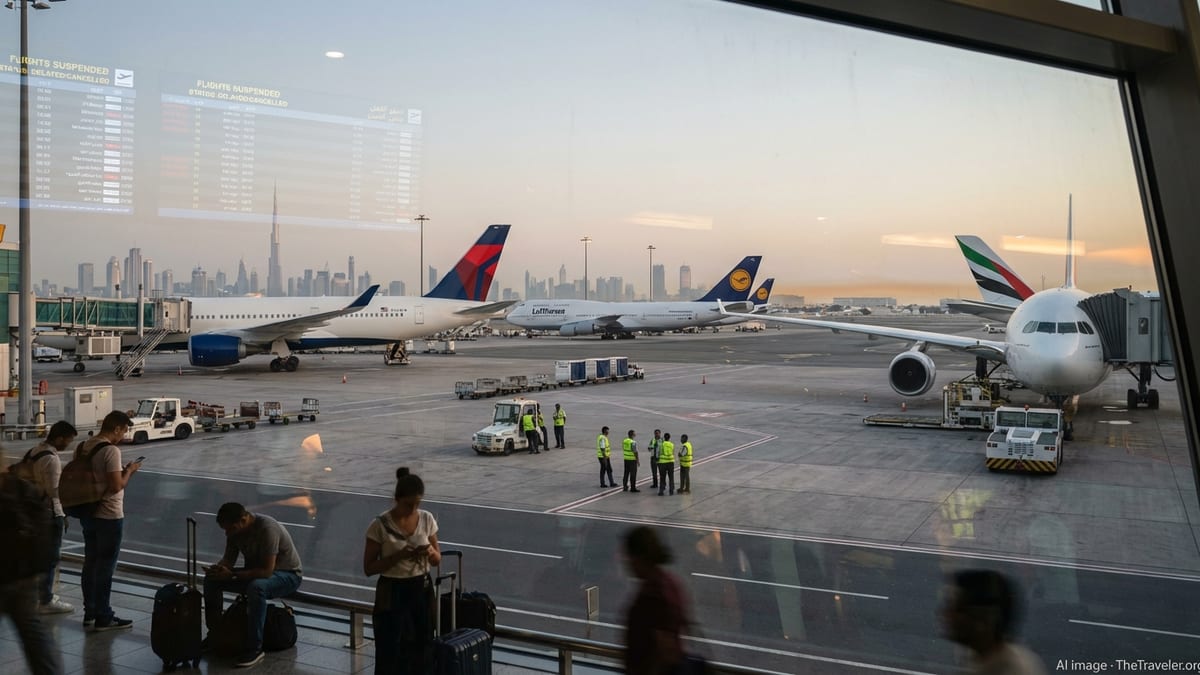
The conflict in the Middle East is exerting pressure not only via fuel markets but also through direct operational disruption. Public reports from airline schedules and airport data providers point to waves of cancellations and reroutings affecting major international hubs such as Dubai, Frankfurt, London Heathrow and New York JFK as carriers adjust to airspace restrictions and recalibrated demand.
At Gulf hubs, including Dubai, airlines have faced intermittent schedule changes and capacity reductions on routes closest to the conflict zone. Longer routings to avoid sensitive airspace have added flight time and fuel burn, further compounding cost pressures. The situation has also complicated network planning for European and Asian carriers that rely on Middle Eastern connections to feed traffic between continents.
In Europe, Frankfurt and Heathrow have seen higher than usual levels of schedule adjustments on services to the wider Middle East and adjacent markets. Flight tracking data and airport operations reports show selective cancellations, downgauging of aircraft and retiming of departures as airlines seek to match capacity with shifting booking patterns and manage crew and fleet utilization under more constrained conditions.
New York JFK, a critical gateway for transatlantic and global traffic, has experienced knock on effects when inbound services from affected regions are delayed or canceled. Airlines operating long haul networks that span the United States, Europe and the Gulf have reported additional operational complexity as they juggle aircraft rotations, maintenance windows and crew duty limits amid heightened uncertainty.
Breaking Even Becomes The New Benchmark For 2026
Against this backdrop, many carriers now frame their 2026 ambitions in far more cautious terms than they did even a few months ago. Commentary from banks and industry observers suggests that for a significant portion of the sector, simply breaking even at the net income level has become a realistic central scenario rather than an overly pessimistic case.
Airlines entered 2026 with comparatively strong balance sheets after several profitable years and capital raisings, which has given them some room to absorb shocks. However, the combination of higher fuel, elevated interest rates and ongoing investment needs is narrowing that cushion. Rising borrowing costs make it more expensive to refinance pandemic era debt and to fund fleet renewal programs that are essential for improving long term fuel efficiency.
Capacity plans are being trimmed as a result. The British Airways parent group, for example, has cut its 2026 capacity growth target to around 1 percent from an earlier 3 percent, largely due to cancellations related to the Middle East and aircraft availability constraints. Similar recalibrations are emerging elsewhere as airlines prioritize yield and cash generation over sheer volume growth.
For now, robust travel demand in many markets is preventing a more severe downturn. Yet the series of forecast downgrades from Wizz Air, Delta, United, British Airways’ owner, Lufthansa, Air France KLM and Qatar Airways signals an industry on the defensive, seeking to protect balance sheets and navigate a year in which geopolitical risk and fuel price volatility threaten to erase much of the profit recovery achieved since the pandemic.