


More news on this day
U.S. Representative Young Kim is calling on the State Department to raise its travel advisory for mainland China from Level 2 to Level 3, arguing that the current guidance understates the risks of wrongful detention, exit bans and arbitrary enforcement of national security laws faced by American visitors.
Get the latest news straight to your inbox!
Call to Move China From Level 2 to Level 3
According to a press release issued on October 29, 2026, and subsequent media summaries, Young Kim, who chairs the House Foreign Affairs Subcommittee on the Indo-Pacific, has sent a formal letter urging Secretary of State Marco Rubio to elevate China’s travel advisory from Level 2 “Exercise Increased Caution” to Level 3 “Reconsider Travel.” The appeal focuses on what she describes as a pattern of state-directed risks for U.S. citizens, including wrongful detentions and the use of exit bans.
Kim’s letter follows the State Department’s October 19, 2026 update to its China advisory, which added a prominent wrongful detention warning and revised language on arbitrary enforcement of local laws, but kept the overall rating at Level 2. Publicly available documentation shows that the advisory now highlights risks tied to national security, counterespionage and data security laws that give authorities broad discretion to investigate and detain foreign nationals.
In her communication, Kim points to ongoing cases of U.S. citizens detained in China and argues that Americans should receive clearer signals about the seriousness of these risks. She contends that leaving China at the same advisory level as many allied democracies can create a misleading impression that the underlying threats are comparable when, in her view, they are rooted in fundamentally different legal and political dynamics.
The push to reclassify China at Level 3 would place it alongside destinations such as Colombia, Nigeria and Pakistan, where the United States already urges travelers to reconsider nonessential trips because of security, detention or civil unrest concerns.
Current U.S. Government Guidance on Travel to China
The State Department’s China country page currently lists mainland China at Level 2 and emphasizes that travelers should exercise increased caution due to arbitrary enforcement of local laws, the risk of wrongful detention and the use of exit bans. The advisory notes that security legislation allows officials wide latitude to interpret conduct as a national security issue, potentially affecting common activities such as research, corporate due diligence, academic collaboration or public commentary.
The advisory history shows that the China rating has shifted in recent years, including a previous Level 3 designation before being moved to Level 2 in late 2024. The October 19, 2026 update did not change the headline level but added the “wrongful detention” risk indicator and expanded language about surveillance, questioning and restrictions that may affect U.S. citizens in various parts of the country.
Travelers are encouraged in the official material to stay informed about local conditions, maintain regular contact with family or employers in the United States and ensure that someone at home holds copies of passports, visas and itineraries. The advisory also underlines that consular support can be limited when local authorities restrict access or delay notification of detentions, a point that has drawn particular concern from lawmakers focused on hostage and wrongful detention cases.
The guidance highlights specific sensitivities in regions such as Xinjiang and Tibetan areas, where heightened security measures, checkpoints and extensive surveillance are common. While these regions are not assigned a higher advisory level than the rest of mainland China, U.S. travelers are told to expect additional scrutiny and to be prepared for restrictions on movement, photography and digital communications.
Wrongful Detentions and Exit Bans in the Spotlight
Kim’s call for a higher risk rating is closely tied to recent attention on alleged wrongful detentions of Americans in China. Publicly released material from Congress and advocacy organizations points to ongoing cases involving U.S. citizens who remain in custody or under travel restrictions, sometimes linked to commercial disputes, security-related accusations or political tensions between Washington and Beijing.
Exit bans, which can prevent individuals from leaving China while legal or administrative matters are pending, have become a central focus of concern. Recent travel advisories describe exit bans that may be imposed without transparent legal processes, sometimes affecting individuals who are not directly involved in the underlying dispute but are connected through family or employment. These measures can leave travelers unexpectedly unable to depart while authorities pursue investigations or use cases as leverage in broader negotiations.
Observers note that national security, counterespionage and data protection laws in China have been expanded in recent years, giving authorities additional grounds to open investigations. Academic work, corporate data transfers, cross-border research and routine online activity can draw scrutiny if officials interpret them as touching on state secrets or national security topics. For travelers, this environment can create uncertainty about what conduct might lead to questioning or detention.
Human rights organizations and some policy institutes have argued that these practices amount to a form of “hostage diplomacy,” in which foreign nationals are detained or restricted in ways that intersect with wider political disputes. While Chinese authorities typically defend such actions as lawful enforcement, the lack of transparent procedures and independent judicial review has led many governments to issue detailed cautionary language for their citizens considering travel.
Implications for U.S. Travelers and Study-Abroad Programs
A shift from Level 2 to Level 3 would not impose a formal travel ban, but it would signal that Americans should carefully reconsider nonessential trips to China and conduct more detailed risk assessments. For leisure travelers, tour operators and business delegations, a Level 3 rating can influence insurance coverage, corporate duty-of-care policies and internal approval processes, potentially leading to fewer group trips or shorter itineraries focused on essential travel.
University and corporate travel offices already treat China as a higher-risk destination than many other countries. For example, some major U.S. institutions require additional approvals, safety plans and insurance enrollment for trips to China, citing national security concerns, digital surveillance and the potential for restricted consular access. A federal move to Level 3 could prompt more universities, nonprofit groups and companies to review their policies, especially for undergraduate study-abroad, faculty field research and technical exchange programs.
Travelers with personal or professional ties that may draw official attention, including individuals with prior government service, dual citizenship, extensive business disputes or public commentary on sensitive issues, are likely to face tougher internal screening from employers and program sponsors if the advisory is raised. Risk managers may recommend enhanced digital hygiene, limited carriage of electronic devices, careful management of business data and more conservative itineraries that avoid politically sensitive events or venues.
Even if the advisory remains at Level 2, the recent addition of the wrongful detention risk label is expected to influence travel decisions. Insurance providers, security consultants and large multinationals routinely track U.S. and allied government advisories and may adjust coverage terms, premiums or on-the-ground support for trips to China as the political and legal environment evolves.
Broader Context for U.S. China Travel Policy
Kim’s appeal comes at a time when the United States and China remain at odds on a wide range of security, economic and human rights issues, from technology controls and outbound investment to maritime disputes and academic exchanges. Travel policy and advisories have become an important part of this broader context, shaping not only individual trip decisions but also the overall volume of people-to-people contact between the two countries.
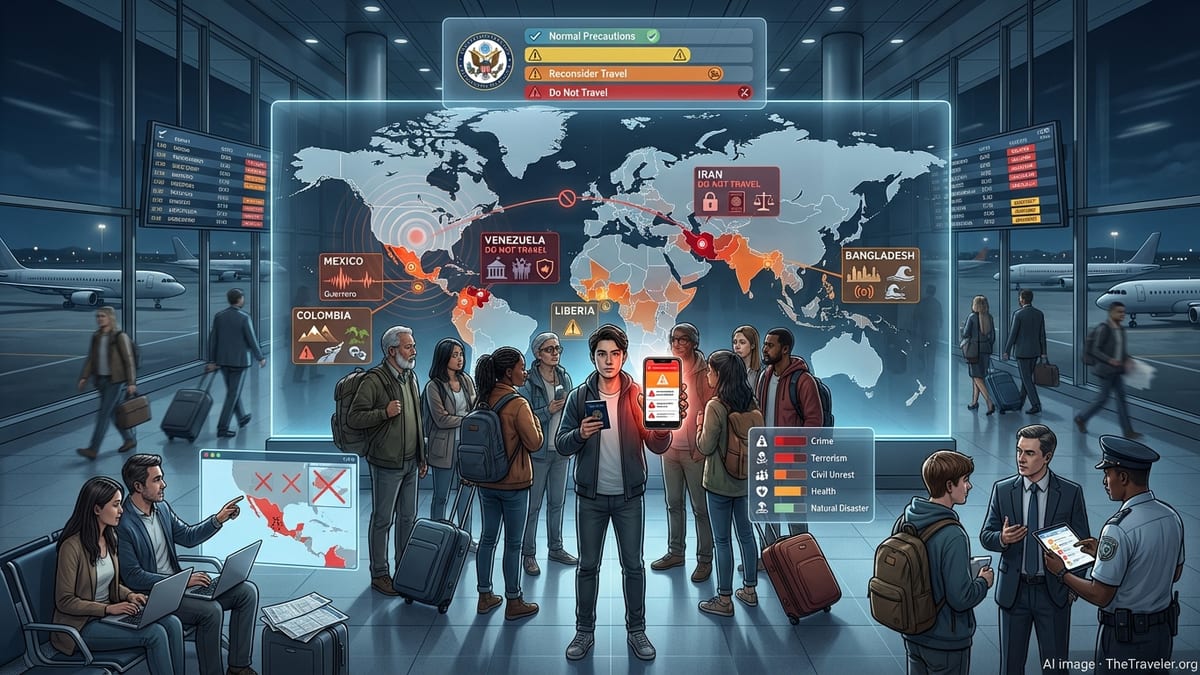
U.S. travel advisories operate on a four-tier system, with Level 1 indicating that travelers should exercise normal precautions and Level 4 advising citizens not to travel. China’s current Level 2 rating places it above destinations considered low risk but below countries where the United States urges citizens to reconsider travel or avoid it entirely because of conflict, widespread crime or systemic detention practices.
Any decision to raise China’s advisory would rest with the State Department, which weighs security, legal and diplomatic factors when assigning ratings. While lawmakers can press for changes through hearings and public letters, final determinations typically reflect input from embassies, consulates, law enforcement agencies and other parts of the U.S. government that monitor threats to citizens overseas.
For now, travelers to China face an environment in which the formal advisory level, legislative pressure for a higher rating and detailed warnings about wrongful detention and exit bans coexist. Americans planning trips are likely to watch closely for any update to the advisory while weighing their own risk tolerance, the essential nature of their travel and the precautions recommended in official guidance.