


Busan is South Korea’s second city and its unofficial capital of sea and sky: a long curve of coastline broken into beaches, rocky peninsulas, working ports and hillside neighborhoods that feel very different from the dense grid of Seoul. The city stretches along the East Sea from the broad sands of Haeundae in the northeast to quieter coves and old ports in the southwest, with commercial centers like Seomyeon and Busan Station in between. For first-time international visitors, the distances can be confusing and it is easy to waste time zigzagging across town. This guide explains Busan’s layout, then offers a detailed four-day itinerary that keeps each day focused on one area, with realistic transit times, food stops and backup plans for weather.
Get the latest updates straight to your inbox!
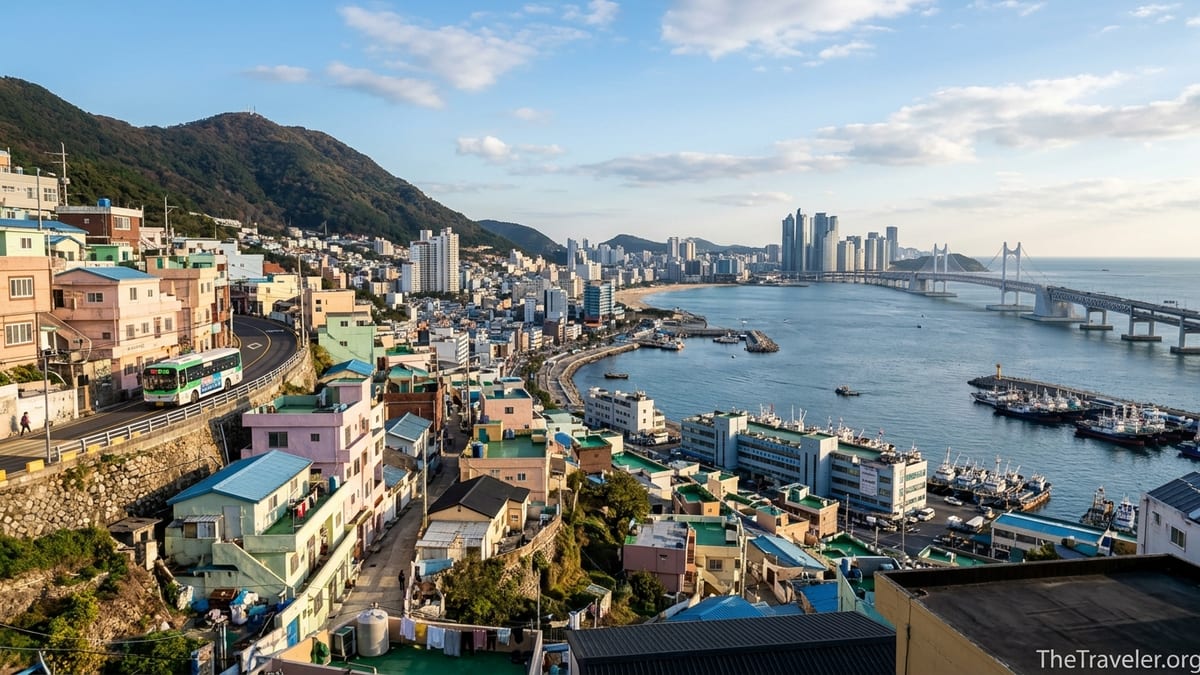
Understanding Busan’s Layout, Districts and When to Go
Busan is a long, narrow city pressed between coastal mountains and the sea. Haeundae and Gwangalli anchor the eastern beaches; Nampo-dong, Jagalchi Market and Busan Station sit around the central port; and Gamcheon Culture Village climbs the hills further inland. Seomyeon lies near the middle as a commercial and transfer hub rather than a sightseeing district. The geography means that moving north–south along the coast is straightforward on the metro, but cutting across hills can be slower than the map suggests, especially by bus.
For a first visit, three full days in Busan is the minimum that feels worthwhile, and four days allows you to see both major beach districts, the historic port area and at least one outlying coastal sight without rushing. Compared with Seoul, Busan feels more relaxed and outdoor-oriented. There are fewer big-ticket museums and palaces and more time on promenades, viewpoints and markets. Many travelers pair four to five nights in Seoul with three to four in Busan, travelling between the cities in about 2.5–3 hours on the KTX high-speed train.
Busan’s main visitor areas each have a distinct character. Haeundae is built around a wide, sandy beach, modern high-rise hotels and attractions like the Blue Line Park. Gwangalli is smaller and hipper, with a long curve of cafes and bars facing the illuminated Gwangan Bridge. Nampo-dong and nearby markets feel more old-Busan: alleys, street-food stalls, fish markets and hillside viewpoints. Seomyeon and the streets around Busan Station are about convenience, shopping and transport rather than sea views. Understanding these differences helps you choose a base and avoid crisscrossing the city unnecessarily.
Busan’s climate is milder than Seoul’s, but still very seasonal. From June to early September the city can be hot and humid, with July and August bringing peak beach crowds and occasional typhoons sweeping up from the south. The official swimming season on major beaches usually runs from early July to late August or early September, with lifeguards and rental umbrellas on the sand; outside those dates you can still walk and paddle, but there may be no lifeguard service and some facilities close. Winters are cool rather than brutal, with many clear days that are ideal for coastal walks, temple visits and cafe-hopping, even if you never swim.
Getting In, Around and Choosing Where to Stay
Most international visitors arrive at Gimhae International Airport, northwest of central Busan. The cheapest and often fastest way into the city is the Busan–Gimhae Light Rail Transit from Gimhae Airport Station, just outside the terminals, to Sasang or Daejeo, where you transfer onto the main Busan Metro. Recent guides and official information indicate that the airport to downtown journey typically costs around 1,600 to 1,800 won with a transport card, depending on distance, and takes roughly 45 to 70 minutes door to door if you are heading to areas like Seomyeon, Busan Station or Haeundae. A taxi to central Busan often takes 30 to 40 minutes in light traffic and might cost in the region of 20,000 won from the airport to Busan Station, somewhat more to Haeundae, which can make taxis good value for two to four people.
From Seoul, the most popular route is the KTX high-speed train on the Gyeongbu Line between Seoul Station and Busan Station. The fastest trains usually take about 2.5–3 hours. There are also slightly slower but cheaper services such as ITX or Mugunghwa on the same corridor, which can take around 4–5 hours. Tickets can be bought online in advance, at station machines or ticket counters, and seats are reserved on most long-distance services. Families or small groups sometimes time their Seoul departure so they reach Busan in the late morning, leave their luggage at the hotel front desk or in a coin locker, and begin sightseeing the same day.
Within the city, Busan’s metro and buses both accept T-money and other common Korean transport cards, as well as region-specific cards sold in convenience stores. As of late 2026, official fare tables indicate that a typical adult metro ride paid with a card starts at about 1,300 won for up to 10 kilometers, with an incremental charge as you travel farther. One of the advantages of using a card rather than paper tickets is the transfer discount, which lets you change between metro and buses within a time limit without paying a full second base fare. When international map apps give incomplete directions, travelers often cross-check journeys using local navigation apps such as KakaoMap or Naver Map, which are available in English and include live bus positions and platform details.
Where you stay affects how efficient this four-day itinerary will feel. Haeundae has the biggest concentration of international-brand hotels and beachfront towers, plus guesthouses and serviced apartments a few blocks inland. Prices for midrange hotels here are often a bit higher than in Seomyeon or Nampo, especially in high season, but you wake up a short walk from the sand. Gwangalli has more small design hotels, pensions and view-focused rooms; these can be good value outside weekends, but waterfront rooms with full bridge views command a premium, particularly on summer Saturdays. Nampo and the markets area offer budget hotels and older midrange properties within walking distance of Jagalchi and BIFF Square, excellent for food and culture. Seomyeon tends to offer the best balance of price and transport convenience, with plenty of restaurants and nightlife but no direct sea view, while the streets around Busan Station are useful for one-night stopovers when rail schedules are the priority.
Day 1: Haeundae Beach, Dongbaekseom and the Blue Line Park
Start your Busan stay in Haeundae to get a sense of the city’s seaside identity. If you are staying nearby, aim to be on the sand by around 9:00 in the morning, when the light is soft and the beach is still relatively quiet even in high season. From Seomyeon or Busan Station, metro Line 1 and a transfer to Line 2 will usually get you to Haeundae Station in about 35 to 45 minutes. From Exit 5 or 7 it is a 10-minute walk down to the waterfront. Pick up a simple breakfast from a bakery or convenience store near the station or choose one of the cafes facing the beach, where a coffee and pastry might cost around 7,000 to 10,000 won per person.
Spend the morning walking east along Haeundae Beach toward Mipo, the old rail terminus at the far end. This is also the access point for Haeundae Blueline Park, which runs along a converted coastal railway. You can ride the open-sided Beach Train or the enclosed, colorful Sky Capsule. According to the operator’s recent fare table, a one-way Beach Train ticket between Mipo and Songjeong costs about 10,000 won per person, while the Sky Capsule is priced per capsule at roughly 50,000 won for two, 55,000 won for three or 60,000 won for four passengers. A popular strategy is to reserve a Sky Capsule ride in one direction for the late morning and return by Beach Train or by walking part of the stunning sea-front path. Ride times are roughly 25 minutes for the train between Mipo and Songjeong and about 30 minutes for the Sky Capsule between Mipo and Cheongsapo, so you can realistically fit both the ride and a short cafe stop into a single morning.
For lunch, many travelers disembark at Cheongsapo, a small fishing village between Haeundae and Songjeong. Around the station and lighthouse you will find seafood restaurants serving grilled shellfish, fish stews and simple set meals. Expect to pay in the region of 12,000 to 18,000 won per person for a basic grilled fish or jjigae set, more for elaborate platters of shellfish. After lunch, walk a section of the coastal walkway back toward Mipo or onward toward Songjeong Beach if you prefer a quieter, more local stretch of sand. The boardwalk is relatively flat, but if you continue inland you will encounter some stairs and short inclines.
Return to central Haeundae in the mid-afternoon and head toward Dongbaekseom Island, the wooded peninsula at the western end of the beach. From the main beachfront, it is 10 to 15 minutes on foot to the trailhead near the Westin hotel complex. A loop walk around Dongbaekseom’s cliffs and camellia trees takes about 45 to 60 minutes at a relaxed pace, with wooden walkways, modest stair sections and views of Nurimaru APEC House and Gwangan Bridge in the distance. In the evening, dine near Haeundae Market, a few blocks inland, to sample Busan specialties like dwaeji gukbap, a comforting pork and rice soup that often costs around 8,000 to 10,000 won a bowl, or milmyeon, a chewy wheat noodle dish served in cold broth for similar prices. If you still have energy, return to the beach promenade to see the lights of the skyscrapers and seasonal installations reflected on the water before catching the metro or taxi back to your hotel.
Day 2: Gwangalli, Gwangan Bridge Views and Seaside Nightlife
Gwangalli Beach and the huge span of Gwangan Bridge offer a different mood to Haeundae. The sand is narrower, the skyline lower, and the focus is as much on cafes, bars and bridge views as on swimming. Start your day around 9:30 with a ride on Metro Line 2 to Geumnyeonsan or Gwangan Station, from which it is a 5 to 10 minute walk to the seafront. Many visitors choose a brunch cafe directly facing the sand, accepting slightly higher drink prices in return for floor-to-ceiling windows. Expect specialty coffee drinks in the 6,000 to 8,000 won range and brunch plates from around 12,000 won upward, with a clear premium for window seats on weekend mornings.
After breakfast, stroll the length of Gwangalli Beach. At the eastern end you can access low rocky outcrops for views back across the sand; at the western end, small piers and side streets lead to quieter corners and residential neighborhoods. The beach itself is flat and stroller-friendly, making this one of the easier waterfronts in Busan for families or anyone with limited mobility. On clear days, consider continuing inland to Geumnyeonsan Mountain Park for sweeping views over the bridge and coastline. Reaching the higher viewpoints involves some steep paths and stairs, so this is best for travelers with a reasonable fitness level and good shoes.
For lunch, look for small local restaurants a block or two behind the main strip, where menus often feature casual dishes like kimchi jjigae, kimbap or simple grilled fish at slightly lower prices than the beachfront. A filling meal can often be had for 9,000 to 15,000 won per person in these back streets. Alternatively, if you skipped Geumnyeonsan, this can be a good time to take a short taxi ride, perhaps 10 to 15 minutes, to Millak Raw Fish Town at the eastern end of Gwangalli. Here, floors of sashimi restaurants overlook the sea. Ordering a platter involves choosing the fish and size, usually priced for two or more people; ask the staff for guidance as menus can be complex and include side dishes.
In the afternoon, you might return to your hotel to rest, or combine Gwangalli with a side trip to Oryukdo Skywalk if the weather is clear. Reaching Oryukdo from Gwangalli usually takes around 40 to 50 minutes by metro and bus or 20 to 30 minutes by taxi depending on traffic. The skywalk itself is a short experience, often less than 30 minutes including waiting time: you put on shoe covers and walk out over a glass platform suspended above the sea. There is no high admission fee but you invest time getting there, so it is best on days with good visibility. If conditions are hazy or rainy, Gwangalli’s cafes and indoor viewpoints make a more comfortable afternoon.
As night falls, Gwangalli comes into its own. Gwangan Bridge lights up in changing colors and patterns, reflected in the bay. This is a prime time to choose a second-floor cafe or bar with large windows. Drinks along the main strip can range from 6,000 won for a beer or house wine to significantly more in cocktail-focused venues, and many places serve fried chicken platters or sharing plates that work for groups. Families can simply sit on the sand with convenience-store snacks and watch the bridge, while couples often enjoy a late walk along the waterline. Compared with Haeundae, Gwangalli at night feels more compact and social, less about large hotels and more about independent venues.
Day 3: Markets, Gamcheon Culture Village and Old Port Busan
Day three focuses on the cultural and historic heart of Busan around Nampo-dong and the port. Begin around 9:00 at Jagalchi Station on Metro Line 1 and walk a few minutes to Jagalchi Fish Market, one of Korea’s best-known seafood markets. The ground floor is full of individual stalls selling live fish, shellfish and crustaceans in tanks; upstairs, informal restaurants will cook your purchases or offer simple set menus. It is polite to ask before taking close-up photographs of vendors, and to keep walkways clear when you stop to look. Prices vary depending on season and species, but a basic grilled fish or seafood stew meal often starts around 10,000 to 15,000 won per person in the upstairs eateries.
From Jagalchi, walk toward BIFF Square and the surrounding streets of Nampo-dong. Here you will find snack vendors selling hotteok filled with brown sugar and nuts, skewers, tteokbokki and other street foods. Most items cost only a few thousand won each, so you can sample several things instead of sitting down for a large lunch. Watch for queues forming in front of particularly famous stalls and be prepared to move aside quickly after receiving your food, as space is tight and locals use these lanes for their daily routines. Continue north to Gukje Market, a large traditional market with clothes, household goods and more food stalls. While bargaining is less common than in some countries, you can politely ask for a small discount when buying multiple items.
In the early afternoon, make your way to Gamcheon Culture Village, which clings to the hills southwest of Nampo. From Toseong Station on Line 1, local buses or short taxis climb the steep roads up to the village entrance in around 10 minutes. The streets within Gamcheon are steep, narrow and stepped, with viewpoints over pastel houses that attract large crowds. The area is still residential, and residents have long requested that visitors respect privacy. Avoid pointing cameras directly into windows or courtyards, step aside when residents need to pass, and keep voices down in quieter alleys. Walking the main signed route with photo spots and cafes usually takes 1.5 to 2 hours. Those with mobility issues may find Gamcheon challenging because of long staircases and uneven paths; in that case, consider focusing your time on Nampo’s flatter markets and the park instead.
Return to Nampo-dong by mid to late afternoon to visit Yongdusan Park, accessible by escalator or via short but fairly steep paths. At the top, Busan Tower and surrounding terraces provide views over the port and city. You can choose whether to pay for tower admission; while the top offers a higher vantage point, some travelers feel that the free outdoor viewpoints in the park are sufficient, especially on days with hazy visibility. As evening sets in, Nampo-dong’s neon signs light up and the markets wind down. This is a good time for a sit-down meal of grilled fish, pork dishes or casual Korean barbecue in the streets behind the main shopping area. Because this is an older commercial district, restaurant prices are often slightly lower than in Haeundae, and it is easy to find hearty dinners in the 12,000 to 20,000 won per person range excluding alcohol.
Day 4: Temples, Coastal Walks and Outlying Views
Use your fourth day to explore one or two of Busan’s more scenic outskirts. A classic choice is Haedong Yonggungsa Temple, a Buddhist temple perched on cliffs northeast of Haeundae. City tourism information and temple-focused guides note that the complex does not charge a fixed entry fee, though parking fees apply for vehicles. Opening hours vary slightly with the season, but recent checks in 2026 confirm early morning opening and closure before late evening; many sources recommend arriving soon after opening to avoid crowds. To reach the temple, take Metro Line 2 toward Jangsan, then a local bus or taxi for the last stretch; from central Haeundae, the journey typically takes 30 to 45 minutes each way.
The temple grounds include stone steps down toward the main courtyard and up to hilltop statues, so some stair climbing is unavoidable. Plan around 1.5 to 2 hours on site if you move at a relaxed pace, more during busy holiday periods when paths can bottleneck. Modest clothing is appreciated; while many visitors take photographs, it is courteous to avoid blocking worshippers or photographing people in the midst of prayer. There are snack stands and simple food stalls near the entrance, but many travelers prefer to return toward Haeundae or Jangsan for lunch in restaurants with more choice.
In the afternoon, you can pair Haedong Yonggungsa with a second coastal attraction, but it is important to avoid overloading the day. Combining the temple with Songjeong Beach is realistic: the beach is a relatively short taxi or bus ride away and offers surfer cafes and a quieter, more local feel than Haeundae. Spending an hour or two at Songjeong for coffee and a walk before heading back to your base keeps total transit time manageable at perhaps 60 to 90 minutes of travel across the whole afternoon. Trying to fit both Haedong Yonggungsa and Taejongdae on the same day is usually inefficient, since they sit on opposite sides of the city and would involve multiple metro and bus legs or lengthy taxi rides.
Alternative excursions include Taejongdae Resort Park, Huinnyeoul Culture Village above the west coast cliffs and the Songdo Beach area with its cable car. Taejongdae involves forested walking paths and cliff-side viewpoints, with internal shuttle buses for those who prefer not to walk the full loop. Huinnyeoul offers narrow alleys, sea views and cafes similar in feel to Gamcheon but with more open sea vistas; some travelers enjoy it as a less crowded alternative. Songdo Beach combines a small sandy bay with a glass-floored skywalk over the water and the Songdo Marine Cable Car, which runs across the bay to a hilltop park with trails and dinosaur-themed installations. Many visitors find the Songdo cable car a better value than paying premium rates for Haeundae’s Sky Capsule if they want a longer ride and changing views, while others prioritize the open-sea track of the Blue Line Park. Your interests and the weather should determine which combination you pick.
The key on this fourth day is to choose a cluster of sights in the same general quadrant of Busan. For example, one realistic plan is Haedong Yonggungsa in the morning, Songjeong Beach in the early afternoon and a quiet evening in Haeundae. Another is a full afternoon at Taejongdae, perhaps followed by dinner in Nampo-dong since the bus back often passes that area. Checking bus routes ahead of time on a local navigation app will help you avoid unnecessary transfers. If rain or strong winds make coastal viewpoints less appealing, consider visiting indoor spaces like Busan Museum, Shinsegae Centum City’s shopping and spa complex, or one of the city’s large multiplayer arcades or cafes instead.
Food Culture, Budgets and Practical Logistics
Busan’s food culture revolves around the sea and a handful of local comfort dishes. Dwaeji gukbap is perhaps the best-known: a rich pork and rice soup that many local restaurants serve around the clock. A typical bowl in a simple eatery might cost 8,000 to 10,000 won and comes with kimchi and side dishes. Milmyeon, a chilled wheat noodle dish developed in Busan, is another affordable staple, often priced similarly to cold naengmyeon noodles elsewhere in Korea. At seafood markets like Jagalchi or Millak, prices climb when you order sashimi or elaborate platters. It is common to choose your fish from a tank and agree a total price for a group, so do not hesitate to ask what the final amount will be before confirming.
Street food is everywhere in areas like BIFF Square, Nampo-dong, Seomyeon and around metro exits in Haeundae. Items such as hotteok, skewers, dumplings and tteokbokki usually cost in the region of 2,000 to 6,000 won per portion, making them an easy way to eat cheaply between sights. At the same time, Busan has a growing scene of modern bakeries and dessert cafes that sell croissants, cakes and elaborately decorated pastries; these can be more expensive than simple Korean bakeries, with individual items in the 4,000 to 8,000 won range. In markets and small eateries, it is polite to return your tray or dishes to the pickup counter if others are doing so, and to avoid lingering at crowded stalls after finishing your food.
Daily budgets vary widely, but some rough examples help. A solo traveler staying in a modest hotel or guesthouse in Seomyeon or Nampo might spend around 70,000 to 120,000 won per night on accommodation, 25,000 to 40,000 won on three meals and snacks, and 5,000 to 10,000 won on metro and bus fares, plus extra for taxis and attractions like cable cars or capsule rides. A couple staying in a midrange Haeundae or Gwangalli hotel with a partial sea view may pay 140,000 to 250,000 won or more per night, with shared food and transport widening the range depending on whether they favor street food and local restaurants or international dining. Families often find that apartment-style stays near Haeundae or Gwangalli offer good value once the cost is divided, but should factor in higher spending on activities such as the Blue Line Park and Songdo cable car.
Accessibility is an important consideration in Busan. The metro itself is generally accessible, with elevators and priority seating, but some older stations may require careful navigation to find lifts. Hillside areas like Gamcheon and Huinnyeoul include long flights of stairs and narrow alleys that are not suitable for wheelchairs and can be tiring for those with limited mobility. For these travelers, flatter routes like the Haeundae and Gwangalli promenades, Dongbaekseom’s boardwalk sections and Nampo’s main shopping streets are better choices. Coin lockers at major metro stations and Busan Station allow you to store luggage for several hours for a small fee, and some private luggage delivery and storage companies operate around Haeundae, Nampo and the train station, which can be handy on arrival or departure days.
Common navigation mistakes include underestimating how long bus journeys take in traffic, assuming walking routes are flat when the map shows a short distance, and changing metro lines unnecessarily instead of walking an extra block at street level. Travelers also sometimes assume they can do both far-northeast sights like Haedong Yonggungsa and far-southwest spots like Taejongdae in a single day; while not impossible, it leaves little time to actually enjoy each place. Checking point-to-point routes in a local map app shortly before you travel will give more realistic travel times than planning purely from static tourist maps printed months earlier.
Two-Day and Five-Day Variations, Weather and Crowd Tips
If you only have two full days in Busan, keep your plans tight and geographically logical. One efficient two-day outline is to spend the first day on Haeundae, Dongbaekseom and the Blue Line Park, then the second on Nampo-dong, Jagalchi Market, BIFF Square and Gamcheon Culture Village. Gwangalli can be added as an evening stop on either day if you are staying nearby or do not mind a metro ride back. In this version, it is usually wiser to skip extensive side trips like Haedong Yonggungsa or Taejongdae and focus instead on experiences you can reach in 40 minutes or less from your hotel.
With five days, you can slow the pace and include more secondary attractions. A reasonable five-day schedule might begin with Haeundae and the Blue Line Park, then continue with Gwangalli and Oryukdo Skywalk, a full cultural day in Nampo-dong and Gamcheon, a temple and coastal day incorporating Haedong Yonggungsa and Songjeong, and a west-coast finale at Taejongdae and Songdo’s cable car or Huinnyeoul Culture Village. The extra day gives you flexibility to insert a rest morning in a cafe if you hit a stretch of rainy or humid weather, or to revisit a neighborhood you particularly enjoyed without needing to rush to tick off new sights.
Crowd patterns and weather should shape your plans. In summer, Haeundae and Gwangalli beaches are busiest on weekends and public holidays, especially in the afternoon when umbrellas and inner tubes pack the sand. Official information and local discussion indicate that the lifeguard-supervised swimming season ends by mid-September, after which some facilities close and beach rules relax, but locals still visit the water on warm days. Typhoon season peaks from late summer into early autumn; if a storm approaches, coastal attractions such as Taejongdae, Oryukdo and Huinnyeoul may temporarily close or become unpleasantly windy, so consider indoor alternatives or central neighborhoods on those days.
Finally, it is worth critically weighing which paid attractions are worth your time and money. Many visitors feel that riding the Haeundae Sky Capsule once is memorable, particularly at off-peak times or in small groups, but some are underwhelmed when queues are long and tickets expensive for a relatively short ride. The Beach Train offers similar views at a lower per-person price and is rarely as competitive to book. Songdo’s cable car gives a longer ride and often more dramatic topography for the fare. Oryukdo Skywalk provides a brief but photogenic glass-floor experience that can feel anticlimactic after a long journey; combining it with a coastal walk or nearby cafes makes it more satisfying. Busan Tower’s paid observation deck is pleasant on clear evenings but arguably skippable if you already enjoy high views from hiking points or hotel lounges. By organizing your days around geography and your own interests rather than a checklist, Busan becomes less a rush of transfers and more a sequence of relaxed coastal neighborhoods, each with its own personality.