


The Bergen Line between Oslo and Bergen operates all year and in winter it usually takes around six-and-a-half to seven-and-a-half hours, depending on the specific departure and operating conditions. Trains are run by Vy with both daytime and night services on most days, and winter journeys require more planning than in summer because of short daylight, snow and occasional disruptions.
Get the latest updates straight to your inbox!
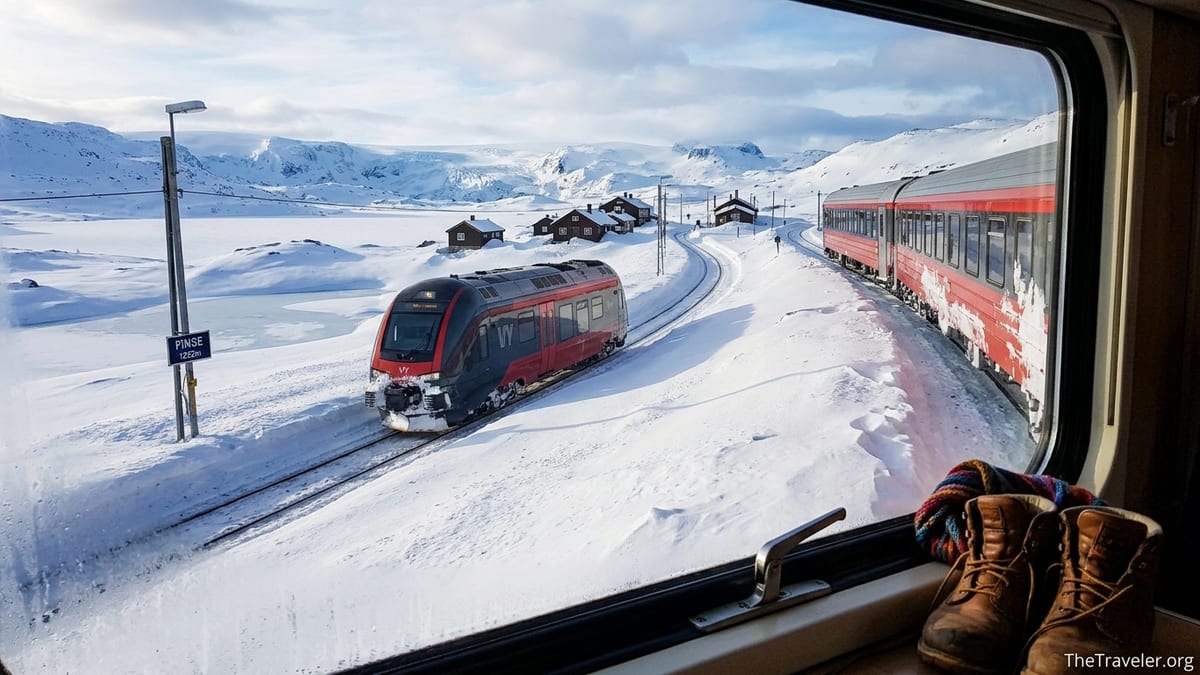
Understanding the Bergen Line in Winter
The Bergen Railway, or Bergensbanen, links Norway’s two largest cities across the spine of the country and has been in operation since 1909. Vy confirms that the journey between Oslo and Bergen normally takes about 6.5 to 7.5 hours, with a mix of regular daytime departures and a night train on many dates. In winter the line runs daily, but individual departures can change with the national timetable revision each December, so it is important to check specific dates in Vy’s journey planner rather than relying on older printed timetables.
Vy’s current information describes six to seven departures per day along the route, taken together in both directions. Daytime services are branded as line F4 Oslo S–Bergen in the timetable, with a separate listing for the Bergen–Voss–Myrdal section as R40. Recent winter timetables for the period from mid-December to late April show several daytime trains plus a night train on most nights, though engineering work can temporarily reduce frequencies. Because departure patterns can shift slightly year to year, especially around Christmas and Easter, travelers should expect small differences rather than identical times every winter season.
Operationally, winter is part of the normal life of the Bergen Line rather than a special season. The route is built for snow and sub-zero temperatures on the Hardangervidda plateau, and traffic generally continues even when lowland roads are affected. The trade-off is that heavy snow, wind or technical issues occasionally slow trains or require closures for safety, and journey times then stretch beyond the scheduled 6.5 to 7.5 hours. Vy flags such disruptions on its traffic information pages and in the app on the day.
For travelers planning a winter trip in the 2026–27 season, it is realistic to treat the Bergen Line as a year-round workhorse but to allow a buffer of at least one or two hours after arrival for onward flights or cruises. The closer the journey date is to holiday periods or major engineering projects, the more important this buffer becomes.
Route Overview: Oslo to the High Plateau and Down to Bergen
The journey starts at Oslo Central Station, heading west through suburbs and forested hills before climbing gently along inland lakes and valleys. Early in the journey, the landscape includes views toward Norefjell and the long Krøderfjord. Trains then continue into higher country, with stations such as Gol and Ål giving a sense of transition between the lowlands and the mountain areas where snow often lingers from early winter into spring.
Geilo, roughly midway between Oslo and Bergen, is the first major mountain resort on the line and a popular stop for skiers. From here the train climbs further to cross Hardangervidda, one of Europe’s largest high-mountain plateaus. The line reaches its highest point at Finse, a small settlement accessible only by rail that sits at around 1,222 meters above sea level. In winter Finse is surrounded by snowfields, frozen lakes and glimpses of nearby glaciers, and it is a noted base for cross-country skiing and polar-style expeditions.
Beyond Finse, the line continues across exposed terrain before descending toward Myrdal, an important junction perched high above the western fjord valleys. Myrdal is the connection point for the Flåm Railway, a steep branch line that drops down to Aurlandsfjord. Continuing beyond Myrdal on the main line, the train runs through a series of tunnels and dramatic valleys toward Voss, with river gorges and waterfalls that can be particularly atmospheric in winter when partly frozen.
From Voss the line follows more temperate valleys and lakes before entering a final sequence of tunnels and emerging at Bergen, near sea level. In winter it is entirely possible to experience several distinct climate zones in a single day, from near-coastal conditions around Bergen through snowy uplands to colder continental air near Oslo, which adds to the feeling of a cross-country expedition even on a standard scheduled service.
Daylight, Departure Times and What You Actually See
In winter, what you see from the train is determined as much by sunrise and sunset as by your seat. Around late December, Oslo’s daylight is limited to roughly the mid-morning to mid-afternoon period, with sunrise close to 09:15 and sunset shortly after 15:00. Bergen’s midwinter day is slightly milder but still short, and the highest sections of the line around Finse often lie in low winter sun for only a few hours. Vy itself cautions that the line is beautiful in winter but that daylight is limited.
On a typical winter timetable, an early-morning Oslo departure around 08:00 allows passengers to leave the city in growing light, reach Geilo late in the morning and cross Hardangervidda and Finse in early afternoon when the sun is still up. This pattern means that most of the dramatic high plateau scenery is visible even near the December solstice. An early afternoon departure from Oslo in deep winter, on the other hand, may traverse much of the mountain section in darkness, limiting views but offering a quieter, more cocooned experience inside the train.
By February and March the balance changes. Day length increases rapidly, and a mid-morning departure can still give broad daylight across the entire mountain stretch while avoiding an especially early start. For instance, in March it is common to have well over ten hours of daylight in Oslo and Bergen. That means both morning and early afternoon trains will usually cross the high plateau with good visibility, which is a key reason many Norwegian travelers consider March a prime month for a scenic winter ride.
For those aiming to capture views on camera, a practical strategy is to choose a departure that reaches Geilo no earlier than mid-morning and Finse before mid-afternoon on the particular date being traveled. Checking expected sunrise and sunset for that date, then cross-referencing with the station passing times in Vy’s journey planner, gives a realistic sense of when snowfields and summits will actually be visible rather than left to the imagination behind dark windows.
Seat Selection, Ticket Types and Onboard Comfort
Vy confirms that seat reservations are included in the ticket price for services on the Bergen Line, and that travelers normally choose specific seats from a seating map during the booking process. An exception applies to the cheapest Lowfare tickets, where a seat is allocated automatically rather than chosen, and some travelers with rail passes must arrange reservations separately through customer service or staffed stations. The operator notes that seat locations can occasionally change when different trainsets are substituted, so exact window or aisle placement is not guaranteed even when selected.
For travelers interested in views, local advice and Vy’s own guidance emphasize that on journeys from Oslo toward Bergen, the left-hand side in the direction of travel tends to offer broader vistas over Hardangervidda and toward the high plateau. On the western half of the route, especially between Myrdal, Voss and the approach to Bergen, many valleys and river views can be more prominent on the right-hand side. However, no seat provides unobstructed scenery throughout, because tunnels, cuttings and snowdrifts often limit the view, especially in rough weather.
Vy sells different ticket products, typically including a more flexible option often labeled Flex, as well as more restrictive discounted fares. Recent policy information states that Flex tickets on the Bergen Line can usually be changed without fee up to the scheduled departure time, though they may not be fully refundable. By contrast, cheaper advance fares tend to be more restrictive about changes and cancellations. Children, youths and seniors benefit from defined percentage discounts on many tickets, though some discounts do not apply to the Flåm Railway, which has its own pricing.
Onboard facilities reflect the line’s long-distance nature. Vy’s information for the Oslo–Bergen route mentions a family carriage, luggage space and toilet facilities on board. Larger suitcases generally go on racks at the end of each coach or above seats, and Vy also offers separate paid baggage transport between Oslo and Voss or Bergen for travelers with more than the standard amount of luggage. Wheelchair users can request ramp assistance and designated spaces when booking, and there are accessible toilets on long-distance trains. Families with small children will find designated pram or stroller spaces in particular carriages on the Bergen Line, and staff can help locate these areas when boarding.
Quiet Zones, Food and Night Trains
Vy operates quiet zones on several Norwegian routes, with specific rules that require silence and discourage phone calls. The formal quiet zone list published by Vy centers on routes in Eastern Norway, and it does not guarantee a dedicated quiet carriage on every Bergen Line departure. Travelers seeking a low-noise environment should check during seat selection to see whether a designated quiet area appears on the carriage map of their chosen train. Where no official quiet zone exists, it is still often possible to find relatively calm seating in end-of-train coaches, away from the family carriage.
Food and drink on the Bergen Line vary by trainset, but long-distance services typically include either a café counter or a small bistro area selling hot drinks, simple hot meals, sandwiches and snacks. Prices are in line with Norwegian norms rather than budget fast food, so many travelers choose a mix of onboard purchases and their own supplies from Oslo S or Bergen station. Tap water on the train is safe to drink, and hot water for baby food can usually be requested from the café staff. In periods of disruption, the onboard catering offer can be reduced if staff and supplies are constrained.
Night departures shorten the perceived journey and free up daylight for other activities but reduce your ability to see the scenery. A typical pattern in recent timetables is for a night train to leave Oslo late in the evening and arrive in Bergen early in the morning, with sleeping compartments and reclining seats available for a supplement. Journey time is broadly similar to daytime runs, but the high plateau section is traversed in darkness for most of the winter. Night trains are a functional choice rather than a scenic one, well suited to repeat visitors or those connecting efficiently with early flights or cruises from Bergen.
Because the presence of a night train on specific dates is subject to timetable changes, it is wise to search by date and look for departures labeled with sleeping car options instead of assuming a nightly service. When sleeper berths are available, they should be booked as early as possible in peak holiday periods, since space is limited and cabins are popular with families and groups who want privacy.
Winter Operations, Disruptions and Engineering Work
Winter snow itself is not a reason to cancel most Bergen Line trains. The route across Hardangervidda was engineered for harsh conditions, and winter snow-clearing and maintenance are a normal part of operations. Trains often run through deep snow walls that make for striking photos but represent normal safe conditions. In these circumstances, delays may be modest or absent, and journey times stay close to the published 6.5 to 7.5 hour range.
Exceptional disruption occurs when a combination of strong winds, heavy drifting snow, avalanche risk or technical problems affect the exposed high plateau. In such situations, infrastructure managers and Vy may slow trains significantly or suspend services across the critical section until conditions improve, sometimes substituting buses on lower parts of the route. Because no road crosses Hardangervidda exactly alongside the railway, replacement transport can be circuitous, and total travel time may increase by several hours.
Separate from weather, planned engineering work also affects winter travel. National timetables indicate periods where the Bergen Line runs on diverted routes, for example via Roa on certain days, or operates to altered times around holiday seasons. There are also multi-day blocks for construction or maintenance during which rail segments might close and buses take over. Vy publishes these timetable changes in dedicated notices and often adjusts the regular F4 Oslo–Bergen timetable PDFs for short windows, such as around Easter.
For travelers, the practical response is to avoid tight same-day connections to flights or long-distance cruises in the deep winter months, especially from late November to early March. Building in a buffer of two to three hours in Oslo or Bergen, or staying overnight before onward international travel, turns potential disruption from a crisis into a manageable delay spent in a café instead of a check-in queue.
One Day or Two: Breaking the Journey at Geilo, Finse or Myrdal
Whether to ride Oslo–Bergen in one long winter day or split it into two stages depends on your priorities. For many travelers, the through journey is entirely comfortable in a single stretch, especially when starting early from Oslo and arriving in Bergen by late afternoon or early evening. Seats are reasonably spacious, there are toilets and food available, and the changing views give a sense of progression that reduces monotony compared with a similar-length flight plus airport transfers.
Breaking the journey introduces extra experiences at the cost of additional logistics. Geilo is the most straightforward overnight stop for winter visitors. It has a compact resort town with hotels and cabins within walking distance of the station, downhill and cross-country ski areas, and restaurants that remain active throughout the snow season. In practice, this makes it easy to take a mid-morning train from Oslo to Geilo, spend an afternoon and evening skiing or walking, stay overnight and continue toward Bergen the next day around mid-morning, arriving in the afternoon.
Finse offers a dramatically different, more remote option. It is only reachable by train or on skis and is surrounded by snow-covered terrain ideal for ski touring. Winter accommodation is more limited and, in some periods, oriented toward groups and outdoor enthusiasts. When a hotel or mountain lodge is open, travelers can step directly from the platform into the snow, spend a day or more exploring the plateau and then re-board the train to continue to Bergen. Because facilities are fewer and conditions harsher, this is better suited to prepared winter travelers rather than first-time visitors with heavy luggage or young children.
Myrdal functions primarily as a junction rather than a destination. While it has basic services and lodging options linked to the Flåm Railway, it is not a full resort like Geilo. A more practical two-day plan that uses Myrdal involves spending a night in Flåm down by the fjord, accessed via the Flåm Railway branch, and returning to Myrdal the following day to rejoin the main line to Bergen. Winter schedules for the Flåm Railway are thinner than summer but still run, so anyone considering this detour must match Oslo–Myrdal arrivals with the Flåm departures for their exact dates.
Sample Itineraries and Cost Comparisons
A realistic one-day winter itinerary might look like this for a February or March trip: arrive at Oslo S at least 30 to 40 minutes before departure, having purchased tickets in advance via Vy’s website or app, and board a morning train around 08:00. This schedule typically reaches Geilo late morning, Finse early afternoon and Myrdal mid-afternoon, all in daylight, before arriving in Bergen between 15:30 and 17:00, depending on the specific train. Travelers staying in central Bergen can then walk or take local transport to hotels within 15 to 25 minutes of arrival, with a safe margin before dinner reservations or evening events.
A two-day alternative might involve a morning or late-morning departure from Oslo to Geilo, arriving by around lunchtime. After checking into a hotel within a short walk or taxi ride of the station, the afternoon can be spent skiing, snowshoeing or simply enjoying the winter atmosphere. The following day, a late-morning train from Geilo can carry you across Hardangervidda and Finse in the bright midday sun, on to Myrdal and Voss, and into Bergen by mid-afternoon. This splits the scenic section into two shorter travel days and allows time for mountain activities.
Ticket prices fluctuate with demand, discounts and ticket type, so the most accurate figures come directly from Vy’s journey planner for your specific date. As a broad indication based on recent winter fares, advance Lowfare tickets on the Bergen Line are often noticeably cheaper than fully flexible options, while Flex tickets cost more but allow date and time changes at no fee up to departure. Families can reduce overall costs through child and sometimes youth discounts, especially when booking early on popular dates such as winter school holidays.
When compared with flying between Oslo and Bergen, door-to-door timing is competitive. A direct flight might take around one hour in the air, but travelers must account for getting to Oslo Airport, security, boarding, potential delays, then transport from Bergen Airport Flesland into the city center. In practice, total travel time by air often runs to four or more hours from central Oslo address to central Bergen hotel. The train, while longer in absolute terms, removes airport formalities, offers a nearly continuous view and deposits you directly at central stations in both cities, making it attractive to travelers who value experience over raw speed.
Who Is the Bergen Line Best For, and When?
For photographers, the Bergen Line is one of Europe’s great winter rail journeys, especially in late February and March when daylight is longer but snow cover usually remains deep on the plateau. A morning or late-morning departure from Oslo in those months brings a long stretch of sunlit views around Geilo, Finse and Myrdal, with low-angle light ideal for capturing shapes in the snow. It is worth reserving a left-hand seat out of Oslo for Hardangervidda and then moving to vestibule windows or door windows on the opposite side later if the train is not crowded.
First-time visitors to Norway who want a scenic highlight without complex logistics will typically be happiest with a single daytime Oslo–Bergen ride. Booking a seat on the view-favored side, paying a little extra for a more flexible ticket in case of plans changing, and allowing a time buffer for onward travel delivers a memorable yet low-stress introduction to the country. Those arriving from overseas might consider riding Oslo to Bergen by day and then flying back, or vice versa, to experience both perspectives.
Families benefit from the family carriage, pram spaces and solid onboard facilities, but should still prepare for a long day. Bringing snacks, games and downloaded shows for children, along with warm clothing for any fresh-air breaks at stations such as Geilo or Myrdal, makes the journey smoother. An overnight stop at Geilo can be an excellent way to break up the journey for younger children while adding a ski day or sledging afternoon.
Travelers choosing between winter and summer will find that the core experience differs more in atmosphere than in logistics. Summer brings longer days, green valleys and open views almost the entire way, with increased tourist traffic and busier Flåm connections. Winter highlights include deep snow, low northern light and a greater sense of isolation across Hardangervidda, but require more care with departure times, buffers and clothing. For scenic rail enthusiasts and photographers, a clear winter day on the Bergen Line is one of the most rewarding ways to cross Norway, as long as expectations around daylight, weather and potential delays are set realistically from the start.