

More news on this day
AEGEAN Airlines has extended and widened flight cancellations across Israel, Iraq, Lebanon, the United Arab Emirates and Saudi Arabia, as spreading conflict and airspace restrictions across the Middle East continue to upend travel plans and complicate airline operations well into late March.
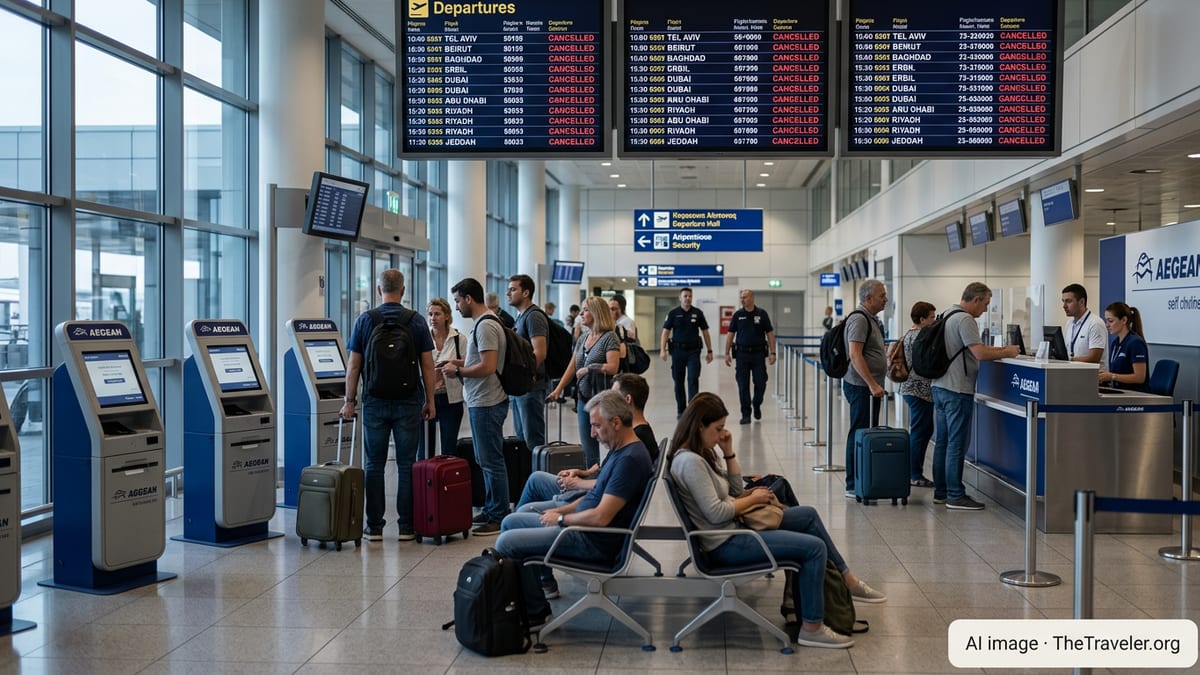
Extended Cancellations Reach Key Middle East Gateways
The Greek carrier confirmed in a series of updates this week that suspensions affecting routes to Tel Aviv, Beirut, Baghdad, Erbil, Dubai, Abu Dhabi and Riyadh will now run into the second half of March, with some flights halted through the beginning of April. The latest adjustments build on earlier short-term suspensions and reflect ongoing uncertainty over how long airspace closures and security alerts will persist.
According to AEGEAN, services linking Athens and other European points with Israel, Lebanon and Iraq remain suspended for at least several more weeks, while flights to the United Arab Emirates and Saudi Arabia face rolling cancellations on multiple dates. The airline said it is monitoring developments daily and will update schedules as conditions evolve, but signaled that a rapid normalization of operations is unlikely.
The move places AEGEAN among a growing list of regional and international airlines that have sharply reduced their Middle East networks following strikes on Iran and subsequent retaliatory attacks that prompted widespread airspace restrictions. Flight analytics firms report that thousands of services across the region have been canceled or rerouted since late February, stranding travelers and pressuring hub airports from Dubai to Doha.
AEGEAN stressed that safety remains its overriding priority, citing official notices to airmen and security guidance as the basis for its decisions. The carrier said crews and aircraft will not operate into airports or air corridors where the risk profile is deemed unacceptable, even if certain routes technically remain open.
United Arab Emirates Joins List of Affected Markets
The United Arab Emirates has become the latest market where AEGEAN is extending cancellations, highlighting how far the disruption has spread beyond initial flashpoints. Flights between Athens and Dubai, as well as services involving Abu Dhabi, have been canceled on multiple days in March following what Emirati authorities have described as a temporary and partial closure of national airspace and tighter control of remaining traffic.
Dubai International and Abu Dhabi International, two of the world’s busiest long-haul hubs, saw traffic fall sharply after the latest round of strikes and missile interceptions in the wider Gulf region. While some evacuation and limited commercial flights continue to operate, schedules remain heavily trimmed and are subject to sudden change based on overnight security assessments.
AEGEAN’s decision to suspend more services to the UAE effectively adds the country to a list of impacted destinations that already includes Iraq, Saudi Arabia, Lebanon and Israel. Aviation observers note that because Athens typically functions as a connecting point between Europe and the Eastern Mediterranean, cancellations on these routes ripple outward, affecting itineraries for passengers originating in multiple European cities.
For travelers in the UAE who had planned to use AEGEAN to reach Greece or onward points in Europe, the extended suspensions mean reduced options in the near term and a greater reliance on other carriers that may also be operating with constrained capacity. Airport officials and travel agents in Dubai and Abu Dhabi report a surge in rebooking requests and rising prices on remaining seats.
Security Concerns and Airspace Restrictions Drive Decisions
The airline’s latest schedule cuts come against the backdrop of the ongoing Strait of Hormuz crisis and a broader conflict environment that has triggered successive waves of airspace closures across the region. In recent days, authorities in Iran, Iraq, Israel, Qatar, Bahrain, Kuwait and other states have restricted or fully closed their skies to civilian traffic for varying periods, forcing airlines to ground flights or adopt lengthy detours.
Risk consultants say that even where airspace is technically open, operators face elevated threats from potential missile activity, drone incursions and electronic interference affecting navigation systems. Insurers, too, are reassessing coverage for flights traversing certain corridors, which in turn influences airline decisions on whether to maintain or suspend routes.
AEGEAN has pointed to these dynamic and overlapping risks as a key factor behind its Middle East schedule reductions. The carrier has emphasized that the safety assessments are continuous and that it will only consider resuming flights when it is satisfied that both overflight and destination risks have returned to acceptable levels, in coordination with national and international aviation authorities.
Industry analysts note that the airline’s moves align with a broader pattern among European and Asian carriers, many of which have sharply scaled back services into Israel and neighboring states since late February. With hub airports across the Gulf handling fewer transit passengers and airlines curbing flying hours across conflict-adjacent airspace, the global long-haul network is undergoing a rapid reconfiguration.
Impact on Travelers and Flexible Options for Rebooking
The extended cancellations have far-reaching implications for leisure and business travelers, as well as for diaspora communities that rely on links between Greece and the wider Middle East. Passengers booked to or from Tel Aviv, Erbil, Baghdad, Beirut, Dubai, Abu Dhabi, Riyadh and other affected cities now face a patchwork of options that vary by travel date and destination.
AEGEAN has introduced flexible policies for impacted customers, allowing those with tickets on suspended flights over the coming weeks to change their travel dates without additional fees for new journeys through the end of April. Alternatively, travelers can cancel their reservations and receive a credit voucher for future use, providing some financial relief amid the disruption.
Travel agents report that many passengers are opting to postpone trips entirely rather than rebook via complex routings that may still be vulnerable to last-minute changes. Others are attempting to reach their destinations via alternative European or Gulf hubs, though availability is limited and transit times have lengthened as aircraft avoid contested airspace.
Consumer advocates are urging travelers to check flight status repeatedly in the days and hours before departure and to ensure that airlines and agencies have up-to-date contact details. With conditions evolving rapidly, schedule changes are often communicated at short notice, leaving little time to adjust plans once at the airport.
Wider Shock to Regional Tourism and Aviation
Beyond immediate flight cancellations, the unfolding crisis is casting a shadow over tourism and business travel across the Eastern Mediterranean and Gulf. Hoteliers, tour operators and cruise lines that depend on smooth connectivity through regional hubs are reporting cancellations and weaker forward bookings for the spring season, especially on itineraries that include multiple Middle Eastern stops.
In Greece, where tourism is a critical pillar of the economy, industry groups say the impact so far is concentrated in segments tied closely to Israel and nearby markets, such as city breaks and short-notice leisure trips. Longer-haul visitors from North America and northern Europe, who typically connect via central or western European hubs, have so far been less directly affected, although the situation remains fluid.
Aviation experts warn that even a relatively short period of heightened tension can have lasting effects on route viability. Airlines like AEGEAN must weigh not only immediate security concerns but also aircraft availability, crew planning and demand projections when deciding how and when to restore suspended services. If geopolitical risks persist, some routes may return with reduced frequencies or smaller aircraft before full schedules are reinstated.
For now, travelers eyeing journeys between Europe and the Middle East are being advised to plan for potential disruption well into March and to build flexibility into their itineraries. As AEGEAN and other carriers continue to recalibrate their networks in response to fast-moving events, the region’s role as a global aviation crossroads faces one of its most severe tests in years.