


More news on this day
Escalating conflict across the Middle East is forcing Vietnam Airlines, Emirates, Qatar Airways, Turkish Airlines and Etihad Airways to reroute key Europe services, driving up costs for travelers and squeezing tourism flows to Vietnam, France and Germany alongside major hotel groups such as Hilton, Accor and Marriott.
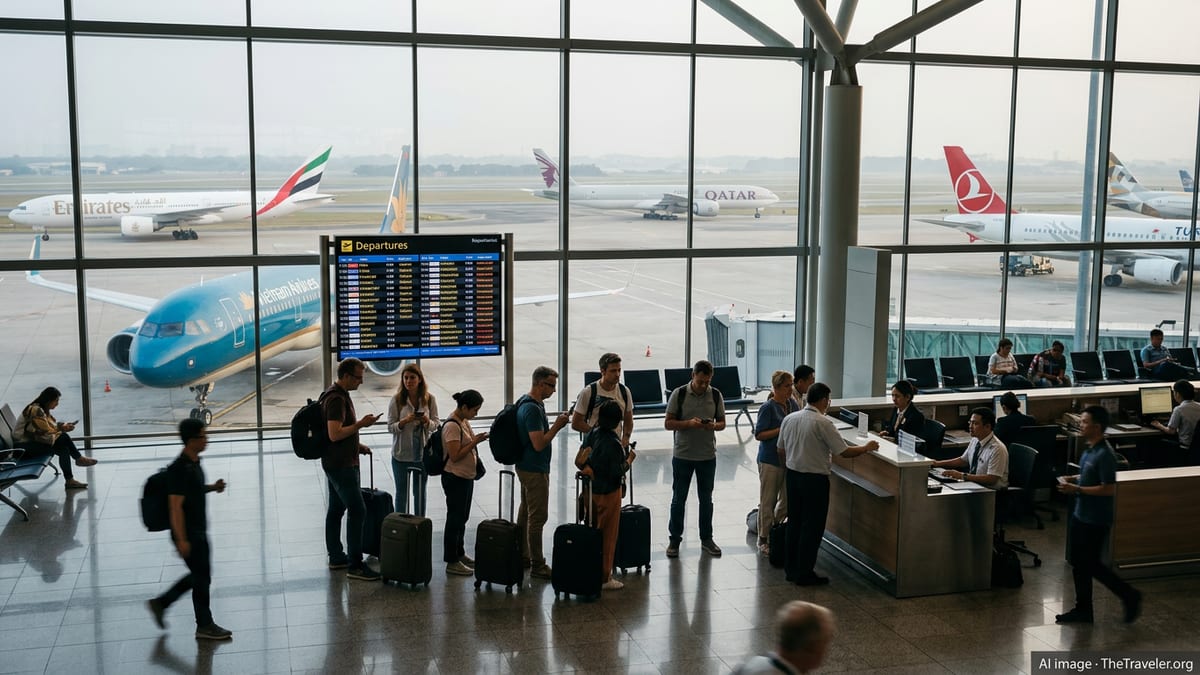
Europe Flights Divert as Middle East Becomes No-Go Zone
Airspace closures across Iran, Iraq, Israel, Kuwait, Qatar, Bahrain and the United Arab Emirates since late February have abruptly shut down some of the world’s most important aviation corridors between Europe and Asia. Gulf hubs in Dubai, Abu Dhabi and Doha, usually handling tens of thousands of Europe-bound passengers daily, have seen large parts of their operations grounded or diverted as military activity intensifies.
Vietnam’s Civil Aviation Authority has ordered all carriers to avoid conflict-affected skies, triggering immediate route changes on Europe services that would normally overfly the Gulf or nearby territories. Routes which once tracked across Iran or Iraq now bend north over the Caucasus or south over Egypt and the Red Sea, adding up to several hours of flying on some Europe to Asia sectors and complicating crew and aircraft rotations.
Industry analysts say the disruption has landed on a network already constrained by the near-total loss of Russian and Ukrainian airspace since 2022. With traffic funneled into fewer safe corridors, airlines from Asia and the Middle East are now competing for limited routings, pushing up fuel burn, air navigation charges and schedule buffers built into daily operations.
Vietnam Airlines Stretches Europe Links as Detours Bite
Vietnam Airlines has confirmed that all 12 of its European routes remain operational, including flagship services from Hanoi and Ho Chi Minh City to Paris and Frankfurt, but acknowledges that paths are being flexibly adjusted to keep distance from the conflict. The carrier is closely coordinating with air traffic authorities to reroute flights around closed segments of Middle Eastern airspace while maintaining connectivity with its European gateways.
These detours are extending block times between Vietnam and Europe, in some cases by more than an hour, according to regional aviation updates. Longer flight times translate into higher fuel consumption at a moment when jet fuel already accounts for roughly a third of airline operating costs. Vietnam Airlines faces the added challenge of keeping aircraft rotations tight enough to preserve onward connections within its domestic and regional network.
For passengers, the impact is most immediately visible in departure boards and journey times. Travelers returning to Europe after the Tet holidays have reported abrupt schedule changes, longer overnight transits and creeping fare levels on Vietnam to Europe itineraries that depend on Middle Eastern or Turkish connections. While Vietnam Airlines continues to fly non-stop or via safer corridors, alternatives are fewer when partners in the Gulf are forced to curtail services.
Gulf Giants and Turkish Airlines Rebuild Network Maps
Emirates, Qatar Airways and Etihad, whose business models are built on funneling Europe to Asia traffic through their Gulf mega-hubs, are among the hardest hit. Waves of cancellations and diversions have followed partial and temporary closures of their home airspace, leaving aircraft out of position and thousands of passengers needing rebooking on already crowded non-Middle Eastern routes.
Where services can operate, flight paths are stretching significantly. Some Europe to Asia flights that once cut directly across the Middle East are now doglegging via the eastern Mediterranean, Central Asia or the Horn of Africa, adding two to five hours to total journey times on certain city pairs. Analysts warn that such detours can lift fuel and overflight costs by 20 to 30 percent on affected sectors, an increase that airlines are likely to recoup through higher fares or new fuel surcharges.
Turkish Airlines, with its hub in Istanbul located just to the northwest of the most volatile zones, has emerged as a critical alternative bridge between Europe and Asia. While also rerouting some services to avoid risk areas, the carrier has been able to maintain a relatively robust schedule, absorbing demand from passengers originally booked on Gulf carriers. The shift underscores how geopolitical risk can quickly rewire global connectivity, tilting traffic toward hubs perceived as safer while conflicts rage.
Tourism to Vietnam, France and Germany Faces New Headwinds
The knock-on effects are rippling through tourism sectors in Vietnam, France and Germany, markets that depend heavily on long-haul air access. Tour operators report that Europe to Vietnam itineraries built on multi-stop tickets via Gulf hubs have been hardest to manage, with groups facing last-minute rerouting, unexpected layovers and, in some cases, outright cancellations as airspace restrictions tighten.
Inbound flows to France and Germany from Asian markets are facing similar turbulence. Many travelers from Southeast Asia, India and Australasia rely on Gulf or Turkish connections to reach European gateways such as Paris Charles de Gaulle and Frankfurt. As schedules are thinned and detours lengthen flight times, some prospective visitors are postponing trips or shortening their stays, eroding the high-yield long-haul segment that European tourism boards have been working to rebuild since the pandemic.
In Vietnam, local tourism firms fear a double hit: outbound Vietnamese heading to Europe now face scarcer, more expensive seats, while inbound European tourists may think twice about a trip that suddenly involves longer flying times and higher prices. Industry groups are urging governments to support marketing campaigns and consider temporary fee relief for airlines in order to preserve vital long-haul connectivity through the crisis period.
Hotel Giants Brace for Softer Demand and Higher Costs
Global hotel groups including Hilton, Accor and Marriott are closely watching booking patterns as flight disruptions reverberate through key city markets. In Vietnam, large branded properties in Hanoi, Ho Chi Minh City and coastal resort destinations are particularly exposed to any slowdown in European arrivals, which typically underpin higher-spending segments such as escorted tours, meetings and incentive travel.
France and Germany, both heavily reliant on international arrivals to fill city-center and airport hotels, are seeing an early shift in booking curves as Middle East-linked itineraries are adjusted. Hoteliers in Paris, Frankfurt and Munich report a growing number of short-notice changes from corporate and leisure travelers originally ticketed on Gulf carriers, with some stays shortened or replaced by virtual meetings as uncertainty persists around return flights.
At the same time, costs are moving in the wrong direction for operators. Prolonged flight times and diversions are likely to push up airfares, leaving travelers with less discretionary budget for accommodation and dining. Major chains are also grappling with higher energy and food costs tied to volatile oil markets, narrowing margins just as they had begun to stabilize post-pandemic.
Executives at multinational hotel brands say they are leaning on flexible pricing, dynamic inventory management and closer coordination with airline partners and tour operators to protect occupancy. However, many acknowledge that if Middle Eastern airspace remains restricted deep into the year, the combined effect of more expensive travel and fragile consumer confidence could soften performance across hotel portfolios in Vietnam, France, Germany and other long-haul-dependent markets.