


More news on this day
Aeromexico is preparing to deepen its presence in Italy with a planned nonstop service between Mexico City International Airport and Milan Malpensa from March 2027, signaling a strategic push to strengthen connectivity between Mexico and one of Europe’s most dynamic economic hubs.
Get the latest news straight to your inbox!
New Mexico City–Milan Link Planned for March 2027
According to recent company communications and industry coverage, Aeromexico intends to launch direct flights between Mexico City International Airport (AICM) and Milan Malpensa Airport in March 2027, subject to the usual regulatory approvals. The service would give Mexico’s flag carrier a second Italian gateway alongside Rome Fiumicino, which it already serves as part of its Europe portfolio.
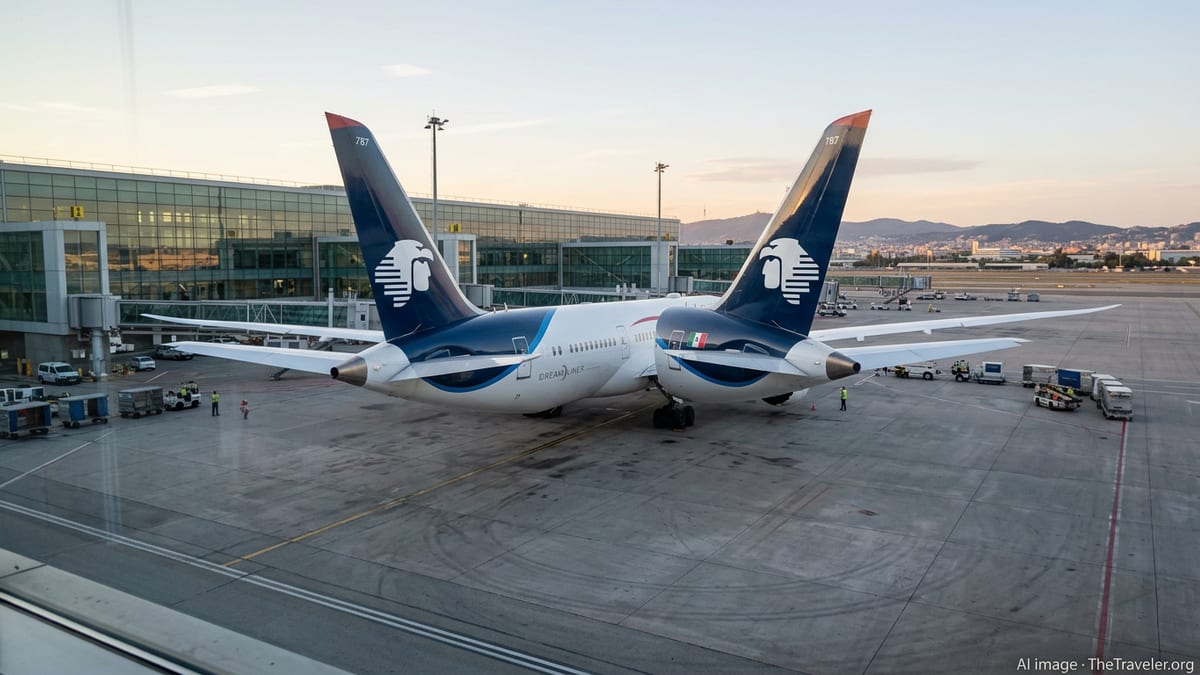
Reports indicate that the route is planned to operate with Boeing 787 Dreamliner aircraft, Aeromexico’s flagship long-haul type. Publicly available fare displays on the airline’s website already show sample round-trip itineraries between Mexico City and Milan for spring 2027, suggesting that the carrier is positioning the route for both leisure and corporate demand.
Industry analyses frame the move as part of Aeromexico’s broader international expansion following its restructuring and renewed fleet investment. Italy has emerged as a logical target, with Milan’s status as a financial and fashion capital creating steady premium traffic flows, while Mexico’s tourism draw and growing exports provide two-way demand.
Italy Emerges as a High-Potential Market for Mexico
Recent tourism data cited in business media show that Italy has been climbing the ranks of European source markets for Mexico. One widely referenced report notes that Italian arrivals to Mexico surpassed 118,000 visitors in the most recent full year, registering double-digit percentage growth. The trend mirrors a wider rebound in transatlantic travel and increasing interest in long-haul leisure trips to Latin America.
For Aeromexico, Milan adds another European point where demand is driven not only by holiday travelers but also by business and trade links. Northern Italy hosts a concentration of manufacturing, fashion, design, and automotive firms with existing commercial ties to Mexico, including in the aerospace and automotive supply chains. Direct connectivity between Mexico City and Milan is expected to support these flows by reducing reliance on one-stop itineraries via other European hubs.
Publicly available information also shows that Aeromexico has been actively marketing Italy-bound itineraries, initially through Rome and partner connections, and more recently by highlighting Milan in its online fare promotions. The prospective Mexico City–Milan nonstop consolidates that focus by giving the airline its own metal on a key Italy route, rather than depending solely on codeshare links or third-country gateways.
Strategic Role Within Aeromexico’s Transatlantic Network
The planned Milan launch fits into a pattern of Aeromexico reinforcing long-haul connectivity from its primary hub at Mexico City. Network data and alliance documentation describe the carrier as a leading Latin American member of the SkyTeam alliance, with Mexico City serving as a central node for traffic flows between the Americas, Europe, and Asia. Adding Milan would create new one-stop options for passengers traveling from Italian markets to major cities across Mexico and parts of Latin America.
Observers note that the route also helps diversify Aeromexico’s European footprint beyond long-established links to Madrid, Paris, Amsterdam, and Rome. Milan Malpensa offers strong connectivity within Europe and to parts of the Middle East and Africa via other airlines based there, positioning the new service as a potential feeder for multi-stop itineraries. At the same time, the direct link strengthens the airline’s ability to compete for point-to-point corporate contracts between northern Italy and Mexico.
The use of Boeing 787 Dreamliners aligns with Aeromexico’s emphasis on fuel-efficient widebody operations. Public fleet information highlights the carrier’s strategy of deploying Dreamliners on key long-haul markets, supporting both lower unit costs and an upgraded onboard experience in economy and premium cabins. Applying that model to Milan suggests that Aeromexico views the route as a long-term pillar of its transatlantic schedule rather than a short-lived experiment.
Capacity, Scheduling and Regulatory Steps Ahead
While promotional materials and social media posts have outlined the March 2027 target, detailed schedules and weekly frequencies have not yet been formally published. Statements referenced in business press indicate that specifics on flight times and frequency will be confirmed once regulatory processes are completed. In practice, carriers on similar long-haul launches often adjust planned capacity in response to advance bookings and slot availability.
Early booking displays on Aeromexico’s site and major online travel agencies already list Mexico City–Milan round-trip options for late March and early April 2027, with economy fares positioned to stimulate early demand. Analysts expect initial capacity to focus on core transatlantic travel days, with scope to scale up frequencies if demand from both corporate and leisure segments proves robust.
Regulatory filings and public comments also underscore that the route’s start date remains contingent on government approvals in both Mexico and Italy. Such conditions are standard for new long-haul services, particularly when they involve updates to bilateral air service agreements or airport slot coordination at busy European hubs like Milan Malpensa.
Implications for Travelers Between Mexico and Europe
For travelers, a nonstop Mexico City–Milan option promises shorter journey times and fewer connections on an increasingly popular corridor. Leisure passengers traveling from Italy to Mexican beach destinations such as Cancun, Los Cabos, or Puerto Vallarta would gain a one-stop itinerary via Mexico City on a single ticket, rather than connecting through Madrid, Paris, or other European hubs. Conversely, Mexican travelers headed to northern Italy would be able to reach Milan directly and then continue onward within Europe.
The route is expected to integrate with Aeromexico’s loyalty program and SkyTeam earning and redemption structures, according to alliance and airline documentation. That opens additional possibilities for frequent flyers using points to reach Italy or to connect onward into Europe on partner airlines. For corporate accounts, the presence of a direct flight often plays a key role in shaping preferred-carrier agreements and travel policies.
Observers in the aviation sector are watching the Mexico City–Milan plans as a bellwether for how Latin American carriers will balance growth across Europe’s traditional hubs and emerging secondary cities over the next decade. If the route performs in line with expectations, it could encourage further experimentation with new European destinations from Mexico and potentially from other hubs in the region.