


Landing at the new Siem Reap Angkor International Airport is the first step toward Angkor Wat, but it is also where you should quickly sort out your phone connection and local money. This guide walks you through everything that matters in the arrivals hall: where to buy a SIM, how to use eSIM, which ATMs and exchange counters to trust, how U.S. dollars and Cambodian riel work in practice, how to pay your taxi, and what cash you should carry before walking out of the terminal.
Get the latest updates straight to your inbox!
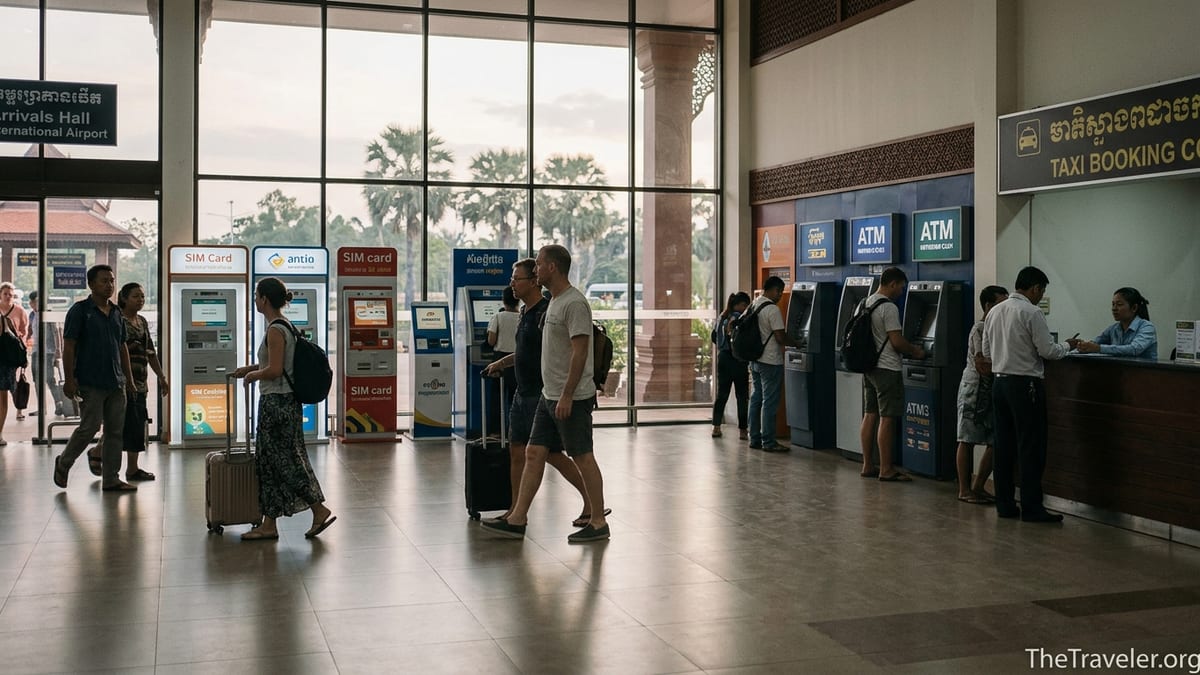
Understanding the New Siem Reap Angkor Airport Layout
Siem Reap Angkor International Airport (SAI) sits about 50 kilometers from downtown Siem Reap, so your arrival choices for connectivity and cash directly affect the next 45 to 60 minutes of your journey into town. After disembarkation you first pass immigration, baggage claim and customs. Only once you clear customs do you enter the public arrivals hall where telecom kiosks, ATMs and the official transport counters are located. You cannot backtrack, so it is worth knowing what you want before you get there.
The arrivals hall itself is modern but relatively compact. On one side you will find a line of mobile operator counters, usually Metfone, Smart and Cellcard, selling tourist SIMs and helping with activation. Nearby are bank-operated ATMs and at least one currency exchange counter run by a local bank such as Cambodia Asia Bank. Farther along the hall are desks for official taxis, private cars and, depending on the time of day, shuttle or minibus services into Siem Reap.
Because the airport is new and designed primarily for international visitors heading to Angkor, almost every service in the arrivals area is priced in U.S. dollars. That includes SIM cards, taxi fares, coffee and snacks. Cambodian riel is used mainly for small change. This dual-currency reality means arriving with some U.S. dollar cash makes your first hour in Cambodia easier, although you can manage with only a debit or credit card if necessary.
The most efficient strategy is to do three things before leaving the building: get a working phone connection, withdraw or exchange a modest amount of cash in U.S. dollars (plus riel for small purchases) and arrange transport. Once you step outside, there are no additional ATMs or kiosks immediately on the curb, and the ride into town is long enough that you do not want to be worrying about money or maps.
SIM Cards and eSIM Options on Arrival
Cambodia’s mobile market is dominated by three main operators: Metfone, Smart and Cellcard. All have a presence in Siem Reap and typically operate kiosks at Siem Reap Angkor Airport. These counters focus on simple tourist packages that bundle data, some local calls and a validity window that suits short trips. For example, you might see offers such as 40 GB of data for 7 days for around 5 to 7 U.S. dollars, or 60 to 80 GB for 30 days for roughly 10 to 15 U.S. dollars, depending on operator and promotions at the time.
At the arrivals kiosks staff will usually insert the physical SIM, register it to your passport as required by Cambodian regulations, and configure the APN settings. This generally takes under five minutes. You pay in cash U.S. dollars, and change is often given partly in riel. If you land late at night, Metfone is often the safest bet for a 24 hour counter, while Smart and Cellcard typically keep extended but not always overnight hours. If your flight arrives after midnight it is wise to plan for either Metfone or an eSIM solution.
eSIM is increasingly convenient for visitors who want to arrive connected. Several global eSIM providers now sell Cambodia or regional Southeast Asia data plans that work on the major local networks. A common pattern would be buying a 10 or 20 GB Cambodia eSIM in advance for about 10 to 20 U.S. dollars, scanning the QR code at home and landing in Siem Reap already online. The tradeoff is that eSIM plans often include data only, with no local phone number for calls or SMS, which can matter if a hotel or driver prefers to call a Cambodian number.
If you need both a local number and lots of data, one practical combination is to activate a regional eSIM for immediate connectivity and purchase a small local physical SIM at the airport. For example, you might use a 10 GB regional eSIM for your whole Southeast Asia trip and buy a 5 dollar Metfone or Smart SIM on arrival just to have a Cambodian number. Conversely, budget travelers who are comfortable being offline for the short ride into town can skip eSIM and rely entirely on an airport SIM card, which is still usually cheaper than roaming on most foreign carriers.
ATMs, Currency Exchange and How Much Cash to Carry
By the time you reach the arrivals hall you have already passed the point where you can pay for a visa on arrival, so the ATMs and exchange services inside SAI are mostly for general spending and your transfer. Several Cambodian banks operate ATMs in the arrivals area and they typically allow withdrawals in U.S. dollars, Cambodian riel or both. A normal pattern is to be offered a choice on the screen: withdraw, for instance, 100 or 200 U.S. dollars in notes, or the equivalent in riel.
Airport ATMs are convenient but often come with higher fixed fees, commonly around 4 to 6 U.S. dollars per withdrawal on top of your home bank’s fees. To reduce the impact, it is better to withdraw once for a larger amount rather than many times for small amounts. Many independent travelers choose to take out something like 150 to 250 U.S. dollars on arrival, which is usually enough to cover a taxi, a few days of food and small expenses without carrying an uncomfortable amount of cash.
Currency exchange counters at SAI, usually operated by local banks, are straightforward but rarely offer the best rates. If you arrive with euros, pounds, Australian dollars or other major currencies and want convenience over every last percentage point, changing a modest amount at the airport is fine. For example, exchanging 100 euros into U.S. dollars will not ruin your budget even if the rate is slightly worse than in town. However, for larger exchanges, many travelers prefer to wait until they are in Siem Reap proper and use a reputable downtown money changer such as one of the well known bureaus near Pub Street that locals and expats recommend for fairer spreads.
If you already hold U.S. dollar cash, there is often no reason to use airport exchange at all. U.S. dollars are accepted almost everywhere in Cambodia, including for taxis, hotels and Angkor passes. The key is to carry clean, undamaged bills in small denominations. Torn or heavily marked notes are frequently refused. Stopping at an ATM can still be useful to get riel for small purchases, but even that can be postponed until you reach town if you are comfortable paying only in dollars at first.
U.S. Dollars vs Cambodian Riel in Everyday Use
Cambodia operates in a dual-currency environment, and Siem Reap is one of the clearest examples. Prices for hotels, restaurant meals around Pub Street, Angkor tickets, most tours and even many mini-marts are usually quoted in U.S. dollars. When you pay, any change under one dollar is commonly returned in Cambodian riel using an informal rate that hovers around 4,000 riel to 1 U.S. dollar. For instance, if a bill comes to 3.50 dollars and you hand over a 5 dollar note, you may receive 1 dollar plus about 2,000 riel in change.
Riel becomes more important as you move into smaller, more local transactions. Street food stalls, small convenience shops away from the center and rural vendors near less visited temples may quote in riel. A bowl of noodles might cost 8,000 to 10,000 riel, a bottle of water 2,000 to 3,000 riel, and a short local tuk tuk ride 10,000 to 16,000 riel depending on distance and bargaining. In all of these scenarios, the vendor is usually happy to accept dollars but may have limited ability to give precise change in U.S. currency, so having some riel notes makes life smoother.
For most short term visitors, there is no need to pre-order riel before arriving. If you withdraw from a Cambodian ATM you can choose to receive either dollars or riel, or sometimes a mix. One practical approach is to withdraw mainly dollars and then collect riel naturally as change over your first few days, topping up with a dedicated riel withdrawal if you find yourself using local markets a lot. If you are visiting more rural areas around Siem Reap or continuing overland to places like Battambang or Kampong Thom, carrying more riel can become increasingly useful.
The main pitfall to avoid is ending up with a large stack of low denomination riel notes at the end of your trip. Riel is difficult to exchange outside Cambodia and is rarely accepted in neighboring countries. Try to spend your remaining riel on final meals, last-minute souvenirs or a tip to your driver before you head back to the airport, and keep a small reserve of U.S. dollars for departure expenses and emergencies.
Paying for Taxis and Other Transport from the Airport
Because Siem Reap Angkor Airport is far from town, arranging your transfer is one of the first concrete financial decisions you will make. Inside the arrivals hall you will find official counters selling fixed price transport into the city. Typical prices fluctuate, but as a general guide, a standard taxi into central Siem Reap might run in the region of 25 to 35 U.S. dollars, depending on vehicle type and current fuel costs. Larger vans for families or groups are more expensive, while shared shuttles, if operating, can be cheaper.
Payment at these counters is almost always in U.S. dollars. Some accept credit cards, but the staff may apply an extra 2 to 3 percent fee or round the price up to cover card charges. If you intend to pay by card instead of cash, it is worth asking explicitly before you commit. Once you have paid, the staff will either escort you to a waiting driver or give you a slip to hand to the taxi dispatcher outside. Tipping is not required but rounding up by 1 or 2 dollars for a courteous driver or help with heavy luggage is appreciated.
If your hotel or guesthouse has arranged a pickup, clarify in advance how payment works. Many midrange and upscale hotels offer transfers included in room rates, especially for multi-night stays, while budget guesthouses might simply call a local driver and ask you to pay directly in cash upon arrival. A common scenario is a pre-arranged sedan or minivan meeting you with a sign, with payment of 25 to 30 U.S. dollars handed to the driver at your hotel rather than at the airport.
Ride hailing apps and tuk tuks are more limited at the airport due to concession arrangements, but they become common once you reach town. In Siem Reap itself, short tuk tuk rides usually cost 2 to 3 U.S. dollars within the central area, and 4 to 6 U.S. dollars for longer trips, with drivers often preferring cash. Some local ride hailing apps and chat based services are emerging, and a few allow digital wallet payments, but as a new arrival you should plan to pay for your first transfer in cash or card rather than relying on app based transport immediately.
How Much Small Cash You Really Need on Day One
For a typical traveler staying in a midrange hotel and eating at casual restaurants, the first 24 hours in Siem Reap do not require a large amount of cash. A realistic breakdown might be 25 to 35 U.S. dollars for a taxi from the airport, 5 to 10 dollars for an airport SIM card if you choose to buy one, 10 to 15 dollars for a simple dinner and drinks near Pub Street, and another 5 to 10 dollars for small purchases such as water, snacks, or a tuk tuk ride within town. In total, having around 60 to 80 U.S. dollars easily accessible in cash for day one is usually comfortable.
Within that amount it helps to carry a mix of denominations: several 1 dollar bills, a handful of 5s and 10s, and one or two 20s. Taxi drivers and small shops sometimes struggle to break 50 and 100 dollar notes, especially late at night or early in the morning. If you arrive carrying only large notes, consider using a hotel front desk, a reputable money changer in town, or even a supermarket cash transaction to break them into smaller bills on your first full day.
Riel can be left until later if you are tired after the flight. You can comfortably navigate your first evening using only dollars, even when buying water or a snack. When you do decide to obtain riel, using an ATM inside town or exchanging a small amount at a known money changer is usually more cost effective than the airport counter. After a day or two, many travelers end up naturally with a wallet that has 20 to 50 U.S. dollars in bills and the equivalent of 5 to 10 dollars in riel for daily use.
If you plan to buy your Angkor pass right away or book tours on the spot, factor those into your cash planning. The Angkor Archaeological Park passes are priced in U.S. dollars and can be expensive, so many visitors prefer to pay by credit card at the official ticket office to preserve their cash for smaller expenses. The same logic applies if you are booking a multi day temple tour or a floating village excursion; using a card for these larger purchases reduces the need to carry large sums of cash around town.
What to Prepare Before Leaving the Terminal
The ideal sequence in the arrivals hall is simple: visit a SIM or eSIM help counter if needed, use an ATM or exchange desk for a modest starter amount of cash, then secure your transport ticket or meet your driver. Before you walk out into the tropical heat, spend a moment checking everything. Confirm that your phone has data service by loading a map of the route to your hotel, verify the cash amount and mix of notes in your wallet, and make a note of the taxi price or the plate number of your vehicle in case of questions later.
It is also sensible to store offline information before leaving the building’s Wi Fi zone. Download an offline map of Siem Reap and Angkor, save your hotel name and address in both English and Khmer if possible, and take a screenshot of any pre-booked voucher or confirmation. Many drivers do not read detailed English emails, but showing them a screenshot with the hotel logo or a pin on a map is usually enough.
Hydration and comfort matter more than many first time visitors expect. Siem Reap is hot and humid for most of the year and the drive from the new airport can be nearly an hour. Buying a bottle of water in the arrivals mini mart or vending area, ideally with small change in riel, is a small but helpful step. If you tend to feel motion sick, consider sitting in the front seat of the taxi and having a plastic bag handy just in case. None of this costs much, but preparing inside the terminal is easier than trying to fix problems from the highway.
Finally, double check security basics before stepping outside. Keep your passport, phone and cash in separate but secure locations, such as a money belt and a zipped daypack. Avoid counting large wads of cash in public. While Siem Reap is generally a relaxed and welcoming destination, it is still a busy tourist town where pickpockets sometimes work crowded areas. Starting your trip with a calm, organized exit from the airport sets the tone for the rest of your stay.
The Takeaway
Arriving at Siem Reap Angkor Airport does not need to be stressful if you have a simple plan for connectivity and cash. Know that U.S. dollars rule most transactions, with riel appearing mainly as small change, so bringing or withdrawing a modest amount of clean, small U.S. bills is more important than hunting for riel before you land. Use the airport telecom kiosks or an eSIM to get online quickly, and choose an ATM or limited currency exchange transaction for convenience rather than the perfect rate.
Once you clear arrivals, focus on three essentials before you walk out: your SIM or eSIM is working, you have enough cash in suitable denominations for at least a taxi and the first evening, and your transport into town is confirmed. With those boxes ticked, the longer ride from the new airport into Siem Reap becomes simply your first look at rural Cambodia instead of a scramble to find money and signal. That calm, prepared start makes it easier to appreciate what you really came for: sunrise over Angkor, quiet temple corridors and evenings in a town that has adapted itself almost entirely to travelers like you.
FAQ
Q1. Do I need to get Cambodian riel at the airport, or are U.S. dollars enough?
U.S. dollars are enough for your arrival, including taxis, SIM cards and basic purchases. You can wait until you are in town to withdraw or collect some riel for small local transactions.
Q2. How much cash should I withdraw or bring for my first day in Siem Reap?
For most travelers, having around 60 to 80 U.S. dollars in mixed small bills is comfortable for day one, covering a taxi, a SIM card, a meal and incidental expenses.
Q3. Are there reliable ATMs inside Siem Reap Angkor Airport arrivals?
Yes, several Cambodian banks operate ATMs in the arrivals hall and they generally work well with foreign cards, though they often charge a fixed withdrawal fee and sometimes offer both USD and riel.
Q4. Is it better to use an airport currency exchange counter or wait until I reach town?
Airport counters are convenient but typically offer weaker rates. Many travelers change a small amount for immediate needs at the airport and wait to make larger exchanges at reputable money changers in central Siem Reap.
Q5. Can I buy a local SIM card at Siem Reap Angkor Airport, and what does it cost?
Yes, kiosks for major operators such as Metfone, Smart and Cellcard usually sell tourist SIMs with several gigabytes of data for roughly 5 to 15 U.S. dollars, depending on package and duration.
Q6. Should I set up an eSIM before arriving, or is buying a SIM at the airport enough?
Both options work. An eSIM gives you instant connectivity when you land, while an airport SIM is often cheaper and includes a local number. Many visitors are comfortable relying entirely on an airport SIM.
Q7. How do I pay for a taxi or transfer from the airport into Siem Reap?
Official airport taxis and shuttles are usually paid in U.S. dollars at a fixed rate. Some counters accept cards, but cash is more widely accepted and avoids potential surcharges or card machine issues.
Q8. Are credit and debit cards widely accepted in Siem Reap?
Cards are commonly accepted at midrange and upscale hotels, larger restaurants and some tour operators, but small shops, local eateries and tuk tuks generally prefer cash, especially for amounts under about 10 U.S. dollars.
Q9. What denominations of U.S. dollars are best to bring for Cambodia?
Bring clean, undamaged bills, mainly 1, 5, 10 and 20 dollar notes. Many small businesses struggle to change 50s and 100s, and worn or torn notes are often refused.
Q10. Is it safe to use ATMs and carry cash around Siem Reap?
Using ATMs from well known banks and exercising normal precautions is generally safe. Carry only the cash you need for a day or two, keep it in a secure pocket or money belt, and avoid displaying large amounts in public.