


More news on this day
Africa World Airlines has issued a public apology after passengers were left stranded at Kumasi’s Prempeh I International Airport when a Kumasi to Accra service was cancelled on October 26, 2026, intensifying scrutiny of how Ghana’s domestic carriers handle disruption and compensation.
Get the latest news straight to your inbox!
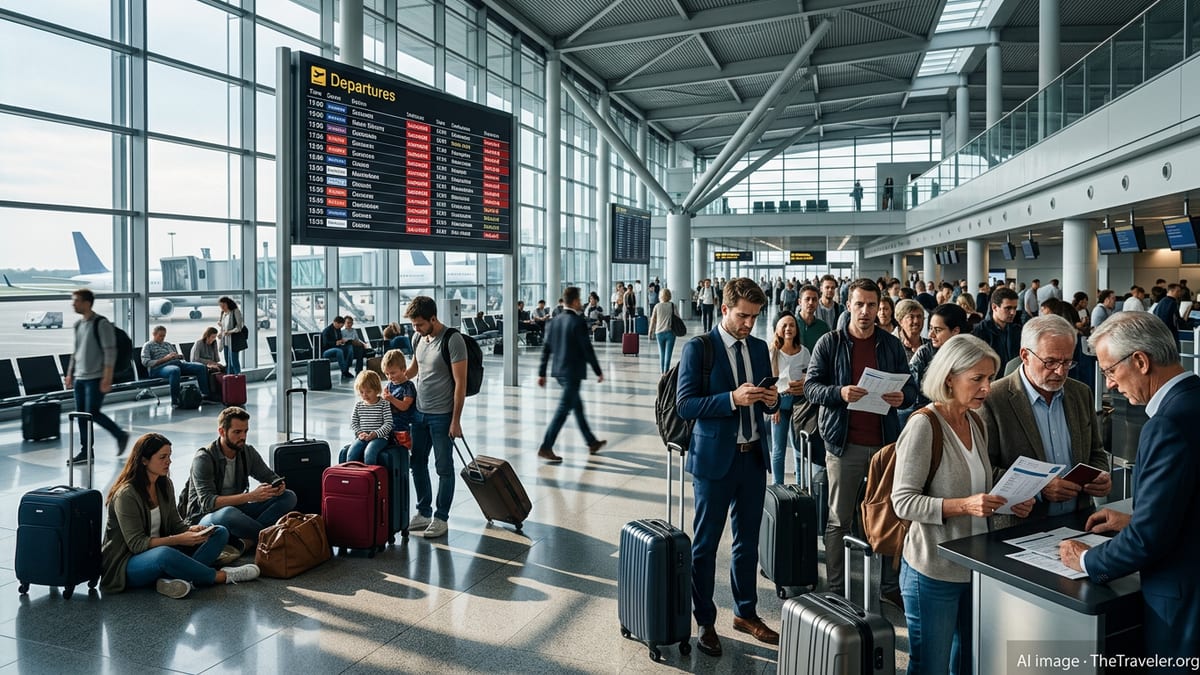
Stranded passengers on key Kumasi–Accra corridor
According to published coverage from Ghanaian outlets, travellers booked to fly from Kumasi to Accra on October 26 arrived at Prempeh I International Airport to find departure times for Africa World Airlines services repeatedly adjusted before flights were ultimately marked as cancelled. On the same day, rival domestic carrier Passion Air also cancelled a Kumasi–Accra rotation, sharply reducing options on one of the country’s busiest internal routes.
Reports indicate that the cancellations left dozens of passengers in the terminal with no immediate way to complete same day trips to the capital. Local media accounts describe confusion at check in and boarding areas as travellers tried to establish whether they would be placed on later services, refunded, or assisted with alternative transport by road.
Video clips shared on Ghanaian social media channels and carried by news platforms show agitated travellers crowding airline desks and raising concerns about missed onward connections in Accra, including same day international departures from Kotoka International Airport. Several passengers reported out of pocket expenses for last minute hotel stays in Kumasi or for rearranging ground transport after their flights did not operate.
The incident unfolded on a corridor that has long been central to Ghana’s domestic air network. Publicly available flight data indicates that the Accra–Kumasi route is served by multiple daily rotations and can record more than 90 weekly flights in peak periods, reflecting sustained demand from business travellers, students, government workers and visitors seeking to avoid a road journey that can take four to six hours depending on traffic.
Africa World Airlines issues public apology
Following widespread criticism of the disruption, Africa World Airlines released a public apology addressing the scenes that unfolded in Kumasi. The statement, summarised in Ghanaian media reports, acknowledged the disruption to travel plans and referenced the airline’s internal procedures for handling cancellations, rebooking and refunds.
Publicly available information shows that the apology emphasised the carrier’s regret for the inconvenience caused and signalled that affected customers could pursue remedies through the channels specified in Africa World Airlines’ customer commitment and conditions of carriage. These documents set out how the airline intends to respond when it is unable to operate a scheduled service.
Reports indicate that the apology came after images and video from Prempeh I International Airport circulated widely online, triggering debate among travellers about how African carriers manage operational disruption. Commentators in Ghanaian media contrasted the written promises in airline policies with the experiences described by passengers at the terminal on October 26.
As of October 29, 2026, available coverage does not specify whether Africa World Airlines plans additional gestures of goodwill beyond the remedies already laid out in its published policies. The focus has instead turned to whether those policies were applied promptly and consistently as events unfolded in Kumasi.
What AWA’s published policies say about cancellations
Africa World Airlines’ customer commitment and conditions of carriage, published on the airline’s official channels, outline how it intends to handle delays, cancellations and other disruptions. The documents state that when a flight is cancelled by the airline, customers may either request a refund of the unused portion of the ticket or be placed, at no additional fare, on the next available Africa World Airlines flight on the same route, subject to seat availability and applicable fare rules.
The customer commitment further notes that the airline aims to provide timely information about known delays and cancellations, including updates at airports and through contact details supplied at booking. Guidance indicates that, for tickets purchased directly from Africa World Airlines, refund requests for cancelled flights are processed within defined time frames once all required documentation has been submitted.
The airline’s refund rules also distinguish between tickets purchased from Africa World Airlines and those issued by third party travel agencies or corporate travel managers. Publicly available policy language makes clear that tickets issued by agencies are not refunded at the airport and that travellers in those cases are expected to work through their issuing agent to complete refund or rebooking processes.
In addition, Africa World Airlines’ policies outline limited circumstances in which hotel accommodation or other incidental support may be offered, most often in cases of involuntary denied boarding where a passenger is away from home and no same day alternative is available. The documents also emphasise that liability for knock on costs, such as missed onward connections on other airlines or additional ground transport, is restricted under the conditions of carriage.
Renewed scrutiny of passenger rights in Ghana
The Kumasi disruption has renewed public attention on the broader framework governing air passenger rights within Ghana and across Africa. Regional aviation bodies have adopted consumer protection guidelines intended to strengthen information, care and compensation in cases of long delays, cancellations and denied boarding, but implementation varies from state to state.
Legal and aviation commentary in Ghanaian media notes that domestic passengers affected by cancellations depend in practice on the specific commitments made by each carrier in its conditions of carriage, in addition to any national regulations that may apply. In the absence of uniform enforcement, travellers often rely on documentation of what was promised at the time of booking and what support was actually provided at the airport when plans were disrupted.
Advocacy groups and travel commentators argue that high frequency domestic corridors such as Kumasi–Accra, Tamale–Accra and Takoradi–Accra are particularly sensitive to disruption because many journeys are tied to time specific business meetings, official engagements or international departures. In those cases, the difference between being accommodated on a later same day service and being postponed to the following day can result in substantial additional cost to travellers.
The events in Kumasi are being discussed alongside other high profile disruption cases on the continent, with analysts pointing out that fuller adoption of regional consumer protection rules and clearer communication protocols could reduce the scope for chaotic scenes when multiple flights on a single route are cancelled at short notice.
Practical takeaways for travellers using Kumasi and other Ghanaian airports
For travellers planning journeys between Kumasi and Accra, the incident has underscored the importance of understanding airline policies before departure. Publicly available booking information for domestic Ghana services indicates that most fares allow same day changes for a fee or offer flexibility within a defined booking class, while promotional fares can come with more restrictive change conditions.
Travel advisors interviewed in published coverage encourage passengers on time critical itineraries, such as those connecting to long haul flights from Accra, to allow generous buffers between domestic arrival and international departure and to keep essential items in cabin baggage in case of last minute schedule changes. They also highlight the value of monitoring flight status through official airline channels and airport displays on the day of travel.
For those whose flights are cancelled, Africa World Airlines directs customers to contact its customer service channels or, where applicable, their issuing travel agency to initiate rebooking or refund procedures. Documentation such as booking confirmations, boarding passes and receipts for additional expenses can be helpful if travellers later seek to challenge how a disruption was handled under the airline’s policies.
While Africa World Airlines’ apology has addressed the immediate incident at Kumasi, the reaction around Ghana suggests that travellers will be watching closely to see how the carrier and its domestic competitors handle future disruptions on key routes. The Kumasi episode has become a focal point in ongoing conversations about reliability, accountability and passenger care in West Africa’s growing aviation market.