


As winter grips northern Europe and North America, searches for sunshine escapes in Agadir and Fuerteventura are climbing. Both offer short‑haul flights from the UK, a strong package‑holiday scene and the promise of blue skies when home is grey. Yet the experience on the ground feels very different. One is a North African city beach backed by souks and Berber culture, the other a laid‑back Canary Island where windsports and long white sands dominate. If you are weighing up Agadir versus Fuerteventura for your next winter sun break, the details on temperatures, costs and beaches can make the decision much clearer.
Get the latest updates straight to your inbox!
Winter temperatures: how warm do Agadir and Fuerteventura really feel?
Both Agadir and Fuerteventura are firmly in “light‑jacket at most” territory in midwinter, but they sit in different climate zones and that shapes how your holiday feels. Agadir, on Morocco’s Atlantic coast, has winter daytime highs around 20 to 21 degrees Celsius in January, according to local climate summaries, with a reputation for clear blue skies and plenty of sun hours even in the coolest months. Several recent trip reports from December mention afternoon temperatures in the low‑20s, warm enough for T‑shirts outdoors in the sun but cooler once the sun drops.
Fuerteventura, one of Spain’s Canary Islands, is closer to the tropics and benefits from very stable ocean‑regulated temperatures. Long‑term climate data for the island shows winter averages of about 22 degrees for daytime highs and around 15 degrees overnight. Many visitors who return in November and January report air temperatures in the low‑ to mid‑20s on calm days, which is similar to Agadir but with slightly milder evenings.
The key difference is how the two destinations handle wind and cloud. Agadir, sheltered by the Atlas foothills, often enjoys calm, bright winter days which can feel noticeably hotter than the raw numbers suggest when you are sitting on a south‑facing hotel terrace. Fuerteventura is famous for its trade winds, and while winter winds are generally softer than in summer, breezy days are still common. That breeze keeps sunbathing comfortable but can make the air feel cooler the moment clouds arrive, so having a light fleece or windbreaker in your daypack is wise.
For most winter‑sun seekers, the practical takeaway is that both destinations will usually give you poolside weather between late November and February, but Agadir has a slightly more “sun‑trap” feel while Fuerteventura offers almost spring‑like consistency. If you really dislike wind, Agadir edges ahead. If you value mild evenings and steady day‑to‑day conditions, Fuerteventura has the advantage.
Sea and pool temperatures: will you actually swim?
Choosing between Agadir and Fuerteventura is not only about air temperature. If your ideal winter break involves daily swims, the water and pool situation matters just as much. On Morocco’s Atlantic coast, sea temperatures off Agadir hover in the high teens Celsius in midwinter. Local weather guides put January sea temperatures at around 17 to 18 degrees. That is technically swimmable and you will see surfers in the water all year, but many casual bathers from northern Europe find it brisk rather than balmy, especially on breezy days.
In practice, that pushes many winter visitors in Agadir towards heated hotel pools. Mid‑range and upscale resorts such as Iberostar Waves Founty Beach or Riu Tikida Dunas advertise at least one heated pool specifically for the winter season, while unheated outdoor pools can feel chilly for long dips in December and January. When browsing package descriptions from UK tour operators for departures in December 2026, you will often see “heated pool” highlighted as a selling point for four‑star properties.
Fuerteventura’s Atlantic waters are influenced by the Canary Current, but the island still offers slightly warmer winter seas. Regional climate guides indicate sea temperatures roughly between 19 and 21 degrees through the core winter months. Families posting about November visits often describe the water as “cool but fine once you are in”, especially in sheltered bays like Caleta de Fuste or Costa Calma. You are unlikely to get the 25‑degree water of a Greek August holiday, yet confident swimmers and children used to cooler water tend to adapt quickly.
Hotel pools in Fuerteventura are a mixed picture. Some resorts, particularly family‑focused all‑inclusive complexes in Corralejo or Jandía, heat at least one pool through winter, while others rely on the mild climate and leave pools unheated. When scanning current package listings, it is common to see one heated pool in higher‑end four‑star hotels and ambient‑temperature pools elsewhere. If daily comfortable swimming is non‑negotiable, checking the small print for “heated pool in winter” is just as important as deciding between Agadir and Fuerteventura themselves.
What you will pay: packages, on‑the‑ground costs and value
Price is where the gap between Agadir and Fuerteventura is often most visible. Morocco’s lower general cost of living means everyday spending money usually goes farther in Agadir than on a Spanish island. At the same time, competition among UK and European tour operators keeps package prices keen in both destinations, especially outside Christmas and New Year.
Recent winter‑sun searches show one‑week all‑inclusive packages to Agadir in early December 2026 starting at around 500 to 550 pounds per person from regional UK airports, with examples including seven nights at a three‑ or four‑star resort, flights and transfers bundled. Comparison sites list specific deals such as a week at a well‑known beachfront all‑inclusive in mid‑December from Manchester for just over 500 pounds per person, rising to 600 to 700 pounds for more upscale properties on similar dates. Closer to Christmas and New Year those figures climb sharply, sometimes doubling for departures between 23 December and the first week of January.
Fuerteventura packages, covering flights plus a week in a three‑ or four‑star all‑inclusive, generally start a little higher for equivalent dates. For example, winter‑sun deal roundups for December 2026 show offers to Caleta de Fuste or Corralejo in the region of 650 to 800 pounds per person for seven nights all‑inclusive from UK airports, again with significant increases around the festive period. Bed‑and‑breakfast or self‑catering deals can undercut those prices, particularly for couples happy to dine out in local tapas bars rather than rely on buffet dining.
Once you land, day‑to‑day spending usually favors Agadir. A simple café breakfast of mint tea and msemen pancakes near the promenade might cost the equivalent of 2 to 3 pounds per person, while a seafood tajine in a mid‑range local restaurant can often be found for under 8 to 10 pounds. In Fuerteventura, a café breakfast in a resort town such as Corralejo is more likely to sit in the 6 to 8 euro range, and a main course in a seafront restaurant easily reaches 14 to 18 euros before drinks. Alcohol is another differentiator: local beer and wine are widely available and inexpensive in Fuerteventura, while in Morocco licensing rules and taxes mean alcohol is usually only served in hotels and select bars, with import brands priced closer to western European levels.
Beaches and scenery: city bay versus island coastline
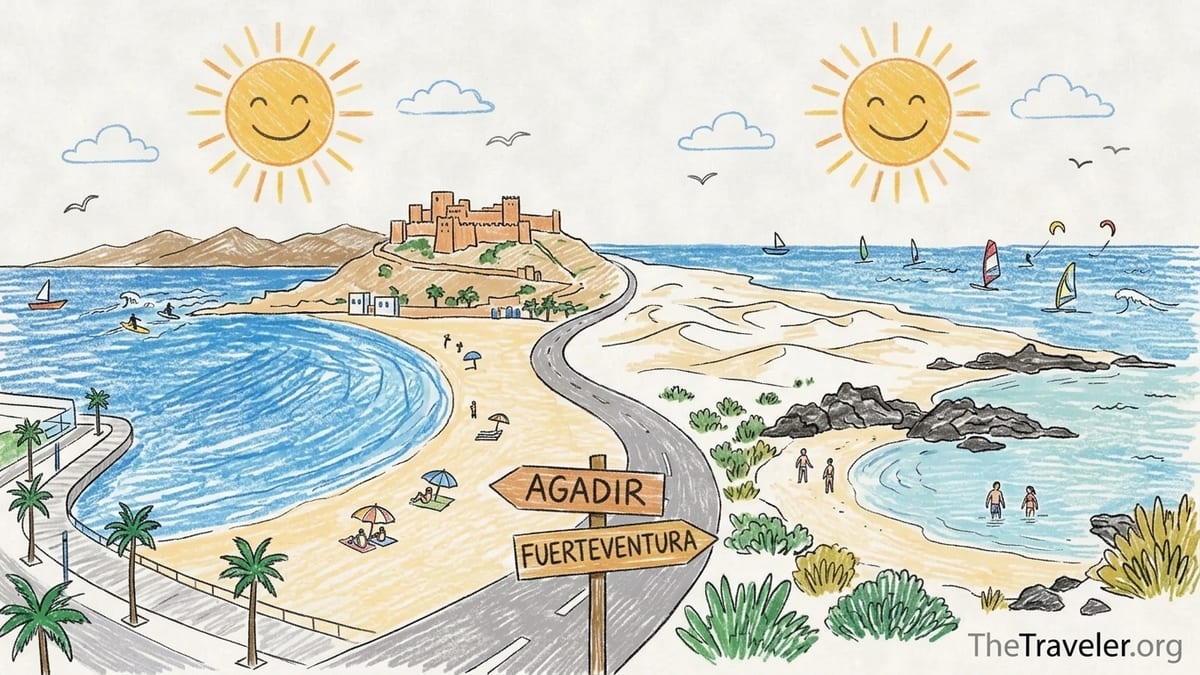
On the face of it, both destinations promise long golden sands, but the feel of the beaches and their backdrops is very different. Agadir’s main draw is its sweeping urban bay, a crescent of sand roughly six kilometres long framed by a modern seafront promenade and overlooked by the hilltop kasbah. The beach is broad and gently shelving, ideal for walking and jogs, with sections in front of large resorts laid out with sunbeds and parasols. To the north, surf‑friendly breaks appear near Anza and along the Taghazout Bay development, while to the south the sands stretch towards the mouth of the Souss‑Massa National Park.
Fuerteventura’s calling card is variety. The island is known for some of the longest white‑sand beaches in the Canary Islands, from the endless strand at Sotavento on the Jandía peninsula to the honey‑colored dunes of Corralejo in the north. In the resort town of Caleta de Fuste, a horseshoe‑shaped artificial cove offers sheltered waters for young children, while the wild west coast near El Cotillo draws surfers to more exposed Atlantic swells. Whereas Agadir is fundamentally a single long urban bay, Fuerteventura serves up a choice of landscapes within a relatively short drive, from lava‑rock coves to postcard‑perfect sandbars.
Access and ambiance on the sand also differ. In Agadir you step from city streets or hotel gardens directly onto the beach, with camel rides, quad‑bike vendors and beach football lending a busy, sometimes chaotic energy. Lifeguard posts, flag systems and cordoned swimming areas are in place along the central stretch. In Fuerteventura, especially outside the main resort strips, beaches often feel quieter and more natural, backed by low dunes or volcanic hills rather than high‑rise hotels. Facilities can be sparser away from towns, so families with small children may prefer staying close to resort beaches where lifeguards, toilets and cafés are on hand.
For pure beach‑hopping and scenic variety, Fuerteventura is hard to beat. If you like the idea of waking up to the same familiar bay, with cafés and the medina just behind you, Agadir’s city‑beach setup might suit you better.
Culture, atmosphere and things to do off the sand
Choosing between Agadir and Fuerteventura is not just about climate and coastlines. The atmosphere off the beach is where the two diverge most sharply. Agadir gives you a taste of Morocco with relatively soft edges: it is a rebuilt modern city after the 1960 earthquake, with broad boulevards, a marina, shopping malls and a walkable beachfront corniche. Yet within a short taxi ride you can be haggling over spices in the Souk El Had, sipping sweet mint tea in a café frequented by locals or listening to live Amazigh music in a small bar attached to a riad‑style guesthouse.
Day trips from Agadir put classic Moroccan landscapes within reach. Popular options include a guided excursion to the walled coastal town of Essaouira, around three hours north, or a loop through the Souss‑Massa National Park to spot birdlife and enjoy quieter wild beaches. Many winter visitors also book outings to Paradise Valley in the Atlas foothills for short hikes and canyon views, though winter water levels in the natural pools can be low. For football fans or culture lovers, combining Agadir with a night or two in Marrakech, about three hours inland by road, delivers a powerful contrast between beach calm and medina intensity.
Fuerteventura leans more towards a relaxed, outdoors‑focused island feel. Resort towns like Corralejo, Caleta de Fuste and Morro Jable have plenty of bars, restaurants and some late‑night venues, but the overall pace is slower and the cultural contrasts less pronounced for European visitors. English and German are widely spoken, menus are familiar and many pubs show Premier League matches during the winter season. Away from the resort strips, Fuerteventura’s attractions are largely natural: volcanic inland scenery for self‑drive explorations, small fishing villages such as El Cotillo and the windswept lighthouse at Punta Jandía.
If you are craving an “abroad” feeling with new languages, call to prayer drifting over town and the chance to dive into a different food culture, Agadir offers more depth. If you want somewhere that feels very easy, with minimal culture shock and simple logistics for families or older travelers, Fuerteventura’s island atmosphere may prove more restful.
Who each destination suits best: families, couples and activity seekers
Both destinations work for a broad mix of travelers, but certain types will get more out of one than the other. Families often appreciate Fuerteventura’s familiarity and infrastructure. Resorts in Corralejo and Jandía in particular cater heavily to families, with kids’ clubs, shallow hotel pools, water slides and easy access to gently shelving beaches such as those at Caleta de Fuste. Supermarkets stock familiar brands, tap water standards match the rest of Spain and driving is straightforward for those wanting to hire a car and explore.
Agadir can also be family‑friendly, especially within self‑contained all‑inclusive resorts that bundle children’s pools and entertainment into the package. However, parents of very young children sometimes find elements of city‑beach life, such as more assertive street vendors or busy roads, a little more demanding than in a purely resort‑focused Canary Island setting. On the flip side, older children and teens may find wandering the souk or bargaining for football shirts more memorable than another generic seafront strip.
Couples weighing romance against convenience will find positives in both. Agadir’s seafront sunset cafés, rooftop terraces and excursions into the Atlas foothills can feel adventurous yet accessible on a long weekend. A typical three‑ or four‑night escape might blend lazy mornings by the pool at a mid‑range beachfront hotel with evenings in local restaurants and a day tour inland. In Fuerteventura, couples often opt for adults‑only hotels in quieter parts of Jandía or along the less developed stretches south of Corralejo, combining long walks on windswept sands with relaxed evenings in small tapas bars.
For activity seekers, the choice may hinge on your passion. Surfers and kitesurfers will find reliable winter swells and winds in both Agadir’s surroundings and on Fuerteventura’s coasts, though Fuerteventura has a more established windsports infrastructure, particularly around Flag Beach near Corralejo and the lagoons of Sotavento. Hikers and those curious about cultural day trips may lean towards Agadir, which offers access to mountain villages, argan cooperatives and historic towns that have no direct equivalent on Fuerteventura.
Practicalities: flights, language, safety and etiquette
Getting to both destinations from Europe is straightforward. Agadir’s Al Massira Airport sits around half an hour’s drive from the resort strip, and current winter schedules show direct flights from several UK airports and major European hubs, often bundled inside packages that include coach transfers. Fuerteventura Airport lies on the east coast of the island, within a short transfer of Caleta de Fuste and under an hour’s drive from Corralejo or Jandía via main island roads. Competition on routes from the UK and Germany in particular helps keep fares competitive in the winter low season.
Language and everyday logistics feel different on the ground. In Agadir, Moroccan Arabic and Amazigh are the main local languages, but French is widely used in tourism and English is common in hotels and larger restaurants. In Fuerteventura you are in Spain, so Spanish dominates, yet English and German are prevalent in resort areas. Paying by card is straightforward in both destinations in hotels, chain supermarkets and mid‑range restaurants, though in Morocco you will still want local cash on hand for small taxis, market purchases and tips.
Safety levels for visitors are broadly good in both places, with the usual caveats about watching belongings on busy beaches and in markets. In Agadir, it is normal to encounter touts offering excursions, quad‑bike rides or souvenirs; a polite but firm “no, thank you” generally suffices if you are not interested. Modest dress is appreciated away from the beach and hotel pools, particularly when visiting souks or smaller towns, though standard resort wear is fine along the seafront. In Fuerteventura, dress codes align with Mediterranean norms and the main hazard on winter days is often the strength of the sun, which can catch visitors off guard even when air temperatures feel mild.
From a paperwork perspective, Fuerteventura follows standard Spain and EU rules, while Morocco maintains its own entry requirements that can change, so it is sensible to check the latest official guidance from your home country’s foreign office or state department before booking. Both destinations are popular with package operators precisely because entry formalities and on‑the‑ground logistics are tried and tested for winter visitors.
Conclusion: choosing your ideal winter sun match
For many travellers deciding between Agadir and Fuerteventura, there is no wrong answer. Both promise a welcome blast of light and warmth at a time when home can feel monochrome. Yet once you look closely at temperatures, costs and beaches, the differences sharpen into a useful checklist.
If you are chasing value, keen to stretch your spending money and curious about combining beach downtime with souks, mountain day trips and North African flavors, Agadir emerges as a compelling choice. Expect slightly cooler ocean water, a busy urban bay rather than untamed coves, and a layer of cultural texture that will appeal to travellers who enjoy a sense of place.
If you want something closer to a classic European beach holiday transplanted into winter, with familiar food, very stable weather, long walks on wild sands and easy family logistics, Fuerteventura is likely to fit better. You may pay a little more overall for equivalent packages and meals, but in return you gain straightforward infrastructure and some of the finest beaches in the Canary Islands.
In the end, the best winter sun destination is the one that matches your priorities for this particular trip. A couple seeking an affordable, atmospheric long weekend might find Agadir unbeatable in December. A family looking for stress‑free half‑term warmth with plenty of sandcastles and kids’ clubs could feel happier in Fuerteventura. Both are seeing a surge in winter‑sun interest for good reason, and both are capable of delivering that simple midwinter pleasure: waking up, drawing the curtains and seeing sunlight on the water instead of frost on the window.