


More news on this day
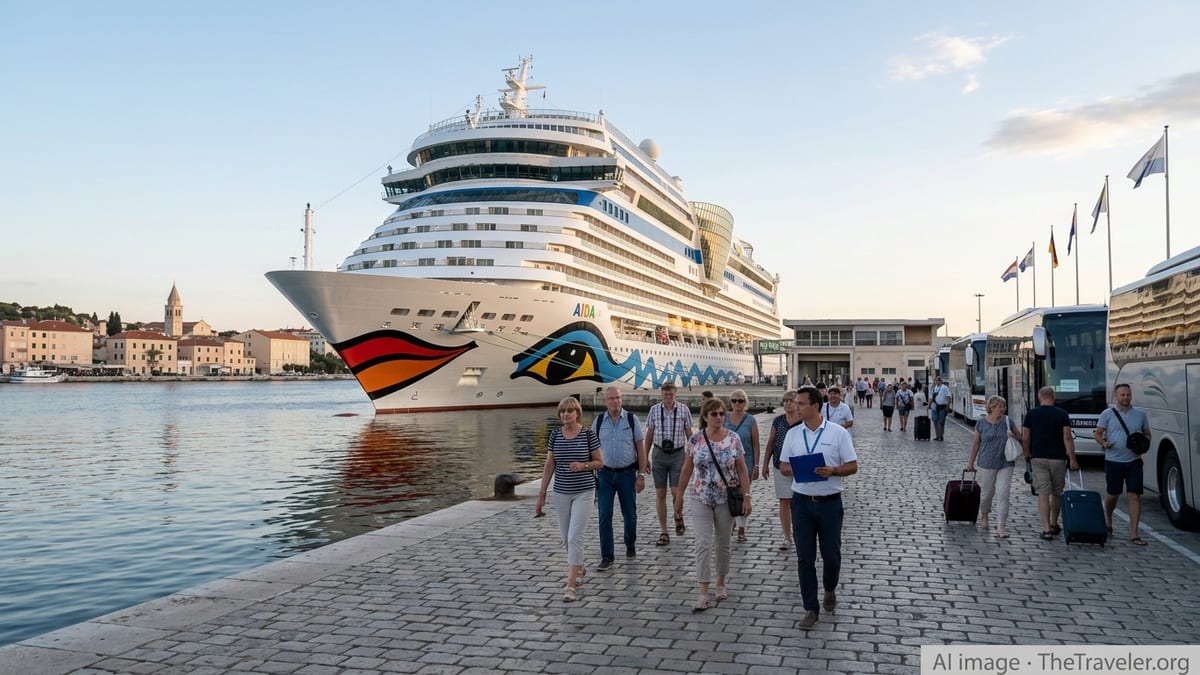
As cruise lines ramp up their Europe deployment for 2025 and 2026, AIDA Cruises is positioning its fleet to help international travelers move smoothly between multiple European countries on a single itinerary, turning classic city-hopping into a streamlined, sea-based experience.
Get the latest news straight to your inbox!
Strategic European Routes Built for Country-Hopping
Publicly available schedules show that AIDA’s Europe program now threads together Western Europe, the Mediterranean and Northern Europe in ways that allow guests to experience several countries within one voyage. Western Europe sailings, for example, link ports in Germany with calls in France, Belgium, the Netherlands and the United Kingdom, positioning routes so that guests can see major capitals and coastal cities without repeated hotel check-ins or internal flights.
Mediterranean itineraries scheduled through 2026 similarly connect Spain, Italy, France and sometimes smaller states such as Malta in a single loop. Independent cruise tracking and planning sites indicate that ships like AIDAcosma and AIDAnova continue to be deployed on week-long and longer sailings that combine marquee ports such as Barcelona, Civitavecchia for Rome and Palma de Mallorca with lesser-known coastal towns, giving visitors a cross-section of cultures within a relatively compact timeframe.
For travelers seeking cooler climates, AIDA’s Northern Europe and Western Europe offerings highlighted on booking portals show itineraries that string together Norway, Denmark, the United Kingdom and occasionally Iceland. These routes cater to guests drawn to fjords, historic trading cities and contemporary northern capitals, with multi-country vistas unfolding overnight as ships reposition while passengers sleep.
Alongside these regional programs, longer combination voyages and world cruises, including extended itineraries from Hamburg, underline a strategy of using key German homeports as gateways to wider European and global networks. This approach allows guests to plug into multi-country routes from a single embarkation point while ships handle the complex repositioning in the background.
Key Gateways and Ships Connecting the Continent
Travel industry coverage and AIDA’s own booking platforms identify several cities as recurring hubs for multi-country European voyages. In the Mediterranean, Palma de Mallorca, Barcelona and Civitavecchia near Rome appear frequently as starting points for itineraries visiting Spain, Italy and France, with some routes extending into the Adriatic to reach Croatia or Greece. These ports offer international air links that make it easier for long-haul guests to access the start of a cruise and immediately begin country-hopping by sea.
In Northern and Western Europe, Hamburg and Kiel in Germany stand out as principal turnaround ports, particularly for routes to the Norwegian fjords, the Baltic region and the metropolises of Western Europe. Reports from cruise analysts describe how these homeports function as anchors for sailings that can include the United Kingdom, France, Belgium and the Netherlands in a single itinerary, effectively creating a mobile city-break schedule on water.
Flagship vessels such as AIDAnova and AIDAcosma, both among the line’s newest ships, are regularly associated with these multi-country European programs. Public data on fleet deployment shows them assigned to week-long and 14-night sailings that maximize the number of distinct nations visited, while also incorporating sea days for onboard relaxation. Other ships across the fleet rotate through Western Europe and Mediterranean routes, giving repeat guests varied combinations of ports even when sailing from the same gateway city.
For travelers planning far ahead, specialist cruise guides tracking the 2026 season point to a broad spread of European routes already on sale. These sources suggest that international guests can align school holidays or long-haul vacation windows with sailings that either focus on a specific region or stitch together Atlantic, North Sea and Mediterranean ports into extended journeys.
Practical Entry, Visa and Border Considerations
While the appeal of seeing multiple countries in one voyage is clear, international travelers must navigate Europe’s entry rules before embarking. AIDA’s own frequently asked questions and pre-departure guidance emphasize that guests are responsible for holding valid passports and visas where required, and that requirements can differ depending on nationality, itinerary and the mix of Schengen and non-Schengen countries on a route.
For many Europe-focused sailings, ports fall within the Schengen Area, a zone where internal border checks are reduced and short-stay rules generally allow up to 90 days within a 180-day period for eligible visitors. Travel advisories and cruise-planning resources highlight that guests who require a Schengen visa typically need it to cover the full duration of the cruise, including all Schengen ports, even if they remain onboard at certain stops. When an itinerary includes non-Schengen destinations, such as the United Kingdom or select ports in the Balkans, additional entry rules or visas may apply.
Public guidance from cruise lines and visa information services also note that some operators may request passport details in advance and, in certain cases, hold passports temporarily to simplify border formalities with local authorities. Travelers are therefore encouraged by official information portals and consumer travel media to verify requirements well before departure, cross-checking the specific ports of call, the sequence of Schengen and non-Schengen countries and any upcoming changes to European entry systems.
Because regulations can shift between booking and sailing, especially on departures scheduled for 2026 and beyond, experts recommend that guests monitor updates from government immigration websites and the cruise line’s documentation centers. This approach helps ensure that the promise of effortless movement between countries by sea is matched by equally smooth border crossings on shore.
Onboard Experience Tailored to International Guests
Although AIDA traditionally caters strongly to the German-speaking market, recent coverage in cruise trade publications suggests that the line is receiving growing interest from international guests who are drawn to its Europe-centric itineraries. English-language booking tools and onboard information, referenced in publicly available brochures and digital guides, outline how key services, safety briefings and excursion descriptions are increasingly accessible to non-German speakers.
Shore excursion programs marketed for the 2024 to 2026 seasons feature thousands of tours globally, with several hundred focused on sustainable or locally immersive experiences. In Europe, this translates into guided city walks in historic quarters, culinary tours spotlighting regional specialties and active excursions such as cycling or fjord hiking, allowing guests to encounter each country in a distinct way within the confines of a single cruise.
Onboard, large resort-style ships such as AIDAnova and AIDAcosma are designed to function as floating base camps between countries. Industry overviews point to diversified dining concepts, family-friendly water parks, spa facilities and live entertainment as central to the product, giving guests consistent comfort and amenities even as the scenery and cultures change daily outside.
For global travelers used to independent rail or road trips across Europe, this style of cruising offers a simplified alternative. Instead of managing multiple currencies, hotel check-ins and regional transport schedules, guests unpack once and rely on AIDA’s logistics to deliver them from one country to the next, integrating transportation, accommodation and much of the sightseeing infrastructure into a single package.
Planning a Seamless Multi-Country Voyage With AIDA
Travel planners advising clients on Europe have noted that the most efficient AIDA itineraries for country-hopping are those that either start and finish in the same major port with a dense cluster of calls in between, or link two primary gateways with limited sea days. Western Europe routes marketed for 2026, for example, showcase sequences that might include Hamburg, Southampton, Le Havre for Paris and Belgian or Dutch ports in one loop, providing four or more national experiences within a week.
Similarly, Mediterranean voyages that combine Barcelona, ports in southern France, Italian hubs and island destinations allow visitors to sample multiple culinary traditions, languages and landscapes with minimal transit time. By examining published route maps and seasonal deployment, travelers can choose between shorter samplers of a region or longer combination cruises that merge back-to-back itineraries into extended journeys around the continent.
Experts in cruise trip-planning often suggest aligning personal interests with specific clusters of ports rather than simply counting the number of countries. For art and history, routes heavy on Italy, France and Spain may be most appealing, while nature-focused guests often gravitate toward Norwegian fjords and North Atlantic islands. AIDA’s growing range of shore excursions in each region, highlighted in promotional materials and third-party reviews, allows guests to tailor their onshore time without losing the underlying simplicity of a single-vessel voyage.
With European cruise deployment expanding into 2026 and beyond, the latest AIDA programs underscore how multi-country travel can be condensed into one continuous journey by sea. For global visitors deciding how to experience Europe in a limited vacation window, these itineraries offer a structured, cruise-based alternative to traditional city-hopping, merging logistical ease with the variety of a multi-nation tour.