


More news on this day
Passengers on an Air Canada flight from Los Angeles to Montreal faced hours of uncertainty after their aircraft veered off the runway and came to a stop in the grass, leaving those onboard stranded while crews worked to secure and inspect the jet.
Get the latest news straight to your inbox!
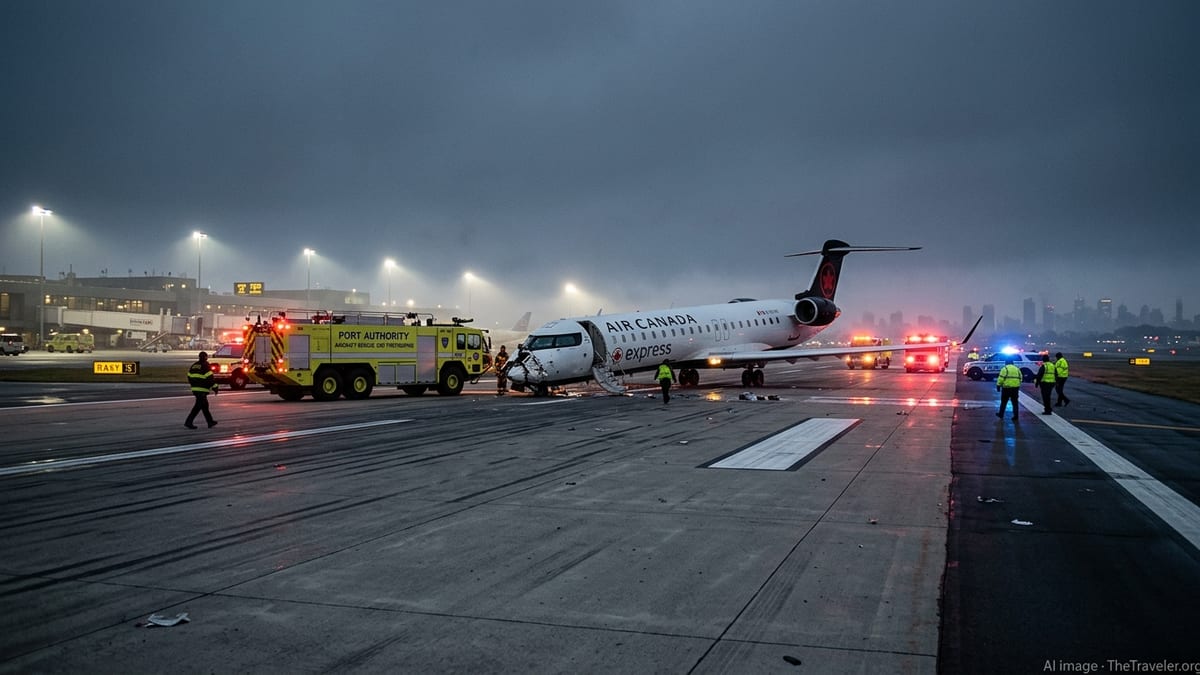
Runway Excursion After Routine Transcontinental Flight
Publicly available information shows that the incident occurred on July 9, 2026, when Air Canada flight AC774 was arriving at Montréal–Trudeau International Airport after a routine journey from Los Angeles International Airport. The aircraft, reported to be carrying around 160 passengers and several crew members, initially touched down on the runway without signs of a major problem.
According to published coverage, the jet then experienced what has been described as a runway excursion. After landing, the aircraft reportedly veered off the paved taxiway area and continued across a stretch of grass adjacent to the runway complex before coming to a halt. Images and video shared on social media and in news reports show the aircraft stationary on uneven ground, surrounded by airport vehicles.
Reports indicate there was no fire and no serious injuries associated with the event. The jet remained largely intact, and external damage visible in publicly circulated images appeared limited to landing gear tracks and disturbed ground near the wheels. However, the position of the aircraft off the prepared surface required airport teams to secure the site and arrange for specialized ground handling before passengers could be moved.
Hours Onboard as Crews Assess Aircraft and Airfield
Once the aircraft came to a stop in the grass, passengers found themselves confined to the cabin for an extended period. Passengers quoted in Canadian and international media described remaining onboard for roughly three hours following the excursion, as ground crews and emergency responders positioned equipment and evaluated how to safely bring the aircraft back to the paved taxiway system.
Accounts shared publicly describe a mix of relief and frustration inside the cabin. Travellers could see emergency vehicles surrounding the aircraft, but normal deplaning via a jet bridge was impossible due to the aircraft’s location away from the terminal. Portable stair units and buses had to be brought to the site, a process that generally requires coordination between airport operations, ground handling providers and the airline.
Reports indicate that during this period, airport personnel carried out standard post-incident procedures, including visual checks of the landing gear and airframe and confirmation that there was no fuel leak or other immediate hazard. Only once the situation was deemed stable could the deplaning process begin, prolonging the time passengers remained in their seats after what had started as a normal landing.
Operational Disruptions and Runway Closure Ripple Effects
The runway excursion at Montréal–Trudeau also had consequences beyond the affected flight. Public flight-tracking data and media reports show that runway operations were temporarily constrained while the incident aircraft remained in the grass, prompting delays and minor diversions as air traffic controllers and airport managers adjusted traffic flows.
Published accounts indicate that the main runway was closed for a period while airport teams responded to the excursion and assessed the condition of the landing surface and adjacent safety areas. Although the closure was relatively short, even brief interruptions at a busy hub can cause scheduling challenges, particularly during peak travel times or when weather and airspace congestion are already affecting flights.
Some arriving and departing flights reportedly experienced delays of up to around an hour, with airlines advising passengers to monitor flight status updates throughout the day. For travellers on connecting itineraries, these knock-on delays created further complications, including missed connections and rebooking efforts that extended well beyond the airport’s immediate response to the runway incident.
Airline Response and Passenger Support Measures
According to statements cited in news coverage, Air Canada described the landing as normal before the aircraft experienced a runway excursion while exiting the main runway. The airline indicated that the aircraft was secured and that all customers were eventually transported from the aircraft to the terminal. The publicly available information suggests that cabin crew maintained order on board while waiting for clearance to begin deplaning.
Reports from passengers indicate that, once off the aircraft, travellers were assisted through customs and baggage claim as operations allowed. Some accounts reference efforts by the carrier to rearrange onward travel or provide accommodations for those whose journeys were significantly disrupted by the delay and subsequent schedule changes.
As is standard in such situations, the airline is expected to participate in any review undertaken by aviation regulators and safety investigators, providing flight data, maintenance records and crew reports. Publicly available information at this stage focuses primarily on the immediate operational response and the passenger experience, with more detailed technical findings likely to emerge later through formal investigative channels.
Safety Record and Ongoing Investigation Context
A runway excursion, in which an aircraft departs the runway or taxiway surface during landing, takeoff or taxi, is a recognized aviation safety risk but remains relatively rare given the volume of global air traffic. Data from international aviation bodies published in recent safety reports highlight that commercial jet travel continues to maintain a low rate of serious accidents, with most runway events resulting in limited damage and few or no injuries.
In the case of the Montreal incident, reports so far do not point to adverse weather as a primary factor, and visibility in publicly shared footage appears reasonable. Investigators are likely to examine a range of possible contributors, including runway surface conditions, aircraft speed during rollout, braking performance, and the configuration of taxiway exits used after landing.
While technical details have not yet been released, aviation specialists note that excursions occurring at low speed, after an otherwise uneventful landing, tend to focus attention on ground handling, braking action and cockpit decision-making during the final phase of rollout. These reviews often result in updated guidance, training refinements or procedural changes rather than sweeping design modifications.
For passengers, the incident underscores both the resilience and vulnerabilities of modern air travel. The ability of the aircraft structure to withstand an unexpected departure from the paved surface, the orderly response by airport teams, and the absence of serious injuries all align with the sector’s robust safety framework. At the same time, the hours spent waiting inside a stationary aircraft illustrate how even non-catastrophic events can create a prolonged and stressful experience for travellers, particularly when they occur at the end of a long-haul journey.