


More news on this day
Fresh Iranian strikes on Bahrain and Jordan amid an escalating confrontation with the United States are stoking new uncertainty for travelers using Dubai and other key Middle East hubs, as airlines weigh risks to aircraft, crews and passengers in an increasingly volatile airspace.
Get the latest news straight to your inbox!
New Barrage Extends Conflict’s Reach Into Bahrain and Jordan
Recent reporting from regional and international outlets indicates that Iran has expanded its latest wave of missile and drone attacks to include targets in Bahrain and Jordan, following renewed United States airstrikes on Iranian military infrastructure. The incidents mark a sharp escalation from earlier exchanges that had largely focused on coastal areas along the Strait of Hormuz and bases in the Gulf.
Coverage from news agencies describes alert sirens sounding repeatedly in Bahrain as projectiles were intercepted over the kingdom, with authorities there confirming defensive measures and visible disruption in Manama and around key facilities. In Jordan, public information points to Iranian projectiles aimed at military installations used by US forces, with interceptions reported near the Muwaffaq Salti Air Base and other strategic sites.
These strikes come on top of earlier barrages that already targeted Bahrain, Kuwait and Qatar as part of Iran’s stated response to US attacks on its territory and its naval assets. The latest salvos appear designed to increase pressure on Washington and its regional partners, but they also push the conflict further into air corridors that are critical for long-haul passenger and cargo traffic linking Europe, Asia and Africa.
For travelers, the significance is less about the individual facilities hit and more about the pattern: a growing list of states, including Bahrain and Jordan, experiencing repeated alerts and interceptions near major population centers and, in some cases, within reach of civilian aviation routes.
Dubai’s Central Role Keeps Flights Moving, But With Added Caution
Dubai International Airport remains the busiest international hub in the region and a key transit point for passengers whose journeys span multiple continents. Publicly available aviation data and prior incident reports show that Dubai’s airspace has already faced closures and diversions this year after Iranian missiles and drones were intercepted over the United Arab Emirates, prompting temporary suspensions of arrivals and departures.
In the most recent flare-up, Dubai has so far avoided direct closure for extended periods, but the city’s role as a regional redistribution point means it is acutely sensitive to instability in neighboring states. When Bahrain or Jordan face missile alerts or short-lived airspace restrictions, knock-on effects can ripple quickly into Dubai, where flights are re-routed, delayed or re-timed to avoid affected corridors.
Industry trackers and travel advisories suggest that airlines transiting Dubai are now building in additional fuel margins and contingency flight plans in case they need to skirt certain portions of Gulf and Levantine airspace at short notice. Some carriers have already adjusted routings slightly farther south over Saudi Arabia or over the Red Sea on selected services, a move that adds time and cost but helps reduce exposure to the most contested skies.
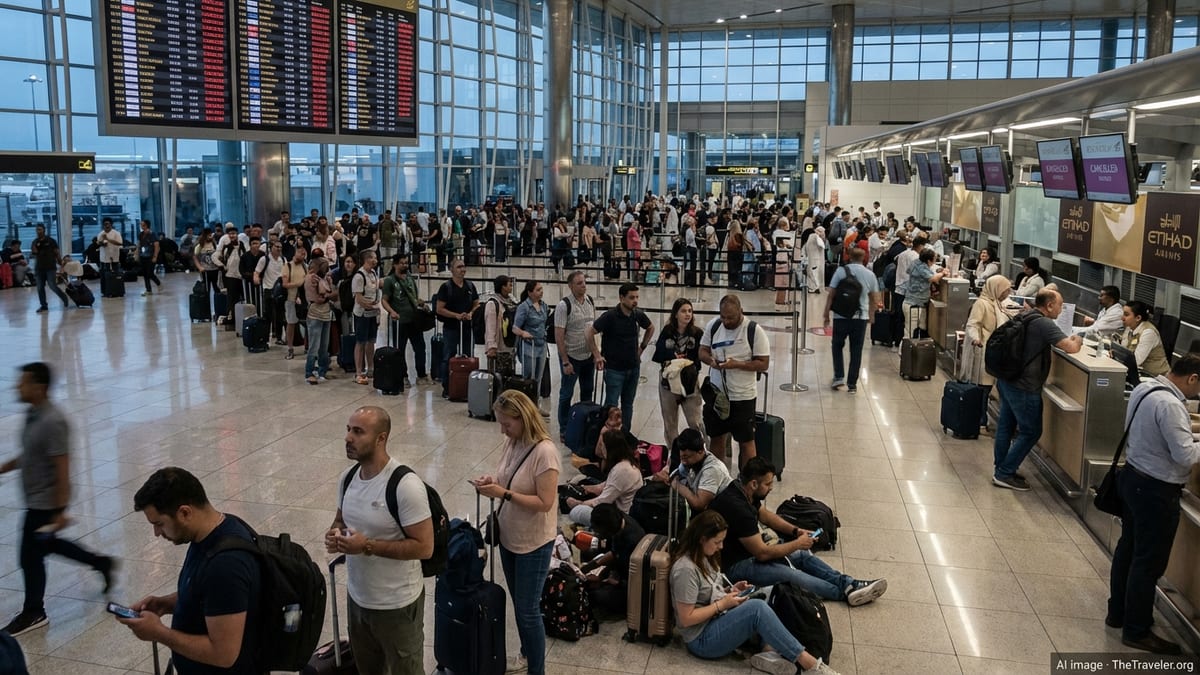
For passengers, most itineraries still operate, but there is growing evidence of longer flight times, last-minute gate changes and revised departure slots. Dubai’s connectivity is robust and the airport’s operations teams have experience managing disruption, yet the city’s status as a crossroads means it will remain vulnerable to sudden regional escalations as US Iran tensions deepen.
Bahrain and Jordan Face Renewed Scrutiny Over Airspace Safety
Bahrain’s compact geography and its role as host to US naval and air assets have placed it repeatedly on Iran’s target list throughout the current conflict. Historical records from earlier this year already document strikes and airspace closures that forced its national carrier, Gulf Air, to shift aircraft to other airports and left some passengers stranded or facing repeated cancellations.
The new wave of attacks has led to additional siren activations and further concern over the safety of overflights and scheduled services to and from Bahrain International Airport. Travel advisories compiled by risk consultancies describe operations there as heavily disrupted, with certain airlines suspending or limiting services and others adopting a wait-and-see posture pending clearer security assessments.
Jordan, which had initially seen fewer direct hits earlier in the war, is now more firmly in the line of fire. Recent public reporting indicates that Iranian missiles and drones have been fired toward US-linked facilities inside the kingdom, including at least one major air base. Even when intercepted, such barrages can trigger temporary restrictions on approaches and departures, prompting some carriers to curtail nighttime operations or consolidate flights.
For travelers bound for Amman or transiting via Jordanian airspace, schedules remain in flux. While the main international airport remains open, aviation notices and airline bulletins point to potential delays, diversions or re-routings, particularly if further strikes coincide with peak travel periods.
Airlines Rework Routes and Risk Calculus Across the Region
The growing complexity of the airspace picture has compelled airlines and aviation regulators to revisit their risk assessments on an almost daily basis. Published guidance from European and international safety bodies has already urged carriers to take extra caution when planning routes over parts of the Gulf and adjacent areas, citing the risk of miscalculation or misidentification in crowded skies.
In practice, this has meant that some European and Asian carriers have stopped overflying specific sectors of Iranian, Iraqi or Bahraini airspace, even when formal closures are not in place. Others continue to fly but at higher cruising altitudes or along narrower, pre-agreed corridors designed to keep civilian jets clear of active military zones and interceptor paths.
Regional airlines based in the Gulf, including those operating out of Dubai, Abu Dhabi, Doha and Manama, face particularly intricate decisions. Their route networks are built around short hops between neighboring capitals as well as long-haul connections that rely on the most direct great-circle paths crossing contested areas. With each new US strike or Iranian response, network planners must weigh commercial imperatives against rapidly shifting security considerations.
Insurance costs, crew duty limitations and aircraft availability are also starting to play a larger role. Extended routings use more fuel and take more time, which can push pilots and cabin crew close to their legal duty limits and force airlines to trim frequencies or rotate aircraft differently. For passengers, the impact is felt in tighter connection windows, occasional missed onward flights and an uptick in unplanned overnight stays.
What Travelers Using Dubai and the Wider Region Should Expect
For now, most experts tracking aviation movements note that the region’s big hubs, including Dubai, continue to function, albeit under visible strain. The overwhelming majority of flights are still taking off and landing safely, and there has been no indication in public data of a direct hit on a civilian airliner amid the latest exchanges between the US and Iran.
However, the broadening of Iranian strikes to include renewed targeting of Bahrain and Jordan underlines how quickly the operational environment can change. Even when air defenses succeed in intercepting incoming missiles or drones, precautionary closures, diversions and ground holds can cascade through airline schedules across the Gulf.
Travelers planning to route through Dubai or to destinations such as Manama and Amman should be prepared for a less predictable experience than in previous years. The most likely inconveniences are schedule changes, longer journeys and occasional last minute rerouting, rather than outright cancellations of all services, but the situation remains fluid and closely tied to developments in the wider US Iran confrontation.
As both Washington and Tehran signal readiness to continue military operations following attacks on shipping and bases across the region, aviation stakeholders are bracing for further disruptions. Even a limited escalation can have an outsized impact on global connectivity, given the Middle East’s central role in linking continents and the tight margins on which modern airline networks operate.