


More news on this day
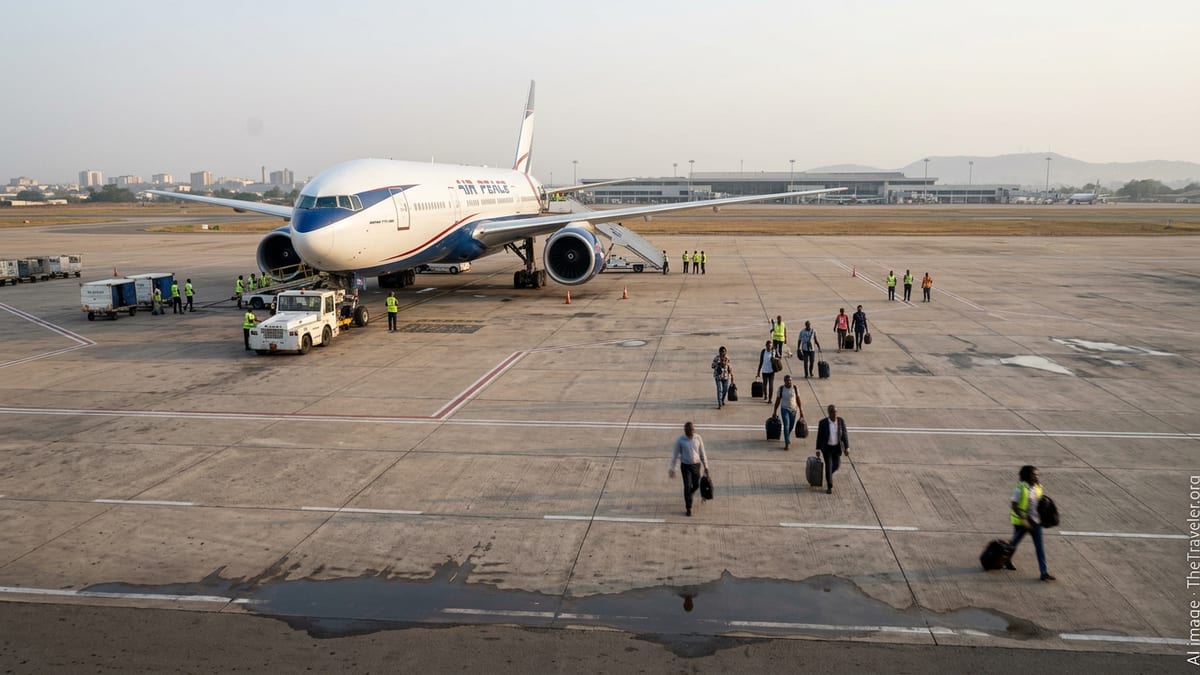
Air Peace is pushing back against Nigeria Civil Aviation Authority delay statistics for August 2026, saying the widely circulated disruption summary lacks cause breakdowns and that only about 15% of its delays were within the airline’s direct control.
Get the latest news straight to your inbox!
What the NCAA delay report shows for August 2026
Published coverage indicates the Nigeria Civil Aviation Authority released a “Summary of Domestic Airline Flight Disruption Operations” for August 2026 showing widespread delays across the country’s domestic network. The dataset has been recirculated by multiple Nigerian outlets in recent days as a snapshot of operational performance heading into a busy late-summer travel period.
Across the domestic market, the summary lists 7,961 scheduled flights for the month, with 4,765 recorded as delayed and 36 recorded as cancelled. That equates to a delay rate of roughly 59.9% and a cancellation rate of about 0.5%, figures that have fueled renewed scrutiny of airline reliability, airport capacity, and turnaround constraints.
Air Peace and United Nigeria Airlines were highlighted in reporting as among the carriers with the highest counts of delays in the NCAA’s table. One frequently cited figure from the summary is that Air Peace recorded 1,330 delayed flights out of 1,864 domestic flights attributed to it for August, a ratio that drew immediate attention because Air Peace is one of the largest domestic operators by volume.
Air Peace’s response: cause attribution and a flight-count dispute
Air Peace’s rebuttal has focused on two core points: what the airline says is missing context about why delays happen, and what it describes as a mismatch between the flights it operated and the flights counted in the NCAA table. According to published coverage of the airline’s statement, Air Peace says it operated 2,564 flights in August, versus 1,864 listed for the airline in the regulator’s summary.
The carrier has also argued that, when delays are separated into root causes, only a small share should be attributed to airline-controlled factors. Reporting on the response quotes the airline’s position that only around 15% of delays were “airline-caused,” with the remainder tied to operational constraints outside the airline’s direct control.
In its public pushback, the airline points to disruptions that can compound across the day. Even a short departure hold early in the schedule can ripple into later legs if aircraft rotations, crew duty limits, or gate availability become misaligned, a dynamic familiar to travelers when morning delays turn into afternoon cancellations or missed connections.
External factors cited: weather, airports, and ground handling
In published accounts of the airline’s statement, Air Peace cites a range of external drivers it says can distort simple delay tallies. These include adverse weather and the knock-on effects of diversions or safety holds, as well as airport facility and infrastructure limitations that can slow turnarounds and constrain departures.
The airline also referenced bird strikes as a contributing factor, a risk that can trigger mandatory inspections, aircraft substitutions, and cascading schedule changes. Separately, the statement cited industrial actions by aviation unions among the disruption drivers, an issue that can affect airport services and airside support even when an airline’s aircraft and crew are ready.
Another element raised in coverage is aircraft damage linked to a ground-handling company, which Air Peace said removed one aircraft from service for more than 14 days. For travelers, that kind of out-of-service event can be especially disruptive because it reduces spare capacity, making it harder for airlines to recover quickly when other issues arise on the same day.
Why the “who caused the delay” question is complicated for travelers
Delay statistics can be reported in very different ways depending on whether they focus on counts of delayed flights, total delayed minutes, or causality categories. Without a cause breakdown, travelers may see a single headline delay rate without knowing how much stems from airline operations versus weather, airport congestion, or air traffic flow measures.
In the United States, airlines that report on-time performance to the Department of Transportation must classify delays of 15 minutes or more into standardized buckets such as carrier-caused, late-arriving aircraft, National Aviation System, weather, and security. That framework illustrates how official reporting can separate controllable versus external causes, although it still cannot capture every operational detail behind a disruption.
Nigeria’s latest NCAA disruption summary, as described in published coverage, has helped quantify the scale of domestic delays in August, but Air Peace’s critique signals that travelers and analysts are increasingly looking for more granular attribution. A flight that is late because of a late-arriving aircraft, for example, may trace back to weather or airport constraints earlier in the day, rather than a single decision on the delayed leg.
What to watch next for Nigeria’s domestic flyers
The immediate question is whether the NCAA will respond with additional detail, including clearer definitions for what counts as a “delay,” standardized thresholds, and consistent reconciliation of scheduled versus operated flights across carriers. When flight-count baselines differ, delay ratios can look dramatically worse or better depending on which denominator is used.
Another focal point is whether airports and handling providers will face heightened scrutiny alongside airlines. Published reporting around the dispute has brought renewed attention to turnaround equipment reliability, gate constraints, and the resilience of ground operations, all of which can be decisive during peak hours at major domestic airports.
For travelers, the controversy underscores the value of tracking flight status closely on travel days, particularly during periods of storm activity or operational constraints. Even when an airline disputes responsibility for delays, the practical impact for passengers remains the same: late departures, missed plans, and uncertainty, with the broader system’s ability to absorb disruptions becoming the key variable.