


More news on this day
Travellers heading to Dubai and across the Middle East face another period of uncertainty as major international airlines extend route cancellations, delay resumptions and divert flights in response to ongoing regional conflict and airspace risk assessments.
Get the latest news straight to your inbox!
Regional security backdrop keeps pressure on Gulf air corridors
Publicly available information from aviation agencies and industry briefings indicates that airspace across parts of the Middle East remains constrained following this year’s escalation in conflict involving Iran and neighbouring states. Several countries continue to enforce full or partial airspace restrictions, forcing airlines to lengthen routings or suspend services on selected corridors.
The European Union Aviation Safety Agency has extended a conflict-zone information bulletin to at least 16 November 2026, covering large parts of the Gulf, including the United Arab Emirates, Bahrain, Qatar, Oman, Kuwait and Saudi Arabia. The advisory urges operators to carefully assess risks when planning flights through affected airspace and has been repeatedly cited by carriers adjusting schedules and routings.
Sector analysis published in recent months suggests that international traffic via Middle Eastern hubs has been funnelled into narrower corridors north and south of the primary conflict zones. This has added flying time on some long haul routes between Europe or North America and Asia, increased fuel burn and reduced network flexibility, which in turn limits the capacity airlines can offer into hubs such as Dubai, Abu Dhabi and Doha.
While airports in the UAE remain open and operating, regional incidents, including attacks on airports in Saudi Arabia and drone strikes earlier in the year, have contributed to a cautious stance by a number of non-Gulf carriers. As a result, a patchwork of suspensions, reduced frequencies and re-routed services continues to affect passengers planning trips to or through Dubai and the wider region.
Dubai routes: extended suspensions by European and Asian carriers
Dubai International Airport continues to handle large volumes of traffic, but recent schedule updates show that several European and Asian airlines are maintaining or extending suspensions on direct services. According to published coverage, Dutch carrier KLM has cancelled its flights between Amsterdam and Dubai until at least late March 2027, alongside prolonged cancellations on services to Riyadh and Dammam.
Factbox-style updates from global news outlets indicate that Air Canada is keeping its Dubai route offline into early 2027, aligning these decisions with an ongoing suspension of services to Tel Aviv. Singapore Airlines has also extended the suspension of its SQ494 and SQ495 flights between Singapore and Dubai until the end of February 2027, citing the regional security environment and associated routing challenges.
Lufthansa Group airlines have repeatedly pushed back their own Dubai restart plans. Specialist aviation trackers and industry sites report that the group, which includes Lufthansa, SWISS, Austrian Airlines and Eurowings, now targets a resumption of Dubai services no earlier than late November 2026, after earlier plans for an October or early November return were postponed.
At the same time, some European low cost and leisure carriers have either delayed or cancelled planned winter-season launches to Dubai, reducing options for price-sensitive travellers from secondary cities. Schedule changes remain fluid, and airlines continue to update forward bookings as operational and security assessments evolve.
Partial recovery as some carriers resume Dubai and Gulf operations
Against this backdrop of extended suspensions, other airlines are gradually restoring services to Dubai and nearby hubs. Travel industry reporting shows that British Airways plans to resume daily London to Dubai flights from 3 November 2026 after a prolonged pause, with a second daily rotation pencilled in for the northern summer 2027 season, subject to conditions.
Regional media coverage indicates that several Lufthansa Group brands intend to rebuild a limited Dubai presence from late November, with incremental increases through the winter once risk assessments allow. Separate reporting points to Eurowings and Austrian Airlines preparing to reconnect Dubai with a handful of German and Central European cities, although exact start dates have shifted more than once as the situation develops.
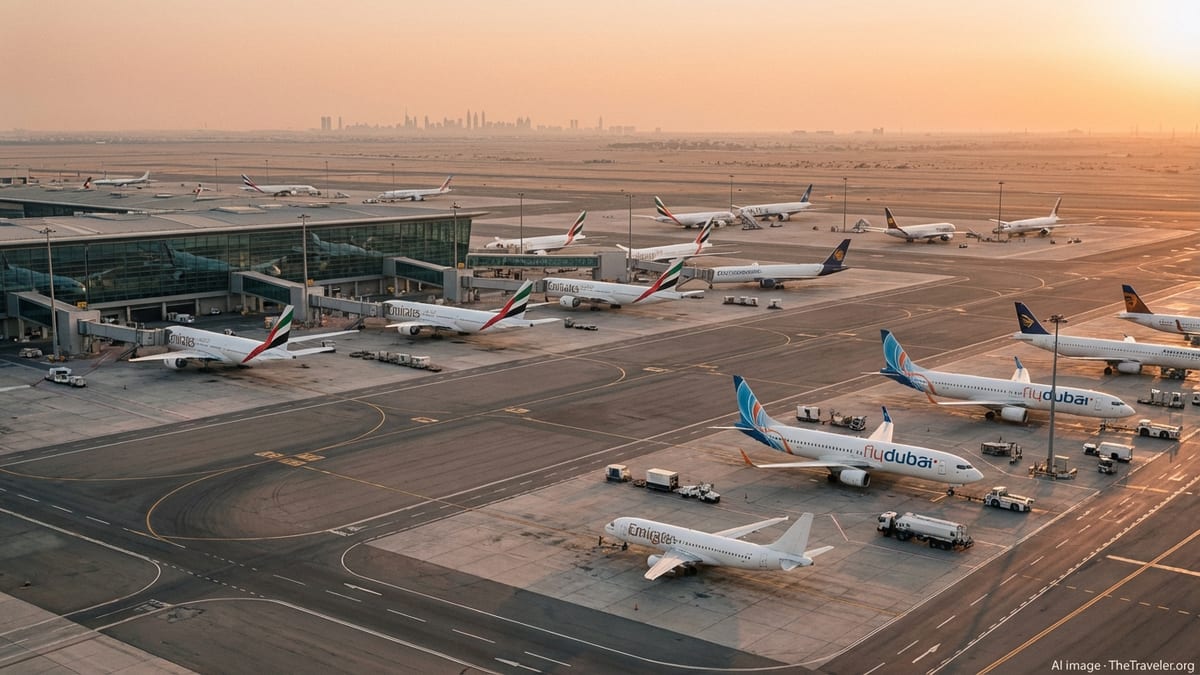
Locally based carriers centered on the UAE, including Emirates, Etihad Airways, flydubai and Air Arabia, are generally operating a far larger share of their pre-conflict networks. Recent traffic data cited in Gulf-focused outlets suggests that Emirates has restored operations to well over 90 per cent of its pre-disruption capacity, while flydubai is targeting a full recovery or modest growth by the end of 2026, subject to route specific restrictions.
Nevertheless, schedules across the Gulf remain subject to last minute adjustment. Airlines continue to reroute flights around closed or partially closed airspace in Iraq, Iran and parts of the Levant, which can result in longer flight times, fuel stops on selected ultra long haul routes and occasional short notice cancellations when operational or safety margins are affected.
Knock on effects across wider Middle East networks
The disruption is not limited to services touching Dubai. Airlines have scaled back or suspended flights to several points across the broader Middle East, reshaping connection patterns for travellers who would normally use Dubai as a transfer hub. Reporting from regional news outlets lists continuing suspensions on routes into Tel Aviv, parts of Iraq and certain secondary Saudi airports by a mix of European, Asian and North American carriers.
Low cost operators have also adjusted their Middle East footprint. Wizz Air, for example, has deferred or curtailed some services into Jordan and selected Gulf destinations, referencing EASA security updates, the continued closure or restriction of Iraqi airspace and the fuel implications of longer routings. Other budget airlines serving the region have similarly trimmed frequencies or postponed new route launches into early 2027.
Airspace and airport disruptions in Saudi Arabia have had particular spillover effects. Following attacks on Riyadh’s King Khalid International Airport in October, Saudi regulators temporarily curtailed operations, and international airlines responded with short term suspensions and diversions. Although normal operations have largely resumed at major Saudi airports, some foreign carriers continue to avoid routings that would bring aircraft close to these locations, adding further complexity to regional scheduling.
Industry bulletins focused on cargo and logistics underline that reduced bellyhold capacity on passenger aircraft and the reallocation of widebody jets away from riskier corridors are also affecting freight flows. This can indirectly shape passenger markets, as airlines balance the revenue contribution of cargo against the costs and risks of maintaining or restoring passenger services through affected hubs.
What travellers flying via Dubai should do now
With schedules changing frequently and some carriers extending cancellations into 2027, travellers booked to or through Dubai in the coming months are being urged by travel bodies and consumer advisers to monitor their flights closely. Publicly available guidance consistently recommends checking the latest status on the operating airline’s website or app within 24 hours of departure, and again before leaving for the airport.
Passengers affected by cancellations or significant timetable changes are generally being offered rebooking on alternative dates, refunds, or in some cases rerouting via other hubs in the Middle East or Europe. The precise options depend on the airline’s policies and the fare type purchased, and travellers may need to contact the airline or their travel agent to confirm entitlement, especially where journeys involve multiple carriers on a single ticket.
Because routings can change at short notice, travellers should allow additional connection time when itineraries involve multiple stops in or near the region. Reports from flight tracking services show instances of extended flight times on certain Europe to Asia and Asia to North America sectors routed around restricted airspace, which can compress connection windows for tight itineraries.
Air transport analysts caution that the regional security outlook remains uncertain and that further schedule changes, both positive and negative, are likely over the northern winter season. For now, Dubai remains open and functioning as a major international hub, but the mix of airlines and routes serving the city is in flux, and passengers relying on non Gulf carriers in particular may face longer journeys or reduced choice until risk assessments improve.