


More news on this day
Latvian carrier AirBaltic has reported record first quarter 2026 results, delivering 12.3% year on year revenue growth and solid operational performance, even as fuel prices, currency movements and one off items limited net profit gains.
Get the latest news straight to your inbox!
Revenue Surges to New Highs in Early 2026
Publicly available information shows that AirBaltic entered 2026 with its strongest first quarter on record, extending the momentum built over the past two years of recovery in European air travel. The airline’s revenue increased by 12.3 percent compared with the same period in 2025, supported by higher passenger volumes, improved yield management and continued expansion of its route network from the Baltic region.
Industry coverage indicates that the growth was broad based across both leisure and business segments, reflecting sustained demand on core routes linking Riga with major European hubs and popular holiday destinations. Capacity increases introduced in late 2025, particularly on routes to Southern Europe and the Middle East, also began to contribute meaningfully to top line growth as they matured through the winter season.
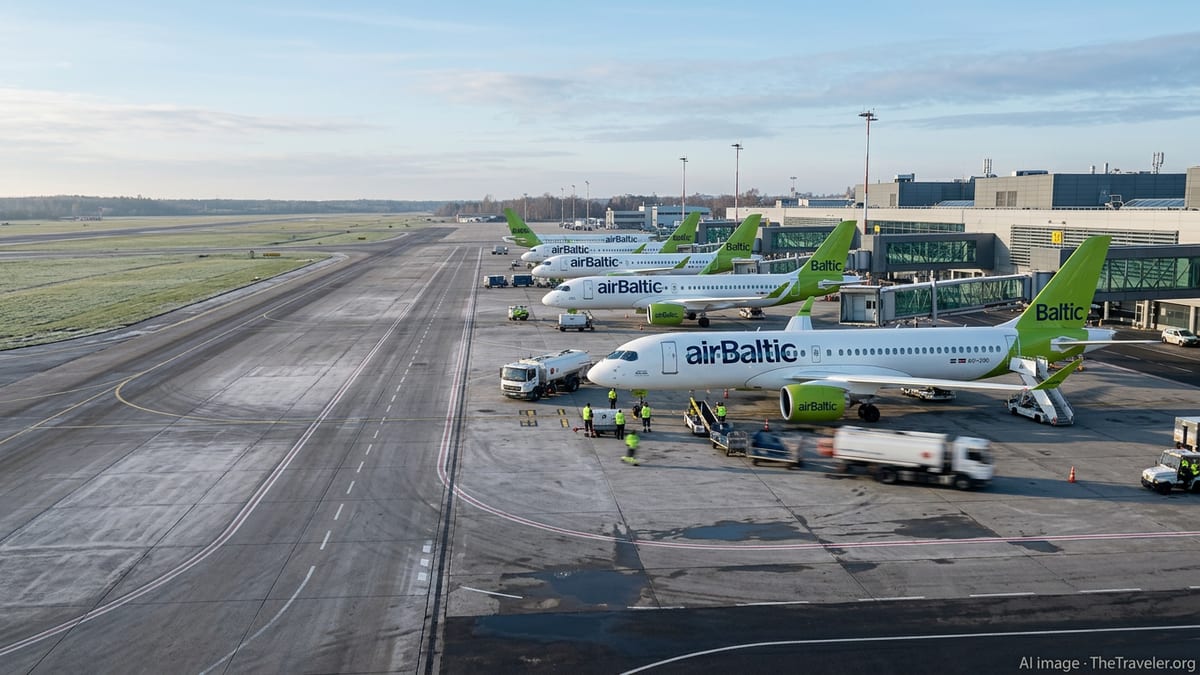
Analysts following the airline note that AirBaltic’s focus on a single type fleet of Airbus A220 aircraft continues to underpin its commercial performance. The type’s fuel efficiency and range have enabled the carrier to deploy capacity flexibly across short and medium haul routes while keeping unit costs in check, a key factor in sustaining revenue growth in a competitive regional market.
The strong first quarter performance sets a higher base for the rest of 2026, positioning the company ahead of internal planning assumptions that were framed around a more moderate demand outlook. This has increased expectations that AirBaltic may be able to accelerate deleveraging and fund elements of its longer term expansion strategy from operating cash flow, provided market conditions remain supportive.
Operational Metrics Highlight Robust Core Business
Operational data for the first months of 2026 point to a solid underlying business, with reports indicating higher load factors and stable on time performance compared with the previous year. Passenger numbers rose in line with capacity increases, suggesting that additional seats introduced into the market were largely absorbed without significant discounting pressure.
Available information on punctuality shows that AirBaltic maintained a competitive on time record despite a challenging winter period across Northern and Central Europe. The airline’s hub at Riga International Airport benefited from relatively smooth operations, allowing for effective connections onto secondary cities that rely heavily on the carrier’s network.
Industry observers highlight that aircraft utilization remained high across the Airbus A220 fleet, supporting unit cost efficiency. By concentrating on a single aircraft family, AirBaltic has been able to streamline crew training, maintenance and spare parts inventories, helping to mitigate some of the cost volatility seen elsewhere in the sector.
The operational resilience in the first quarter is seen as particularly important as the carrier prepares for the busy summer season, when schedules intensify and airports across Europe face peak congestion. A solid winter performance generally provides airlines with a stronger platform to manage operational complexity later in the year.
External Headwinds Weigh on Bottom Line
Despite the strong revenue and operational trends, the airline’s net profit for the quarter was constrained by external factors largely outside management’s direct control. Published coverage points to higher average jet fuel prices compared with early 2025, which eroded part of the benefit from the more fuel efficient fleet even after accounting for hedging programs.
Currency fluctuations also played a role, with movements between the euro and several non euro currencies affecting both revenue and cost lines. For an airline operating across a wide geographic footprint, exchange rate swings can quickly alter the economics of particular routes, adding complexity to pricing and capacity decisions.
In addition, AirBaltic continued to navigate airspace restrictions and reroutings linked to the geopolitical situation in Eastern Europe. These detours can lengthen flight times and increase fuel burn, while also limiting the ability to serve some previously important markets at optimal frequencies.
Sector analysts note that such external pressures have affected many European carriers in the current environment, and AirBaltic’s ability to grow revenue and maintain operational discipline in spite of them is seen as a positive indicator of the underlying strength of its business model.
Strategic Positioning in the Baltic and European Market
According to industry reporting, AirBaltic continues to play an outsized role in connecting the Baltic states with the rest of Europe and beyond. Riga remains the airline’s primary hub, but the carrier has also been developing services from secondary bases in Tallinn and Vilnius, reinforcing its position as the leading network airline in the region.
The first quarter of 2026 saw further refinement of the route portfolio, with capacity redeployed toward destinations showing the strongest demand and yield. Additional flights to major Western European capitals and Mediterranean leisure markets are designed to capture both inbound tourism and outbound travel from the Baltics, where economic indicators have remained relatively resilient.
AirBaltic’s all Airbus A220 fleet provides a competitive advantage in this strategy, allowing the airline to operate efficiently on thinner point to point routes that might be uneconomical for carriers using larger aircraft. This has enabled the company to open and sustain links that strengthen regional connectivity while feeding traffic into larger partner networks.
Observers suggest that the airline’s performance in early 2026 reinforces its relevance as a regional connector at a time when travelers and corporate clients value reliability, schedule choice and modern aircraft. The combination of focused geography and a flexible fleet is viewed as a core differentiator in an increasingly consolidated European market.
Outlook: Cautious Optimism for the Remainder of 2026
Looking ahead, AirBaltic enters the main summer travel season with momentum from its record first quarter and a booking environment that, according to available forward indicators, remains supportive. The carrier is expected to add capacity on selected high demand routes while keeping a careful eye on evolving macroeconomic and geopolitical conditions.
Fuel prices, currency developments and regulatory changes around airspace and environmental policy remain key variables for the rest of the year. Publicly accessible commentary from sector analysts emphasizes that managing these external risks, while continuing to execute on cost control and revenue optimization, will be crucial for translating strong demand into sustained profitability.
Nonetheless, the combination of 12.3 percent revenue growth, stable operations and a focused strategy has put AirBaltic in a comparatively strong position among medium sized European airlines. If current demand trends hold, the carrier appears well placed to build on its record opening quarter and further strengthen its financial standing during 2026.
For travelers, the airline’s performance is likely to translate into a more extensive schedule, particularly from the Baltic capitals into key European cities and holiday destinations, reinforcing AirBaltic’s role as a central player in Northern European air connectivity this year.