


More news on this day
A fresh assessment from Airports Council International Asia-Pacific & Middle East details how the 2026 Gulf conflict is reshaping aviation across the Middle East, triggering sharp traffic losses, costly reroutings and a profound reordering of global air corridors through April 2026.
Get the latest news straight to your inbox!
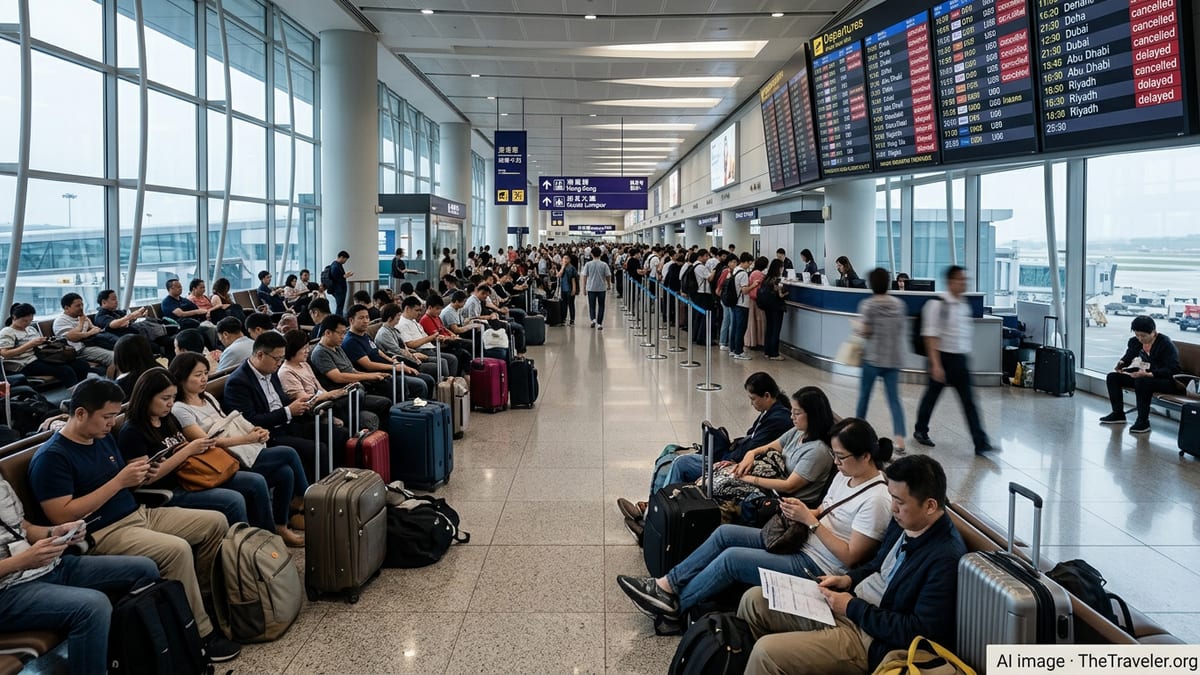
Sharp Traffic Declines at Key Middle Eastern Hubs
The new Airports Council International Asia-Pacific & Middle East report, produced with consultancy analysis and released in mid-May, concludes that the ongoing Gulf conflict has pushed many of the region’s largest hubs into an abrupt reversal after several years of post-pandemic recovery. Publicly available information on airport and airline performance indicates that passenger flows through major hubs in the United Arab Emirates, Qatar and Kuwait fell steeply in March and April as airspace closures, missile and drone risks and shifting demand patterns cut into long-haul connecting traffic.
The council’s assessment, which tracks conditions through 30 April 2026, describes a pronounced decline in international traffic to and from the region even as global demand continues to rise. Industry data published by airline associations shows that, while worldwide passenger traffic in March increased modestly year on year, international traffic for Middle East carriers plunged compared with 2025, reflecting large-scale cancellations and diversions around the conflict zone.
Regional airports that depend heavily on transfer traffic between Europe, Asia and Africa have been hit hardest. Analysis cited in the report points to double-digit percentage declines in long-haul connections routed through traditional Gulf super-hubs, alongside reports of thinner schedules to secondary markets in Eastern Europe, Central Asia and parts of Africa. These reductions have interrupted years of steady growth that had positioned Middle Eastern airports among the world’s fastest-expanding transit gateways.
Within local markets, however, the picture is more mixed. The ACI assessment notes that point-to-point demand in relatively insulated domestic and short-haul regional segments has held up better, suggesting that resident and essential travel continues even as discretionary long-haul journeys are deferred or rerouted.
Cargo, Fuel and Airfares Under Pressure
Beyond passenger traffic, the ACI Asia-Pacific & Middle East report highlights severe dislocations in cargo flows and aviation fuel supply chains. Publicly available freight data show Middle Eastern carriers suffering some of the steepest declines in global cargo demand during March, reflecting both the direct impact of suspended routes and the diversion of high-yield shipments to alternative corridors in Europe, Central Asia and parts of Africa.
The conflict has coincided with a major disruption to oil and shipping movements through the Strait of Hormuz, described by energy agencies and economic monitors as one of the largest supply shocks in recent decades. With jet fuel supplies constrained and shipping insurance costs elevated, fuel prices for airlines serving the region have surged. Industry analyses referenced in the ACI paper indicate that carriers have responded with targeted fuel surcharges and, in some cases, capacity reductions on marginal routes.
The combination of reduced competition on some surviving routes and higher operating costs has pushed average fares higher on key city pairs that previously relied on Gulf hubs for one-stop connections. Travel-data providers cited in recent coverage report notable price increases on Europe–Asia itineraries that have shifted away from the Middle East toward alternative hubs, including in Turkey and parts of Western and Central Europe.
Airports across the Middle East are also grappling with the revenue effects of weaker throughput. The ACI assessment notes that aeronautical income from landing charges and passenger fees has fallen in line with traffic, while some non-aeronautical revenues from retail and food and beverage outlets have softened as dwell times and passenger volumes decline. At the same time, heightened security requirements, rerouting coordination and contingency staffing are adding to cost pressures.
Global Routes Rerouted Around a Strategic Chokepoint
A central theme of the ACI Asia-Pacific & Middle East report is the extent to which the conflict is forcing the global air network to bend around a once-stable transit corridor. With airspace over parts of Iran and adjacent areas restricted or closed since late February, airlines have reprofiled long-haul routes linking Asia with Europe and North America, often adding hundreds of nautical miles and up to several hours of flying time.
European air navigation analysis published in recent weeks illustrates the scale of the disruption, indicating thousands of flights per week affected by reroutings to avoid conflict airspace and related military operations. This has led to increased traffic density over alternative corridors such as the eastern Mediterranean, the Caucasus and sections of Central Asia, requiring closer coordination between air navigation service providers and airlines to manage capacity and safety margins.
The displacement of flows is being felt far from the conflict zone. Airports in Europe and parts of Asia that previously competed with Gulf hubs for connecting traffic are now seeing stronger growth, while some African and Central Asian gateways are capturing niche flows that once passed almost exclusively through the Middle East. Independent schedule and capacity analyses through late April show capacity redeployments from Middle Eastern hubs toward these alternative routings for the May to July period.
For travellers, the result is a patchwork of longer routings, altered connection points and changing schedules. Industry advisories compiled in public forums and travel alerts describe passengers facing extended journey times between Asia and Europe, reduced choice on certain city pairs and a heavier reliance on carriers based outside the conflict region.
Business Aviation and Regional Connectivity Strained
The impact of the conflict is not limited to scheduled commercial airlines. Business aviation specialists report that corporate and private jet activity in the Middle East has dropped sharply since late February, with operators relocating aircraft to perceived safer bases in Europe, North Africa and parts of the Arabian Peninsula. Analysis from business aviation data providers indicates that what was once a thriving market for high-end charter and fractional services has shifted toward more cautious, selective use of the region’s airports.
Some states on the periphery of the conflict are benefiting from this realignment. Reports on business aviation trends in April highlight increased activity at airports in Egypt, Oman and Saudi Arabia, which are absorbing traffic that previously focused on hubs closer to the Gulf. Nevertheless, operators continue to face operational challenges, including route planning around military airspace, constrained fuel availability and rapidly changing risk assessments.
Within the region, the ACI assessment underscores the vulnerability of smaller airports and secondary cities that rely on links to major Gulf hubs for connectivity. Reductions in frequencies from network carriers have narrowed travel options for residents and businesses in these markets, potentially dampening investment and tourism flows. Some governments have turned to emergency or ad hoc services to maintain minimum connectivity, but these measures are described in public reports as stopgaps rather than long-term solutions.
Tourism-dependent economies across the wider Middle East and neighboring regions are watching developments closely. Coverage from tourism and economic outlets notes that while some leisure demand is diverting to alternative destinations in Europe, Asia and island markets, countries that had invested heavily in positioning themselves as stopover or short-break hubs around Gulf connections are facing an abrupt reassessment of their growth strategies.
Resilience Strategies and Recovery Scenarios
Despite the severity of the disruption, the ACI Asia-Pacific & Middle East report stresses that Middle Eastern aviation retains significant structural strengths, including modern infrastructure, geographically strategic locations and experience in managing previous shocks. Public statements from ACI leaders in recent days have emphasized resilience, sustainability and adaptability as strategic priorities for airports across the wider region.
Scenario analyses in the council’s assessment outline several possible recovery paths depending on the duration and intensity of the conflict and the speed at which airspace restrictions can be eased. A relatively swift stabilization could allow airlines to rebuild schedules through key hubs later in 2026, although capacity is expected to remain below pre-conflict plans for some time as carriers and passengers gradually rebuild confidence.
In more prolonged disruption scenarios, the report suggests that some of the traffic redistribution now benefiting alternative hubs could become semi-permanent, with airlines consolidating new routings and forging deeper partnerships outside the Gulf. This would have lasting implications for airport investment plans, employment and broader economic diversification strategies in Middle Eastern states that had counted on sustained aviation-led growth.
Against this uncertain backdrop, ACI Asia-Pacific & Middle East points to several resilience measures gaining momentum across the region’s airports, including diversifying revenue sources, investing in energy security and exploring new route opportunities less exposed to conflict corridors. The assessment concludes that, while the Middle East’s role as a global aviation crossroads remains intact in the long term, the 2026 conflict has exposed critical vulnerabilities and accelerated a strategic rethink that will shape the region’s aviation map well beyond April 2026.