

More news on this day
Fresh capacity announcements from British Airways, Qantas, Delta Air Lines, Emirates, Hong Kong Airlines and Shenzhen Airlines are supercharging tourism flows to and from Australia, but the surge in long-haul and regional traffic is exposing how fragile many small island airports remain as they struggle to keep pace with demand.
Get the latest news straight to your inbox!
Flag Carriers Expand Lift Into Australia
Publicly available route and schedule data show that major network airlines have steadily rebuilt and expanded their Australian operations since late 2024, helping to underpin a sharp rebound in international arrivals. British Airways continues to market the Kangaroo Route between London and Australia, providing one of the few one‑stop options for through itineraries between Europe and cities such as Sydney and Melbourne via Asian and Middle Eastern hubs. Industry coverage indicates that this long-standing corridor has regained much of its pre‑pandemic capacity, aided by growing connecting traffic from across Europe.
Qantas, for its part, has embarked on a multi‑year program to restore and then exceed its pre‑2020 international network. Company statements and trade media reports point to more than 200,000 additional international seats being added from February 2025, much of it deployed on routes linking Australia with North America, Asia and the Pacific. The flag carrier’s long‑haul Airbus A380s and new-generation widebodies are being redeployed on high‑demand sectors, reinforcing Australia’s role as a long‑haul tourism hub.
Emirates has also rebuilt its Australian footprint, including the relaunch of daily Dubai–Adelaide services in late 2024. Aviation data for 2025 show international passenger volumes at Adelaide Airport reaching record levels as Gulf and Asian carriers return. This renewed connectivity feeds visitor flows not only into mainland Australia but also onward into the wider Pacific, where regional links rely heavily on through traffic from long‑haul hubs.
Chinese and Hong Kong carriers are adding to the momentum. Shenzhen Airlines launched its first direct Shenzhen–Melbourne route in December 2025, opening a new channel for southbound leisure and business travellers, while Hong Kong Airlines has resumed and grown services to Sydney and introduced Melbourne flights as part of a wider rebuild of its long‑haul network. Together, these moves deepen access from northern Asia to Australia’s major gateways.
Delta and Partners Drive Transpacific Growth
On the transpacific, US airlines are rapidly increasing their presence in Australia. Delta Air Lines has moved beyond its long‑standing Los Angeles–Sydney route to add seasonal Los Angeles–Brisbane flights and, more recently, nonstop Los Angeles–Melbourne service. Airline announcements and tourism board releases highlight plans to upgrade some of these operations from seasonal to near‑year‑round as demand strengthens.
Delta’s Brisbane flights, which initially operated on a three‑times‑weekly seasonal pattern, are scheduled to return from October 2025 through March 2026, using widebody aircraft configured for long‑haul premium and leisure traffic. In late 2025, the carrier also inaugurated Melbourne services, and aviation industry coverage in early 2026 indicates that the route is slated to ramp up toward daily frequencies for the southern summer, significantly increasing US–Australia capacity.
These developments complement growing services from other North American carriers, with industry analysis pointing to an 8 percent year‑on‑year increase in US–Australia air travel between April 2024 and April 2025. The added lift underpins a surge in high‑spending visitors heading not only to Sydney, Melbourne and Queensland’s coastal resorts, but also to Pacific islands that rely on Australian gateways for connections.
Tourism operators report that the combination of North American and European demand, coupled with rising outbound travel from China and Southeast Asia, is compressing peak seasons and putting pressure on infrastructure far beyond Australia’s major city airports.
Pacific Island Gateways Hit Capacity Ceilings
While large Australian hubs are absorbing higher traffic with relative ease, many small island airports in the wider region are nearing their limits. Data from tourism authorities and aviation analysts show that destinations such as Palau, Fiji and Micronesian islands have recorded double‑digit growth in visitor arrivals since new direct or one‑stop routes via Australia were introduced or expanded.
In Palau, for example, published figures for the first half of 2025 show visitor numbers rising by more than 20 percent year‑on‑year, with new Qantas‑operated Brisbane–Palau services cited as a key driver alongside increased regional connectivity. These flights effectively plug the archipelago into a global network of European, North American and Asian services funnelling through Brisbane and other Australian gateways, dramatically widening the potential pool of visitors.
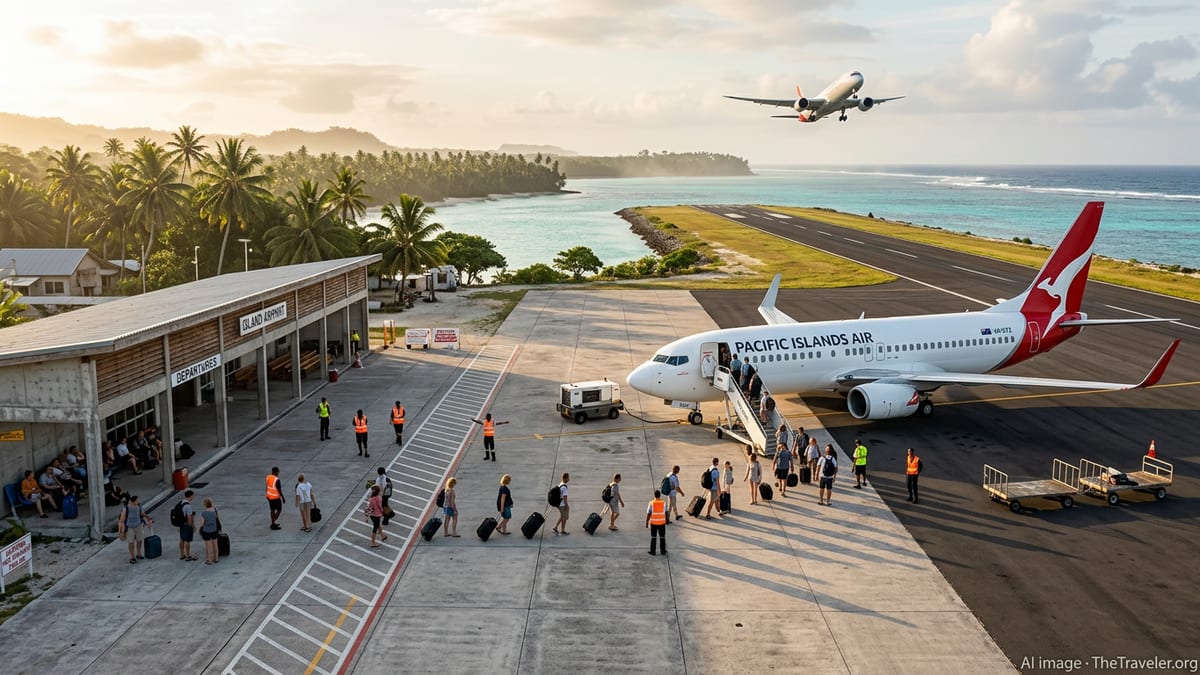
However, many of these islands operate from single‑runway airports with limited ramp space, short operating hours and modest terminal facilities. Industry reports note that at peak times, a single widebody arrival can strain immigration processing, baggage handling and ground transport. When multiple airlines adjust schedules or add charters around holidays, queues lengthen and on‑time performance deteriorates.
Airport authorities across the Pacific have flagged the need for upgraded runways, expanded aprons and climate‑resilient terminal buildings, but financing and construction timelines often lag behind the pace of airline expansion. As a result, the benefits of new connectivity from carriers such as Qantas, Emirates and Hong Kong Airlines are tempered by operational bottlenecks on the ground.
Operational Strain and Sustainability Concerns
The surge in traffic through island airports is exposing vulnerabilities beyond pure capacity. Aviation safety assessments for the Pacific highlight constraints including limited air traffic control coverage, older navigation equipment and restricted night operations at some fields. When long‑haul arrivals from Australia or Asia are delayed, aircraft can arrive close to curfew times, forcing diversions or schedule disruptions that ripple across networks.
There are also growing concerns about environmental and social pressures. Small islands with delicate marine ecosystems and limited freshwater supplies are grappling with the impact of more frequent flights and cruise calls feeding off the same tourism demand. Local planning documents in destinations such as Palau emphasize the importance of managing visitor numbers in line with carrying capacity, even as new air services promise much‑needed economic growth.
Some tourism strategies now prioritize what is described as “high‑value, low‑volume” visitation, seeking to align new routes from Australia and Asia with conservation goals. This can create tension when airlines aim to maximize load factors and utilize aircraft efficiently, while island governments and communities prefer to cap arrivals during sensitive periods or at specific sites.
Observers note that without coordinated planning between airline schedulers, tourism boards and airport operators, further rapid increases in capacity from carriers including British Airways, Qantas, Delta, Emirates, Hong Kong Airlines and Shenzhen Airlines could intensify these strains. The challenge is to maintain reliability and visitor experience while avoiding a scenario in which infrastructure and natural environments are pushed beyond safe limits.
Planning for a More Balanced Growth Path
Industry analysts argue that the current wave of airline expansion presents both an opportunity and a warning for Australia and its island neighbours. On one hand, the restoration of long‑haul connections and the arrival of new entrants help diversify source markets, reduce travel times and support year‑round tourism demand. On the other, the uneven readiness of small airports and communities raises questions about how sustainable this trajectory will be.
Some Pacific governments are already linking negotiations over new routes and capacity increases to infrastructure commitments, environmental safeguards and community engagement. Public documents show proposals for incremental growth in frequencies, seasonal caps on certain types of aircraft, and the use of newer, quieter and more fuel‑efficient jets to mitigate noise and emissions.
For Australia, the rapid build‑up of services by British Airways, Qantas, Delta, Emirates, Hong Kong Airlines and Shenzhen Airlines reinforces its position as the primary aviation hub for the South Pacific. Yet it also increases responsibility to support resilient, well‑planned connectivity that does not overwhelm smaller partners. Aviation and tourism observers suggest that closer regional cooperation on slot coordination, contingency planning and climate adaptation will be essential as the next phase of capacity growth unfolds.
With more widebodies and new routes scheduled to come online through 2026, the balance between booming demand and fragile infrastructure will remain at the center of the conversation about how best to welcome the next wave of visitors to Australia and its island neighbours.