


More news on this day
Europe’s airline and airport industry is intensifying calls for the European Union to temporarily suspend its new Entry/Exit System at external Schengen borders this summer, warning that the biometric controls are already generating long queues and could push airports to a breaking point during July and August.
Get the latest news straight to your inbox!
Industry Groups Warn of a “Critical Point” for Summer Travel
Airports and airline associations across Europe are urging EU institutions to activate emergency flexibility in the Schengen Entry/Exit System during the peak holiday season. In recent days, organizations including ACI Europe, Airlines for Europe and the International Air Transport Association have renewed their appeals for the option to pause or scale back EES checks when congestion becomes unmanageable.
According to publicly available statements and media coverage, these groups argue that the system’s full rollout since April 2026 has coincided with border-processing times that can stretch well beyond two hours at some airports, with isolated reports of queues of four to six hours during busy periods. They say the situation is especially acute where infrastructure and staffing were already under strain, and where land and sea crossings share facilities with air terminals.
Industry representatives describe the current phase as a “critical point” ahead of the main European holiday months, noting that air traffic is returning to or exceeding pre-pandemic levels while border procedures have become more complex. They contend that without temporary relief, the risk of missed flights, crowding in arrival halls and knock-on delays throughout the network will grow sharply as passenger numbers climb.
Their appeals focus not on abandoning EES entirely, but on securing a legal and operational mechanism that would let national authorities suspend mandatory biometric registration at specific border points for limited periods, particularly at peak times, and revert to traditional manual checks where necessary.
How the EES Works and Why It Is Slowing Borders
The Entry/Exit System is one of the European Union’s largest border-management technology projects. It replaces manual passport stamping for non-EU nationals entering or leaving the Schengen area with a centralized database that stores biographic details, biometrics such as fingerprints and facial images, and time and place of each border crossing.
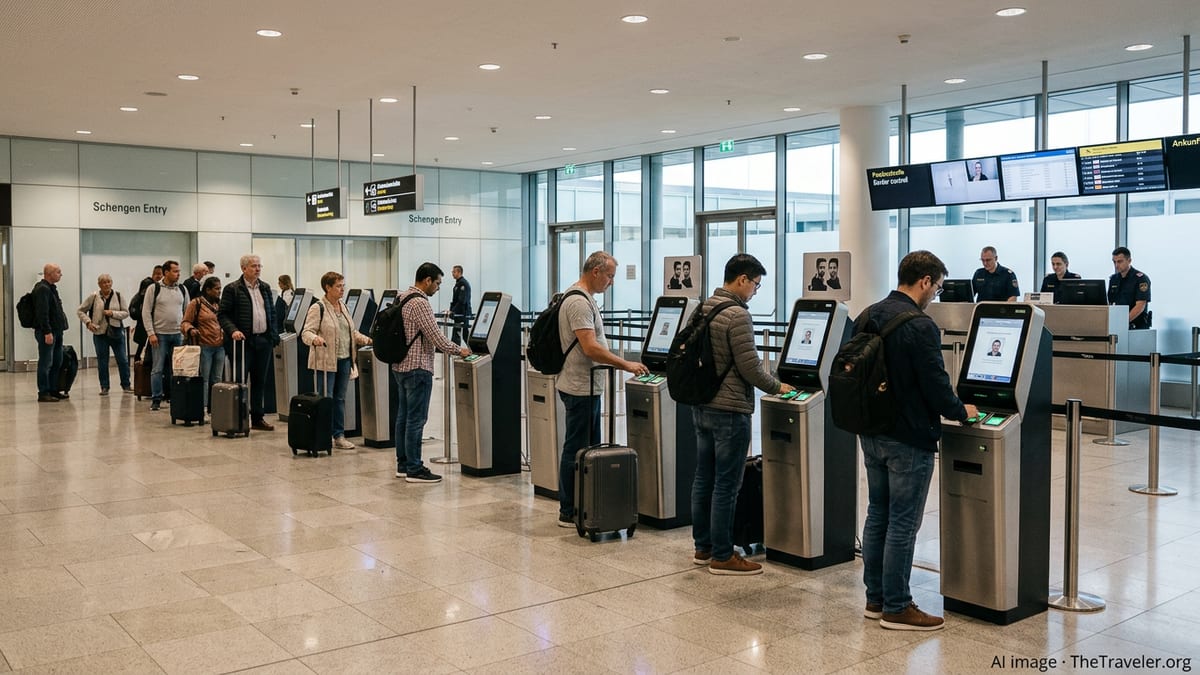
For first-time travelers, the process involves capturing fingerprints and a facial scan at a kiosk or staffed booth, confirming travel documents, and registering the information in the system. Subsequent trips are intended to be faster, relying primarily on facial recognition and automated checks against the existing record. The system is designed to strengthen external border controls, reduce identity fraud and more accurately track short stays.
However, reports from airports and passengers since the phased rollout began in October 2025 and the system became fully operational in April 2026 indicate that the initial enrollment step is taking far longer than anticipated in many locations. Several surveys and operator briefings suggest that processing time per traveler can be up to 70 percent higher than under the previous manual-stamp regime when large numbers of first-time registrants arrive at once.
These extended processing times are being magnified at major hubs that handle large flows of non-EU visitors, including transatlantic and long-haul leisure traffic. Airport managers have highlighted constraints such as limited physical space for more booths, the need to segregate passengers who have not yet enrolled from those who have, and the challenges of integrating new biometric hardware with existing border-control systems.
Queues, Missed Flights and Local Flashpoints
Evidence from national and regional media across Europe points to mounting disruption since the spring. Reports describe long snaking queues at passport control in several large and medium-sized airports, particularly at weekends and during school holidays, with some passengers missing onward connections despite arriving in the terminal hours before departure.
Coverage of the first weeks of full EES operation has highlighted particularly acute congestion at some Mediterranean gateways that rely heavily on summer tourism, as well as at airports serving major capitals. Passenger accounts shared through news outlets and public forums frequently reference waits of two to three hours to clear border checks, and in some cases more, especially for non-EU travelers unfamiliar with the new procedures.
In one high-profile example, the operator of Rome’s airports publicly warned that it might have to suspend use of the digital system during the peak season to avoid what it described as a potential “disaster” for passengers. Similar warnings have surfaced from other airport executives, who argue that despite months of preparation and investment, current staffing and infrastructure are not sufficient to cope with sustained peak EES processing volumes.
These localized flashpoints have reinforced the industry’s argument that, while the technology may function as intended on paper, the real-world rollout has revealed structural weaknesses that cannot be fully resolved before the busiest weeks of the year. Airport groups say that without temporary relief, further incidents of severe crowding, missed flights and last-minute improvisation at border checkpoints are likely.
Call for a Legal Path to Temporary Suspension
Central to the current dispute is the question of how much flexibility member states have to adjust or suspend EES checks once the system is officially in full operation. During the initial phased introduction from late 2025, several border points were allowed to temporarily revert to manual processing to manage surges in demand, but aviation groups say those options are becoming more limited under the current regulatory framework.
In an open letter and a series of joint communications this year, airports and airlines have asked the European Commission and other EU institutions to clarify and extend the legal tools that would permit targeted suspension of EES registration requirements. Their proposals focus on allowing member states to use a mix of manual and automated checks at specific border posts, or to pause biometric enrollments altogether during defined peak periods such as July and August.
The associations argue that such a mechanism would not undermine the long-term goals of the system, since most first-time registrations could be shifted to shoulder seasons, evenings or quieter days. They also emphasize that manual passport checks remain a legally valid alternative and can, in many cases, be conducted more quickly when large groups arrive at once, particularly families and older travelers who may struggle with self-service kiosks.
Publicly available briefing documents from these groups also stress that the requested suspension powers would be temporary and conditional, triggered only when waiting times at border control exceed agreed thresholds or when safety concerns arise due to overcrowding. They frame this as a pragmatic way to protect the integrity of the system while preventing avoidable disruption during its most challenging phase.
Balancing Security Goals with Passenger Experience
Behind the immediate debate over summer suspension lies a broader tension between the EU’s security objectives and the travel industry’s focus on passenger experience. Policymakers have long presented EES as a necessary modernization of external border controls that will eventually streamline travel by shifting checks into the background and reducing reliance on manual document inspection.
Aviation bodies do not contest the core aims of the project and have repeatedly expressed support for robust, technology-driven border management. Their concern, as set out in recent press materials and conference presentations, is that the transition period has been underestimated and that workloads have been misaligned with available resources, particularly at major tourist gateways.
With the separate European Travel Information and Authorisation System due to be introduced in late 2026, industry figures warn that public confidence could be undermined if the first major digital border initiative is widely associated with chaos and delays. Some commentators argue that a controlled, time-limited suspension of EES registration during peak summer months could help stabilize operations and buy time for further staff training, system fine-tuning and infrastructure upgrades.
EU institutions, for their part, have so far signaled that they see EES as broadly functioning in line with expectations, while acknowledging technical and operational issues. As the holiday season intensifies, the coming weeks are likely to test whether compromise measures can be found that preserve the system’s security benefits without subjecting travelers to prolonged queues at some of Europe’s busiest border crossings.