


More news on this day
Akasa Air’s first commercial flight powered by a blend of Sustainable Aviation Fuel and conventional jet fuel is being seen as a pivotal moment in India’s efforts to cut aviation emissions, coming alongside new supply agreements that position the young carrier as one of the sector’s more aggressive movers on decarbonisation.
Get the latest news straight to your inbox!
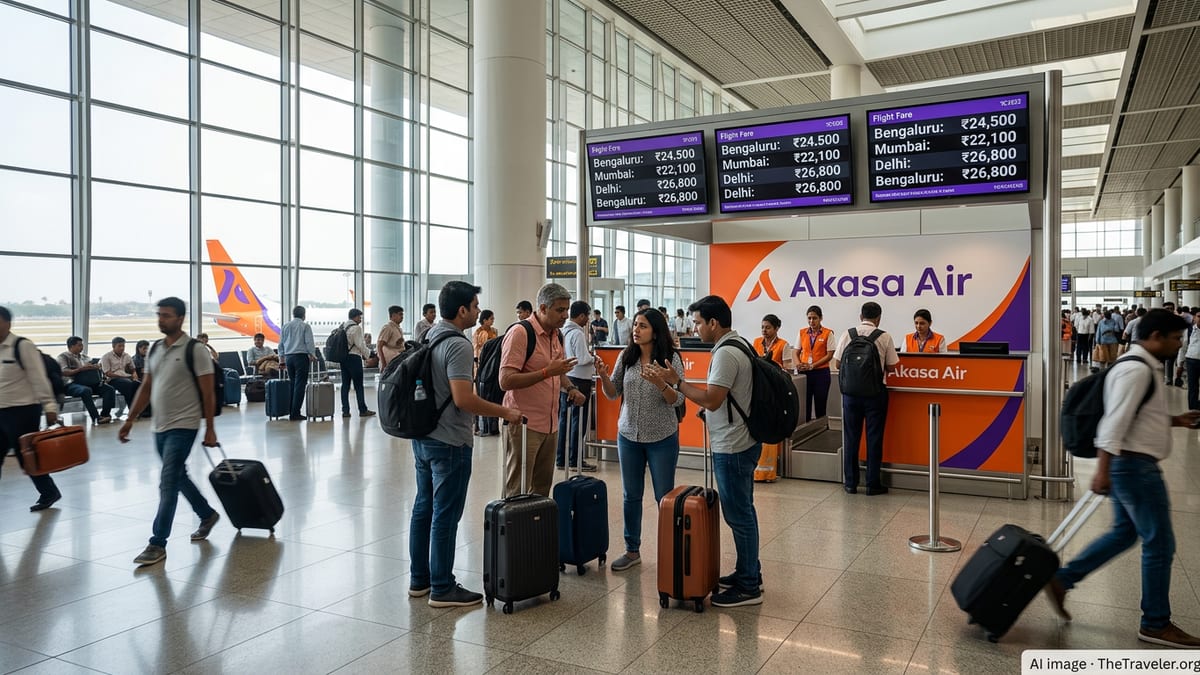
A Landmark SAF-Blended Flight for a Young Carrier
Reports from recent industry coverage indicate that Akasa Air has operated its first commercial service using a blend of Sustainable Aviation Fuel (SAF) and conventional aviation turbine fuel, joining a small but growing group of Indian airlines testing lower-carbon fuels on regular routes. While SAF-powered demonstration flights have taken place in India before, this step is notable because it links an emerging airline’s growth strategy directly to decarbonisation targets rather than treating SAF purely as a one-off showcase.
Publicly available information shows that Akasa Air, which began operations in 2022 and has since expanded into international markets, has built its brand around a younger, fuel-efficient Boeing 737 MAX fleet. The transition from efficient aircraft alone to actively integrating SAF-blended fuel indicates an evolution from incremental efficiency gains toward more structural emissions reductions via new energy sources.
Industry watchers describe SAF-blended flights as a bridge technology: they can be used in existing aircraft and airport fuel systems while more transformative propulsion technologies, such as electric or hydrogen aircraft, mature. For Akasa Air, the successful operation of a blended-fuel flight helps validate the airline’s technical readiness to use SAF at scale once supply becomes more readily available and costs decrease.
The milestone also aligns with India’s broader push to align aviation growth with climate goals. Government policy discussions and sector roadmaps increasingly frame SAF as essential if India is to accommodate rapid air-traffic growth without a corresponding surge in emissions.
Strategic Fuel Partnerships Deepen the SAF Pipeline
Akasa Air’s SAF-blended flight has been backed by a series of partnerships designed to secure future volumes of low-carbon fuel. In January 2026, during the Wings India 2026 aviation show in Hyderabad, Indian Oil Corporation Limited (IOCL) and Akasa Air signed a letter of intent to explore the supply of SAF for the airline. According to published coverage, the agreement outlines collaboration on volumes, delivery points, and production pathways, signaling preparation for commercial-scale offtake once domestic SAF production ramps up.
IOCL’s own trajectory strengthens this prospect. Public data shows the refiner has become the first Indian company to secure international sustainability certification for SAF production at its Panipat refinery, a facility positioned to serve both domestic and international carriers as regional demand for low-carbon jet fuel rises. By aligning early with a certified producer, Akasa Air is attempting to lock in access to credible, traceable SAF at a time when global supplies remain tight.
The airline has also moved to diversify its SAF play. In July 2026, Akasa Air and Bharat Petroleum Corporation Limited (BPCL) announced a memorandum of understanding focused on establishing a framework for supply and offtake of SAF-blended aviation fuel at selected Indian airports. According to company disclosures, the collaboration covers infrastructure, logistics, and operational readiness for blended fuel, broadening the number of gateways where Akasa could potentially uplift SAF in the future.
Together, these arrangements suggest that the first SAF-blended flight is not an isolated publicity event but part of a multi-partner roadmap. With both IOCL and BPCL developing low-carbon fuel capabilities, Akasa Air is seeking to create a competitive, multi-supplier environment that may ultimately help ease costs and improve access as the SAF market matures.
Positioning Within India’s Emerging SAF Ecosystem
Akasa Air’s SAF initiatives are unfolding within a wider national effort to build a domestic ecosystem for sustainable aviation fuels. Government briefings and industry analyses highlight India’s interest in turning waste oils, agricultural residues, and other feedstocks into certified jet fuel, both to cut emissions and reduce exposure to imported fossil fuels. Pilot projects, refinery upgrades, and policy consultations have been under way to establish technical standards and commercial models for SAF production and use.
In this context, Akasa Air’s early adoption strengthens the demand side of the equation. Producers and refiners typically need long-term offtake commitments from airlines to justify investment in SAF facilities, which can require significant capital and carry technology risk. By signing framework agreements with major state-owned refiners and proceeding with a first blended flight, Akasa Air is sending a signal that there will be willing buyers once product becomes available at scale.
The approach also dovetails with the airline’s broader growth strategy. Industry reports note that Akasa Air has rapidly expanded its route network and placed large aircraft orders since its launch, positioning itself among India’s more ambitious low-cost carriers. Integrating SAF into this expansion allows the airline to compete not only on price and network but also on environmental performance, a factor increasingly scrutinised by corporate travel buyers and international partners.
Other Indian carriers have also begun SAF trials and partnerships, indicating that the market is moving from concept to early deployment. However, Akasa Air’s recent blend of operational use, multi-supplier agreements, and branding around “green flying” places it among the more visible players in this transition.
Challenges of Scaling Green Fuels in a Price-Sensitive Market
Despite the momentum, significant headwinds remain before SAF can meaningfully displace conventional jet fuel in India. Publicly available analyses consistently point to price as the central obstacle: SAF currently costs substantially more than traditional aviation turbine fuel, and even partial blends can add materially to an airline’s operating expenses. For cost-sensitive carriers operating in a highly competitive domestic market, passing these costs on to passengers is not straightforward.
Another challenge is supply. Although refiners such as IOCL are investing in certified SAF production capacity, volumes are still modest compared with the scale of India’s aviation fuel demand. Logistical questions around transporting, storing, and blending SAF at multiple airports also need to be resolved, particularly for smaller or regional hubs where infrastructure is limited.
There are, however, signs that policy frameworks and partnerships may help offset these barriers over time. Sector reports point to discussions around incentives, carbon accounting mechanisms, and international schemes that could provide financial support or regulatory recognition for airlines using SAF. By having already operated SAF-blended flights and signed long-term cooperation agreements, Akasa Air is positioning itself to take advantage of such measures as they materialise.
Observers note that early movers could benefit from reputational advantages and preferred access to limited SAF supply, especially for international routes where environmental standards and reporting requirements are more stringent. This calculus appears to underpin Akasa Air’s decision to advance its green-fuels agenda even while costs and infrastructure remain challenging.
A Testing Ground for the Future of Indian Aviation
Akasa Air’s first SAF-blended commercial flight offers a glimpse of how India’s fast-growing aviation sector might balance expansion with environmental responsibility. By pairing operational trials with concrete supply partnerships, the airline is helping to turn SAF from an abstract climate solution into an operational reality within one of the world’s most dynamic air travel markets.
Whether such initiatives can scale will depend on how quickly policymakers, refiners, airports, and airlines can collectively build a viable SAF value chain. Early steps, such as IOCL’s certified production and BPCL’s exploration of blended-fuel delivery at Indian airports, suggest that the building blocks are starting to fall into place, even if full commercial maturity remains several years away.
For travellers, the immediate impact of a single SAF-blended flight may be limited, but the symbolism is significant. It points to a future in which choosing a domestic or regional flight in India could carry a progressively smaller carbon footprint, particularly as more carriers and airports join the SAF ecosystem that early movers like Akasa Air are helping to shape.
Indian Oil – Akasa Air SAF partnership coverage (The Economic Times)
Wings India 2026 SAF supply reporting (The Print)
Akasa Air – BPCL SAF MoU announcement (PublicNow)
Government briefing on Indian SAF certification and initiatives (PIB)