


More news on this day
Flights between the United Arab Emirates and the United Kingdom are facing fresh disruption, as a major outage at London Heathrow’s air traffic control systems combines with renewed tensions and strikes linked to Iran to trigger delays and cancellations across Dubai and Abu Dhabi routes.
Get the latest news straight to your inbox!
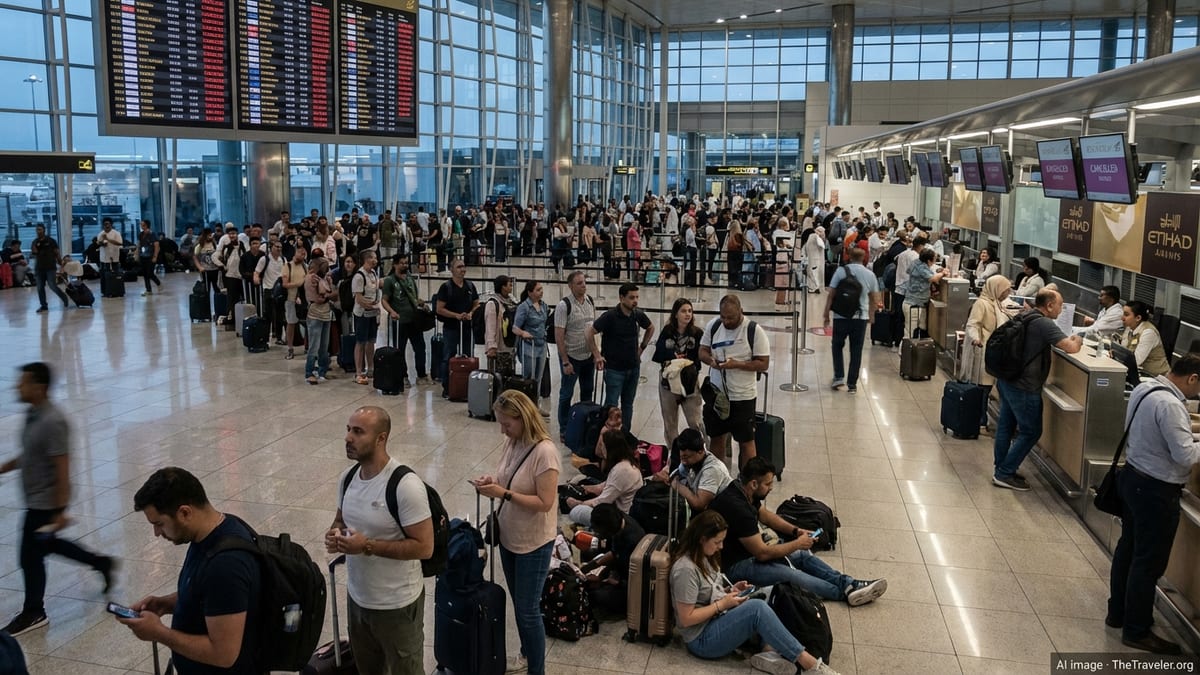
Heathrow outage ripples into UAE hubs
Knock-on disruption from a technical failure at Britain’s National Air Traffic Services has spread well beyond the UK, affecting services connecting London with key Gulf hubs. Published coverage indicates that more than 1,000 flights were cancelled across UK airports on 8 September after the fault, with Heathrow and other London gateways among the worst hit as departures were held and arrivals limited.
By 9 September, hundreds of additional flights had been cut or rescheduled as airlines worked through the backlog, according to flight tracking data cited in European media reports. The scale of the outage has had a cascading effect on carriers operating tight turnarounds between London and long haul destinations, including Dubai and Abu Dhabi, where evening and overnight banks of flights rely heavily on on-time arrivals from Heathrow.
Information published by Heathrow shows that arrivals were suspended for several hours while the technical issue was addressed, with departures resuming under capacity constraints. That pattern has translated into rolling delays on some Gulf services, as aircraft and crews arrive late into the UAE and schedules are re-timed to recover.
Industry analysts quoted in recent reporting note that even relatively short technical failures can generate prolonged disruption on long haul networks. In this case, the combination of missed connections, crew duty time limits and aircraft being out of position has pushed some London–UAE sectors into cancellation or extended delay territory.
Etihad and Emirates adjust London schedules
Publicly available updates from Gulf carriers show that Abu Dhabi based Etihad Airways has been among the airlines most directly affected on UK routes. Recent UAE aviation coverage lists at least one London Heathrow–Abu Dhabi service cancelled and others operating with significant delays after the 8 September air traffic control failure, including a flight whose inbound leg was diverted to Paris Charles de Gaulle before continuing to the UAE.
Etihad’s broader network has also seen schedule changes in recent days on routes to Indonesia and Thailand due to separate operational factors, underscoring how a major event in one region can complicate recovery efforts elsewhere. Reports indicate that the airline has been rebooking passengers and arranging onward connections where possible as it rebuilds normal patterns between Abu Dhabi and European capitals.
Dubai based Emirates has issued travel advisories for customers booked to and from the UK, highlighting potential delays and urging passengers to monitor flight status before leaving for the airport. The airline’s latest travel updates refer to disruptions at multiple UK airports following the NATS issue, with London Heathrow a key focus due to its role as a primary Emirates gateway.
Regional media tracking UAE operations note that some Emirates services to Heathrow and other long haul destinations have already been operating with delays this week because of a mix of operational and geopolitical pressures. The additional strain created by the UK air traffic control fault has therefore landed on networks that were already managing tight margins.
Iran related tensions keep Gulf airspace on edge
The Heathrow outage has coincided with renewed tensions linked to Iran that continue to affect parts of the wider Middle East airspace. Earlier this year, joint US and Israeli strikes on Iran and subsequent retaliatory action prompted several states to temporarily close sections of their airspace, forcing carriers to cancel or reroute services across West Asia and into the Gulf. Press clippings from the period show Emirates, Etihad and other regional airlines cancelling flights on routes touching those corridors as operators sought to avoid affected skies.
In the latest phase, Gulf based reporting points to ongoing security sensitivities in and around the Strait of Hormuz and across key maritime and aerial corridors, with additional sanctions and military activity adding to the uncertainty. While UAE airports in Dubai and Abu Dhabi remain open and largely operational, airlines have been dynamically adjusting routings and schedules to respond to evolving risk assessments on Iranian and adjacent airspace.
Current aviation bulletins indicate that some services directly involving Iran remain suspended or subject to late changes, even as core Gulf to Europe flows continue. The result is a patchwork of disruption in which the Heathrow air traffic control failure primarily explains the latest wave of delays to and from London, while earlier and ongoing Iran related developments have contributed to a more fragile baseline for schedule planning.
For travellers moving between the UK and the UAE, this intersection of technical and geopolitical factors means that even flights not directly overflying restricted airspace can be affected by upstream diversions and crew rotation challenges. Long haul routes that typically rely on precise timing to make banked connections in Dubai and Abu Dhabi are particularly exposed when multiple stressors hit the network at once.
Dubai and Abu Dhabi operations: mostly running, but with delays
Despite the headlines, the overall picture at Dubai International and Abu Dhabi International remains one of largely functioning operations with pockets of disruption. Gulf based outlets report that most services from the UAE’s main airports are operating on schedule, with only minor delays on many regional and long haul routes. However, specific flights involving the UK and certain Asian destinations have seen more significant timing changes.
Recent roundups of UAE flight status highlight that Dubai and Abu Dhabi passengers bound for London are among those most likely to experience knock on impacts from the Heathrow outage. For example, Abu Dhabi departures to Heathrow have included one outright cancellation and several late running services since the 8 September failure, while Dubai’s Heathrow flights have been subject to delay advisories and rolling schedule updates.
At the same time, carriers such as flydubai and Air Arabia are contending with separate operational and regional issues, including periodic disruptions linked to Indonesia’s volcanic activity and broader Gulf security dynamics. These parallel challenges can absorb spare aircraft and crew capacity that might otherwise be used to smooth recovery on UK routes.
Airport authorities in the UAE have continued to advise passengers to arrive in good time for departures and to check their airline’s digital channels for the latest status. With aircraft sometimes departing within revised windows once clearance is obtained from UK air traffic control and other regulators, being close to the gate when a new slot opens remains critical.
What travellers between the UK and UAE should do now
For passengers booked between Dubai or Abu Dhabi and London over the coming days, publicly available guidance from airlines and airports converges on a few practical steps. Travellers are urged to verify their flight status on official websites and apps before leaving for the airport, as same day schedule changes and aircraft swaps remain possible while the post outage backlog at Heathrow and other UK airports is cleared.
Airlines are also encouraging customers to ensure contact details are current in booking profiles so that notifications about delays, cancellations or reroutings reach them quickly. Where significant changes occur, carriers have been offering rebooking options and, in some cases, accommodations or alternative routings via other hubs, depending on ticket conditions and local regulations.
Travel industry commentators suggest that passengers connecting beyond Dubai or Abu Dhabi to onward destinations may want to allow longer minimum connection times than usual, particularly if the first leg involves Heathrow. Choosing earlier departures in the day, where available, can provide a buffer if schedules slip, while flexible tickets may offer more room to adjust plans if disruption persists.
With both the Heathrow technical failure and Iran related tensions illustrating how rapidly conditions can shift on key intercontinental corridors, the overarching message from published advisories is to stay informed and build contingency into travel plans. While operations between the UK and UAE are gradually stabilising, the situation remains fluid enough that close monitoring is advisable for anyone heading through Dubai or Abu Dhabi in the near term.
Heathrow disruption and delays information