


More news on this day
Passengers travelling through Dubai and Abu Dhabi on Wednesday are facing a new round of cancellations and delays, as a technical outage at London Heathrow coincides with fresh Iran-linked strikes that continue to unsettle air traffic across the Gulf.
Get the latest news straight to your inbox!
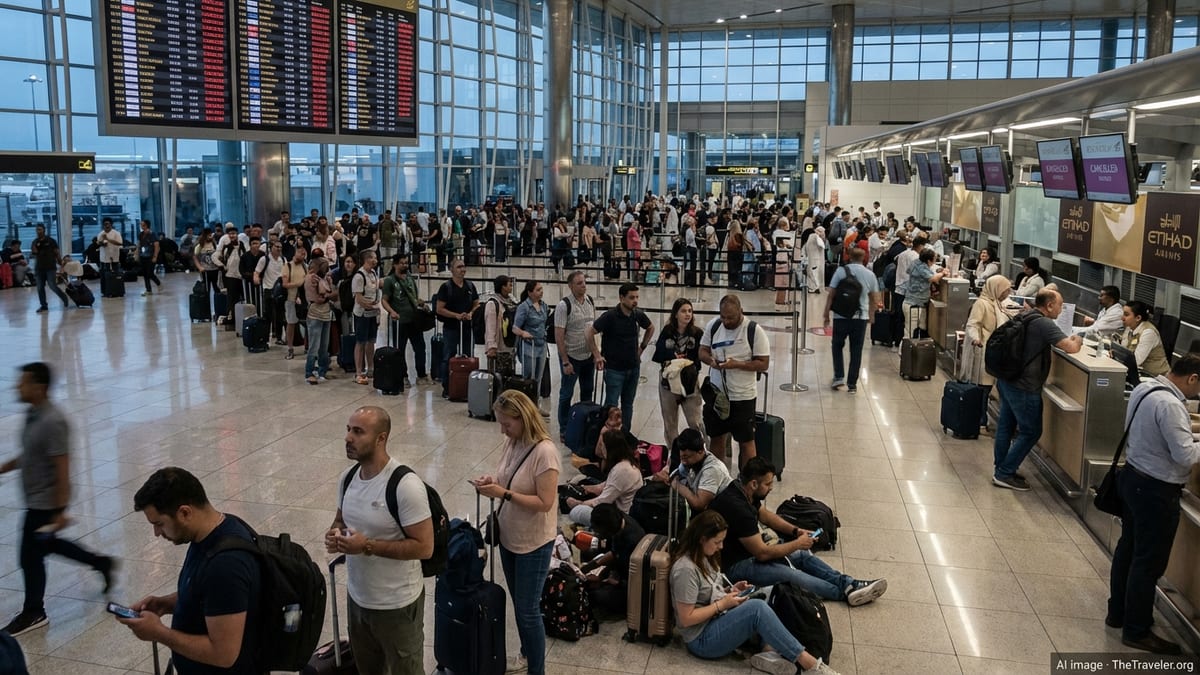
Heathrow outage ripples onto UAE routes
Flight disruption at London Heathrow following an air traffic control systems problem is extending to key links with the UAE, affecting services into both Dubai International and Abu Dhabi’s Zayed International Airport. Publicly available data and airline updates show that the knock-on impact from Tuesday’s outage is continuing into Wednesday, with schedules still being re-shaped as airports work through a backlog of grounded aircraft.
According to same-day reporting, arrivals into Heathrow were suspended for several hours on Tuesday to allow the UK’s National Air Traffic Services to resolve a technical fault in its flight processing systems, leading to widespread cancellations and missed connections. Heathrow and Gatwick together recorded hundreds of cancellations and further delays on Wednesday morning, adding pressure to already constrained long-haul operations.
Among the most visible UAE impacts are Emirates services from London. Flights EK004 and EK006 from Heathrow to Dubai were listed as cancelled on Wednesday, while other departures were showing extended delays. Additional services from regional UK airports into Dubai and Abu Dhabi have been subject to schedule changes as aircraft and crews are repositioned.
Travel tracking platforms indicate that while some Etihad services between Abu Dhabi and London are operating, departure and arrival times are irregular, with extended routings and late arrivals feeding through to subsequent rotations. The situation remains fluid, with UK airport disruption expected to take at least the rest of the day to stabilise.
Fresh Iran strikes deepen Gulf aviation uncertainty
The Heathrow issues are unfolding against a backdrop of renewed Iran-linked military activity that has already prompted several days of disruption across Gulf airspace. Over the past week, US strikes on Iranian targets and retaliatory drone and missile launches directed at US-linked facilities in Bahrain, Kuwait and elsewhere in the region have heightened operational risk assessments for airlines.
Regional coverage indicates that Iran has stepped up its use of drones and missiles in response to US and Israeli operations, including recent attacks in and around the Strait of Hormuz. The waterway and surrounding skies are among the most strategically sensitive corridors for global aviation and shipping, and any escalation typically prompts rapid route reviews and insurance reassessments.
UAE-focused outlets report that flights across the wider Middle East had already been disrupted early this month as the confrontation intensified. Gulf carriers and international airlines have diverted, delayed or cancelled selected services, particularly those overflying conflict-affected airspace or serving destinations near recent strikes.
For Dubai and Abu Dhabi, which sit at the crossroads of these routes, the renewed tension has compounded existing scheduling challenges. Airlines are attempting to balance safety-driven airspace adjustments with the need to keep major hubs connected, resulting in a patchwork of operating, delayed and suspended services that can change at short notice.
Emirates, Etihad and other carriers adjust operations
Emirates, Etihad Airways and other UAE-based airlines are continuing to operate the majority of their networks, but with selective cancellations, diversions and rolling delays. Recent travel advisories compiled by UAE media show that services to and from Kuwait, Bahrain and parts of Iraq have experienced particular disruption as carriers respond to changing security guidance.
In Dubai, airport arrival boards on Wednesday showed a mix of on-time flights, late arrivals and outright cancellations from Europe, the Gulf and South Asia. Services from certain UK airports, including London Heathrow, were among those most affected, reflecting both the UK air traffic issues and the broader regional context.
Abu Dhabi’s Zayed International Airport has reported similar patterns, with some long-haul flights rerouted or delayed due to airspace restrictions or congestion elsewhere in the network. Earlier in the week, at least one Abu Dhabi service to Manila was diverted after a temporary airport closure, illustrating how ripple effects from security measures and operational decisions outside the Gulf can reach UAE hubs.
Low-cost and regional carriers are also adjusting. Coverage from European regulators and regional media notes that some airlines have extended suspensions on services to Dubai and Abu Dhabi into the autumn, citing conflict-zone advisories for parts of Gulf airspace and the need to maintain buffer routes around sensitive areas.
What passengers travelling via Dubai and Abu Dhabi should expect
For travellers, the combination of a major UK airport outage and heightened regional tensions means that even confirmed bookings may be subject to last-minute changes. Publicly available guidance from airlines and travel authorities consistently urges passengers heading to or from Dubai and Abu Dhabi to check their flight status frequently on the day of departure and to monitor email or app notifications for rebooking options.
Those travelling from the UK to the UAE in the coming days are likely to face the greatest uncertainty. With Heathrow and Gatwick still working through disrupted schedules, airlines are prioritising available slots, which can lead to late-notice aircraft swaps, schedule compressions and the consolidation of lightly booked services. Travellers with tight connections through Dubai or Abu Dhabi to onward destinations in Asia, Africa or Australasia may want to consider longer layovers or more flexible itineraries.
Within the Gulf, some flights continue to operate largely as normal, but routing adjustments around higher-risk airspace can add flight time and increase the likelihood of missed connections if downstream schedules are not fully realigned. Travel experts quoted in regional coverage advise allowing extra time at airports and keeping essential items, including medications and a change of clothes, in carry-on baggage in case of unexpected overnight stays.
UAE-based residents returning home are also being encouraged, through local media updates, to stay alert to further announcements about route suspensions or schedule changes, particularly on routes crossing or skirting Iranian and adjacent airspace. While there is no indication of an immediate halt to operations at Dubai or Abu Dhabi, the current environment suggests that intermittent disruption could persist as geopolitical developments unfold and aviation authorities update their guidance.
Gulf News: UAE flight update as Iran tensions escalate
The Independent: UK airport disruption continues at Heathrow and Gatwick
The National: Middle East flights status and UAE travel disruption