


More news on this day
A contracted Amazon cargo plane carrying packages from Puerto Rico overran a runway at Miami International Airport on Sunday, striking vehicles beyond the airfield perimeter, killing five people and injuring five others in a fiery crash that disrupted one of the United States’ busiest gateways to Latin America.
Get the latest news straight to your inbox!
Runway Overrun Turns Routine Cargo Flight Into Fatal Crash
Publicly available information indicates the widebody cargo jet, a Boeing 767-300 operated by North Carolina-based carrier 21 Air on behalf of Amazon, was completing a flight from San Juan, Puerto Rico, when it attempted to land at Miami International Airport on September 6. Reports describe the aircraft overrunning a diagonal runway, crossing airport boundaries and smashing through a fence before coming to rest near a roadway on the airport’s northwestern side.
Images and video from the scene show the aircraft bearing prominent Amazon Prime Air branding, its fuselage broken and engulfed in flames as thick black smoke billowed over nearby warehouses and roadways. Initial tallies from multiple news outlets state that five people were killed and five injured, with victims including occupants of vehicles struck beyond the runway end. The flight’s two pilots survived but were among those transported to local hospitals.
Local coverage notes that the collision with vehicles occurred near Northwest 42nd Avenue, a heavily trafficked corridor running along the airport’s western edge. The plane’s fuel ignited after impact, complicating rescue efforts as fire crews worked to reach both the cockpit and crushed vehicles on the road.
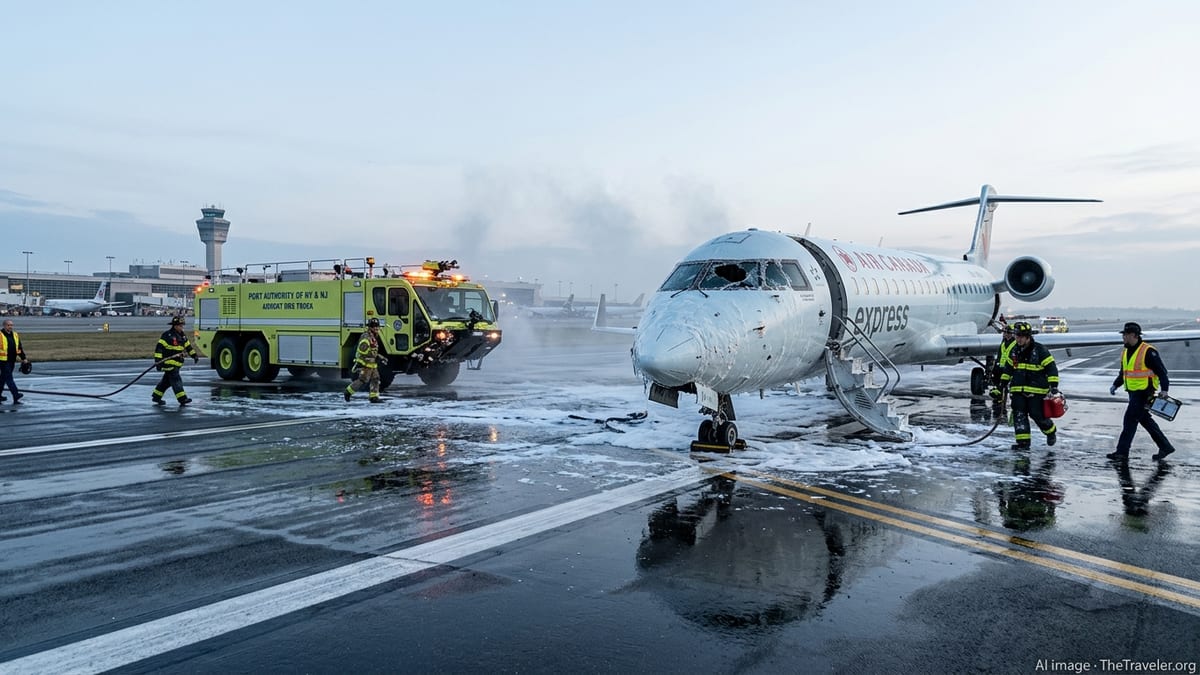
According to published accounts, Miami-Dade Fire Rescue units stationed on the airfield reached the burning aircraft within minutes, facing intense flames and scattered debris. The fire was brought under control after a large foam response, but the wreckage remained smoldering into the evening as investigators began documenting the scene.
Ground Stop and Widespread Disruption for Travelers
The crash triggered an immediate operational halt at Miami International Airport, with a full ground stop implemented while emergency crews responded. Reports from airport and airline trackers describe all runways temporarily closed as first responders converged on the northwest sector of the airfield.
Miami is a key hub for both passenger traffic and air cargo, especially on routes connecting the continental United States with the Caribbean and Latin America. Travel and aviation outlets report that the incident caused cascading delays and diversions, with some inbound flights rerouted to nearby airports such as Fort Lauderdale and West Palm Beach, and outbound departures held at gates for several hours.
By late Sunday, most passenger operations had resumed on unaffected runways, though airlines warned of residual delays carrying into Monday. Airport updates cited ongoing closures of certain taxiways and the area surrounding the wreckage, resulting in longer taxi times and adjusted arrival and departure patterns.
For travelers, the crash added another layer of disruption at the tail end of a busy late-summer weekend. Passengers shared images of grounded aircraft lined up at gates, while flight-status platforms showed clusters of delayed departures to major domestic hubs and international destinations.
Focus on Landing, Weather and Runway Conditions
Federal investigators have opened an inquiry into the circumstances that led a modern twin-engine freighter to run out of landing room on a dry runway at a major U.S. airport. Early coverage referencing aviation officials indicates that the probe is expected to concentrate on the approach and landing profile, including touchdown point, speed and braking performance, as well as runway surface conditions and any issues with the aircraft’s systems.
Weather at the time of the accident appears to have been typical for late afternoon in South Florida, with scattered showers in the region but no immediate indication of severe storms at the field according to meteorological summaries cited in national reporting. Analysts quoted in aviation-focused outlets note that investigators will examine potential factors such as a long landing, thrust reverser or brake problems, or decisions made during the final approach.
Runway overruns are a known risk area in commercial aviation, particularly at airports where runways end near public roads or built-up areas. Travel safety commentators point out that Miami International, like many legacy airports, is tightly hemmed in by urban development, leaving limited space between runway ends and surrounding streets, warehouses and parking areas.
Specialized National Transportation Safety Board teams are expected to review flight data and cockpit voice recorders, examine tire marks and debris patterns, and reconstruct the aircraft’s stopping distance. Public updates on the technical causes are likely to emerge over weeks and months rather than days as the investigation progresses.
Contracted Amazon Air Operations Under New Scrutiny
The jet involved in the Miami crash was not owned or directly operated by Amazon. Instead, it flew under Amazon Air’s logistics network through a wet-lease arrangement with 21 Air, a cargo carrier that provides aircraft and crews while the e-commerce company supplies freight and branding. Media analysis notes that this subcontracting model, common across the cargo industry, enables Amazon to scale its air network rapidly without building a traditional in-house airline.
Industry reports highlight that Amazon Air relies on a patchwork of operators, including Atlas Air, Air Transport International and 21 Air, to move packages between distribution centers and regional hubs. The Miami accident has drawn renewed attention to how safety oversight functions in such arrangements, with federal regulators responsible for overseeing the certificate-holding carrier, while brand-name logistics clients set performance and schedule expectations.
Commentary in business and aviation outlets recalls the 2019 crash of Atlas Air Flight 3591 near Houston, another Amazon-branded cargo operation in which three crew members died. That earlier incident prompted discussions about training, fatigue and the pressures of just-in-time e-commerce logistics. The Miami runway overrun is now prompting fresh questions about risk management in high-tempo overnight cargo operations into congested airports.
Publicly available corporate statements emphasize that cargo clients typically require contracted carriers to meet or exceed federal safety regulations and undergo regular audits. Nonetheless, transportation analysts suggest that brand visibility, such as the prominent Amazon Prime livery on the stricken jet, means that the traveling public often associates such incidents more with the retail brand than with the less-known operating airline.
Travel and Safety Implications for Miami as a Global Gateway
Miami International Airport serves tens of millions of passengers each year and is a primary gateway for travelers connecting between North America, the Caribbean and Latin America. In addition to its large passenger footprint, the airport ranks among the top U.S. hubs for international freight, with extensive cargo operations clustered around its western and northern perimeters.
Travel-industry observers note that the Amazon cargo crash underscores the complex coexistence of heavy freight activity and dense passenger traffic at major hubs. While cargo flights typically operate at off-peak hours, they share runways, taxiways and airspace with passenger jets, and incidents on or beyond the airfield can have immediate consequences for both sectors.
Urban planners and safety advocates have long pointed to the limited buffer zones between certain Miami runways and adjacent roads or buildings. The fact that several victims in this crash were reportedly in vehicles on a public roadway has renewed attention to land-use decisions around airports serving fast-growing metropolitan areas.
For travelers, experts stress that commercial aviation in the United States remains one of the safest modes of transportation, with fatal accidents extremely rare relative to the number of flights. However, highly visible events such as the Miami runway overrun tend to sharpen public focus on airport infrastructure investments, emergency response capabilities and the balance between economic growth and safety margins in dense urban environments.
CBS Miami coverage of the Amazon cargo plane crash
ABC News report on the Miami runway overrun
NBC 6 South Florida reporting and video from Miami International Airport
Local 10 Miami breakdown of the cargo plane crash and response