


More news on this day
American travelers heading overseas this fall are confronting a more volatile security landscape as a fresh worldwide U.S. government warning coincides with violent protests in parts of Europe, regional tensions in the Middle East and evolving airport security rules that are reshaping how trips are planned and insured.
Get the latest news straight to your inbox!
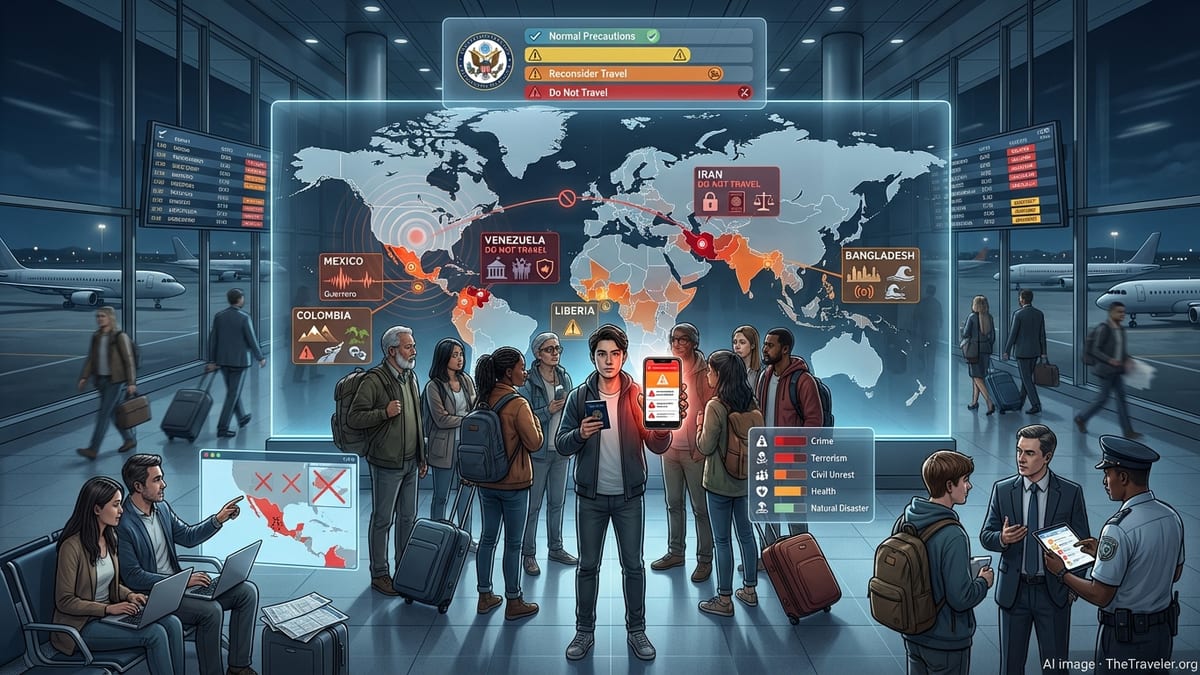
Worldwide Caution Puts Global Risks Back in Focus
A renewed Worldwide Caution notice from the U.S. Department of State, updated in July 2026, advises Americans in all regions to exercise increased vigilance amid heightened geopolitical tensions and the potential for terrorism, targeted violence and disruptive protests. Publicly available information emphasizes that the alert is not tied to a single country, but to an elevated and uneven global risk environment in which incidents can unfold with little warning.
The Worldwide Caution page, which is maintained alongside country-specific advisories, highlights concerns about terrorist attacks on soft targets such as hotels, transportation hubs, tourist sites and places of worship. It notes that civil unrest and politically motivated violence can also disrupt travel plans, especially around major political events, high-profile trials, or regional flashpoints in the Middle East and parts of Europe.
Travel advisory data shows that risk levels vary widely by destination, from Level 1 guidance to “exercise normal precautions” to Level 4 “do not travel” warnings for countries facing armed conflict, persistent terrorism or state collapse. The Worldwide Caution overlays this map rather than replacing it, meaning Americans are now urged to combine global alerts with detailed country pages, local news and carrier updates when making decisions.
Security and risk consultancies tracking 2026 trends describe the overall operating environment this autumn as elevated, citing the convergence of political protests, terrorism concerns and extreme weather that can compound security incidents and complicate evacuations. Corporate travel managers are being encouraged to reassess duty-of-care plans, communication trees and contingency budgets for staff moving through higher-risk regions.
France’s Violent Protests Offer a Case Study in Sudden Disruption
Nowhere are the new realities more visible than in France, where a wave of student-led demonstrations over education funding merged in mid-October with nationwide protests over rising living costs and fuel prices. Reporting from French and international outlets describes October 17 as a tipping point, when scattered marches escalated into some of the country’s worst unrest in years, including looting, arson and clashes with police in parts of Paris and other cities.
Coverage from travel and tourism industry publications indicates that more than 1,700 separate demonstrations were recorded across France on that single Saturday, drawing hundreds of thousands of people into streets nationwide. French Interior Ministry updates cited in those reports point to more than 6,000 arrests and hundreds of injuries among law enforcement personnel since the protests began in late September.
In response, U.S. diplomatic posts in France issued security alerts in mid-October urging Americans to avoid demonstration areas, anticipate disruptions to public transport and factor possible curfews, museum closures and short-notice event cancellations into their plans. Travel trade outlets report that the Louvre and other marquee cultural sites have closed on select protest days, while tour operators have rerouted itineraries or scrapped some coach excursions when marches intersect with popular sightseeing districts.
Despite the images of burning vehicles and smashed shopfronts circulating globally, recent reporting suggests that many tours and independent trips are continuing, particularly outside core protest zones and on non-march days. However, the French unrest underscores how quickly a Level 2 advisory country, where Americans are advised to exercise increased caution, can present localized, high-intensity risks that affect specific neighborhoods, dates or types of activity such as late-night transit or attendance at major sporting events.
Regional Tensions and Aviation Security Add New Layers of Complexity
Beyond Europe, the Worldwide Caution draws attention to heightened volatility in the Middle East, where published coverage chronicles periodic airspace closures, flight diversions and airport security surges linked to regional flare-ups. The advisory notes that Americans in the region should be prepared for sudden schedule changes and constrained commercial options if hostilities escalate or if militant groups threaten international aviation.
Risk briefings compiled in October 2026 highlight that conference season and renewed demand for corporate travel are colliding with this uncertain backdrop. Analysts warn that organizations with employees flying to global hubs in the Gulf, Levant and Eastern Mediterranean may need backup routings through secondary airports, as well as clear protocols for sheltering in place if outbound flights are abruptly canceled.
At the same time, airports and airlines are adjusting security and identity-verification practices in ways that can both enhance safety and introduce new friction points for American travelers. U.S. airport documents and airline communications describe a patchwork of measures from expanded facial-recognition gates and more rigorous secondary screening for certain routes, to trial programs that change how trusted-traveler benefits such as expedited security lanes can be used.
Travelers transiting large U.S. hubs to reach overseas destinations continue to report longer waits at some security checkpoints, particularly where new screening technology is being phased in or where staffing has not fully kept up with post-pandemic passenger growth. For international departures, airlines are advising passengers to arrive earlier than they might have a year ago, especially for flights to regions under greater security scrutiny.
How American Travelers Are Adjusting Plans and Protections
With risk indicators flashing more brightly, Americans are recalibrating how they plan and protect international trips. Travel insurance providers and consumer advisories emphasize careful reading of policy language, noting that not all products treat terrorism, civil unrest and government travel warnings in the same way. Some policies may cover trip cancellation if a destination’s advisory level is raised after booking, while others focus more on medical evacuation, security extraction or trip interruption once on the ground.
Industry analysis published in recent weeks suggests that demand is rising for robust medical and evacuation coverage tied to 24-hour assistance centers that can coordinate care, rebook flights or organize overland exits when local infrastructure is strained. Corporate travel programs are also reexamining how they track employees abroad and how quickly they can push verified security updates through apps, texts or traveler portals during fast-moving incidents.
Travel advisors recommend that Americans heading to protest-affected destinations build additional time into itineraries for security checks and potential rerouting around marches, particularly on weekends or politically symbolic dates. Some tour operators have begun shifting guided walks away from central plazas and government districts on known demonstration days, while maintaining cultural visits in less affected neighborhoods or nearby towns.
In cities such as Paris, where unrest has been intense but geographically concentrated, reports from tourism boards and industry groups indicate that hotel bookings have softened modestly in some central arrondissements but remain relatively stable in outlying districts and regional destinations. The pattern points to a more nuanced form of risk management, in which travelers adjust neighborhoods, transport modes and timing rather than abandoning trips entirely.
Practical Steps for Navigating a More Uncertain World
Against this backdrop, safety agencies and traveler advocacy groups continue to stress a set of practical measures for Americans venturing abroad. Public guidance consistently highlights the importance of enrolling overseas trips in official traveler enrollment programs, which allow embassies to send targeted security messages and, in some crises, account for citizens during evacuations or shelter-in-place orders.
Security primers released by allied governments advise visitors to keep a low profile near political rallies, avoid photographing protests or security forces and be cautious around government buildings, transportation hubs and major religious or sporting venues. Travelers are also urged to carry copies of passports and key documents, maintain charged phones with offline maps, and have a basic plan for reaching their accommodation on foot if public transport is disrupted.
Analysts note that information discipline has become a central skill for modern travelers. That means relying on a combination of official advisory pages, local news outlets and verified airline or airport channels instead of viral videos or informal social media threads that can exaggerate or misrepresent conditions on the ground. For destinations facing recurring unrest, monitoring planned protest calendars in local media for the days immediately before and after arrival is increasingly seen as routine trip preparation.
For now, the Worldwide Caution does not close borders or prohibit leisure travel, but it does mark a new phase in which Americans are being asked to approach overseas trips with greater situational awareness and flexibility. In practice, that may involve choosing hotels with multiple exit routes, budgeting extra time for airport formalities, and accepting that itineraries might change at short notice as global politics and local tensions continue to intersect with tourism.