

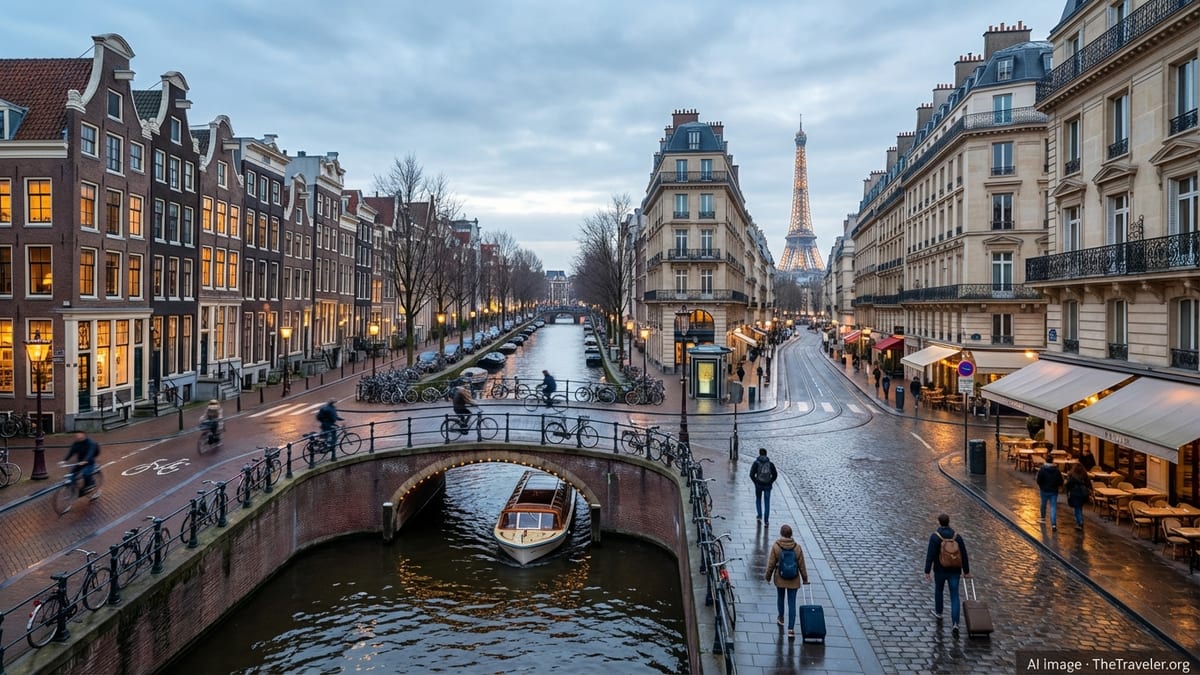
Choosing between Amsterdam and Paris for a short trip is a classic traveler’s dilemma. Both cities are European icons filled with art, history, food and nightlife, and both are currently experiencing near record visitor numbers as tourism rebounds.
Yet the texture of a two or three day stay in each place is very different. From crowd levels and costs to museums, food culture and logistics, the better choice depends less on which city is “best” and more on what kind of short break you want. This comparison works best after understanding whether Amsterdam is worth visiting on its own.
Overall Vibe: Compact Canals vs Grand Boulevards
Amsterdam and Paris leave very different first impressions, especially on a short visit where your days are compressed and every hour counts. Amsterdam’s center is compact, low rise and threaded with canals that make the city feel almost like an overgrown village.
Paris, by contrast, is built on scale and spectacle, with broad haussmannian boulevards, monumental squares and a skyline punctuated by the Eiffel Tower and Sacré Coeur. Reviewing the main things to do in Amsterdam highlights how it differs from Paris.
For a quick getaway, that difference in scale matters. In Amsterdam, the main historic core is small enough that you can walk from Centraal Station to the Jordaan, the Museumplein and De Pijp in a single day with time left over for café stops. The city’s relatively flat streets and human scale can feel especially forgiving if you are arriving jet lagged or only have a weekend to explore.
Paris offers a more cinematic urban drama but demands more energy. The city is roughly four times the population of Amsterdam and its points of interest are more spread out. On a two or three day stay, you will spend more time crossing neighborhoods by metro or bus, or walking long axes such as the route from the Louvre through the Tuileries to the Arc de Triomphe. That can be exhilarating if you enjoy big-city energy, but it also makes a short trip more intense and potentially more tiring.
What You Can Realistically See in 2–3 Days
With tourism now essentially fully recovered in both cities, short trip planning is increasingly about smart choices and realistic expectations. In Amsterdam, the compact layout works to your advantage for a tightly timed visit. Many classic first-time experiences are clustered: the Rijksmuseum, Van Gogh Museum and Stedelijk all frame the Museumplein, while the canal belt, Nine Streets and Jordaan form one interconnected area of narrow streets and bridges.
On a two day trip to Amsterdam, you can reasonably take a canal cruise, visit at least one major museum, tour the Anne Frank House if you book far ahead, explore the Jordaan and perhaps add a bike ride in the Vondelpark or along the waterfront. Because the city center is dense but walkable, spontaneous wandering is less likely to derail your schedule.
In Paris, a first-time visitor’s wish list is often longer than the calendar allows. Eiffel Tower, Louvre, Notre Dame, Montmartre, the Seine, maybe Versailles: these are major sites requiring transit and, often, timed tickets. Since 2024 and into 2025, several blockbuster attractions have been managing heavy demand, and the reopening of Notre Dame at the end of 2024 has added another must see for many travelers. Attempting to “do” Paris in 48 hours can quickly become a race between queues and metro transfers.
If your goal is to feel that you have covered the essentials of a city in a short time, Amsterdam typically offers a more achievable checklist. Paris rewards either a longer stay or a more selective approach, such as focusing your brief visit on one or two districts and a couple of big-name sights rather than trying to sample everything.
Costs, Tourist Taxes and Crowds
Budget and crowd tolerance have become central to choosing between Amsterdam and Paris, especially for short breaks where fixed costs are amplified across fewer days. Amsterdam has deliberately raised its tourist tax to among the highest levels in Europe as it tries to manage overtourism and shift the profile of visitors. For hotel stays, the tax now stands at 12.5 percent of the room rate on top of a per person city charge in many cases, which can noticeably increase the cost of a weekend stay.
Base prices in Amsterdam for accommodation and dining have also climbed with demand, although the city is smaller and offers a somewhat narrower range of ultra-luxury options than Paris. Accommodation options also influence the choice, especially when comparing the best hotels in Amsterdam. Recent analyses of tourism spending show average per trip costs for international visitors to Amsterdam in the mid 200 euro range for relatively short stays, but in practice, centrally located hotels in high season often come at a substantial premium. The city has also capped new hotel development and tightened rules on vacation rentals, which limits supply.
Paris, meanwhile, is also busy and expensive, but it offers a wider spectrum of price points due to its size. Visitor numbers for Paris and the wider Île de France region climbed back toward and beyond 2019 levels by 2024, with around 50 million visitors annually and tourism revenue hitting new highs in 2024. Room rates accelerated ahead of and during the 2024 Olympic period and have remained elevated into 2025, especially around top neighborhoods and near major attractions.
For a short trip, this means that both cities are costly by European standards, and both are crowded during peak periods. Amsterdam’s center can feel saturated with tourists in spring and summer and even on busy weekends in shoulder seasons, particularly along the Red Light District lanes, Damrak and the canal belt. Paris experiences heavy pressure around the Eiffel Tower, the Louvre, Montmartre and along the Seine. If your ideal short break involves quieter streets and more local feeling neighborhoods, your choice may come down to how far from the core you are willing to stay in either city.
Transport and Getting Around on a Short Break
For travelers arriving from North America or elsewhere in Europe, both cities are well connected. Amsterdam Schiphol is a major hub, linked to the city center by frequent trains that reach Amsterdam Centraal in about 15 to 20 minutes. Paris has two main airports that handle international traffic, Charles de Gaulle and Orly, with multiple train and bus options into the city. Train connections are also strong: high speed lines link Paris with London, Brussels and other European cities, and Amsterdam sits on routes to Brussels, Paris and German hubs.
What really differentiates the two on a short stay is local mobility. Amsterdam’s compact center and extensive tram network make it simple to get around without a car. Bicycles are a defining part of daily life; rental shops and bike share systems are widespread, and well marked cycle lanes run through most central districts. For a visitor with only a couple of days, this makes it easy to cover ground quickly while still feeling immersed in the city’s street life.
Paris has been making notable changes to its public transport and ticketing systems, particularly from January 2025, when it introduced a unified single metro fare valid across the network for two hours and continued phasing out paper tickets. Metro, RER suburban trains, buses and trams knit together the metropolitan area, and a multi day pass on a Navigo card can be good value for a short intensive visit. However, the system is busier and can be more confusing for first timers, with overlapping zones, multiple rail operators and sometimes crowded platforms, especially at major interchanges.
If your priority for a short trip is minimal logistical friction, Amsterdam is typically easier to grasp within a day. Paris offers more reach and a larger network, but also more complexity. Travelers comfortable with urban transit will find Paris manageable, yet those who prefer to explore mostly on foot may feel that Amsterdam’s scale suits a weekend break better.
Culture, Museums and Iconic Sights
From a cultural standpoint, both cities are powerhouses, but what you can feasibly absorb on a short trip differs. Amsterdam’s museum cluster on the Museumplein puts several major institutions within steps of one another. The Rijksmuseum holds the national collection of Dutch Golden Age art, including works by Rembrandt and Vermeer. The Van Gogh Museum, dedicated almost entirely to the artist, is compact enough to explore in a few hours without the sense of exhaustion large encyclopedic museums can induce.
Elsewhere in Amsterdam, the Anne Frank House remains one of the city’s most sought after sites, with strictly timed reservations that can sell out weeks in advance, particularly in high season. The Stedelijk Museum serves modern and contemporary art fans, while smaller institutions and house museums offer more specialized perspectives. The scale of these spaces means you can often combine a museum visit with time on the canals and in neighborhoods in the same day.
Paris, on the other hand, offers a density of major museums that is unmatched, but each can easily occupy most of a day. The Louvre, the world’s most visited museum, requires strategy even on a brief visit, with timed entry, security checks and long internal walking distances. The Musée d’Orsay, with its Impressionist and Post Impressionist collections, is more manageable but still substantial. The reopening of Notre Dame has revived a key spiritual and architectural anchor in the historic center, and the city continues to refine visitor flows around the cathedral after restoration.
For a two day break, it is unrealistic to do justice to more than one or two of Paris’s headline museums and monuments without turning the trip into a series of rushed photo stops. Travelers who want a dense hit of world class art and decoration might still opt for Paris and commit to a single major museum plus one or two big monuments. Those who prefer a lighter, more balanced mix of culture and city wandering often find Amsterdam’s museum offerings better calibrated to a short stay.
Food, Nightlife and Local Atmosphere
Culinary expectations frequently tip the scales between Amsterdam and Paris, especially for travelers who see a short city break as a chance to eat and drink well. Paris maintains a global reputation for gastronomy, from bakeries and neighborhood bistros to multi star dining rooms. In the last few years, the city’s food scene has diversified further, with a growing emphasis on natural wine bars, neo bistros and international influences that sit alongside classic patisseries and fromageries.
On a two or three day visit, a traveler in Paris can easily plan mornings around café terraces and bakeries, mid days around markets or casual brasseries and evenings around more formal dinners or wine bars. Because the city is larger and its culinary ecosystem deeper, last minute reservations can be trickier at the most sought after places, but excellent food at different price points is widely available if you are willing to explore beyond the most touristed streets around key monuments.
Amsterdam’s food reputation has been rising, but it is more modest and localized. Traditional Dutch dishes and street snacks like herring, bitterballen and stroopwafels coexist with a strong café culture, specialty coffee shops and a growing number of creative kitchens that reflect the city’s international population. Indonesian and Surinamese cuisines have a particular presence, reflecting historical ties, and there is an increasing emphasis on sustainable and plant forward menus.
Nightlife in both cities is vibrant but different in tone. Amsterdam has been actively reshaping its party image, particularly in and around the Red Light District, with new smoking bans in certain streets and campaigns aimed at curbing rowdy tourist behavior. Nightlife remains lively, with clubs, live music venues and late night bars, but there is a clear push from city authorities to shift the balance toward a more mixed, culture oriented profile. Paris offers everything from classic jazz clubs and historic cabarets to contemporary nightclubs and riverside bars along the Canal Saint Martin and the Seine, with a slightly less concentrated focus on any single party district.
Seasonality, Weather and When a Short Trip Works Best
Weather and seasonality can significantly shape a short break, especially when you have little time to adapt to conditions. Amsterdam has a temperate maritime climate with relatively mild but often wet winters and cool summers. Rain and wind are common throughout much of the year, and gray skies are frequent in late autumn and winter. That said, the city’s indoor attractions, cafés and bars mean that even a rainy weekend can feel atmospheric rather than wasted, provided you pack accordingly.
Spring, especially April and May, is a popular time for Amsterdam when tulip season draws visitors not only to the city but also to surrounding flower fields and gardens. This is also when canal side terraces begin to fill on sunny days, though it can still be chilly. Summer brings longer days and outdoor events but also higher prices and heavier crowds. For a short trip, shoulder seasons like late March or early October can strike a good balance between activity and crowd levels.
Paris experiences somewhat warmer summers and milder winters, though it can also be rainy and gray, particularly from late autumn to early spring. Early summer and early autumn are especially appealing for short breaks, with comfortable temperatures for walking and plenty of daylight hours. Winters are typically cold but rarely severe, and Paris has enough indoor attractions to make a December or January weekend still feel rewarding, especially if festive markets or seasonal exhibitions appeal.
Because both cities are major year round destinations, there is no true low season anymore, but crowd patterns shift. Paris can be quieter in parts of August when some locals leave, though this has been changing as more businesses stay open for tourists. Amsterdam now sees consistent visitor volumes throughout much of the year, with particular spikes on long weekends and during major events. If your schedule is flexible, choosing midweek arrivals and departures outside peak school holiday periods will improve the quality of a short stay in either city.
Which City Fits Which Traveler on a Short Trip
While both cities appeal to a broad range of travelers, certain profiles tend to match better with one or the other for a brief visit. First time visitors to Europe often gravitate toward Paris because of its iconic status. If seeing the Eiffel Tower, the Louvre and Notre Dame has been a lifelong dream, a two or three day Paris stay can be emotionally powerful, even if logistically compressed. Paris also tends to work well for travelers who are especially motivated by food and shopping or by fashion and design.
Amsterdam, by contrast, often suits travelers who prioritize a mix of culture and relaxed exploration over landmark collecting. It is particularly appealing for those who like to explore cities mostly on foot or by bike, who appreciate canal side architecture and who want to fit substantial art experiences into relatively low stress days. It is also a strong choice for repeat visitors to Europe who have already seen the largest capitals and are looking for a slightly more intimate, though still very busy, urban break.
For couples on a romantic weekend, both cities compete closely. Paris leans toward grand romance, with sweeping river views, ornate bridges and classic bistros. Amsterdam offers quieter moments along tree lined canals, cozy brown cafés and intimate canal house hotels. Families may find Amsterdam somewhat easier to manage with children because of its scale, straightforward transport and many parks, though Paris offers unmatched kid friendly showpieces such as the Eiffel Tower and major museums that can captivate older kids and teenagers.
Safety considerations are broadly similar in both cities: neither is considered dangerous for tourists, but petty crime such as pickpocketing occurs in crowded areas, and both have busy red light or nightlife districts that require normal urban awareness. On a short trip, the biggest risk to enjoyment usually comes from fatigue and overprogramming rather than from serious safety issues.
The Takeaway
There is no universal winner in the Amsterdam versus Paris debate for a short trip. Each city delivers a distinct experience, and each has evolved in response to record visitor numbers and pressures on residents. Amsterdam is compact, easily navigable and rich in museums and canal side atmosphere, making it particularly well suited to two or three day visits where you want to feel that you have truly absorbed the essence of the place.
Paris offers unparalleled cultural weight and visual drama, but it demands more from a visitor in terms of planning, transit use and energy. A short Paris stay can be unforgettable if you approach it with realistic expectations and a focused itinerary, choosing a couple of must see highlights rather than chasing every landmark. It is a city that rewards depth over breadth, even on a tight schedule.
If you lean toward a slower paced city break where you can wander, linger in cafés and still check off major cultural sights without constantly racing the clock, Amsterdam is likely the better choice. If your idea of a short trip is to be immersed in one of the world’s great capitals, surrounded by monumental architecture, haute cuisine and blockbuster museums, Paris remains hard to beat.
Ultimately, the best decision may be shaped by opportunity. As flight and train schedules, seasonal events and personal interests align, some travelers will find it easy to pair the cities on one longer journey. For a single short trip, though, understanding the trade offs in scale, cost, crowds and cultural focus will help you choose the city that matches your time frame and travel style, ensuring that your brief escape feels rich rather than rushed.
FAQ
Q1: Is Amsterdam or Paris cheaper for a short trip?
For most visitors, Amsterdam and Paris are similarly expensive, but costs play out differently. Amsterdam has very high tourist taxes on accommodation and limited hotel supply in the center, which can drive up room prices. Paris can be pricey near major sights, yet its larger size and broader hotel inventory often mean more budget and midrange options if you are flexible on neighborhood.
Q2: Which city is easier to explore in just two days?
Amsterdam is generally easier to cover in two days because its historic center is compact and walkable, with many major sights clustered around the canal belt and Museumplein. Paris is larger and more spread out, so you will rely more on the metro and need to be selective about which neighborhoods and attractions you prioritize.
Q3: Where will I face bigger crowds on a weekend break?
Both cities are busy year round, but crowding feels different. Amsterdam’s compact center can seem saturated with tourists in popular areas like the Red Light District and Dam Square. Paris has more space overall, yet top attractions such as the Eiffel Tower, the Louvre and Montmartre can see very heavy lines and crowded squares, especially in peak season.
Q4: Which city is better for art and museums if I only have time for one or two visits?
Paris has a greater number of major museums, but each can be overwhelming on a short trip. Amsterdam’s Rijksmuseum and Van Gogh Museum are world class yet compact enough to fit comfortably into a day that also includes time on the canals. If you want blockbuster variety and are willing to devote most of a day to a single museum, Paris wins. If you prefer a high quality but manageable art experience integrated into a relaxed itinerary, Amsterdam is a strong choice.
Q5: Is it easier to get around Amsterdam or Paris without speaking the local language?
Both cities are accustomed to international visitors and offer English friendly services, especially in tourism zones. Amsterdam tends to feel more uniformly comfortable for English speakers because Dutch residents commonly speak English. In Paris, you will still be able to navigate and order food in English at most central locations, though learning a few basic French phrases improves interactions and can make the experience smoother.
Q6: Which destination suits a romantic weekend better?
Paris is often seen as the archetypal romantic city, with grand views, elegant bridges and classic restaurants. It is ideal if you dream of iconic backdrops like the Eiffel Tower and sunset walks along the Seine. Amsterdam offers a more understated romance: quiet canal walks, cozy brown cafés and intimate boutique hotels in canal houses. The better choice depends on whether you prefer big screen drama or quieter, more intimate charm.
Q7: If I am traveling with children, should I pick Amsterdam or Paris?
Families often find Amsterdam easier with younger children because distances are shorter, public transport is straightforward and parks and waterways break up the day. Paris, however, offers headline attractions that can captivate older kids and teens, such as the Eiffel Tower, major museums and large urban parks. For a low stress family weekend, Amsterdam has an edge; for big showpiece experiences, Paris may appeal more.
Q8: Which city is better for nightlife on a short break?
Amsterdam has a concentrated nightlife scene with bars, clubs and music venues, though the city has been tightening rules in some party areas to reduce nuisance tourism. Paris offers a wider range, from wine bars and jazz clubs to late night spots along canals and in neighborhoods like the Bastille and Oberkampf. If you want a dense, walkable cluster of nightlife, Amsterdam works well; if you prefer variety and are comfortable moving between districts at night, Paris delivers more options.
Q9: How far in advance should I book major attractions in each city?
In Amsterdam, it is important to book tickets for places like the Anne Frank House and the Van Gogh Museum as early as possible, especially in spring and summer. In Paris, timed reservations for the Eiffel Tower, the Louvre and some other key sites are now strongly recommended or required during busy periods. For both cities, securing spots at major attractions several weeks ahead is wise for peak seasons and popular weekends.
Q10: If I have been to one of these cities before, does that change which is better for a short return trip?
Yes. If you have already visited Paris and seen the major landmarks, a short return trip can focus on specific neighborhoods, smaller museums and local food scenes, which makes the city feel more manageable. Similarly, if you know Amsterdam’s center, a follow up weekend can be dedicated to exploring lesser known districts, contemporary culture or nearby day trips. The better repeat destination is the one where you feel there is more depth you still want to explore in two or three concentrated days.