


Landing at Antalya Airport and driving straight out along the Mediterranean is one of the most flexible ways to explore Turkey’s famous Turquoise Coast. From mass-market resorts like Lara Beach and Belek to laid-back Kalkan and Kaş, having your own wheels turns a simple beach holiday into a full Turkish Riviera road trip. This guide explains how Antalya Airport car rental works in real life, with examples of what to expect on prices, insurance, tolls, parking, and driving conditions so you can decide whether a car is really worth it for your trip.
Get the latest updates straight to your inbox!
Where and how to rent a car at Antalya Airport
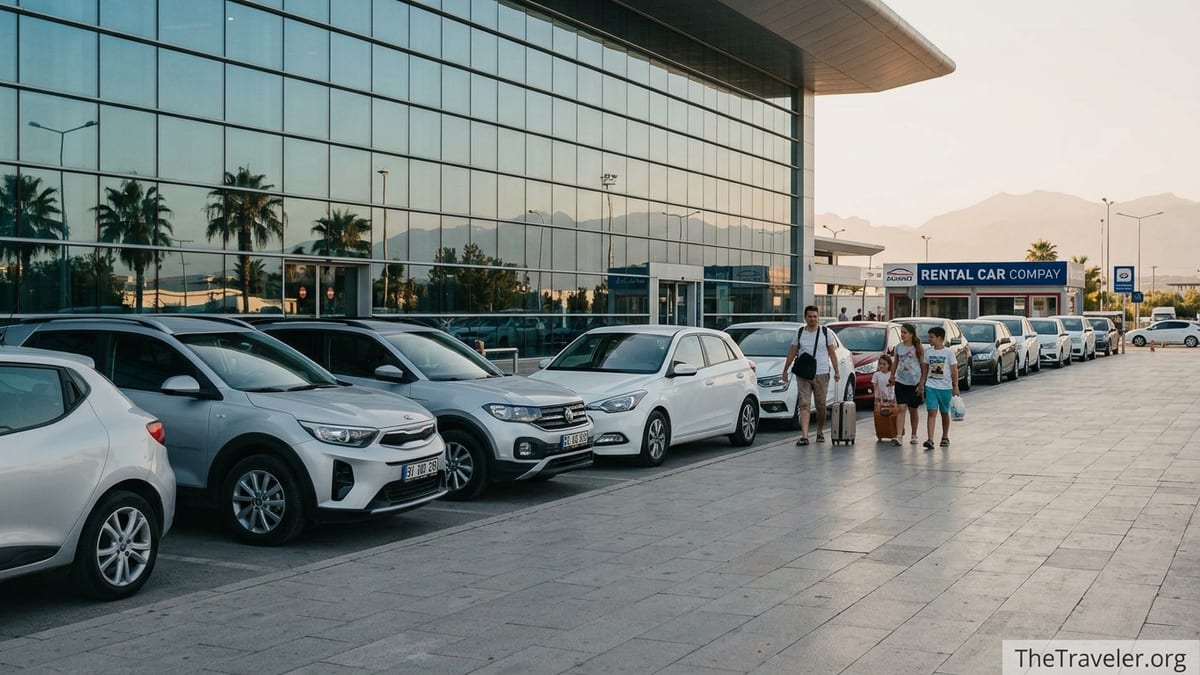
Antalya Airport (AYT) is built for holiday traffic, and that shows in the number of rental desks. The airport itself lists more than 20 rental companies operating in or around the terminals, including international brands such as Avis, Budget, Europcar, Enterprise, National, Alamo and Hertz, plus large Turkish firms like Garenta, RentGo, Avec and local outfits such as Aytucar and Filo Rent a Car. Most major companies have counters inside the international terminals and domestic terminal, with cars parked in the adjacent multi-story lots or outdoor car parks.
In peak summer months from June to September, compact cars with reputable brands typically start around the equivalent of 30 to 45 euros per day when booked a few months ahead for a one-week rental, but can rise significantly if you walk up on arrival or try to book last minute for just two or three days. Travelers often report that local brands advertise small hatchbacks online for 15 to 20 euros per day, but this rate may only apply if you accept a high excess and limited mileage, so always read what is included.
At the airport you will see two main models. International brands and large Turkish chains operate from proper desks in the terminal and hand over cars from the official airport car parks. Many smaller companies arrange to meet customers outside arrivals with a sign, then walk you to a nearby lot or shuttle you a few minutes off site. Both models are normal in Antalya, but for first-time visitors, especially arriving late at night, booking with a brand that has an on-airport desk inside the terminal is usually simpler and provides clearer recourse if anything goes wrong.
For peace of mind, many travelers use comparison platforms that show several of these providers side by side with filters for customer rating, deposit and insurance. When comparing offers, look specifically at the required security deposit, the fuel policy, whether there is a mileage cap and any extra airport or out-of-hours fees, as these can matter more than small differences in the base daily rate.
Essential rental conditions, deposits and insurance explained
Rental conditions in Turkey are broadly similar to those in the rest of Europe, but there are local nuances that matter. Most airport rentals require the main driver to be at least 21, to have held a license for at least one or two years, and to present a credit card in their own name for the deposit. Some companies add a young driver surcharge for drivers under 25, and a senior driver fee for those over 70. The rental agreement usually states that every rental requires a credit card as guarantee even if you plan to pay the rental charge itself in cash or with a debit card.
Deposits vary widely. With a basic insurance package, large international brands at Antalya Airport often block the equivalent of 400 to 800 euros on your card for a standard compact car, more for SUVs. Local companies sometimes advertise lower rental rates, then require a similar or higher deposit. Travelers occasionally report disputes about minor scratches or stone chips when returning cars, so it is essential to photograph the car in detail from all angles, plus close-ups of any damage, both at pickup and drop-off. Doing this in the car park with time-stamped photos on your phone is a simple way to avoid misunderstandings later.
Every rental car in Turkey is legally required to include basic third-party liability insurance. Collision Damage Waiver (CDW) and Theft Protection are typically included in the advertised rate but come with an excess. At a mid-range Antalya Airport rental counter, you might see a compact car with CDW including a 400 to 800 euro excess. The agent will then offer “full insurance” or “zero excess” for an additional daily fee, often 8 to 20 euros per day depending on vehicle class and provider. This can quickly double the headline price for short rentals, so do the math based on your risk tolerance.
If you already hold a separate excess insurance policy from a third party, be aware that many desk agents will still pre-authorize the full excess on your card and may strongly encourage you to buy their own coverage. Politely insist on the conditions you booked, but read the rental agreement carefully before signing. Pay attention to exclusions such as damage to undercarriage, windscreen or tires, which are common on coastal and village roads. In Turkey these items are often not covered by the standard CDW but may be included in an expanded “full coverage” package, so make sure you understand what you are paying for.
Driving from Antalya Airport to major Turkish Riviera resorts
The main advantage of renting at Antalya Airport is starting your road trip immediately. The airport lies to the east of the city, close to the D400 coastal highway, which runs along much of the Turkish Riviera. Driving times are approximate and depend heavily on summer traffic, but they provide a realistic framework for planning.
Resorts closest to the airport, such as Lara Beach and Kundu, are about 15 to 25 minutes away in light traffic, mostly via wide urban roads. Belek and Kadriye, popular with golf and all-inclusive resorts, are typically a 30 to 40 minute drive along the D400. Farther east, Side and neighboring Kumköy and Evrenseki are about 1 to 1.5 hours away. Alanya, at the far eastern edge of the main resort belt, often takes around 2 hours from Antalya Airport in normal daytime conditions. Travelers driving in high season should build in extra time for slow-moving traffic near resort zones and around weekend check-in and check-out days.
To the west, the scenery becomes more dramatic, and a car really shows its value. Kemer lies under an hour from the airport, mainly on good roads with some curves as you approach the coast-hugging section. Continuing west, the road threads past Phaselis, Olympos and Adrasan before eventually reaching Kaş and Kalkan. The drive from Antalya to Kaş is around 180 to 190 kilometers and typically takes about 3 to 3.5 hours without long stops in steady conditions. The route is well paved and signposted, but includes winding sections and frequent changes in elevation as it hugs the coastline, so cautious driving is important, especially for those not used to such roads.
These driving times are comparable to, and sometimes faster than, combined transfers and taxis, especially if you plan to split your stay between multiple towns. For instance, a traveler wanting to spend a few nights in Kemer, then continue on to Kaş and finally return to Antalya would find it considerably easier and more flexible with a rental car than by arranging separate shuttle transfers for every leg.
Tolls, HGS and fuel: what to expect on the road
Turkey’s main toll system for highways and some major bridges is HGS, a radio-frequency sticker placed on the windshield that allows electronic toll collection. Most rental cars used on intercity routes come equipped with an HGS tag that is already activated. When you drive through a toll point, cameras and sensors register the plate and tag, and the toll amount is charged to the HGS account linked to the vehicle. The rental company then passes this charge to you, sometimes with a small service or administration fee per rental or per crossing.
From Antalya Airport, most coastal journeys along the D400 between major Riviera resorts are on untolled roads, which means some visitors never encounter a toll gate. However, if your itinerary includes inland highways or if you are connecting from Antalya via a newer motorway section, you may pass through HGS toll points. The tolls themselves are usually modest, often just a few Turkish lira for short sections, but a handful of rental companies charge an additional service fee per use or per rental for managing the HGS account. Check your rental conditions to see if there is a flat fee added for HGS usage or a per-crossing surcharge.
Fuel costs are a larger factor than tolls on most Turkish Riviera road trips. Petrol prices in Turkey fluctuate with global markets and exchange rates, and are typically higher than in the United States but broadly similar to or slightly below some Western European levels. Many rental cars in Antalya are compact petrol hatchbacks or small diesel sedans, with crossovers and SUVs increasingly common among families. A realistic day of coastal driving that includes the round trip from Antalya to Phaselis, plus detours to the beach and a village restaurant, might involve 150 to 200 kilometers, which in a modern compact car would usually consume 10 to 15 liters of fuel. Before setting off, confirm whether your rental uses petrol or diesel, because confusing fuel types at the pump can lead to an expensive repair bill not covered by standard insurance.
Fuel stations along the Riviera corridor are plentiful. On most routes between resorts you will pass several large, modern service stations with staffed pumps, restrooms, convenience stores and sometimes simple restaurants. Many stations accept international credit cards, although having some local currency in cash is still useful in case a card terminal is down or a smaller roadside station prefers cash payments.
Parking and navigating towns along the Turkish Riviera
Parking practices along the Turkish Riviera combine formal parking lots, curbside paid areas and informal solutions. In large resort areas like Lara Beach, Belek and many parts of Alanya, big hotels and resorts typically provide their own car parks free of charge for guests. If you are staying in a large all-inclusive resort, your biggest parking challenge might simply be finding your way through the hotel complex rather than dealing with street parking.
In city areas such as Antalya’s Konyaaltı district and the historic Kaleiçi old town, municipal parking lots and multi-story garages are common. Rates are moderate by Western European standards. A typical guarded lot near the center might charge the equivalent of a few euros for a few hours or 5 to 10 euros for a full day, depending on location and season. Street parking may be controlled by attendants issuing tickets and collecting payment when you leave. Always keep your parking ticket handy, as losing it can lead to paying a higher fixed fee.
Smaller coastal towns such as Kemer, Çıralı, Olympos, Kaş and Kalkan present a mix of narrow streets, steep hills and informal parking. Guesthouses and small hotels often have a short row of spaces out front or a small lot nearby reserved for guests. In high season, you may need to leave the car a short walk away on a side street. In Kaş, for example, parking directly in the compact center near the harbor can be tight in July and August, so many drivers use the paid lots on the edges of town and walk to the waterfront in 5 to 10 minutes.
Throughout this coastline, you will encounter improvised parking near popular beaches and viewpoints. Locals may wave you into a private field or gravel lot and request a modest cash fee for the day. In most cases this is legitimate, but use common sense: do not leave valuables in sight, take a quick photo of where the car is parked, and make sure you are not blocking any access roads or gates. Where possible, prefer official paid lots or hotel car parks for overnight parking, as these are less likely to cause disputes or towing issues.
Is renting a car from Antalya Airport worth it?
Whether a car is “worth it” depends on your travel style, itinerary and comfort with driving abroad. For travelers planning to base themselves at a single large resort near Antalya, especially all-inclusive hotels in Lara Beach, Belek or many Alanya complexes, the value of a rental car can be limited. These resorts offer airport shuttles, abundant taxis and organized excursions to major sights like Aspendos, Perge or the Düden waterfalls. If your plan is to mostly stay within the resort and join a couple of day tours, a car might sit unused in the hotel car park for much of your stay.
On the other hand, a rental car can be highly worthwhile for travelers who want to explore beyond the standard excursion circuit. For example, a couple staying in Kemer with a car can visit Phaselis in the early morning before tour buses arrive, then drive up into the Beydağları mountains for lunch in a village restaurant, and finish the day with a sunset stop at a quiet cove that is impractical to reach by public transport. Similarly, a family basing themselves in Kaş or Kalkan can use a car to access scattered beaches, ancient ruins such as Patara and Xanthos, and rural restaurants spread along the coast and inland valleys.
Cost-wise, a one-week rental in shoulder season for a compact car, including moderate insurance, fuel and a few paid parking sessions, can be broadly comparable to buying two or three organized bus excursions plus airport transfers for two people. For three or four people traveling together, especially families with luggage, a car often works out cheaper per person while offering far greater flexibility. The trade-off is the responsibility of driving and parking in sometimes unfamiliar conditions, particularly in summer heat and in towns with narrow, busy streets.
If you are uncertain, consider splitting the difference. Some visitors arrange a private transfer from Antalya Airport to their first base, then rent a car locally for just three or four days to explore the region. Many agencies operating at the airport, including larger Turkish players like Aytucar that have multiple branches in the Antalya region, also maintain local offices in resort towns, which makes it possible to pick up a car in one location and return it in another for an additional one-way fee.
Practical tips for safe and relaxed driving
Driving along the Turkish Riviera is generally straightforward, but there are a few local habits to be aware of. Speed limits are posted in kilometers per hour and often change around villages, tunnels and sharp curves. Fixed and mobile speed enforcement cameras are increasingly used on main routes, and fines are charged to the vehicle’s registered owner, later passed to you by the rental company. This is another reason to drive conservatively, especially near built-up areas where limits can drop quickly.
On the D400 coastal road and similar routes, local drivers sometimes overtake assertively, and you may encounter vehicles changing lanes or pulling out from side roads more abruptly than you might expect at home. If you are not comfortable with this, adopt a defensive driving style: keep ample following distance, avoid overtaking unless you have a very clear view, and let faster cars pass. In mountainous or winding sections, especially between Kemer and Kaş, use lower gears for better control on descents and do not feel pressured to match local driving speeds.
Night driving is possible but not ideal for visitors unfamiliar with the area. Some rural stretches have limited lighting, and livestock or pedestrians may occasionally appear near the verge. If your flight lands late, consider staying the first night in or near Antalya and starting your coastal drive in daylight. The same applies in reverse if you need to catch an early-morning departure; overnight closer to the airport to avoid a long pre-dawn drive.
Lastly, always carry your passport or ID, driving license, rental contract and proof of insurance in the car or easily accessible. Routine police or gendarmerie checks do occur on highways and at town entrances. Officers typically check documents and sometimes ask basic questions about your route. As long as your paperwork is in order, these checks are usually quick and uneventful.
The Takeaway
Renting a car at Antalya Airport can transform a straightforward beach holiday into a flexible exploration of the Turkish Riviera. The airport hosts a wide range of rental companies, from international brands to large Turkish operators, and cars are readily available in high season if you book ahead. Understanding deposits, insurance options and the HGS toll system will help you avoid surprises at the counter and on your credit card after you return home.
For visitors heading to a single all-inclusive resort, particularly near Antalya, a rental car is optional. But for those who want to mix resort time with quiet beaches, ancient ruins and mountain villages between Kemer and Kaş, having your own vehicle is often the most rewarding choice. With realistic expectations about driving standards, parking and costs, and by building in time to enjoy the scenery rather than rushing between stops, you can make an Antalya Airport rental car the starting point of a memorable Turkish Riviera road trip.
FAQ
Q1. Do I need an international driving permit to rent a car at Antalya Airport?
Most major rental companies accept a standard driving license from many countries printed in Roman letters, as long as it is valid for the rental period and meets their minimum license-holding requirements. However, if your license is not in Roman script or if your home country’s rules are unclear, it is safer to carry an international driving permit in addition to your national license.
Q2. How much does it typically cost to rent a car from Antalya Airport?
Prices vary by season, car class and provider, but a compact car from a reputable company in shoulder season often runs around the equivalent of 30 to 45 euros per day for a one-week rental when booked in advance. In peak summer or for very short rentals, rates can be significantly higher, especially if you add full insurance and extras like child seats or GPS.
Q3. Is it safe to drive from Antalya to Kaş or Kalkan?
The coastal road from Antalya toward Kaş and Kalkan is paved, well signposted and widely used by locals and tourists. It is scenic but includes winding sections and changes in elevation. Drivers who take their time, avoid night driving where possible, and follow posted speed limits generally find the route manageable. Newer drivers may wish to plan extra daylight time and rest stops to stay relaxed.
Q4. Are there toll roads around Antalya and on the Turkish Riviera?
Many of the main coastal routes between Antalya, Kemer, Belek, Side and Alanya are untolled. However, Turkey uses an electronic HGS toll system on certain highways and bridges, and some itineraries that go inland or connect with major motorways may encounter toll points. Most rental cars are equipped with an HGS sticker, and tolls are charged through the rental company after your trip, sometimes with a small service fee.
Q5. Where can I park in Antalya city and the old town area?
Antalya has municipal parking lots, multi-story car parks and controlled street parking zones. Near the old town of Kaleiçi, many visitors use guarded lots or garages on the perimeter, then walk into the historic area, which has many narrow streets and some vehicle restrictions. Rates are moderate, and hotels in nearby districts like Konyaaltı often provide free or low-cost parking for guests.
Q6. Do I really need a car if I am staying at an all-inclusive resort?
If you plan to mostly stay within a large resort in Lara Beach, Belek or similar areas and join a few organized tours, you may not need a car for your entire stay. Many travelers in this situation rely on airport transfers, taxis and tour buses. A car becomes valuable if you want to explore independently, visit less accessible beaches or ruins, or split your time between several towns along the coast.
Q7. What should I check before driving away in my rental car?
Before leaving the airport car park, inspect the vehicle carefully for existing scratches, dents, cracked glass or interior damage and ensure these are recorded on the rental form. Take time-stamped photos or video from multiple angles, confirm the fuel type, note the fuel level, and check that essential items such as lights, wipers and air conditioning work. Make sure you know how to contact roadside assistance and understand the basic terms of your insurance coverage.
Q8. How do I handle fuel payment and petrol stations on the Turkish Riviera?
Fuel stations are common along main roads and near resorts. Most are full-service, with attendants who pump fuel for you. International credit cards are widely accepted at larger stations, though carrying some local currency is useful for smaller or rural stations. Always double-check that the correct fuel type, petrol or diesel, is being used for your rental car.
Q9. Can I take my Antalya rental car on a ferry to the Greek islands?
Most standard rental agreements in Turkey do not allow taking the vehicle outside the country or on international ferries without explicit written permission, which is rarely granted for short-term tourist rentals. If you are considering such a trip, discuss it with the rental company before booking and be prepared for the likelihood that it will not be permitted.
Q10. What happens if I get a traffic or toll fine in a rental car?
Traffic and toll violations are linked to the vehicle’s registration, so any fines are first issued to the rental company. The company then charges the amount to the credit card on file, often with an additional administration fee as specified in your rental agreement. This process can occur weeks after your trip, so it is wise to drive carefully, observe speed limits and ensure you understand how tolls are handled in your contract.