


More news on this day
A home security camera in the Thunder Bay area has captured the moment a freight train derailed, producing striking video that is circulating widely online and drawing renewed attention to rail safety and travel disruptions in northwestern Ontario.
Get the latest news straight to your inbox!
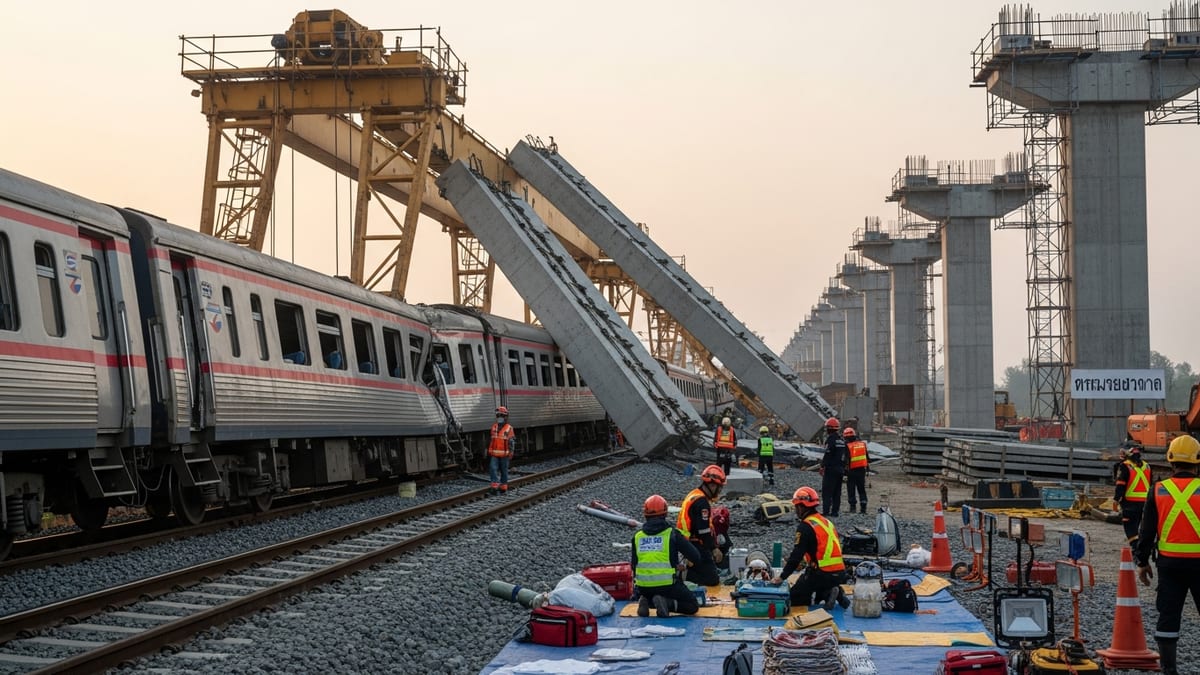
Dramatic Footage From a Residential Street
The incident unfolded near Thunder Bay, where a freight consist left the tracks within view of nearby homes. The train was moving through a mixed residential and commercial corridor when several cars derailed, sending clouds of dust and debris into the air. The sequence was recorded in full by a home security system positioned to monitor a front driveway and adjoining street.
In the video, which has been shared across regional news outlets and social media platforms, the rail cars appear to move normally for several seconds before a section visibly jolts and begins to sway. Moments later, multiple cars leave the rails, piling up along the right-of-way and partially blocking adjacent access routes. The fixed angle of the camera highlights how quickly a routine train movement can turn into a major incident.
Published coverage indicates that local emergency responders arrived shortly after the derailment to assess damage and secure the area. Early reports suggest that the incident involved freight cars rather than passenger equipment, which reduced the potential for large-scale casualties. There were no immediate reports of serious injury, although full assessments of damage and any minor injuries were still being compiled.
For nearby residents, the most immediate impact came from noise and dust, as well as temporary restrictions on movement near the tracks. The video has become a focal point for community discussion, illustrating how rail infrastructure runs directly alongside homes and everyday public spaces throughout the Thunder Bay region.
Rail Safety Under Renewed Scrutiny
The derailment adds to an ongoing national and international conversation about freight rail safety, particularly in communities that lie along busy main lines. Recent years have seen a series of high-profile rail incidents in Canada and the United States, prompting calls for improved track inspection, better monitoring of rolling stock and stricter operational standards on heavily used corridors.
Transportation safety investigations in Canada have repeatedly highlighted the effect of track conditions, train handling and equipment maintenance on derailment risk. While the precise cause of the Thunder Bay area incident remains under review, experts frequently point to a combination of infrastructure stress, harsh seasonal conditions and increasing freight volumes as underlying challenges for rail operators in northern regions.
Publicly available safety data show that many freight derailments occur in relatively remote areas, but those that take place in or near urban centers draw particular attention because of their proximity to housing, local businesses and major travel routes. The latest incident near Thunder Bay falls squarely into that category, with the home-security video emphasizing how little separation can exist between rail lines and residential neighbourhoods.
Advocacy groups focused on rail safety and environmental risk have used similar events to argue for slower speeds through built-up areas, more frequent inspections and, in some cases, re-routing of certain hazardous cargoes. The Thunder Bay video is already being used in online discussions to illustrate the potential consequences of derailments when trains are operating close to homes and arterial roads.
Impact on Travel and Regional Connectivity
Thunder Bay serves as an important hub in northwestern Ontario, connecting highway corridors, regional airports and long-distance rail lines. Any disruption on the freight network in this area can have knock-on effects for supply chains, from container traffic to bulk commodities bound for other provinces or for export through Great Lakes ports.
Reports from regional outlets indicate that rail movements were temporarily halted on the affected line while crews worked to remove damaged cars and inspect the track. Such pauses can lead to delays for subsequent freight trains, which in turn may affect delivery schedules for shippers relying on just-in-time logistics.
Although the derailment involved freight traffic, events of this kind can also indirectly affect passenger travel. When incident response teams and rail operators prioritize cleanup and inspection, there can be temporary changes to dispatching priorities or operating windows that ripple across routes. Travelers heading through northwestern Ontario by road may also experience localized congestion if level crossings or nearby streets are closed while heavy equipment is brought in to clear the site.
Industry observers note that regional tourism can be sensitive to perceptions of safety and reliability on major transport corridors. While there is no indication of long-term disruption to travel in and around Thunder Bay as a result of this derailment, the dramatic nature of the video has ensured that the incident is widely noticed by people planning journeys through the region.
How Home Security Cameras Are Changing Rail Incident Records
The Thunder Bay derailment highlights the growing role of private video systems in documenting transportation incidents. Home security cameras, dashboard cameras and commercial surveillance networks now frequently capture events that once might have gone unrecorded, providing investigators and the public with detailed visual timelines of critical moments.
Transportation safety investigations in North America increasingly rely on video from a variety of sources, including outward-facing locomotive cameras and nearby commercial security systems. The Thunder Bay footage, originating from a private home, adds another layer to this trend by showing the incident from the perspective of an ordinary residential street rather than from inside the rail network itself.
Analysts suggest that such recordings can assist in clarifying the sequence of events in a derailment, from train speed to the behavior of individual cars as they encounter a problem area of track. They can also reveal how debris spreads, how close it comes to nearby structures and how residents react in the first moments after an incident.
At the same time, the increasing circulation of dramatic video raises questions about online privacy and the potential for footage to be shared widely before full factual information is available. In the Thunder Bay case, short clips circulated quickly, while technical details about train configuration, cargo and track condition were still emerging from official documentation and media coverage.
Thunder Bay’s Longstanding Relationship With the Rails
Thunder Bay has a long history as a rail and port city, serving as a key link between the Prairie provinces and the Great Lakes. Freight trains passing through the region carry grain, minerals, manufactured goods and intermodal containers, making rail operations central to the local and regional economy.
Over decades, neighbourhoods and commercial districts have grown up alongside mainline tracks, especially near yards and junctions where trains assemble and change direction. The latest derailment near residential streets underscores how closely intertwined rail infrastructure is with daily life in the area, from the sound of passing trains to the presence of level crossings on frequently used routes.
Local discussions following the recent incident have touched on long-running themes such as noise, vibration, and the perceived risks associated with living near active rail lines. For some residents, the home-security footage reinforces concerns about what could happen if a derailment were to involve hazardous materials or occur at a busier time of day.
For visitors and travelers transiting through Thunder Bay, the event serves as a reminder that the city’s role as a rail crossroads brings both economic vitality and complex safety considerations. As investigations continue and rail traffic resumes normal patterns, the widely viewed home camera video will likely remain a reference point in ongoing debates about how best to balance connectivity, commerce and community safety along the rails of northwestern Ontario.