

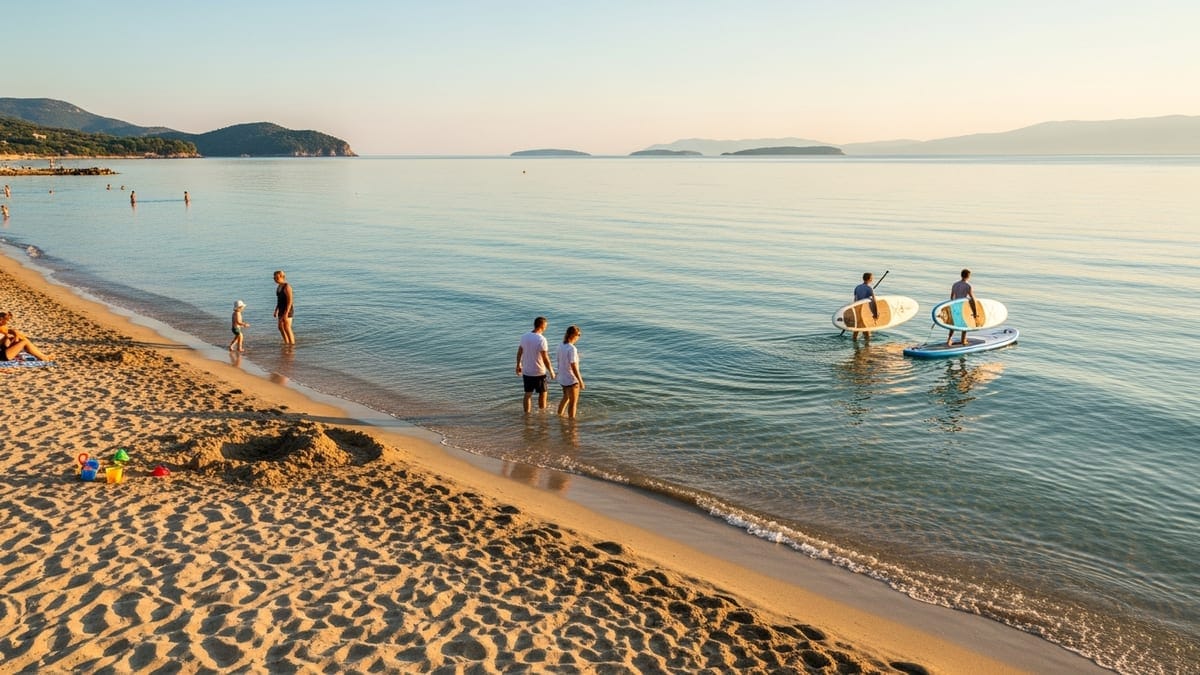
Arillas Beach, on the northwest coast of Corfu, is one of those rare stretches of sand where the pace slows the moment you step onto the waterfront. Sheltered by two low peninsulas and looking out toward tiny islets on the horizon, it offers safe swimming, low-key water sports and a relaxed, village atmosphere that appeals as much to families as to independent travelers.
Getting to Know Arillas Beach
Arillas sits roughly 35 to 50 minutes by road from Corfu Town and the island’s international airport, depending on traffic and route. The road winds through olive groves and small villages before dropping down to a long, shallow bay framed by low, green headlands. The beach itself stretches for about two kilometers, a pale-golden arc of sand with views to the Diapontia Islands scattered offshore.
Unlike some of Corfu’s resort strips, Arillas has grown up around an existing village community rather than the other way around. Low-rise, family-run hotels and studios sit just back from the shore, with a simple seafront lane that separates the sand from tavernas, bars and small shops. There are no high-rise developments or noisy nightclubs, which helps preserve a calm, almost old-fashioned Greek island feel even in high summer.
The beach has earned a reputation as one of the more peaceful, less commercialized bays on Corfu. You will still find organized sunbed areas, water sports and beach bars, but everything operates on a gentler scale. Many visitors return year after year, particularly families with younger children and couples who value space, shallow water and easy access to amenities without the bustle of a large resort.
Arillas also has a growing wellness and slow-travel scene, with yoga retreats and meditation groups based in the olive-covered hills behind the beach. Yet the shoreline itself remains reassuringly simple: sand, sea, sunsets and that long, open view to the horizon.
Swimming Conditions and Sea Seasons
The defining feature of Arillas for swimmers is the shallow, gently shelving seabed. In most sections of the bay, you can walk out for a good distance before the water reaches waist or chest height, which is an obvious advantage for families and less confident swimmers. The seabed is predominantly sandy, with only occasional patches of shingle or seagrass, so getting in and out of the water is usually easy on the feet.
The natural shape of the bay, guarded by peninsulas to the north and south, helps protect Arillas from the stronger winds and swell that can affect more exposed parts of Corfu’s west coast. There can still be days with a moderate chop or small waves, particularly if winds blow in from the open Ionian Sea, but for much of the typical season the sea is calm or only lightly ruffled. On quieter mornings, especially in June and September, the water can resemble a swimming pool, clear enough to see the sand ripples below.
Sea temperatures usually become comfortable for most swimmers from late May, warm significantly in July and August, and remain swimmable well into October in many years. In early season, the water feels refreshing but manageable for short dips, while mid-summer brings bathtub-warm shallows that children can play in for hours. Late September and early October often deliver some of the best conditions of all: warm seas, settled weather and fewer crowds on the sand.
Even at the height of the season, Arillas tends to feel less intensely packed than some better-known Corfu beaches. There are organized zones with rows of sunbeds that extend to the waterline, but long sections between them remain relatively open, giving you the option of quieter stretches where you can swim with fewer people nearby. Most sunbeds are removed once the main season ends, turning the beach into an almost entirely natural sweep of sand for autumn visitors.
Choosing Your Spot on the Sand
Although Arillas is one continuous bay, the character changes subtly as you walk along it. The central zone, where the seafront road passes closest to the water, is the liveliest. Here you will find several of the beach’s main tavernas and bars right above the sand, along with clusters of sunbeds and parasols belonging to seafront hotels and restaurants. This is the most convenient part of the beach if you want to be close to food, drinks and facilities, and it is particularly handy for families who will be in and out of the accommodation during the day.
Toward the northern end of the bay, the beach curves gently towards the low headland that separates Arillas from neighboring Agios Stefanos. This side generally feels a little quieter and more open. There are still organized areas, but they are interspersed with free sections where you can put down your own towels and umbrellas. The sand here is broad and flat, and at low tide there is often a wide expanse between the water and the back of the beach, making it a good place for ball games and for children to run around.
The southern end of Arillas, beneath the headland that leads toward Agios Georgios, has a slightly wilder feel. The sand narrows and you begin to see sections of natural clay and rock protruding from the cliffs behind the beach. This is where some visitors come for impromptu “spa” sessions, smoothing the clay on their skin and letting it dry in the sun before rinsing in the sea. You will also find more secluded pockets here, especially in shoulder seasons, and a more informal atmosphere that can include a few naturists on quieter days.
If you arrive by car, simple roadside parking is available behind most of the beach. Spaces closest to the central area fill up quickly in high summer, especially after late morning, so early arrivers tend to have the pick of spots both on the sand and for parking. Many regular visitors choose a favorite zone and return there repeatedly, whether for convenience, views or simply habit.
Water Sports and On-the-Water Adventures
Despite its tranquil reputation, Arillas offers a broad spectrum of water activities when the season is in full swing. The main watersports base sits on the central stretch of the beach, with direct access from the sand. Here you can arrange everything from banana and ring rides to water skiing, wakeboarding and parasailing, as well as boat and pedalo hire. The atmosphere is friendly and informal, and activities are typically available to both complete beginners and experienced riders.
For those who prefer engine-free exploration, stand up paddleboarding and kayaking are increasingly popular in Arillas. Small operators and guided tours use the beach as a starting point for trips to the nearby islet of Karavi, an uninhabited rock outcrop off the coast. On calm days, paddlers can skirt the island’s shoreline, visit small sea caves on its eastern side and stop at tiny pocket beaches that are otherwise difficult to reach. These excursions often include time for snorkeling in clear, relatively shallow water where small fish and sea grasses are easily visible.
Motorboat rental is another highlight in Arillas. Several local outfits offer small self-drive boats, usually without the need for a formal boating license, after a safety briefing and demonstration. With a rental boat you can follow the coastline in either direction, discovering quiet coves, drop anchor off remote beaches and swim from the boat in deeper, cleaner water away from shore-based crowds. For those who prefer not to drive, skippers are available for private trips, often sharing local knowledge about the coast and recommending good spots for lunch and swimming.
If you want an introduction to water skiing or wakeboarding, Arillas is well placed. Calm mornings and the shelter of the bay create the right conditions for first lessons. Instructors generally offer short, focused sessions in which you can practice getting up on the skis or board behind the boat. For thrill-seekers, the classic banana and big inflatable sofas towed at speed by a motorboat remain a staple, adding a burst of laughter and energy to otherwise languid beach days.
Snorkeling, Kayaking and Exploring the Coastline
Although Arillas is not a major snorkeling destination by Greek island standards, it does offer some pleasant, easy underwater exploration, particularly around the rocky edges of the bay. The clearest waters tend to be near the headlands and along the coast beyond the main swimming area, where the seabed becomes a mix of rocks, sand and patches of seagrass. Bringing basic gear is worthwhile if you enjoy watching shoals of small fish and observing the textures of the sea floor.
Keen kayakers and stand up paddleboarders can use Arillas as a launch pad to explore both north and south. To the north, the headland toward Agios Stefanos offers low cliffs, small indentations in the coastline and shifting views back toward the sandy bay. To the south, the route takes you past clay cliffs and more rugged sections where the land rises more steeply from the sea. On days with calm water, these paddles are straightforward and rewarding, though it is always wise to check conditions locally and keep an eye on wind direction.
Paddling or boating out toward the islets visible from the shore adds another dimension to Arillas. The trio of Kravia, Gineka and Sikia, frequently visible in the middle distance, becomes more impressive up close, especially at sunset when the rocks glow gold and orange. Greek myth adds a layer of romance, with local stories suggesting the islets are the petrified remains of Ulysses’ ship. Whether or not you subscribe to the legend, watching the evening light wrap around these offshore silhouettes from a kayak or motorboat is a memorable experience.
For those who prefer to keep their explorations strictly shore-based, a coastal walk links Arillas with its neighbors. Footpaths and small roads lead over the headlands to Agios Stefanos to the north and Agios Georgios to the south, offering elevated views down into Arillas’ bay. These walks are best attempted in the cooler parts of the day, ideally early morning or late afternoon, with good footwear, water and sun protection.
Beachfront Taverns, Drinks and Sunsets
Arillas’ relationship with the sea is as much about what happens on the waterfront as in the water. The seafront lane that runs behind the beach is lined with family-run tavernas, cafés and small bars, many of which have been in the same hands for decades. Tables spill out onto terraces barely a few steps above the sand, making it easy to transition between beach towel and dining chair throughout the day.
Several longstanding restaurants directly on the beach specialize in Corfiot and broader Greek dishes: grilled fish sourced from local waters, seafood pasta, souvlaki, stifado, stuffed vegetables and generous salads. Many menus highlight ingredients from family gardens or local farms, and the setting encourages unhurried meals that unfold in stages rather than rushed sittings. It is common to see generations of the same family working together in the kitchen and front of house, reinforcing the village feel.
Daytime visitors often favor a handful of beach bars for coffees, fresh juices, ice creams and light snacks between swims. As the sun drops toward the horizon, these same venues transform into some of the best places on the island to watch the sunset. Arillas faces west, and on clear evenings the sky burns through shades of apricot, pink and violet before fading to deep blue. Sitting on a terrace with a cold drink, listening to the sea and watching the sun descend behind the Diapontia Islands, is for many the defining experience of the resort.
In the evening, the atmosphere remains mellow. Some places host low-key live music or Greek nights, but full-scale clubbing is absent. For travelers who prefer conversation, candlelight and the sound of the sea over amplified beats, Arillas is a rewarding base. The compact nature of the seafront also means that you can walk everywhere, moving from a sunset cocktail to a late dinner without needing transport.
Practical Tips, Safety and When to Visit
Arillas’ main beach is well set up for a straightforward day by the sea. In season you will find organized sunbed and umbrella rentals along much of the shore, public showers and informal parking behind the sand. Families should find it easy to access the beach with strollers, although in a few spots you may need to negotiate small steps or ramps where the seafront lane sits slightly above the sand.
For swimmers, the gently shelving seabed and relative shelter are natural safety advantages. Nonetheless, it remains important to respect the sea. Pay attention to local conditions, especially on windier days, and avoid swimming far offshore when there is active boat or jetski traffic. Young children should always be supervised, even in the shallows, and inflatable toys are best kept close to shore, as offshore breezes can push them seaward more quickly than expected.
The main visitor season in Arillas runs roughly from May through October. May and June bring fresher air, blooming landscapes and quieter beaches, ideal for walkers and those who do not need peak heat. July and August are the busiest and hottest months, with lively beach life, fully operational water sports and the most vibrant evening scene. September often combines warm seas with slightly milder daytime temperatures and a more relaxed rhythm as schools resume in many European countries.
Outside the main season, many seafront businesses close, but the natural beauty of the bay remains. Off-season visitors experience a very different Arillas: quiet, sometimes dramatic seas, empty sand and a village geared more toward local life than tourism. For most travelers keen on swimming, water sports and a choice of tavernas, however, late spring to early autumn is the most practical window.
Beyond the Beach: Trails, Wellness and Village Life
While the beach is Arillas’ obvious star, part of its appeal lies in what lies just beyond the sand. The hills and olive groves behind the resort are crisscrossed by small lanes and footpaths, some of which have been incorporated into a signposted walking route often referred to as the Arillas Trail. This loop explores farmland, old olive presses and viewpoints over the bay, offering a gentle counterpoint to days spent on a sunbed.
In recent years, Arillas has gained a modest reputation as a wellness hub within Corfu. Several retreat centers, studios and guesthouses host yoga holidays, meditation workshops and personal development courses, particularly in shoulder seasons when the weather is still mild but the beaches are less crowded. The calm, village-scale feel of the resort supports this atmosphere, and it is not unusual to see morning yoga sessions taking place on shaded terraces or quiet parts of the beach.
Village life continues in parallel with tourism. Away from the seafront, you will find small supermarkets, a bakery, a pharmacy and other everyday services that serve both locals and visitors. The presence of longtime residents who know one another contributes to a sense of continuity. Travelers who return annually often develop longstanding relationships with hosts and restaurant owners, reinforcing Arillas’ reputation for hospitality and repeat visits.
For day trips, local travel agencies in the village arrange boat excursions, island tours and transport to Corfu Town, nearby beaches and inland villages. This makes it easy to use Arillas as a base: spend some days swimming and kayaking in the bay, then intersperse those with excursions to explore Corfu’s broader cultural heritage, mountain landscapes and other coastal sights.
The Takeaway
Arillas Beach is not the place to come for high-octane nightlife or aggressive beach clubs. Its strengths lie elsewhere: in the security of shallow water for children, the quiet satisfaction of an unhurried taverna lunch steps from the sea, the chance to paddle to a tiny offshore island and the simple pleasure of watching the sun sink behind distant islets. It is a resort that still feels like a village, where repeated visits reveal layers of familiarity rather than constant novelty.
For swimmers, the bay offers calm, clear conditions for much of the season, and enough space that you can always find a stretch of water to call your own. For those who enjoy getting on the water, there is plenty to keep you occupied, from entry-level watersports and motorboat hire to guided paddleboard trips along the coastline. Added to that are scenic coastal walks, a growing wellness scene and easy connections to other parts of Corfu.
Whether you are planning a first trip to Corfu or debating where to return, Arillas rewards travelers who value atmosphere as much as amenities. Come for the safe swimming and sunsets, stay for the sense of place that lingers long after you have shaken the sand from your shoes.
FAQ
Q1: Is Arillas Beach suitable for young children and non-swimmers?
Yes. The water along most of Arillas Beach is shallow and gently shelving, so you can walk out a good distance before it becomes deep. Combined with relatively calm conditions and easy access to the sand, this makes it an excellent choice for families with young children and for adults who are not confident swimmers.
Q2: When is the best time of year to swim at Arillas?
The sea is usually warm enough for comfortable swimming from late May through October. July and August bring the highest water temperatures and the liveliest beach atmosphere, while June and September offer slightly cooler air, warm seas and fewer crowds. In many years, early October still provides pleasant sea temperatures and quieter days on the sand.
Q3: Are there lifeguards on duty at Arillas Beach?
Lifeguard provision can vary by season and section of the beach. In peak summer months certain parts of the shore may have lifeguard coverage, but this should not be assumed everywhere or at all times. It is important to follow any local signage, ask your accommodation or beach staff about current arrangements and always supervise children closely.
Q4: What kind of water sports can I try at Arillas?
During the season you can expect a good range of options that usually includes banana and ring rides, water skiing, wakeboarding, parasailing, pedalo and canoe hire, stand up paddleboarding and small motorboat rental. Most activities cater to beginners as well as those with prior experience, with instructors on hand for guidance and basic lessons.
Q5: Do I need a boating license to rent a motorboat?
For the small motorboats typically hired to visitors in Arillas, a formal boating license is generally not required. Rental operators usually provide a safety briefing, route suggestions and a simple demonstration of the controls before you set off. For larger or more powerful vessels, different rules may apply, so always check the specific requirements with the rental company.
Q6: Is Arillas a good base for exploring other parts of Corfu?
Yes. Although Arillas feels self-contained, local travel agencies and bus or taxi services link it with Corfu Town, nearby resorts and key attractions. You can easily combine beach days with boat trips, inland village visits or excursions to other well-known beaches. Its relatively quiet evenings and village feel make it an appealing base to return to after day trips.
Q7: Are there plenty of places to eat close to the beach?
The seafront at Arillas is lined with family-run tavernas, cafés and bars, many of them just a few steps above the sand. You will find everything from hearty Greek dishes and fresh seafood to lighter snacks, vegetarian options, coffee and cocktails. Because most places are clustered along the same lane, it is easy to survey menus and pick a spot that suits your mood and budget.
Q8: How busy does Arillas Beach get in peak season?
In July and August the central section of the beach, closest to most accommodation and tavernas, can become lively and well populated, especially in the late morning and early afternoon. However, the bay is long enough that quieter spaces are usually available if you are willing to walk a little toward either end. Even at its busiest, Arillas tends to feel calmer than some of Corfu’s larger, more commercialized resorts.
Q9: Is snorkeling worthwhile at Arillas?
While Arillas does not offer dramatic reef snorkeling, the clear water and mix of sand, rocks and seagrass around the edges of the bay make for pleasant, easy exploration. You can expect to see schools of small fish and varied seabed textures. For more interesting underwater scenery, consider paddling or boating toward the nearby islets and rocky stretches of coast, always observing local safety advice.
Q10: What should I pack for a day at Arillas Beach?
Essentials include swimwear, a hat, high-factor sunscreen, sunglasses and a light cover-up for sun protection. Water shoes can be useful if you plan to explore rockier sections near the headlands. If you prefer not to rent a sunbed, bring a beach towel or mat and, ideally, a small umbrella for shade. A reusable water bottle is useful, though drinks and snacks are readily available from the many seafront cafés and bars.