

From saguaro forests outside Tucson to the stark alkali flats of Nevada’s Black Rock Desert, the Southwest offers some of the most distinctive desert scenery on Earth. Arizona and Nevada share scorching summers, endless horizons and star-filled skies, yet their landscapes, ecosystems and travel experiences diverge in surprising ways. For travelers drawn to arid horizons, understanding how these two desert giants compare can help shape an unforgettable journey.
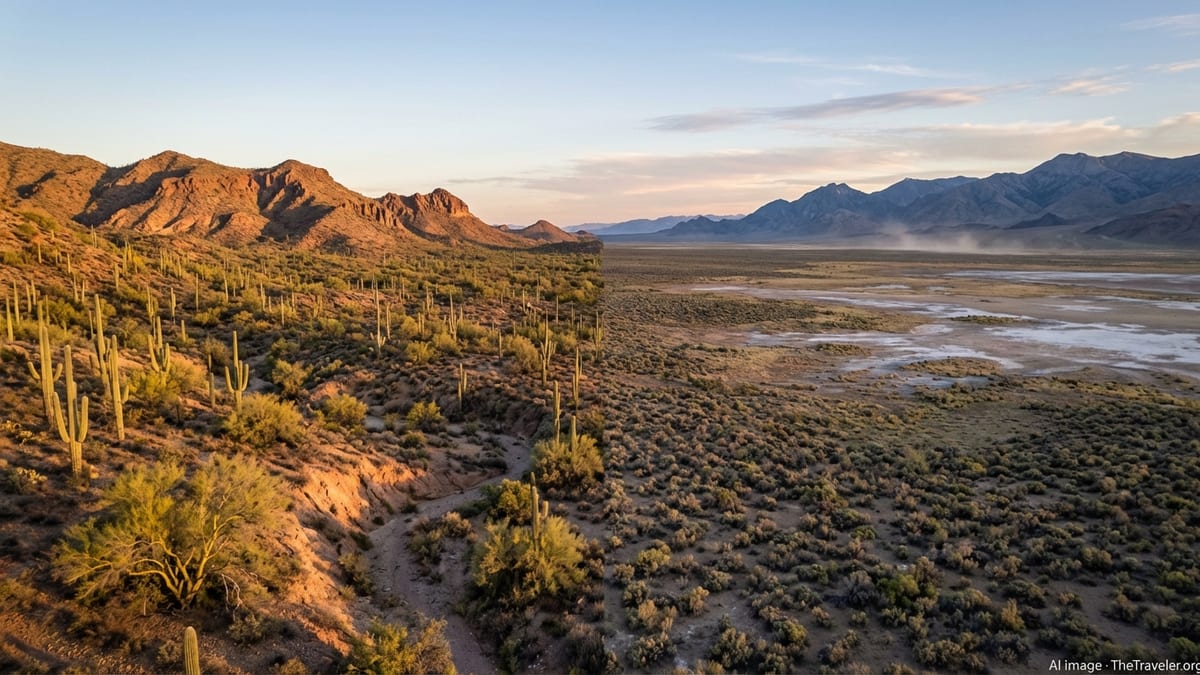
Two Deserts, Two Characters: Sonoran vs Great Basin and Mojave
Arizona’s desert identity is dominated by the Sonoran Desert, often described as one of the most biologically diverse and visually lush deserts in the world. Its signature icon is the towering saguaro cactus, which grows naturally only in this region and creates a distinctive, almost sculptural skyline around Tucson and Phoenix. Thanks to bi-seasonal rainfall patterns, much of the Sonoran Desert supports dense stands of cactus, palo verde trees and desert shrubs that give the land an unexpectedly green, textured look in cooler seasons.
Nevada’s deserts feel starker and more austere. Most of the state lies within the Great Basin Desert, the only cold desert in North America, with broad sagebrush basins, salt flats and ranges that catch winter snow. Southern Nevada also dips into the Mojave Desert, which brings Joshua tree woodlands, creosote flats and rugged volcanic peaks. Rather than towering saguaros, Nevada’s classic desert scenes revolve around low sage, scattered yucca and long, empty horizons under a big changing sky.
For travelers, this means Arizona’s desert tends to feel more “alive” at first glance, especially in spring, with bird calls, varied plant life and frequent bursts of color. Nevada’s desert rewards a slower gaze: subtle gradients in the sage, the geometry of distant mountain ranges and the stark beauty of playas and dry lake beds that shift with light and weather.
Climate shapes these differences. Arizona’s low-elevation Sonoran zones are typically hotter overall, with extremely intense summer heat but relatively mild winters. Nevada’s Great Basin sits at higher elevation on average, with cooler nights, more pronounced winter cold and a greater chance of encountering snow in desert valleys and on surrounding peaks, especially away from Las Vegas.
Signature Landscapes and National Parks
Arizona offers a remarkable density of protected desert landscapes. Saguaro National Park, split into two districts flanking Tucson, preserves classic Sonoran Desert scenery with forests of giant saguaros, rocky foothills and far-reaching sunset views. The park’s trail network traverses everything from low cactus gardens to higher-elevation foothills, giving visitors a strong sense of the Sonoran ecosystem’s range.
Further north, the desert edges of the Grand Canyon region and the Vermilion Cliffs form part of a high-desert mosaic where sagebrush, pinyon-juniper and canyon country meet. Areas like the McDowell Sonoran Preserve in Scottsdale showcase protected urban-adjacent desert, with hundreds of miles of trails winding through granite outcrops, washes and cactus-studded hillsides that glow at sunrise and sunset.
Nevada counters with wide-open expanses and more solitude. Great Basin National Park, in the eastern part of the state, rises from sage desert to alpine peaks in a single protected area. At its base, the Great Basin Desert stretches across broad basins dotted with sagebrush and rabbitbrush. As you climb, the scenery shifts quickly to pinyon-juniper woodlands, high meadows and ancient bristlecone pine groves. While much of the park is mountainous, that dramatic rise from desert floor to glacier-carved ridges highlights the vertical reach of Nevada’s desert landscapes.
Northwestern Nevada’s Black Rock Desert underscores the state’s taste for the epic and empty. Here, the remains of prehistoric Lake Lahontan have left a vast playa and surrounding sagebrush plains. For much of the year, the area sees few visitors, offering immense sense of solitude, huge skies and mirage-prone horizons that change with light and weather. In contrast to Arizona’s more frequented parklands, many of Nevada’s most photogenic desert locations are on public lands with minimal built infrastructure.
Iconic Flora and Fauna: Saguaros vs Joshua Trees and Sagebrush
Arizona’s Sonoran Desert is defined by its plant life. Towering saguaros, some more than a century old, share space with organ pipe and barrel cacti, cholla, prickly pear and spindly ocotillo. Palo verde, mesquite and ironwood trees provide dappled shade, supporting a rich community of birds, reptiles and pollinators. Spring wildflower seasons can paint washes and hillsides with poppies, lupine and brittlebush when winter rains cooperate, transforming the desert into a tapestry of color.
Wildlife in Arizona’s deserts tends to be diverse and relatively visible, especially during cooler mornings and evenings. Gambel’s quail scurry through underbrush, Gila woodpeckers nest in saguaro cavities, and desert cottontails and jackrabbits flit between shrubs. Reptiles from lizards to rattlesnakes thrive in the heat, while desert bighorn sheep roam rugged mountain flanks. The presence of riparian corridors along desert rivers and washes, even if often dry on the surface, further boosts biodiversity and birding opportunities.
Nevada’s deserts support a different palette of life. In the Great Basin, big sagebrush dominates, accompanied by rabbitbrush, saltbush and hardy grasses that lend the land a gray-green cast. Wildlife here is adapted to colder winters and drier air, with mule deer, pronghorn and desert bighorn sheep common across large tracts of public land. Birdlife includes sage-grouse in some areas, raptors riding thermals above basins and songbirds flitting among shrubs during the short growing season.
In southern Nevada’s Mojave zones, Joshua trees replace saguaros as the emblematic desert plant. Their twisted limbs and spiky crowns give foothill slopes an otherworldly outline at sunrise and sunset. Creosote bush, yucca and cholla fill the gaps between Joshua trees, while desert tortoises and lizards navigate the rocky ground. Compared with Arizona’s deserts, Nevada’s plant communities may look more subdued, but for travelers who relish big skies and spare lines, the effect can be deeply compelling.
Colors, Light and Photography
Arizona’s desert light is often described as golden and generous. The combination of varied vegetation, rugged topography and frequent clear skies makes for visually rich scenes almost any time of year. In Saguaro country, sunrise backlighting turns cactus spines into halos, while evening light paints ridgelines in warm oranges and pinks. During monsoon season, typically in mid to late summer, towering cloud formations and distant thunderstorms can create dramatic contrasts and rainbows over cactus forests.
Nevada’s deserts lean toward a cooler, more minimalist palette. The dominant tones in the Great Basin are sage green, dusty brown and the white of salt flats and playas. Early and late light stretches shadows across these open surfaces, emphasizing texture and subtle undulations in terrain. In winter and early spring, snow on surrounding ranges adds crisp whites and blues to the scene, providing striking contrast with the subdued colors of the basins.
Photographically, Arizona favors those who enjoy strong foreground subjects and layered depth. Saguaros, ocotillo and boulder fields make easy anchors in a composition, with receding mountain ranges and changing skies providing context. Nevada rewards a more patient, contemplative style: wide lenses to capture endless basins, telephoto work to compress mountain ranges and careful attention to the gradation of tones on clouds, slopes and valley floors.
Both states offer exceptional night skies, particularly away from major cities. High, dry air and low light pollution in many desert regions create prime conditions for stargazing and astrophotography. Nevada’s remote basins often feel especially dark and isolated, while parts of Arizona’s Sonoran countryside offer similarly pristine night skies framed by distinctive cactus silhouettes.
Access, Infrastructure and Crowd Levels
Arizona’s desert attractions are generally easier to reach and better developed for tourism. Phoenix and Tucson serve as major gateways to the Sonoran Desert, with highways and paved park roads leading quickly to scenic trailheads, overlooks and visitor centers. Locations such as Saguaro National Park, McDowell Sonoran Preserve and numerous state parks provide signed trails, informational displays and a wide range of accommodation options within a short drive.
This accessibility means Arizona’s signature desert landscapes can feel busy at peak times, particularly during spring wildflower season, holiday weekends and temperate winter months. Trailhead parking lots near large metropolitan areas can fill quickly, and popular viewpoints sometimes require patience. For many travelers, however, the balance between scenery, comfort and convenience is ideal, especially on shorter trips or for those new to desert environments.
Nevada’s desert landscapes, by contrast, often require more time, planning and self-sufficiency. Outside of Las Vegas and Reno, services can be sparse, distances between towns are long and road conditions vary from well-paved highways to graded gravel and unimproved tracks. Public land dominates much of the state, and while this creates enormous freedom for exploration, it also means fewer developed facilities, limited signage and long stretches without fuel or food.
The reward for this extra effort is space and solitude. Many Nevada desert locations see relatively low visitation compared with Arizona’s headline parks. Travelers willing to navigate long gravel roads and manage their own logistics can find themselves alone amid vast basins, with only wind and the occasional passing pronghorn for company. For some, this remoteness is the primary reason to choose Nevada over Arizona for a desert-focused trip.
Seasonal Experiences and When to Go
In both Arizona and Nevada, timing is everything. Summer heat in low-elevation deserts can be life-threatening without preparation, with daytime highs frequently climbing well past 100 degrees Fahrenheit. Arizona’s state agencies now emphasize extreme heat as a central public health challenge, offering centralized resources to help residents and visitors plan around hazardous conditions. Travelers visiting in the hottest months must treat early mornings and late evenings as the only reasonable times for significant outdoor activity at low elevations.
For most visitors, the prime seasons in Arizona’s deserts stretch from late October through early April. During this window, daytime temperatures are more comfortable, nights are cool and the light is crisp. If winter rains have been generous, early spring may bring carpets of wildflowers to Sonoran washes and slopes, with blossoming cacti following later. Higher-elevation desert fringes can remain cool well into spring, offering a pleasant contrast to warming valley floors.
Nevada’s seasonal rhythm runs slightly cooler, especially in the Great Basin. Autumn and spring are ideal times to explore the state’s basins and ranges, with comfortable daytime temperatures and clear skies. Winter can be rewarding for travelers equipped for cold conditions, revealing dustings of snow across sagebrush plains and heavier accumulations on surrounding mountains. Summer remains challenging in lower Mojave zones and exposed basins, but higher elevations and nighttime temperatures can be more forgiving than in much of lowland Arizona.
Regardless of state, desert travel demands respect for weather. Flash floods can transform dry washes into dangerous torrents after storms, winds can reduce visibility in dusty basins and temperature swings between day and night can be dramatic. Checking local forecasts, carrying adequate water and giving yourself conservative margins on distance and exertion are essential parts of any seasonal plan.
Outdoor Activities and Types of Trips
Arizona’s deserts are well suited to structured, activity-focused itineraries. Hikers can choose from short interpretive loops near major cities to full-day summit pushes in desert mountain ranges. Trail networks in areas such as Saguaro National Park and McDowell Sonoran Preserve allow for easy customization of distance and difficulty, while state parks and national monuments offer additional options for day hikes, scenic drives and family-friendly strolls.
Beyond hiking, Arizona’s desert lends itself to photography workshops, birding trips, cycling routes and guided experiences that combine natural history with Indigenous cultural perspectives. The relative proximity of developed desert scenery to urban hubs makes it straightforward to combine outdoor days with comfortable nights in hotels or vacation rentals, making Arizona particularly appealing for first-time desert travelers and mixed-interest groups.
Nevada leans toward more exploratory, self-directed adventures. Long-distance drives across basin-and-range country invite spontaneous stops at viewpoints, hot springs and historic mining sites. Dispersed camping on public land is common where regulations allow, giving travelers the chance to wake to dawn light over unbroken sagebrush or to watch distant summer thunderstorms sweep across the horizon from a secluded campsite.
Outdoor activities in Nevada often blend desert landscapes with other environments. A single trip might combine hiking among bristlecone pines in Great Basin National Park, exploring slot canyons or volcanic remnants in southern desert preserves and soaking in remote hot springs at night under expansive skies. These trips tend to require more planning for navigation, fuel and safety, but they also deliver a strong sense of discovery.
Culture, History and Sense of Place
The desert landscapes of both Arizona and Nevada carry deep cultural histories that shape how travelers experience them today. In Arizona, the Sonoran Desert has sustained Indigenous communities for millennia, with complex knowledge systems tied to seasonal rhythms, plant uses and water sources. Many cultural sites, including cliff dwellings, petroglyph panels and ancient agricultural features, sit within or adjacent to modern desert preserves, reminding visitors that these spaces have long been inhabited and managed.
Arizona’s major desert cities also contribute to a particular sense of place. Tucson promotes an identity closely tied to the Sonoran Desert, with botanical gardens, museums and food traditions that highlight desert plants and landscapes. Phoenix, while more sprawling and modern, positions itself as a gateway to surrounding desert recreation, with trailheads, mountain preserves and scenic drives woven into the metropolitan fabric.
Nevada’s desert story is different but equally layered. Much of the state’s basin-and-range country remains sparsely populated, shaped by histories of ranching, mining and long-distance travel routes. Ghost towns, abandoned mining camps and historic ranches punctuate the desert, offering glimpses of earlier waves of settlement and extraction. For some visitors, these remnants add a poignant dimension to otherwise empty-seeming landscapes.
In southern Nevada, the bright lights of Las Vegas sit in sharp contrast to surrounding Mojave desert. The city’s global profile draws many travelers who then venture outward for day trips or short escapes into nearby desert parks and conservation areas. This juxtaposition of intense urban entertainment and stark desert quiet is part of Nevada’s modern identity, appealing to those who enjoy shifting quickly between very different kinds of experiences.
The Takeaway
Choosing between Arizona and Nevada for a desert-focused trip is less about which state is “better” and more about what kind of desert experience you are seeking. Arizona’s Sonoran landscapes are vibrant and accessible, with iconic saguaro silhouettes, abundant trails and extensive visitor infrastructure that make exploring relatively straightforward. The state suits travelers who prefer a blend of wild scenery and modern comfort, who value guided experiences and who want to see the classic cactus landscapes that often define the popular image of the American Southwest.
Nevada offers something quieter and more austere: vast sagebrush basins, stark playas and far-flung mountain ranges that reward self-reliant exploration. Its deserts appeal to travelers who relish long horizons, empty roads and nights under dark skies far from city glow. While the scenery may at first appear understated compared with Arizona’s cactus gardens, the mix of Great Basin and Mojave environments creates a powerful sense of scale and solitude.
For many, the ideal Southwest itinerary need not choose. It is entirely possible to begin among Arizona’s saguaros, tracing the contours of the Sonoran Desert, then journey north and west into Nevada’s open basins, watching the vegetation thin and the sky grow even larger. Experiencing both states side by side reveals just how varied desert landscapes can be, and how much they reward travelers who arrive prepared, attentive and willing to slow their pace to match the land.
FAQ
Q1. Which state is better for first-time desert travelers, Arizona or Nevada?
Arizona generally suits first-time desert visitors better because many of its classic landscapes sit close to major cities, with signed trails, visitor centers and a wide range of accommodations nearby. Nevada can feel more remote and self-directed, which is rewarding but requires more planning and comfort with long, lightly serviced drives.
Q2. Where will I see the famous tall cacti?
The iconic tall saguaro cacti grow naturally in the Sonoran Desert, primarily in Arizona and a small part of northwestern Mexico. If seeing forests of giant saguaros is a priority, focus on Arizona locations such as areas around Tucson and Phoenix rather than Nevada.
Q3. Is Nevada’s desert really colder than Arizona’s?
On average, yes. Much of Nevada’s desert sits at higher elevation in the Great Basin, which brings cooler nights and colder winters than lowland Sonoran areas in Arizona. Southern Nevada’s Mojave Desert can still be very hot in summer, but overall temperature swings and winter cold tend to be more pronounced in Nevada.
Q4. When is the best time to visit Arizona’s deserts?
The most comfortable period for most travelers runs from late fall through early spring, roughly late October to early April. During these months, daytime temperatures are milder, nights are cool and there is a better chance of seeing wildflowers and cactus blooms if seasonal rains have been favorable.
Q5. When is the best time to visit Nevada’s deserts?
Spring and autumn are generally the best seasons for Nevada’s deserts, offering moderate temperatures and clear skies. Winter can be rewarding for those prepared for cold, with occasional snow adding contrast to sagebrush plains, while summer is often best reserved for higher elevations and early or late-day outings.
Q6. Which state offers more solitude in the desert?
Nevada typically offers greater solitude because so much of the state is public land with relatively low visitation. Outside a few popular areas, it is common to spend hours or even days seeing very few other travelers, especially on unpaved back roads and in more remote basins.
Q7. Are both states equally safe for desert travel?
Both can be safe if you plan carefully and respect conditions. The main risks include extreme heat, dehydration, long distances without services and sudden storms that can trigger flash floods. Arizona’s more developed sites provide a safety net for newer visitors, while Nevada’s remoteness makes preparation, navigation skills and extra supplies particularly important.
Q8. Which state is better for photography?
Photography opportunities are excellent in both. Arizona favors bold compositions with saguaros, rocky outcrops and colorful sunsets, while Nevada excels at minimalist, wide-angle scenes that emphasize open space and layered mountain ranges. The better choice depends on whether you prefer intricate foregrounds or sweeping, understated vistas.
Q9. Can I combine both states in one desert road trip?
Yes. Many itineraries weave from Arizona’s Sonoran Desert north and west into Nevada’s Great Basin and Mojave regions. This kind of loop lets you experience saguaro forests, canyon country, sagebrush basins and wide playas in a single journey, highlighting the diversity of the American Southwest.
Q10. How should I prepare for extreme heat in Arizona and Nevada?
Plan outdoor activities for early morning or evening in hot months, carry more water than you think you will need, wear sun-protective clothing and a wide-brimmed hat, and know the signs of heat illness. Check local advisories before you travel, and be ready to adjust plans if temperatures or warnings reach dangerous levels.