


More news on this day
Hundreds of flights across Asia and the Middle East were cancelled or heavily delayed this week, with publicly available aviation data indicating at least 432 cancellations and more than 8,700 delays affecting routes through Thailand, the Philippines, Kuwait, Turkey and Jordan, and disrupting schedules for carriers including Saudia, China Southern, Air China, IndiGo and several regional airlines.
Get the latest news straight to your inbox!
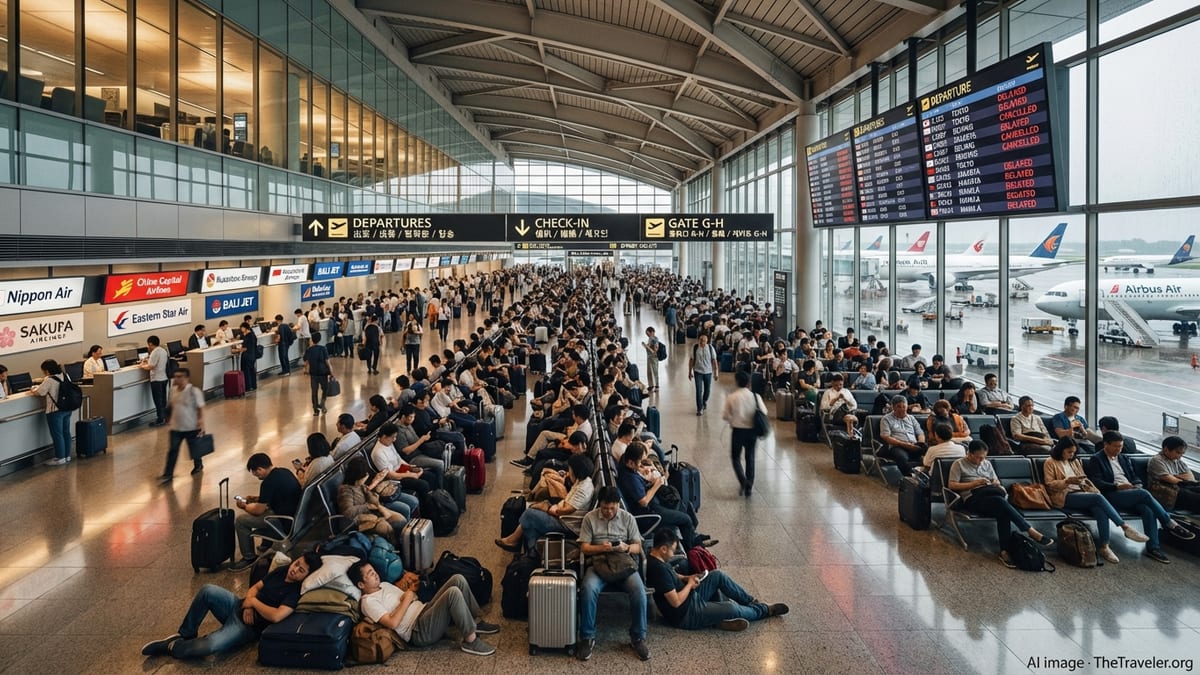
Major Hubs From Bangkok to Istanbul Struggle With Disruptions
Tracking data compiled from flight-status platforms and airport schedule summaries points to a sharp spike in disruption centered on some of Asia and the Middle East’s busiest hubs, notably Bangkok Suvarnabhumi, Manila Ninoy Aquino, Kuwait International, Istanbul and Amman. The tally of at least 432 outright cancellations and 8,754 delayed services reflects a rolling pattern that has built up over several days rather than a single shutdown event.
Bangkok, a key connecting point between Southeast Asia, the Gulf and Europe, has seen waves of delayed departures on long-haul services to Istanbul and other Turkish destinations, alongside regional links to Manila and major Chinese cities. Similar strain has been reported at Manila’s main airport, where congestion has compounded the impact of delayed and re-timed flights, particularly on Middle East and North Asia routes.
In Turkey and Jordan, long-haul and regional operations through Istanbul and Amman have experienced knock-on effects as late-arriving aircraft from Asia miss connection windows, forcing rebookings and in some cases cancellations. Kuwait’s role as a transfer point between South Asia, Southeast Asia and Europe has amplified the impact of schedule changes there, with multi-leg itineraries often unravelling when one sector is delayed or removed from the timetable.
Although the pattern is uneven across individual airports, the combined effect has left thousands of passengers facing overnight stays, last-minute rerouting and lengthy queues at service desks, particularly at peak evening and early-morning departure banks.
Saudia, Southern, Air China and IndiGo Among Affected Carriers
The disruption has been felt across a broad mix of airlines, from large Gulf and Chinese network carriers to fast-growing Indian and Southeast Asian operators. Publicly available timetables and status feeds show Saudia, China Southern, Air China and IndiGo among those most exposed, due largely to their dense schedules linking South and East Asia with the Gulf and onward to Europe and North America.
Saudia’s network, which ties Manila and other Asian cities to Jeddah and Riyadh, has experienced both outright cancellations and late departures, increasing the risk of missed onward connections to Europe and Africa. China Southern and Air China, which operate trunk routes through Bangkok and other Southeast Asian hubs, have seen schedule pressure spread across multiple rotations when an early delay cascades through the day’s flying program.
IndiGo, now one of the region’s largest carriers by departures, has been particularly vulnerable on heavily utilized aircraft that shuttle between India, Southeast Asia and the Gulf. When an aircraft arrives late into a hub such as Bangkok, Manila or Kuwait, there is limited slack in the timetable to recover, so later flights may be retimed or cancelled to restore operational balance.
Regionally focused airlines operating short sectors into Bangkok, Manila, Istanbul and Amman have also been swept up in the disruption as air-traffic flow constraints and ground-handling bottlenecks force carriers to prioritize certain services over others, often leaving lower-yield or less strategically important routes at greater risk of cancellation.
Multiple Drivers: Congestion, Conflict and Capacity Constraints
Industry analyses of recent disruption patterns across Asia and the Middle East point to a combination of structural and short-term factors. Congested airspace on key corridors between South Asia, the Gulf and Europe has left airlines with fewer routing options, meaning that even moderate weather or operational issues can trigger extended airborne holding and late arrivals.
Separately, ongoing geopolitical tensions in parts of the Middle East have led to periodic airspace restrictions and shifts in overflight patterns. When specific flight paths are curtailed, airlines may be required to reroute over longer tracks, increasing flight times and tightening turnaround windows at destination hubs, which can in turn push departure times back across the schedule.
Capacity constraints on the ground add another layer of fragility. Several major Asian and Gulf airports are running close to their declared capacity during peak hours, leaving limited flexibility to absorb bursts of late-running arrivals or departures. Any temporary shortage of ground-handling staff, security screening capacity or air-traffic control slots can therefore ripple rapidly through the day’s operations.
Higher operating costs, including elevated fuel prices, have also encouraged some airlines to trim marginal routes or thin out frequencies. While such moves may be planned in advance, they can coincide with broader disruption and be experienced by travelers as part of a single wave of cancellations and delays.
Passengers Face Rebooking Challenges and Long Waits
The scale and geographic spread of the disruption have made recovery complex for airlines and airports. With multiple carriers affected on overlapping routes, rebooking options have been limited at peak times, particularly for travelers heading between Southeast Asia and Europe via Gulf or Turkish hubs, or between South Asia and the Levant through Kuwait and Amman.
Reports from passenger forums and social media highlight instances of travelers being offered reroutes via alternative hubs, extended layovers or shifts of departure by several days when immediate inventory is unavailable. In some cases, passengers have opted to purchase new tickets on competing airlines to avoid missing time-sensitive commitments, later seeking refunds or credits for their original bookings.
At terminal level, the visible impact has included long lines at check-in and transfer counters, crowded customer-service desks, and increased demand for last-minute hotel accommodation near major airports. Ground staff at Bangkok, Manila, Istanbul and other primary hubs have had to manage both disrupted itineraries and routine peak-season crowds, stretching resources.
Consumer advocates note that passenger rights and compensation rules vary significantly between jurisdictions involved in the current disruptions, meaning that travelers on similar itineraries may face different entitlements depending on the airline’s home country, the point of departure and the exact cause recorded for a cancellation or delay.
What Travelers Can Do as Schedules Remain Volatile
With timetables still in flux on some affected routes, aviation tracking tools and published airline advisories suggest that passengers traveling through Bangkok, Manila, Kuwait, Istanbul or Amman in the coming days should build additional time into connections and monitor their bookings closely. Same-day changes to departure times and operating carriers remain possible while airlines work through aircraft and crew repositioning.
Travel experts generally recommend checking flight status directly with the operating carrier and through airport information pages on the day of departure, as well as enabling app notifications where available. In markets where rebooking capacity is tight, arriving at the airport earlier than usual can increase the chances of securing seats on alternative services if an original flight is cancelled.
Those with complex multi-leg itineraries involving the Middle East and Asia may wish to review minimum connection times and, where feasible, opt for longer layovers or single-ticket journeys on one airline group to reduce the risk of misaligned rebooking policies. Travelers heading to time-critical events or cruises are frequently advised to schedule arrival at least a day early when routing through these hubs during periods of heightened disruption.
While operational metrics typically improve once airlines have completed schedule adjustments and repositioned aircraft, the current episode underscores how interconnected Asian and Middle Eastern air networks have become, and how disruptions in Thailand, the Philippines, Kuwait, Turkey or Jordan can rapidly spill across continents and carriers.