


More news on this day
Travel across Asia faced renewed disruption this week as live flight-tracking dashboards showed hundreds of cancellations and thousands of delays concentrated at major hub airports, including Bangkok and Beijing, complicating connections for both regional and long-haul passengers.
Get the latest news straight to your inbox!
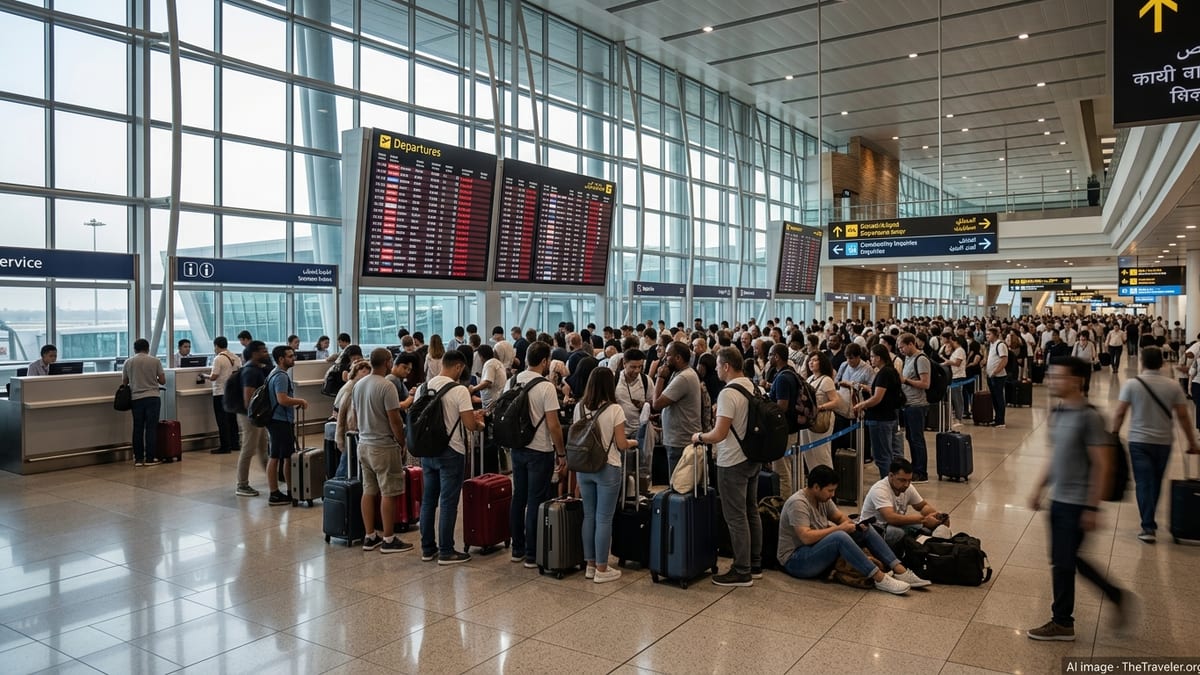
Live dashboards show uneven, fast-moving disruption across the region
Operational stress is shifting hour by hour across Asia’s air network, with public disruption trackers showing that some airports are experiencing far heavier cancellation rates than others. Flightradar24’s Asia airport disruption map for “today” ranked Jakarta Soekarno Hatta (CGK) as the most affected in the region at the time of viewing, listing 253 canceled flights and 23 delayed flights, alongside a high cancellation share shown on its dashboard.
Other large hubs appearing near the top of the same snapshot included Shenzhen (SZX), Delhi (DEL), Taipei (TPE), Shanghai Pudong (PVG), Kuala Lumpur (KUL), Guangzhou (CAN), and Hong Kong (HKG). The picture points to a disruption pattern that is broad rather than confined to one country, with cancellations and delays spread across Southeast Asia, Greater China, and South Asia.
Because these dashboards continuously update, the day’s “worst-hit” airport can change quickly as weather cells move, banked departure waves collide with late inbound aircraft, or airlines absorb schedule changes. For travelers, the key implication is that a smooth departure from one city does not guarantee an on-time connection downline, especially on tight hub-and-spoke itineraries.
Bangkok: mixed impacts across Suvarnabhumi and Don Mueang ecosystems
Bangkok’s two-airport system can amplify knock-on effects when irregular operations hit. Suvarnabhumi (BKK) handles many long-haul and full-service connections, while Don Mueang (DMK) supports a high volume of short-haul and low-cost traffic. When either airport experiences prolonged departure delays, aircraft rotations can break, spreading disruption across multiple cities.
Publicly available flight status pages and trackers showed cancellations within Bangkok’s departure boards during the current disruption window, including examples of canceled domestic departures listed on third-party flight status aggregators that compile airport information. At the same time, Airports of Thailand provides live flight-status portals for both airports, which travelers can use to verify gate changes, delays, and cancellation notices before heading to the terminal.
Bangkok has also been navigating the broader operational environment affecting Asia-bound traffic. Earlier Airports of Thailand communications around disruption linked to regional instability emphasized that airports remained operational while certain flights were disrupted. Even when terminals remain open and operating normally, reroutes, airline schedule trimming, and missed crew connections can still translate into day-of-travel delays.
Beijing: delay volume highlights how quickly hubs can clog
In northern China, Beijing’s scale makes it particularly sensitive to any constraint that reduces arrival or departure rates. FlightAware’s airport delay page for Beijing Capital International Airport (PEK) showed 158 total delays and six cancellations for “today” at the time of viewing, illustrating how a disruption day can develop even without extremely high cancellation totals.
For travelers, high delay counts matter because they can trigger missed onward flights and rebooking queues, especially for itineraries that rely on banked waves of departures. When inbound aircraft arrive late, they may miss their next scheduled leg; when crews time out under duty limits, airlines must swap crews or delay further; and when gates are occupied longer than planned, arriving flights can be held on taxiways or assigned remote stands.
Beijing’s disruption also matters beyond the city itself. As one of Asia’s key connectivity nodes, delays can ripple to secondary cities that depend on timed connections, and to long-haul services that must meet arrival slot windows on the far end.
What is driving the disruption: weather, congestion, and rerouting pressures
Multiple overlapping factors are contributing to the volatility. Seasonal weather across parts of Asia can reduce airport acceptance rates and force spacing between aircraft, while congestion at mega-hubs leaves little slack to recover once a bank is disrupted. These constraints are magnified in dense corridors where many airports depend on the same airways and flow-management restrictions.
Separately, the ongoing impact of airspace restrictions and geopolitical disruptions has continued to reshape routings between regions. IATA materials in 2026 have described how restrictions over parts of the Middle East increase effective flight distance, fuel burn, crew time, and unit costs, and can contribute to capacity adjustments and tighter schedules. Even when disruptions originate far from Asia, longer routings and schedule padding can reduce network flexibility, leaving airlines less able to recover after localized weather or airport constraints.
Published coverage and airline advisories also show that rerouting remains airline- and date-specific, meaning two flights on similar city pairs may take different paths and experience different block times. That variability complicates connections at major hubs because arrival waves can become less predictable.
What travelers can do now: verify status, protect connections, and document costs
With disruption patterns changing quickly, travelers are best served by checking flight status multiple times: the evening before departure, again on the day of travel, and once more before leaving for the airport. Airport operator flight-status portals can be useful for confirming the latest gate, estimated time, and terminal information, while airline apps typically provide the earliest push notifications about rebooking options.
For itineraries with tight connections at large hubs such as Bangkok and Beijing, travelers may want to prioritize earlier departures in the day where possible, since compounding delays often worsen as aircraft rotations slip. If a connection looks vulnerable, proactively exploring rebooking options can reduce the chance of getting stranded when same-day inventory tightens.
Finally, passengers facing delays or cancellations should keep organized records of notifications, boarding passes, and receipts for any eligible expenses. Rebooking and refund rules, and any disruption waivers, vary by carrier and ticket conditions, so travelers may need to rely on the terms associated with their specific booking rather than assuming a uniform policy across airlines.