


More news on this day
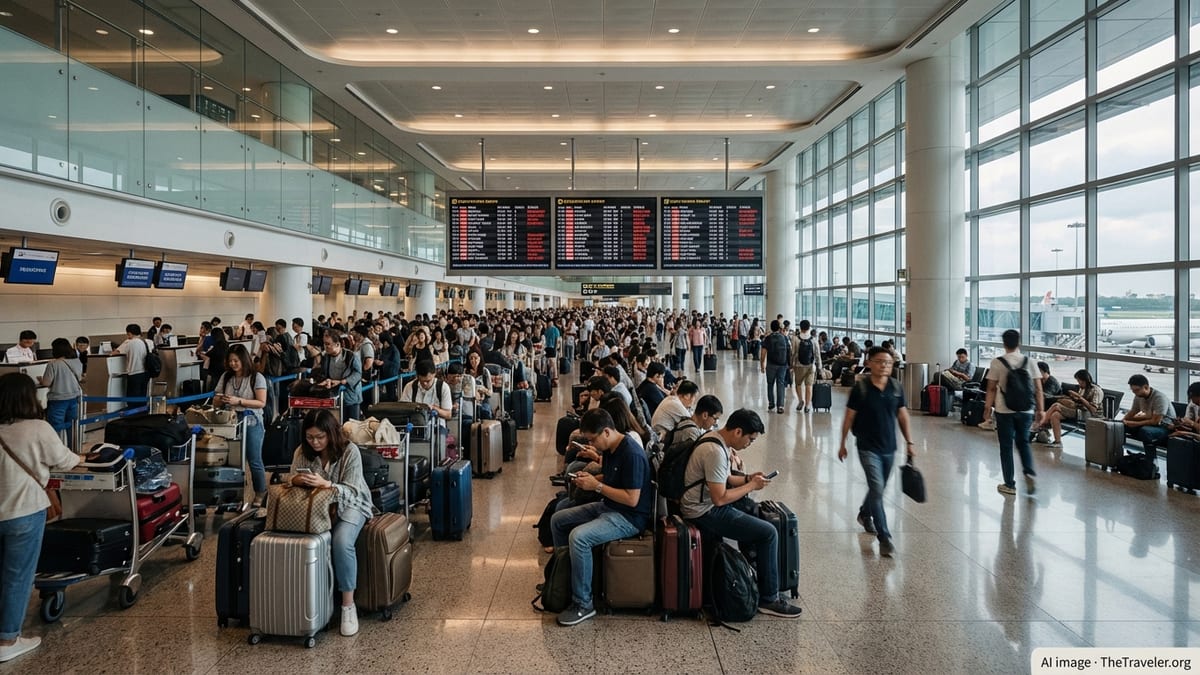
Hundreds of air travelers have been left stranded across Asia and the Gulf as a fresh wave of flight cancellations and delays involving Emirates, FlyDubai, Gulf Air, Qatar Airways, Singapore Airlines, Cathay Pacific and other major carriers ripples through airports from Tokyo and Beijing to Singapore, Kuala Lumpur and Dubai.
Get the latest news straight to your inbox!
Wide Network Disruptions Across Asia and the Gulf
Publicly available flight-tracking data and schedule analyses indicate that at least 46 flights have been cancelled and nearly 800 delayed across recent days, disrupting journeys through some of the world’s busiest international hubs. The impact is being felt in Japan, mainland China, India, Singapore, Malaysia and the United Arab Emirates, with long-haul and regional connections equally affected.
Emirates and FlyDubai, which rely on Dubai as a central transfer point for traffic between Europe, Africa, Asia and Australasia, have been among the hardest hit, along with fellow Gulf operators Qatar Airways and Gulf Air. Reports indicate that waves of airspace restrictions and operational bottlenecks have forced last minute schedule cuts and rolling delays, stranding transit passengers who expected seamless one-stop connections.
Asian giants Singapore Airlines and Cathay Pacific have also trimmed flights, particularly on routes linking their hubs to Japan and the Middle East, compounding pressure on already stretched airport infrastructure. Aviation data cited in regional coverage suggests that passengers bound for or departing from Tokyo, Beijing, Shanghai, Singapore and Kuala Lumpur have encountered extended waits, missed onward connections and unplanned overnight stays.
The cumulative effect is a patchwork of broken itineraries across multiple continents, with travelers attempting to stitch together alternative routings via secondary hubs in Europe and Southeast Asia as prime Gulf connections remain unstable.
Japan, China and India See Knock-On Effects
In Japan, where demand for flights to and from Hong Kong, Southeast Asia and the Middle East has rebounded strongly, targeted schedule cuts have begun to bite. Recent notices from Cathay Pacific show more than one hundred flights on Japan routes removed from timetables over a multiweek period, including services linking Tokyo, Osaka, Nagoya, Fukuoka and Sapporo with Hong Kong. Passengers using these sectors to connect onward to Dubai, Doha or Singapore are facing particular uncertainty.
Mainland Chinese gateways such as Beijing and Shanghai are also experiencing disruption, largely through their role as origin or destination points on itineraries that connect via Gulf hubs. When services through Dubai or Doha are cancelled or retimed, knock on effects reach Chinese departure boards as aircraft and crew fail to arrive on schedule, forcing airlines to consolidate or delay subsequent rotations.
India, a crucial market for Gulf and Asian carriers, is seeing similar challenges. Long haul passengers traveling from cities such as Mumbai and Delhi to Europe and North America often rely on one stop connections through Dubai, Doha, Singapore or Hong Kong. As flights on those trunk routes are reduced or delayed, Indian airports are managing growing numbers of travelers seeking rebooking options at short notice, often into already full cabins.
Airline statements and travel advisories reviewed by regional media emphasize that re-accommodating disrupted passengers is becoming more complex as spare capacity tightens, particularly in premium cabins and on peak departure days from major Indian and North Asian cities.
Singapore, Kuala Lumpur and Hong Kong Struggle With Capacity
In Southeast Asia, Singapore Changi Airport and Kuala Lumpur International Airport have emerged as key pressure points. Singapore Airlines has acknowledged a series of operational incidents and schedule adjustments in recent weeks, including aircraft maintenance issues that led to delays and at least one long haul cancellation. While individually modest, such disruptions can cascade when they occur during already congested departure waves.
Kuala Lumpur, a significant transfer point for traffic between South Asia, Southeast Asia and the wider Asia Pacific region, is contending with a mix of local weather related delays and knock on disruption from passengers rerouted off cancelled Gulf services. Public reporting by aviation analytics firms shows elevated delay levels on routes linking Kuala Lumpur with the Middle East and North Asia compared with typical seasonal patterns.
Hong Kong, the home base for Cathay Pacific, continues to operate under a constrained schedule as the airline trims frequencies to manage costs and respond to higher fuel prices and shifting demand. The decision to temporarily reduce flights on several Japan routes, combined with an extended suspension of some Middle East services, has left fewer options for travelers trying to bypass disrupted Gulf hubs.
With multiple carriers simultaneously adjusting timetables, these hubs are increasingly being used as alternative connection points, but analysts note that they lack the spare capacity to fully absorb the traffic displaced from Dubai and Doha. This imbalance is contributing to longer connection times and higher fares on the limited flights that are still operating.
Dubai, Doha and Gulf Hubs Remain the Epicenter
The most concentrated disruption continues to center on Gulf hubs, particularly Dubai and Doha, which serve as global crossroads for long haul journeys linking Asia with Europe, Africa and the Americas. Earlier waves of airspace closures and security related restrictions significantly curtailed movements through the region, and while some services have resumed, schedules remain fragile.
Reports from regional news outlets and aviation specialists describe periods when Emirates, FlyDubai, Qatar Airways and Gulf Air were forced to pare back the majority of their operations, cancelling a large share of planned flights and delaying many others while rerouting around restricted corridors. Even as airlines gradually restore limited services, irregular aircraft and crew positioning continues to cause rolling disruption.
Travel forums and passenger accounts highlight scenes of crowded terminals at Dubai International Airport and Hamad International Airport, with travelers waiting for updated information as departure screens cycle through cancellations and revised timings. Many stranded passengers are being offered rebookings days later or alternative routings via third country hubs, while others accept refunds and attempt to assemble their own itineraries.
Airline advisories commonly urge passengers not to travel to Gulf airports without confirmed bookings and to monitor flight status closely, underscoring the degree of uncertainty that still surrounds operations in the region.
Travelers Face Uncertain Timelines and Complex Rebookings
For individual travelers, the statistics translate into missed family events, disrupted business trips and unexpected expenses for accommodation and new tickets. According to published coverage and passenger reports, some stranded customers have slept in terminal seating or nearby hotels for multiple nights while waiting for available seats, particularly on long haul services toward Europe and North America.
Consumer advocates and travel industry analysts note that the complex web of codeshares and interline agreements between Gulf and Asian carriers both helps and hinders recovery. On one hand, shared booking systems allow airlines to move passengers between partner flights when cancellations occur. On the other, when multiple linked carriers are experiencing simultaneous disruption, available alternatives can evaporate quickly and leave travelers facing long waits.
Public information from aviation regulators and airport operators suggests that full normalisation of schedules could take weeks once underlying constraints on airspace and capacity ease. Aircraft and crew must be repositioned, maintenance backlogs cleared and slot patterns rebuilt before carriers can reliably restore former frequencies across their global networks.
In the meantime, industry observers recommend that passengers with upcoming itineraries through Dubai, Doha, Singapore or Hong Kong watch for schedule changes, keep contact details updated in airline bookings and consider flexible routing where possible, as the aftershocks from the current wave of cancellations and delays continue to spread across Asia and beyond.